
How leading companies turn conversations into institutional memory, accountability, and consistent execution
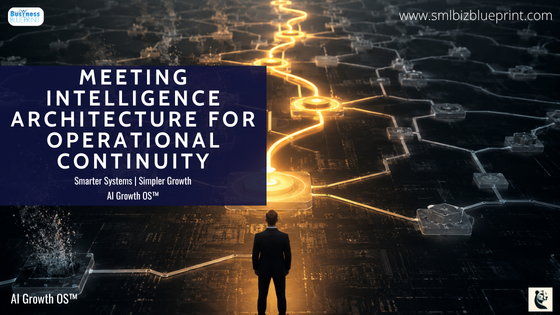
Meeting intelligence architecture is the system that preserves decision context, commitments, and organisational knowledge between meetings, preventing execution drift as companies grow.
Rather than treating meetings as isolated conversations, it creates continuity between decisions and outcomes by capturing critical signals, enforcing accountability, and maintaining institutional memory.
When combined with automation, meeting intelligence architecture transforms everyday discussions into a compounding intelligence asset that improves execution, alignment, and operational stability over time.
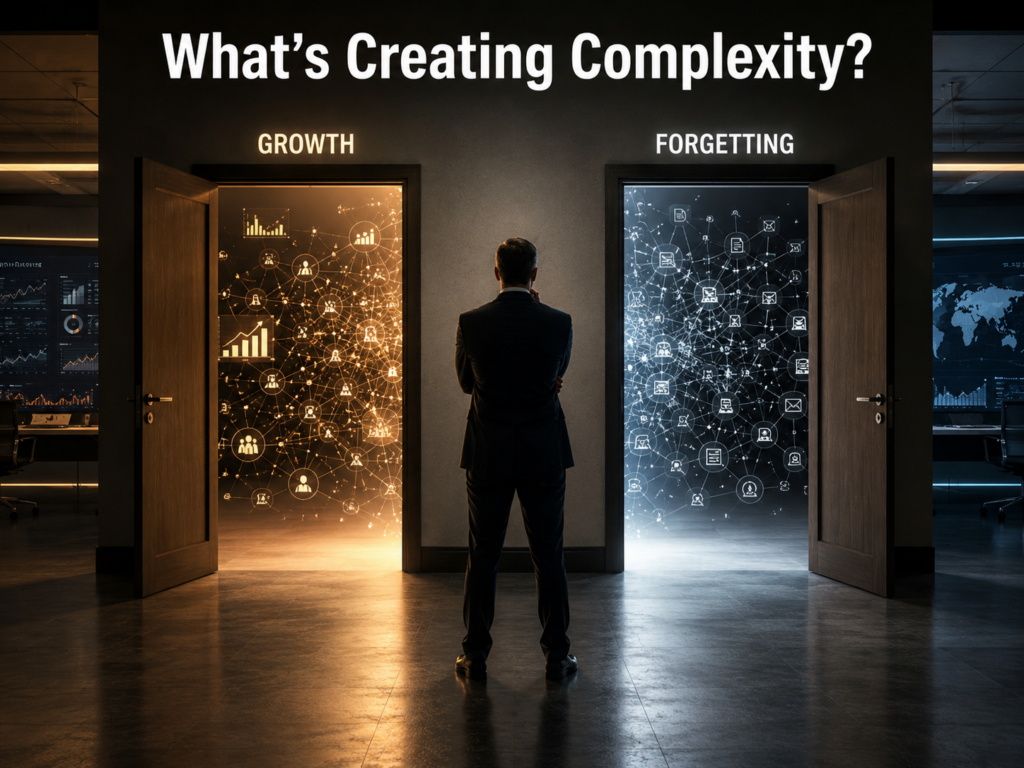
The Organisational Memory Problem Hiding Inside Every Meeting
Most companies do not have a meeting problem.
They have a decision continuity problem.
Decisions are made. Commitments are assigned. Priorities are clarified. Risks are identified.
Then the meeting ends.
A few weeks later, a project stalls because nobody is certain who owns the next step. A leadership team revisits a decision they already made. A new manager asks why a priority exists and discovers the answer lives in someone’s memory rather than the business itself.
The issue is rarely effort.
The issue is that the organisation has no reliable mechanism for preserving context between decision-making and execution.
As businesses grow, this weakness becomes increasingly expensive.
The decision may survive, but the reasoning behind it often disappears. Ownership becomes fragmented. Assumptions are forgotten. Teams inherit outcomes without understanding the logic that created them.
When decision context disappears, execution begins to drift.
Most organisations experience this long before they recognise it.
They notice projects slowing down. They notice teams becoming misaligned. They notice managers asking questions that were supposedly answered months ago.
What they rarely recognise is that these are often symptoms of the same underlying problem.
The organisation is losing its ability to preserve and reuse its own intelligence.
The Hidden Cost of Organisational Forgetting
Most organisations misdiagnose this problem.
They call it an accountability issue.
A communication issue.
A documentation issue.
These explanations describe symptoms, not causes.
The deeper issue is that the organisation forgets faster than it learns.
Every meeting generates intelligence.
Trade-offs are evaluated.
Risks are identified.
Assumptions are challenged.
Decisions are justified.
Yet in many businesses, that intelligence remains trapped inside the people who attended the conversation.
As organisations scale, this creates operational debt.
Knowledge becomes fragmented across departments. Decisions lose traceability. Teams repeat work that has already been done. Leaders become the unofficial memory system for the business.
The cost rarely appears in a dashboard.
In many companies, the warning signs are surprisingly ordinary.
A sales team works from an outdated assumption. Marketing launches a campaign without understanding why the strategy changed three months earlier. Two departments disagree, not because one is wrong, but because they inherited different versions of the same decision.
Leaders spend hours reconstructing context that should already exist inside the business.
Eventually, the company starts paying for decisions it has already made.
Every forgotten decision creates rework.
Every lost commitment creates management overhead.
Every missing piece of context increases decision uncertainty.
Growth becomes more expensive because the business is constantly rebuilding intelligence it has already generated.

The Architectural Principle: Continuity Enforcement
Meeting intelligence architecture exists to solve this continuity problem.
Its purpose is not better notes.
Its purpose is not better transcripts.
Its purpose is not better meeting summaries.
Its purpose is preserving decision continuity.
Decision continuity is the ability to maintain the connection between a decision, the reasoning behind it, the commitments it created, and the outcomes that follow.
Every growing organisation experiences entropy.
Knowledge disperses.
Priorities shift.
Employees leave.
New people arrive without historical context.
Without a mechanism for continuity, the organisation gradually loses the ability to learn from itself.
This is why meetings should not be viewed primarily as communication events.
They are decision-generation events.
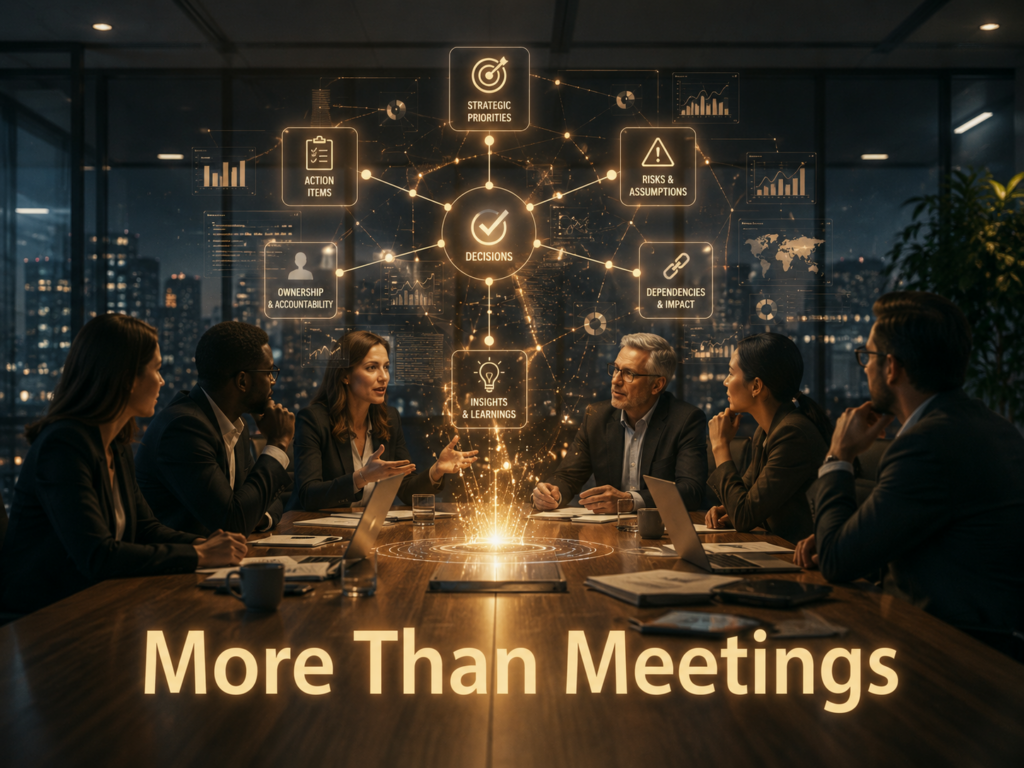
Every meaningful meeting produces decisions, commitments, assumptions, risks, and lessons.
The role of the architecture is to ensure those assets remain available long after the conversation ends.
When decision continuity is preserved, organisational memory becomes cumulative rather than fragile.
Future decisions can build upon previous reasoning instead of replacing it.
The organisation stops relying on memory and starts relying on systems.
Recognising Continuity Breakdown
Continuity failures rarely announce themselves directly.
They appear as familiar frustrations.
A meeting begins with twenty minutes of context reconstruction before any meaningful discussion occurs.
A project loses momentum after approval because nobody follows the decision beyond the meeting itself.
A new leader inherits a function but cannot understand why key priorities exist.
A strategic debate returns every quarter with different participants and the same conclusion.
Most organisations interpret these moments as communication problems.
More often, they indicate that organisational memory has become fragmented and decision continuity is no longer being enforced.
Signal Logic: What the System Is Actually Watching
The effectiveness of any intelligence architecture depends on signal visibility.
Most companies collect information.
Effective systems monitor signals.
Information describes what happened.
Signals indicate where action, oversight, or intervention may be required.
Within a meeting intelligence architecture, several signals matter most.
Decision signals indicate that resources, priorities, or strategic direction have changed.
Commitment signals identify ownership and responsibility.
Dependency signals reveal where execution relies on another person, team, or process.
Risk signals highlight potential obstacles before they become operational problems.
Alignment signals confirm that teams share the same assumptions and objectives.
These signals become valuable when attached to thresholds.
A decision without ownership creates ambiguity.
A commitment without a deadline creates drift.
A dependency without visibility creates bottlenecks.
A risk without escalation creates exposure.
The objective is not to capture every word spoken.
The objective is to maintain operational coherence after the meeting is over.
The system is not asking, “What was discussed?”
It is asking, “What now requires attention, accountability, visibility, or intervention?”
That distinction is what transforms documentation into intelligence.
The Automation Layer
Once signal logic exists, automation becomes a continuity mechanism.
Manual continuity does not scale.
As organisations grow, leaders spend increasing amounts of time recovering context, clarifying ownership, reconnecting decisions to execution, and ensuring commitments are not forgotten.
This creates unnecessary cognitive load throughout the business.
Automation reduces that burden by maintaining continuity between what was decided and what happens next.
Consider a strategic planning meeting.
New priorities are agreed upon.
Owners are assigned.
Dependencies emerge between marketing, sales, operations, and customer success.
Rather than storing those decisions inside meeting notes, the architecture detects critical signals.
Ownership is attached to commitments.
Deadlines are associated with actions.
Dependencies become visible across teams.
Follow-up checkpoints are created automatically.
If commitments remain incomplete beyond defined thresholds, escalation rules activate.
If a decision affects multiple departments, relevant context is distributed to stakeholders.
If future discussions relate to the same initiative, historical reasoning can be surfaced automatically.
Notice what is being automated.
Not decision-making.
Decision continuity.
Most organisations automate tasks.
More resilient organisations automate memory.
What This Means in Practice
For founders and operators, this means fewer conversations begin from zero.
A leadership team can revisit an initiative six months later and immediately understand what was decided, why it was decided, who owned execution, what assumptions existed at the time, and what outcomes occurred.
Most founders have experienced the opposite.
They become the final repository of context for the business. Teams come to them not because decisions have not been made, but because the reasoning behind those decisions was never preserved.
Growth becomes constrained by memory.
Institutional knowledge no longer depends on individual recollection.
It becomes part of the operating system itself.
This distinction becomes increasingly important as complexity grows.
A ten-person company can often rely on shared memory.
A fifty-person company begins to struggle.
A hundred-person company cannot depend on memory alone.
At scale, continuity must be engineered.
Otherwise, growth becomes increasingly dependent on the people who happen to remember.
From Meetings to Compounding Intelligence
The most valuable outcome of meeting intelligence architecture is not efficiency.
It is accumulated intelligence.
Every meeting produces evidence about how the organisation thinks, decides, and executes.
Over time, patterns emerge.
Recurring bottlenecks become visible.
Execution risks become predictable.
Decision quality becomes measurable.
The organisation develops a growing repository of operational knowledge that informs future planning and execution.
This is where AI becomes most valuable.
Not because it can summarise conversations.
Because it can reason across preserved organisational memory.
Traditional documentation systems store information.
AI-enabled memory systems can actively retrieve context, surface forgotten commitments, identify recurring bottlenecks, and connect current decisions to historical outcomes.
Instead of forcing teams to search for knowledge, the system can bring relevant knowledge into the decision itself.
This fundamentally changes the economics of organisational learning.
Knowledge no longer sits in archives waiting to be discovered.
It becomes available when decisions are being made.
The advantage comes from preserved intelligence, not generated content.
Stability as a Competitive Advantage
Operational continuity is ultimately a stability problem.
The question is whether the business can maintain alignment between decisions and execution as complexity increases.
Meeting intelligence architecture strengthens that alignment.
It reduces execution drift by preserving context and maintaining continuity between decisions, ownership, and outcomes.
It increases predictability by reinforcing accountability.
It improves visibility across commitments, dependencies, and risks.
Most importantly, it allows the organisation to retain and reuse its intelligence rather than repeatedly paying to recreate it.
Many companies assume growth creates complexity.
More often, unmanaged forgetting creates complexity.
As context disappears, organisations add more meetings, more reporting layers, more management oversight, and more coordination work to compensate.
The business becomes heavier because it can no longer trust its own memory.
Marketing remains connected to strategic priorities.
Sales understands the reasoning behind decisions.
Operations maintains visibility into commitments and dependencies.
Leadership gains oversight without becoming the communication layer for the entire business.
The result is not better meetings.
The result is a business that remembers.
Organisations that remember effectively learn faster, execute more consistently, and adapt with greater confidence.
Over time, that capability becomes a compounding advantage.
Not because individual decisions become perfect.
But because the business becomes increasingly capable of preserving, retrieving, and applying the intelligence generated by every decision it makes.
Companies do not scale on what they know.
They scale on what they can reliably remember, retrieve, and reuse.
That is the real purpose of meeting intelligence architecture.
FAQs
Meeting intelligence architecture is a continuity system that preserves decisions, commitments, ownership, and reasoning after a meeting ends. Its purpose is not better note-taking but ensuring critical context remains connected to execution, reducing organizational forgetting and improving follow-through.
Why do companies struggle with follow-through after meetings?
Most companies focus on documenting conversations rather than preserving decision continuity. When ownership, dependencies, and decision context are not actively maintained, teams lose alignment and execution gradually drifts from the original intent.
How is meeting intelligence architecture different from meeting notes?
Meeting notes store information. Meeting intelligence architecture preserves operational context. The difference is that decisions, commitments, and risks remain connected to future actions, making organisational memory reusable rather than archived.
What signals should a meeting intelligence system capture?
The highest-value signals include decisions, commitments, deadlines, dependencies, risks, and ownership changes. These signals indicate where execution must occur and where intervention may be required to prevent drift or bottlenecks.
Where does automation fit into meeting intelligence architecture?
Automation acts as a continuity layer rather than a productivity layer. It monitors critical signals, routes information to the right stakeholders, escalates exceptions when thresholds are missed, and maintains visibility without increasing management overhead.
Why does organisational memory become more important as a company grows?
Smaller companies can rely on shared memory and informal communication. As teams expand, knowledge becomes fragmented across departments, making institutional memory a system requirement rather than a leadership responsibility.
How does meeting intelligence architecture create a compounding advantage?
Each meeting generates decisions, assumptions, outcomes, and lessons. When this intelligence is preserved and connected over time, organisations build a reusable knowledge asset that improves future decision-making, execution consistency, and operational predictability.
Other Articles
How to Stop Repeating Business Mistakes at Scale