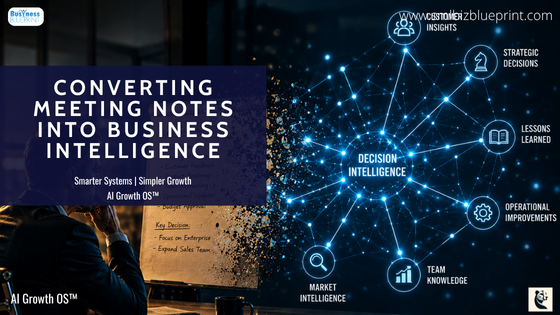

How to transform everyday discussions into a system that improves decisions, preserves knowledge, and compounds strategic value.
Most businesses do not have a meeting problem—they have an organizational memory problem.
Converting meeting notes into business intelligence means capturing the reasoning, assumptions, and decisions behind conversations so knowledge compounds instead of disappearing.
Businesses that preserve decision intelligence learn faster, make better decisions over time, and create an AI-ready asset that becomes more valuable as they grow.
Most businesses think meetings are expensive because they consume time.
That is not the real cost.
The real cost is what disappears after the meeting ends.
Every week, leadership teams discuss customers, hiring, pricing, operations, risks, and growth. Decisions are made. Assumptions are challenged. Experience is shared.
Then the meeting ends, the notes are filed away, and the thinking that created the decision begins to fade.
At first, nothing seems wrong.
Revenue still arrives. Projects move forward. Teams stay busy.
Every leadership team eventually has the same strange experience. A discussion starts. Someone says, “Haven’t we talked about this before?” The room goes quiet for a moment because everyone vaguely remembers the conversation, but nobody remembers the reasoning.
Then the symptoms appear. The same conversations return. New leaders revisit old decisions. Employees leave and take context with them. Teams spend time reconstructing knowledge the business already paid to create.
What looks like a communication problem is often a memory problem.
The standard approach treats meetings as temporary events. Once actions are assigned, the value is considered captured.
But meetings are not primarily communication tools.
They are intelligence-generation systems.
The most valuable thing produced in a meeting is rarely the decision itself. It is the reasoning behind the decision—the trade-offs, assumptions, concerns, and insights that shaped it.
Businesses that preserve this intelligence create an advantage that compounds. Businesses that lose it are forced to relearn the same lessons repeatedly, paying for the same knowledge multiple times through slower decisions, duplicated effort, and management drag.
That distinction becomes increasingly important as AI enters the workplace.
Most leaders think AI’s value comes from automation. Increasingly, its value comes from context. AI can process information. It cannot recover reasoning that was never captured.
The businesses that benefit most from AI will not necessarily have the best tools. They will have the deepest reservoir of organisational intelligence for those tools to learn from.
The future belongs to organisations that learn from themselves.

The Hidden Value Most Businesses Leave Inside Meetings
Most businesses believe meetings produce decisions.
In reality, they produce decision intelligence.
A decision is the outcome. Decision intelligence is the reasoning that led to the outcome. It includes assumptions, customer insights, operational realities, risks, and strategic trade-offs.
That is where the real value lives.
When leadership decides to increase prices, enter a new market, or change a process, the final decision is only a fraction of what was created. The discussion contains the intelligence. The decision is merely the conclusion.
Yet most businesses preserve the conclusion and discard the thinking.
The result is an invisible tax on growth.
Teams revisit old discussions. Leaders repeat previous analysis. New managers ask questions that were already answered months ago. Knowledge exists somewhere, but the organization cannot access it efficiently.
What looks like a communication problem often becomes an execution problem. Decisions take longer. Alignment becomes harder.
Leadership attention gets consumed solving yesterday’s problems instead of identifying tomorrow’s opportunities.
Every repeated conversation carries a hidden cost. Not because discussion is bad, but because the business is paying twice for knowledge it already created once.
One founder sat in a quarterly planning meeting listening to a debate that felt strangely familiar.
Twenty minutes later, someone found notes from eighteen months earlier and discovered the team had already reached the same conclusion. The decision survived. The reasoning did not.
That was the moment he realized the business wasn’t struggling to make decisions—it was struggling to remember them. He stopped collecting notes and started building organizational memory.
Most companies invest heavily in collecting operational data while ignoring decision data.
That is a mistake.
Operational data tells you what happened. Decision data explains why.
This is why your sales team keeps re-explaining the same thing on calls. The knowledge exists, but the business has no reliable way to preserve and reuse it.
Every meeting that disappears takes context with it. The longer that continues, the more expensive growth becomes.
Pro Tip:
Stop asking whether a meeting produced actions. Ask whether it produced reusable intelligence.
Actions create movement. Intelligence creates leverage.
Why Traditional Meeting Notes Rarely Create Business Value
Most meeting notes fail because they are designed for documentation rather than learning.
Most companies don’t have a note-taking problem.
They have an illusion-of-capture problem.
The presence of documentation creates the appearance of knowledge retention. In reality, the most valuable parts of the discussion are often missing.
Traditional notes answer one question:
What happened?
Strategic intelligence answers a different question:
Why did it happen?
That difference changes everything.
A meeting summary might record that a product launch was delayed. Months later, the team can see the decision but not the reasoning behind it. They know what happened but not why it happened.
Without context, knowledge becomes fragile.
As businesses grow, this weakness becomes increasingly expensive. Complexity rises. More people become involved in decisions. Dependencies multiply. Context becomes harder to maintain.
Yet most organisations continue documenting events instead of preserving thinking.
This creates a dangerous illusion. Leaders believe knowledge has been captured because notes exist. In reality, only fragments remain.
The businesses that learn fastest are not necessarily documenting more. They are preserving assumptions, trade-offs, objections, and strategic logic.
Those elements create learning loops.
Simple records do not.
Every time reasoning disappears, future teams are forced to recreate context from scratch. That slows execution and increases decision fatigue.
Pro Tip:
Record assumptions alongside decisions. Outcomes tell you what happened.
Assumptions reveal whether the organisation is actually learning.

What Business Intelligence Looks Like Inside Meeting Conversations
Most business intelligence systems focus on outcomes.
Revenue. Margins. Retention. Conversion rates.
Useful metrics—but all of them describe the past.
Most business dashboards are rear-view mirrors.
By the time a metric changes, the event that caused it has often happened weeks or months earlier.
Meeting conversations often reveal the future.
This is the overlooked opportunity.
When leaders repeatedly discuss customer complaints, onboarding friction, hiring challenges, or market shifts, they are exposing signals before those signals appear in dashboards.
The meeting becomes an early warning system.
Imagine five leadership meetings where onboarding concerns surface briefly each time. No metric has declined yet. No report shows a problem.
But a pattern is emerging.
Most businesses miss these signals because they exist in conversational form.
Business intelligence is not merely data collection.
It is signal detection.
The uncommon insight is that meetings often contain predictive intelligence. They reveal future risks and opportunities before operational systems can measure them.
Organisations that capture these signals gain a significant advantage. They identify issues earlier, respond faster, and learn more effectively.
More importantly, they shift from reactive management to anticipatory management. Problems are addressed while they are still signals rather than after they become metrics.
That changes the economics of growth. Preventing friction is almost always cheaper than correcting failure.
Midway through growth, every business faces a choice.
Continue operating from fragmented conversations.
Or become the organisation that learns from itself.
That identity matters.
Businesses rarely outperform competitors because they work harder. They outperform competitors because they accumulate insight faster.
Every signal ignored today becomes a problem discovered later.
Pro Tip:
Track recurring topics across meetings.
Patterns often reveal strategic opportunities before metrics do.
Building a System to Capture Decisions, Context, and Insights
The goal is not better note-taking.
The goal is building a decision intelligence system.
A useful system captures three things:
- The decision.
- The reasoning.
- The outcome.
Most businesses stop after the first step.
That is where learning breaks.
When a major decision is made, capture the assumptions behind it, the risks discussed, and the indicators that will determine success. Months later, compare expectations with reality.
Now the organisation can learn.
Without that loop, businesses accumulate decisions without accumulating wisdom.
Another overlooked element is disagreement.
Many teams remove dissent from documentation because it feels messy. In reality, disagreement often contains the highest-value intelligence in the room. Alternative viewpoints expose assumptions, blind spots, and hidden risks.
One growing services firm found itself revisiting pricing decisions every quarter.
Opinions changed, memories conflicted, and progress stalled. Once they began documenting assumptions, decision logic, and expected outcomes, discussions became evidence-based rather than memory-based.
The business stopped recycling decisions and started refining them. They became a company that learned from itself.
This is why deals feel close but stall.
The reasoning behind forecasts, customer objections, and pipeline assumptions disappears before teams can learn from it.
Growth increases decision volume. Without systems for preserving context, complexity grows faster than clarity.
Pro Tip:
Build a decision register, not a meeting archive.
Archives store information. Registers preserve learning.
How AI Turns Meeting Data Into Actionable Intelligence
Most businesses think AI’s role in meetings is transcription.
That is a very small opportunity.
The larger opportunity is interpretation.
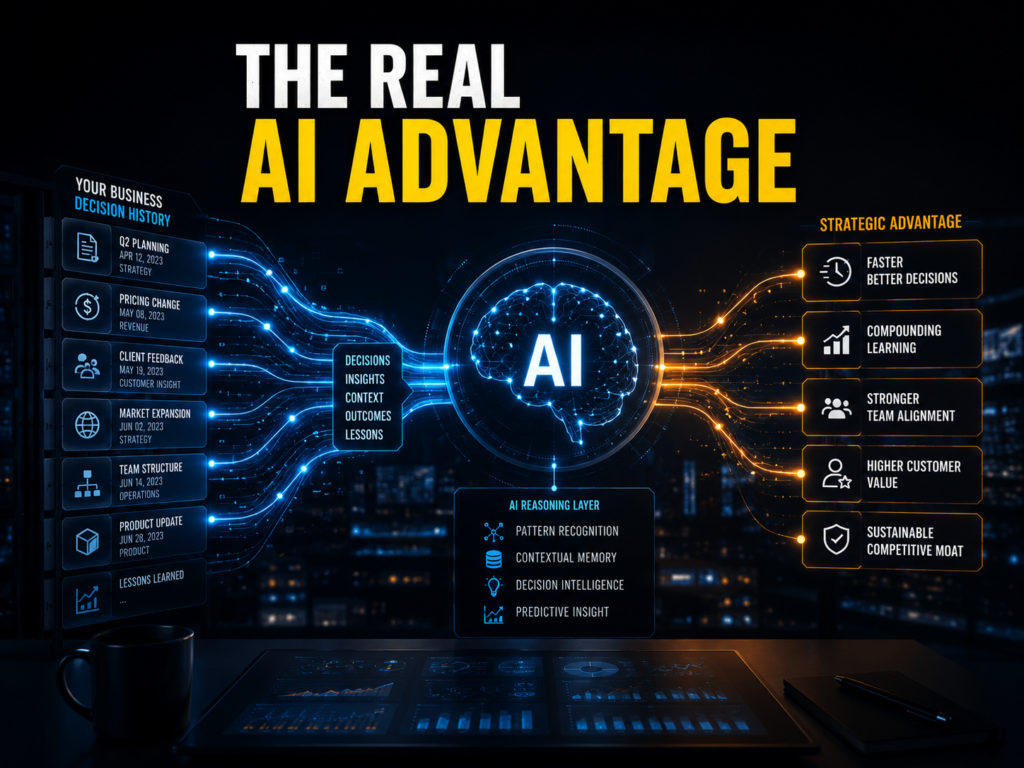
AI can identify recurring themes, emerging risks, unresolved issues, strategic assumptions, and decision patterns across hundreds of conversations.
Humans can review individual meetings.
AI can analyse entire histories.
This creates a critical shift.
Meetings stop being isolated events and become inputs into a growing intelligence system.
This is where many businesses are looking in the wrong place. They are searching for smarter AI when they should be building smarter context.
The competitive advantage is not the model. The competitive advantage is the proprietary business intelligence feeding the model.
Every business will eventually have access to powerful AI.
They will not have access to your decision history.
That is where the advantage lives.
A concern raised by customer support today may connect directly to a sales objection discussed three months earlier. A hiring issue may correlate with operational bottlenecks elsewhere in the business.
Patterns become visible.
This is where many organisations misunderstand AI.
They attempt to automate thinking.
The stronger approach is to amplify thinking.
AI should help organisations see relationships they would otherwise miss.
This is why your pipeline looks strong but doesn’t convert consistently. The answer often exists across dozens of conversations that no individual can connect manually.
AI can.
But only if the intelligence was captured in the first place.
This is the quiet shift happening beneath the surface. Meeting notes are becoming training data. Decision history is becoming context infrastructure. Organisational memory is becoming a strategic asset that software alone cannot replicate.
Competitors can buy similar technology. They cannot easily replicate years of accumulated decision intelligence.
Pro Tip:
Use AI to identify patterns across meetings, not merely to summarise them.
The insight lives in the connections.
Creating Organisational Memory That Compounds Over Time
Most business assets depreciate.
Organisational memory should appreciate.
Yet many companies operate as if knowledge has no long-term value.
Employees leave. Managers change. Markets evolve. Valuable lessons disappear.
The cost rarely appears on a balance sheet.
But it exists.
Teams revisit abandoned initiatives. New leaders repeat old mistakes. Resources are spent solving problems that were already solved years earlier.
The root issue is simple.
Most businesses have information storage.
Very few have memory systems.
Information storage preserves documents.
Memory systems preserve understanding.
Ask a founder how a major pricing decision was made five years ago, and they’ll often remember. Ask the organisation, and you’ll usually find fragments.
Organisations with strong memory learn cumulatively. Organisations without memory relearn continuously.
One compounds.
The other cycles.
The difference becomes dramatic over a decade. One organisation builds an expanding library of decisions, outcomes, customer insights, and operational lessons. The other repeatedly spends time and money rediscovering what it already knew.
Eventually, this becomes less of a knowledge issue and more of a margin issue.
The strongest organisations are difficult to compete with because they remember more effectively than competitors. Not because they employ smarter people, but because they operate smarter learning systems.
Every month without organisational memory allows valuable intelligence to leak out of the business.
Pro Tip:
Measure how often teams revisit previously solved problems.
Repetition often signals memory failure rather than execution failure.
From Meeting Documentation to Strategic Advantage
The real opportunity is not improving meetings.
It is redesigning how businesses learn.
Most leaders believe competitive advantage comes from making better decisions.
Partly true.
But sustainable advantage often comes from learning faster than competitors.
Learning faster requires remembering better.
Remembering better requires systems.
Every organisation generates knowledge. Very few preserve it effectively.
The result is predictable: valuable experience evaporates while the same problems return under different names.
The organisations creating disproportionate advantage are increasingly those that convert experience into assets. They treat decisions, lessons, assumptions, and context as intellectual capital rather than temporary conversations.
That intellectual capital becomes increasingly valuable in an AI-driven economy because it is unique, proprietary, and difficult to copy.
Most companies believe they are building enterprise value through customers, revenue, systems, and processes.
Very few realise they are also building—or losing—a knowledge asset every day.
A business that captures decision intelligence creates a unique asset—not a database, but a growing understanding of how the organisation creates results.
That understanding improves forecasting, delegation, execution, and adaptation.
Most importantly, it reduces the cost of future decisions because the organisation no longer starts from zero.
Competitors can buy the same software. They can hire similar talent. They can access similar information.
They cannot easily replicate years of accumulated organisational intelligence.
That is where the moat begins.
Walk into most boardrooms and you’ll find years of financial data preserved with precision.
Yet the reasoning behind thousands of strategic decisions has quietly vanished. Businesses obsess over protecting numbers while neglecting the thinking that created them.
The organisations that win long term are often not the ones with the best data—they are the ones that remember why the data changed.
Strategic advantage is becoming less about effort and more about accumulated intelligence.
Pro Tip:
Stop evaluating meetings by attendance, duration, or action items.
Evaluate them by how much reusable intelligence they generate.
Conclusion
Most businesses already know their meetings could be better.
That is not the real issue.
The deeper problem is that valuable thinking is being created every day and then quietly discarded.
Conversations disappear. Context disappears. Reasoning disappears.
And with them goes the organisation’s ability to learn.
The solution is not more documentation.
It is preserving intelligence.
Once you view meetings through that lens, everything changes.
Meeting notes become strategic assets.
Decision history becomes organisational memory.
Organisational memory becomes a competitive advantage.
The businesses that thrive in the coming decade will not simply collect more data. They will build better systems for learning from themselves.
The shift is subtle but profound. Knowledge is no longer enough. The organisations that win will be those that can capture, retain, and continuously apply what they learn.
In that environment, organisational memory stops being an operational asset and becomes a strategic one.
Your current state is not inevitable.
Repeated conversations are not inevitable.
Lost context is not inevitable.
Somewhere inside your business, there is knowledge you have already paid for.
The question is whether you’ll still be able to use it a year from now.
You can continue treating meetings as temporary events that disappear when the calendar invitation ends.
Or you can start treating them as one of the most valuable intelligence assets your business creates.
One path produces activity.
The other produces a compounding advantage.
Action Steps
Shift from Meeting Records to Decision Records
Stop measuring success by whether notes were taken and start measuring whether decision logic was captured. Without reasoning, future teams are forced to reconstruct context and repeat analysis.
Create a Central Decision Intelligence Repository
Store decisions, assumptions, risks, and outcomes in one searchable location. This transforms isolated conversations into organisational memory.
Capture Assumptions Alongside Decisions
Assumptions are what allow learning. If outcomes change, you can identify whether the execution failed or the thinking was flawed.
Track Recurring Themes Across Meetings
Repeated concerns often reveal strategic signals before dashboards do. Organisations that detect patterns earlier adapt faster.
Use AI to Analyse Patterns, Not Just Summaries
The real value of AI is connecting conversations across time. Insights emerge from relationships, not transcripts.
Review Decisions as a Learning System
Revisit previous decisions and compare expectations to outcomes. This converts experience into compounding intelligence.
FAQs
What is the difference between meeting notes and business intelligence?
Meeting notes record events. Business intelligence preserves the reasoning, assumptions, and insights behind those events.
Why do businesses keep having the same conversations?
Because decisions survive while context disappears. Without preserved reasoning, teams are forced to reconstruct previous thinking.
How can AI improve meeting intelligence?
AI identifies patterns across large volumes of conversations, helping leaders detect risks, opportunities, and recurring themes.
What should be captured from strategic meetings?
Capture the decision, the reasoning, the assumptions, the risks, and the expected outcome.
Why is organisational memory important?
It allows businesses to learn cumulatively instead of repeatedly solving the same problems.
Can meeting intelligence become a competitive advantage?
Yes. Competitors can copy products and processes. Accumulated organisational intelligence is much harder to replicate.
What is the first step?
Start capturing why decisions were made, not just what was decided.
Other Articles
How to Stop Repeating Business Mistakes at Scale