
Technology can be implemented by anyone, but every AI-assisted decision still requires clear ownership, accountability, and governance.
An AI accountability framework defines who owns the business decisions AI influences—not who manages the technology.
As AI becomes part of everyday decision-making, businesses need clear ownership, governance, learning loops, and decision standards to maintain consistency.
Companies that assign accountability before expanding AI adoption build stronger organisational capability, reduce decision drift, and create a sustainable competitive advantage.
Your business has already delegated decisions to AI.
Not because you announced an AI strategy. Not because you replaced managers with algorithms. But because people throughout your organisation are quietly asking AI what they should do next.
Marketing uses it to shape campaigns. Sales uses it to prepare proposals. Finance analyses forecasts with it. Operations streamlines workflows through it.
HR drafts job descriptions and evaluates interview questions. Individually, these decisions seem harmless—often even impressive.
Work happens faster. Teams feel more capable. Leaders see productivity improving and assume the organisation is becoming smarter.
But speed has a way of hiding structural problems.
One of the first signs rarely appears on an AI dashboard. It usually appears in a leadership meeting.
A CEO asks three executives the same question about a customer.
Marketing confidently explains why the campaign worked.
Sales confidently explains why the customer bought.
Operations confidently explains why delivery nearly failed.
Nobody is arguing.
Nobody is incompetent.
Everyone genuinely believes they are right.
The uncomfortable reality is that each executive is making sense of the same business through a different set of assumptions.
AI hasn’t created the inconsistency. It has simply made it easier for every department to reinforce its own version of the truth.
That is the ownership problem most businesses don’t recognise.
Most conversations about AI still revolve around technology.
Which platform should we buy?
Which model is more accurate?
How should we train our people?
Who should become our AI champion?
These are sensible questions, but they all assume the challenge is successful implementation.
It isn’t.
Implementation determines whether people use AI.
Ownership determines whether the business continues thinking as one organisation after they do.
This is where AI differs from every major technology shift before it.
Previous technologies helped people record work, automate repetitive tasks, or improve communication. AI increasingly participates in the reasoning that determines what happens next.
It proposes pricing strategies, drafts customer responses, identifies hiring candidates, recommends inventory levels, analyses financial risks, and suggests strategic alternatives.
Whether those recommendations are accepted or rejected, they are already influencing business judgement.
That changes the nature of leadership.
The critical question is no longer whether AI makes the final decision.
In most businesses, it doesn’t.
The real question is who owns the judgement that determines whether AI’s recommendation should be trusted, challenged, modified, or rejected.
Technology cannot answer that.
Only leadership can.
This is why organisations often feel more productive while becoming less consistent. AI helps every department improve independently, but without clear ownership, those improvements begin pulling the business in different directions.
Sales develops one decision philosophy. Operations develops another. Customer service develops a third. Individually, they all make sense. Collectively they create decision drift.
The danger isn’t dramatic failure.
It’s gradual fragmentation.
The same customer receives different answers depending on who they speak to.
Similar situations produce different decisions. Leaders spend more time resolving inconsistencies than building capability. The organisation still performs, but it no longer thinks with one coherent voice.
By the time these inconsistencies become visible, they are no longer technology problems.
They are leadership problems.
That is why asking, “Who owns AI?” is the wrong question.
Technology cannot own outcomes.
The better question is:
Who owns the business decisions that AI now influences?
That single shift changes everything.
It moves the conversation away from software and towards leadership. Away from adoption and towards accountability. Away from individual productivity and towards organisational capability.
Because the businesses that create lasting advantage over the next decade won’t necessarily be the ones with access to the most advanced AI.
They will be the ones that build the greatest decision coherence—the ability to make thousands of AI-assisted decisions while consistently expressing the same principles, priorities, and standards across the entire organisation.
AI doesn’t replace leadership.
It amplifies it.
It doesn’t remove accountability.
It reveals where accountability never truly existed.
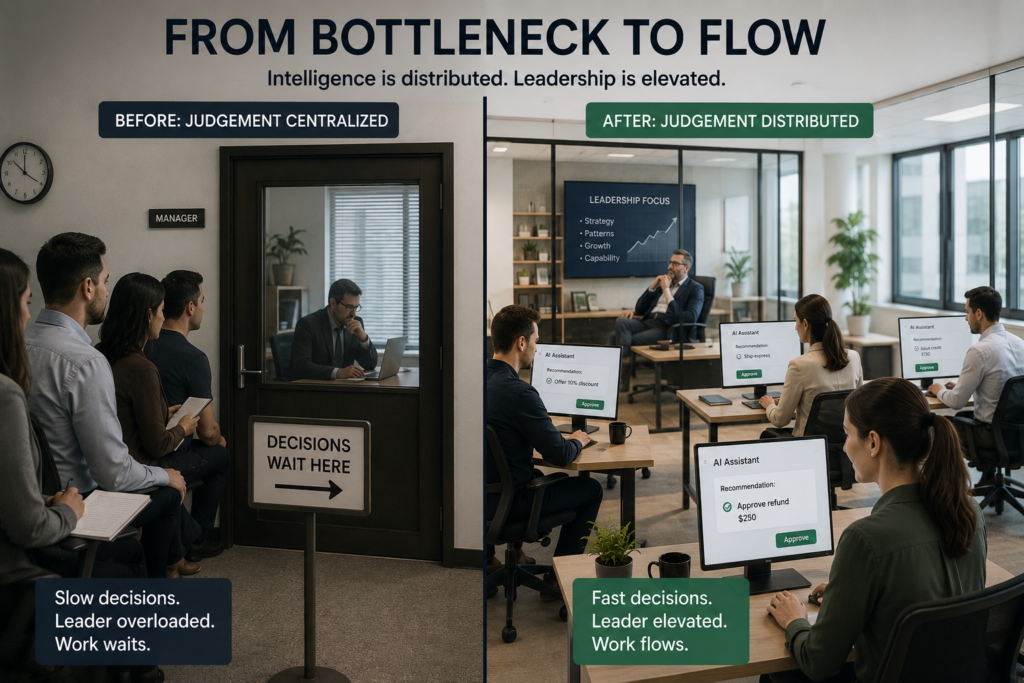
For decades, businesses concentrated judgement in experienced managers because information was scarce. AI changes that. It distributes judgement to the point where work happens, while accountability remains exactly where it has always been—with leadership.
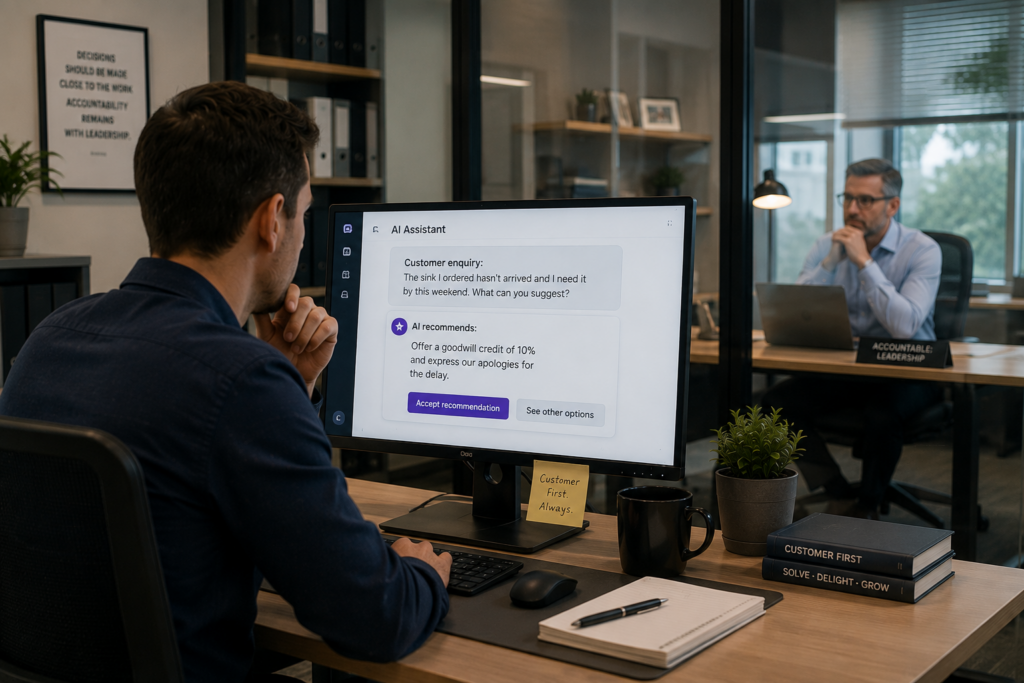
The AI Ownership Problem Most Businesses Don’t Recognise
Most businesses believe they have an AI strategy.
What they actually have is AI activity.
Employees are experimenting with new tools. Teams are writing reports faster, producing more content, analysing more data, and automating more work than ever before.
Dashboards show increasing adoption. Leaders see productivity improving and conclude the organisation is becoming more capable.
It feels like progress.
Sometimes it is.
But activity should never be mistaken for architecture.
One of the most common assumptions I see is that widespread AI usage naturally leads to organisational capability. It doesn’t. In fact, the opposite often happens.
As more people begin using AI independently, the organisation can become less consistent, not more.
The first symptom is rarely an AI mistake.
It’s usually a leadership problem disguised as operational noise.
A customer receives two different prices for the same product.
A proposal from one salesperson sounds completely different to another.
Operations rejects an exception that Sales has already promised.
Customer service apologises for a decision Finance insists was correct.
Each issue is treated as an isolated incident.
Very few leaders stop to ask whether they are seeing the early signs of decision drift.
Decision drift doesn’t arrive with alarms.
It arrives through hundreds of small exceptions that nobody thinks are connected.
Each individual decision appears reasonable.
Collectively, they begin changing how the business behaves.
This is why AI represents a fundamentally different challenge from previous technologies.
Traditional business systems captured information, enforced predefined processes, or automated repetitive tasks. They improved efficiency, but they rarely participated in judgement.
AI is different. It generates alternatives, identifies patterns, suggests actions, drafts recommendations, and increasingly influences the reasoning that happens before a decision is made.
That distinction matters.
The risk isn’t that AI makes the decision.
The risk is that different people begin making decisions using different reasoning while believing they are still working within the same business.
Imagine two regional sales managers reviewing almost identical opportunities.
Both ask the same AI platform for pricing guidance.
One manager has built a career protecting margin. The other has always prioritised customer retention. AI generates sensible recommendations for both because it is responding to different prompts, different priorities, and different commercial assumptions.
Three months later, similar customers are paying different prices.
Margins begin drifting.
Salespeople start sharing whichever AI prompts appear to close the most deals.
Nobody deliberately changed the pricing strategy.
Nobody authorised a new commercial model.
The organisation simply allowed individual judgement to evolve faster than shared decision principles.
I’ve seen versions of this pattern repeated far beyond pricing.
Marketing develops its own interpretation of the brand.
Operations creates its own definition of efficiency.
Sales develops its own qualification criteria.
Finance builds its own approach to commercial risk.
Each department becomes better at solving its own problems.
The organisation quietly becomes worse at solving them together.
Ironically, AI rewards this behaviour.
It makes every function more capable of optimising locally. Unless leadership deliberately defines the principles those optimisations should reinforce, AI accelerates departmental excellence at the expense of organisational coherence.
That is why the conversation about AI ownership often begins in the wrong place.
Leaders ask:
“Which AI platform should we use?”
“Which model is more accurate?”
“Who should become our AI champion?”
These are implementation questions.
The more important question is architectural.
Who owns the principles AI should consistently reinforce?
Because AI doesn’t simply automate work.
It distributes decision influence throughout the organisation.
Every employee suddenly gains access to sophisticated reasoning support. Every recommendation, every prompt, every generated option subtly influences how work is performed.
That influence spreads rapidly, but accountability often remains exactly where it was—undefined.
The result isn’t chaos.
It’s something far more dangerous.
The business slowly develops multiple versions of itself.
Customers don’t notice it immediately.
Neither do leaders.
The organisation continues growing. Revenue continues arriving. Teams genuinely believe they are becoming more productive.
Then one day a customer asks why another client received a different answer.
A board meeting reveals three conflicting interpretations of the same business problem.
A senior leader asks, “Who approved that?”
The room goes quiet.
Not because nobody cares.
Because nobody actually owns the decision principles that produced the outcome.
That’s the moment many organisations realise they don’t have an AI problem.
They have a leadership architecture problem that AI has finally made visible.
Competitive advantage is no longer created by making the occasional brilliant decision.
It is created by ensuring thousands of ordinary decisions express the same underlying principles.
That is decision coherence.
It is what allows a growing business to remain recognisable to its customers, consistent in its operations, and aligned in its leadership—even as AI dramatically increases the number and speed of decisions being made.
Every day AI influences decisions without clearly defined ownership, the organisation creates another opportunity for standards to diverge.
At first, those differences look like flexibility. Over time, they become inconsistency—for customers, employees, and leadership alike.
The longer decision drift goes unnoticed, the more expensive it becomes to restore alignment because fragmented judgement gradually becomes the way the business naturally operates.
Pro Tip
Before asking, “Where can AI save us time?” ask, “Which business decisions cannot afford inconsistent judgement?” The answer identifies where leadership—not technology—must establish ownership first.
Businesses that understand this don’t simply deploy AI faster. They build stronger decision architecture that becomes more valuable every time AI is used.
Monday mornings became strangely quieter. The leadership team assumed AI had solved their reporting problems because meetings were shorter and everyone arrived with polished recommendations.
Six weeks later they realised every department had quietly developed its own version of “good decision-making.” They hadn’t lost control overnight—they had lost a shared way of thinking.
From that point on, they stopped asking who was using AI and started asking who owned the decisions.
Why an AI Champion Is Not the Same as AI Accountability
Every organisation wants an AI champion.
Someone to explore new tools, educate the team, encourage experimentation and keep momentum moving.
That role is valuable.
It is also widely misunderstood.
An AI champion can accelerate adoption.
They cannot own the outcomes of every AI-assisted decision across the business.
Many organisations quietly merge these responsibilities into one role. The result is predictable. The champion becomes responsible for technology they don’t control, commercial decisions they don’t make, and risks they cannot manage.
The confusion comes from treating capability ownership and decision ownership as the same thing.
They are not.
Capability ownership asks:
How do we become better at using AI?
Decision ownership asks:
Who accepts responsibility for the business outcome when AI influences a decision?
Those questions deserve different owners.
Consider an AI-generated pricing recommendation.
The AI champion may have trained the team.
IT may have integrated the platform.
Marketing may have developed the prompts.
But if margins collapse because of the pricing decision, accountability still belongs to the commercial leader responsible for pricing.
AI changes how decisions are made.
It does not change who owns the consequences.
This distinction becomes increasingly important as AI spreads across the organisation.
The more accessible AI becomes, the easier it is for every department to create its own workflows, processes and standards. Innovation accelerates.
So does fragmentation.
This is why your pipeline looks strong but doesn’t convert consistently.
Each department is optimising successfully—but for different definitions of success.
Marketing improves lead volume.
Sales improves conversion.
Operations improves efficiency.
Finance protects margin.
AI helps every function achieve its local objective while nobody owns whether those objectives still produce the best outcome for the business as a whole.
That isn’t a technology problem.
It’s an accountability problem.
Businesses that mature with AI understand something many organisations miss.
Leadership isn’t responsible for having every answer.
Leadership is responsible for defining how important decisions are made, who owns them, and where judgement cannot be delegated.
The longer AI adoption is treated as an IT initiative or an innovation project, the harder it becomes to rebuild organisational consistency. Teams naturally optimise for what they control.
Without shared accountability, AI simply accelerates that separation.
Pro Tip
Separate two responsibilities before expanding AI adoption: Who develops AI capability? and Who owns business decisions?
Keeping them distinct allows innovation to grow without weakening accountability.

The Four Layers of AI Ownership Every Business Must Define
One of the first questions organisations ask is, “Who should own AI?”
It sounds logical, but it’s the wrong question.
AI isn’t one capability that belongs to one person or department. It influences technology, people, decisions, and organisational learning simultaneously.
Expecting a single AI champion to own all of that is like expecting your CFO to own every financial decision in the business.
The better question is:
What exactly needs to be owned?
From that perspective, four distinct ownership layers emerge.
Together, they create the accountability needed to keep AI strengthening the business instead of fragmenting it.
Technology Ownership
Technology ownership is responsible for the AI itself.
This includes platform selection, security, data governance, integrations, compliance, and system reliability. Without clear ownership, businesses quickly accumulate disconnected AI tools, inconsistent data, and unnecessary risk.
Technology ownership ensures AI is secure and reliable.
It does not ensure the business makes good decisions.
Capability Ownership
Capability ownership develops the organisation’s ability to use AI effectively.
Training, prompt libraries, playbooks, knowledge sharing, and internal support all sit here. This is where an AI champion creates the greatest value—helping people build confidence and competence.
The mistake many organisations make is assuming capability ownership also carries accountability.
It doesn’t.
Teaching someone how to use AI is very different from owning the commercial consequences of the decisions they make with it.
Decision Ownership
This is the layer that matters most.
Watch what happens when a leader asks,
“Who approved that recommendation?”
If nobody can answer, the organisation doesn’t have an AI problem.
It has an ownership problem.
Sales owns pricing decisions.
Finance owns financial judgement.
Operations owns operational decisions.
Marketing owns brand decisions.
AI may analyse information, recommend alternatives, or identify risks, but it never owns the outcome. Accountability always remains with the person responsible for the business decision.
AI changes how decisions are made.
It never changes who owns the consequences.
Learning Ownership
This is the ownership layer most organisations overlook.
Most businesses review whether AI worked.
Very few review whether the organisation became better at making decisions because of it.
Learning ownership captures successful reasoning, challenges failed assumptions, and turns individual experience into organisational knowledge.
Otherwise, the best AI workflows remain hidden inside someone’s prompt history and disappear when they leave the business.
Learning ensures capability compounds instead of restarting every time people change.
These four ownership layers work together.
Technology ownership makes AI trustworthy.
Capability ownership makes people capable.
Decision ownership keeps accountability clear.
Learning ownership ensures the organisation continuously improves.
Together they create something far more valuable than AI governance.
They create decision coherence—the ability for hundreds or even thousands of AI-assisted decisions to consistently reflect the same business principles.
That is the competitive advantage most organisations are missing.
AI technology will become increasingly accessible to everyone. What competitors cannot easily copy is an organisation where every decision, regardless of who makes it or which AI tool they use, reinforces one consistent way of thinking.
Every ownership layer left undefined creates a different form of organisational risk.
Technology gaps expose systems. Capability gaps slow adoption. Decision gaps create inconsistency. Learning gaps guarantee repeated mistakes.
Together they slowly erode trust, alignment, and performance.
Pro Tip
Before launching another AI initiative, identify who owns each of these four layers.
If one has no clear owner, you haven’t found a technology problem—you’ve uncovered an architectural weakness.
Building an AI Accountability Framework for Decision-Making
Most businesses respond to AI by writing policies.
They publish acceptable-use guidelines, define security requirements, and create prompting standards. Those controls are necessary, but they don’t answer the question that matters most.
How does this business make consistently good decisions when AI becomes part of the thinking process?
A policy governs behaviour.
An AI accountability framework governs judgment.
That distinction changes the purpose of governance. The goal is no longer controlling technology—it is creating consistency in decision-making as AI becomes embedded across the organisation.
A practical framework begins with four questions.
What decision is actually being made?
Most organisations focus on the task: writing a proposal, forecasting demand, responding to a customer. But beneath every task sits a decision.
Approving a discount. Accepting a level of risk. Allocating resources. Choosing between competing priorities.
If the decision isn’t clear, accountability never will be.
Who owns the outcome?
Not who prompted the AI.
Not who implemented the tool.
Who carries the commercial consequence if the decision proves wrong? That owner remains accountable, regardless of how much AI contributed to the recommendation.
What assumptions is AI introducing?
Every recommendation contains assumptions about customers, markets, acceptable risk, or success. Left unchallenged, those assumptions quietly become organisational standards.
The danger isn’t incorrect information. It’s unquestioned reasoning.
How will this decision improve the next one?
This is where most governance frameworks stop too early. Businesses review outcomes but rarely improve the decision process itself.
Without a feedback loop, AI simply accelerates repetition. With one, it accelerates organisational learning.
Many leaders fear governance will slow innovation.
Good governance does the opposite.
When accountability is explicit, people know where they have freedom, where they need oversight, and where judgment cannot be delegated. Confidence increases because uncertainty decreases.
This is why your sales team keeps re-explaining the same thing on calls.
The issue isn’t missing information. It’s that nobody has converted successful decisions into organisational standards that everyone can follow.
The real purpose of an AI accountability framework isn’t reducing risk.
It is increasing the organisation’s ability to make better decisions repeatedly. Risk reduction is simply a consequence of better judgment.
Every AI-assisted decision creates a new way of thinking.
Without a framework, those ways multiply independently. With one, they strengthen a shared decision architecture that becomes more valuable every time the business learns.
Pro Tip
Build your framework around decisions, not tools.
Software will change. Clear decision principles become part of the organisation’s operating system.
A growing manufacturer believed their AI rollout was successful because every department had adopted new tools.
Yet pricing, forecasting and customer communication kept contradicting each other. Once leadership mapped decision ownership instead of software ownership, those conflicts began disappearing.
The business didn’t just become faster—it became recognisably consistent, and people trusted each other’s decisions again.
Moving from Individual AI Users to an Organisational Capability
One of the biggest mistakes businesses make is confusing individual AI success with organisational capability.
An employee discovers a workflow that saves five hours a week.
A salesperson builds prompts that improve proposals.
Marketing develops an AI process that produces better campaigns.
Finance creates faster forecasting models.
Leadership sees these wins and concludes the business has become AI capable.
It hasn’t.
It has become more productive at the individual level.
There is a fundamental difference between people using AI well and the organisation becoming better because of AI.
The distinction becomes obvious when someone leaves.
I’ve seen businesses lose months of accumulated knowledge because the person with the “magic prompts” resigned. Nobody knew how they consistently produced better proposals, wrote stronger marketing copy, or analysed customer data so effectively.
Their capability wasn’t documented. It wasn’t shared. It wasn’t part of the operating model.
It walked out the door with them.
That isn’t an AI problem.
It’s an organisational capability problem.
Today, many businesses are quietly creating hundreds of personal AI operating systems. Every employee develops their own prompts, workflows, decision rules, and ways of working. Individually, they’re becoming more capable.
Collectively, the organisation is becoming more fragmented.
The best AI workflow is often sitting inside someone’s ChatGPT history.
Nobody else even knows it exists.
That should concern every leadership team.
Real capability isn’t measured by what one person can do.
It’s measured by what the organisation can repeatedly do regardless of who is performing the work.
That requires a different mindset.
Instead of asking,
“How can our people use AI?”
Ask,
“How does every improvement made by one person become an improvement for everyone else?”
That single question shifts AI from being a productivity tool to becoming a capability-building system.
Every significant AI-assisted decision should leave something behind.
A better prompt.
A refined decision principle.
An improved workflow.
A documented lesson.
A stronger operating standard.
Over time, these small improvements accumulate into something competitors struggle to copy—a business that learns faster than the people inside it.
This is where decision coherence becomes a genuine competitive advantage.
New employees adopt proven decision principles instead of inventing their own. Teams solve similar problems in similar ways.
AI reinforces one organisational standard rather than amplifying individual preferences.
The business becomes less dependent on experience, memory, or key individuals because capability has been embedded into the organisation itself.
Leadership’s role changes as well.
Instead of being the source of every answer, leaders become architects of organisational learning. Their responsibility is no longer simply making good decisions, but ensuring every important decision improves the quality of the next one.
That is how AI creates long-term value.
Not by helping individuals work faster.
By helping organisations think better.
Every week valuable AI knowledge disappears into personal prompt libraries, undocumented workflows, and isolated experiments. If those improvements never become organisational capability, your business remains dependent on individuals rather than systems.
Growth becomes fragile because your smartest thinking leaves whenever your best people do.
Pro Tip
At the end of each week, ask one simple question: “What did we learn this week that every team should know?”
If the answer isn’t captured and shared, the organisation hasn’t become more capable—only one person has.
Measuring Whether Your AI Accountability Framework Is Working
Most businesses measure AI the same way they measure any new technology.
How many people are using it?
How many hours did it save?
How much content did it generate?
How many workflows have been automated?
These metrics are useful.
They tell you whether AI is being adopted.
They tell you almost nothing about whether your business is becoming better at making decisions.
That distinction matters because AI doesn’t create competitive advantage through activity.
It creates competitive advantage through better judgement.
A business can automate poor decisions just as efficiently as good ones.
It can produce more proposals, more reports, and more analysis while becoming less consistent with every passing month.
If your AI accountability framework is working, it should improve how the organisation thinks—not simply how quickly it works.
Three measures matter more than any others.
Decision Coherence
The first measure is decision coherence.
When different leaders face similar situations, do they apply the same decision principles?
The objective isn’t identical decisions.
Every situation is different.
The objective is consistent reasoning.
Customers should experience one business, not a different version depending on which department they interact with. Decision coherence tells you whether AI is reinforcing your operating model or quietly creating multiple versions of it.
Decision Learning
Every significant AI-assisted decision should improve the next one.
Ask questions such as:
What assumptions proved correct?
What reasoning should become our new standard?
What did we learn that every team should know?
Most organisations review outcomes.
High-performing organisations review reasoning.
That is how individual experience becomes organisational capability.
Decision Velocity Without Drift
AI should help your business make decisions faster.
The question is whether those faster decisions remain aligned with your strategy.
Can teams act independently while still applying the same principles?
Can the organisation increase decision speed without increasing inconsistency?
If the answer is yes, AI is strengthening your business.
If the answer is no, AI is simply accelerating fragmentation.
These three measures are far more valuable than counting prompts, licences, or hours saved because they focus on what leadership actually owns—the quality and consistency of business judgement.
Ultimately, organisations won’t outperform because they have access to better AI.
That advantage will disappear as technology becomes widely available.
They will outperform because they have built stronger decision architecture.
Their people make decisions more consistently. Their knowledge compounds over time. Their AI reinforces one way of thinking instead of creating dozens.
That is the real measure of success.
Not how often AI is used.
But whether every use makes the organisation better.
Your people optimise whatever leadership chooses to measure. Measure AI activity, and you’ll get more AI activity. Measure productivity, and you’ll get faster outputs.
But measure decision coherence, decision learning, and decision velocity without drift, and you’ll build an organisation whose judgement improves every time AI is used.
Pro Tip
Add one question to every leadership meeting: “What decision did we improve this week?”
If the discussion focuses only on outputs, you’re measuring productivity. If it focuses on better judgement, you’re building organisational capability.
Businesses often worry that AI will replace human judgment.
In reality, the greater risk is quieter: AI exposes whether your organisation ever had consistent judgment in the first place. Technology doesn’t create organisational thinking—it reveals it.
The strongest businesses won’t be remembered for adopting AI first. They’ll be remembered for learning how to think together.
Conclusion
Most businesses are asking the wrong question.
They ask who should own AI.
That question feels practical, but it points in the wrong direction.
AI is not a department, a project, or another piece of software waiting to be managed. It is becoming part of the reasoning behind thousands of business decisions.
Ownership, therefore, cannot begin with the technology. It has to begin with the decisions the technology now influences.
That changes the conversation completely.
An AI champion can encourage adoption. IT can secure the platforms. Teams can experiment with new tools. Those roles matter.
None of them replace leadership accountability.
The responsibility for business outcomes remains exactly where it has always belonged—with the people who own the decisions.
The opportunity extends far beyond reducing risk.
Businesses that define decision ownership, capture organisational learning, and continuously strengthen their decision standards build something competitors struggle to copy. Not better software.
Better judgment.
Over time, every important decision strengthens the next one. AI stops being a productivity tool and becomes an amplifier of organisational capability.
That is what separates businesses that use AI from businesses that become stronger because of AI.
If nothing changes, the outcome is predictable.
Teams will continue adopting AI independently. Decision standards will drift. Customers will experience inconsistency. Leaders will spend more time resolving avoidable conflicts.
The business may become faster, but it won’t become clearer.
The alternative begins with a simple shift.
Design accountability before expanding automation.
Define who owns critical decisions before optimising how those decisions are made.
Build learning into every significant AI-assisted outcome so capability compounds instead of resetting with every new tool.
Businesses that endure don’t merely adopt new technology.
They deliberately improve how they think.
Your current approach is not inevitable.
It is an architectural choice.
So is what comes next.
Action Steps
Map every high-impact business decision before mapping AI tools.
Identify the critical decisions that influence revenue, customer experience, risk, and operational performance. This ensures AI supports the right decisions instead of automating low-value activity. The consequence: AI becomes aligned with business priorities rather than creating disconnected pockets of productivity.
Separate AI capability ownership from business decision ownership.
Define who develops AI skills and who remains accountable for commercial outcomes. These are complementary responsibilities, not interchangeable roles. The consequence: experimentation increases without creating ambiguity when important decisions must be defended.
Create explicit decision rules before expanding AI adoption.
Document the principles, assumptions, escalation points, and review triggers for significant AI-assisted decisions. This creates consistency while still allowing teams to innovate. The consequence: departments make faster decisions without drifting away from organisational standards.
Build a decision review loop instead of an AI usage report.
Review important AI-assisted decisions regularly to identify successful reasoning, failed assumptions, and opportunities to strengthen decision standards. Focus on improving judgment rather than measuring activity. The consequence: every significant decision increases the capability of the organisation instead of remaining an isolated event.
Turn individual AI knowledge into organisational assets.
Capture successful prompts, reasoning patterns, decision criteria, and lessons learned in shared operating playbooks. The goal is to ensure improvements belong to the business—not individual employees. The consequence: capability compounds over time and becomes independent of staff turnover.
Measure organisational consistency instead of AI productivity.
Track whether departments reach similar conclusions under similar circumstances, whether ownership is clear, and whether learning is improving future decisions. Productivity is useful, but consistency is what creates scalable businesses. The consequence: AI strengthens organisational alignment instead of accelerating fragmentation.
FAQs
An AI accountability framework defines who owns the business decisions AI influences, how those decisions are reviewed, and how learning improves future outcomes. It focuses on leadership responsibility rather than technology management.
Who should own AI in a business?
No single person owns AI. Technology, capability, decision-making, and organisational learning each require different owners, while accountability for business outcomes always remains with the responsible business leader.
Why isn’t an AI champion enough?
An AI champion helps people adopt and use AI effectively, but they cannot own the commercial consequences of every AI-assisted decision. Separating capability from accountability prevents organisational confusion.
How do you know if AI is improving your business?
Look beyond productivity metrics. Measure decision consistency, accountability, organisational learning, and whether AI-assisted decisions produce better outcomes over time.
What is the biggest risk of unclear AI ownership?
The greatest risk is decision drift. Different teams begin using AI according to their own standards, creating inconsistent customer experiences, conflicting priorities, and fragmented leadership decisions.
How often should an AI accountability framework be reviewed?
Review significant AI-assisted decisions regularly—monthly or quarterly depending on business complexity. The objective is continuous improvement of decision standards, not simply auditing AI usage.
What should businesses do before expanding AI adoption?
Define which decisions matter most, assign clear accountability for those decisions, establish review mechanisms, and capture organisational learning. Expanding AI without ownership simply scales inconsistency.
Other Articles
How to Remove Decision Bottlenecks With AI