
Discover how leading companies use AI to retain knowledge, improve decisions, and create a competitive advantage that strengthens over time.
Businesses do not gain a competitive advantage by learning more—they gain it by forgetting less.
AI-powered organisational learning helps companies capture decisions, preserve context, and improve future judgment so every lesson strengthens future performance.
The companies that grow fastest are often the ones that turn experience into organisational memory and organisational memory into better decisions.
Most businesses believe growth slows because of execution problems.
They believe the bottleneck is sales performance, operational complexity, hiring, leadership capacity, market conditions, or productivity.
Those issues are real.
But they are often downstream effects of something deeper.
The organisation is generating intelligence faster than it can retain it.
Every week, teams solve problems, discover customer insights, navigate operational challenges, and make strategic decisions. The business becomes smarter for a moment.
Then much of that intelligence disappears into meetings, inboxes, documents, disconnected systems, and individual memory.
The result is a hidden form of organisational friction.
Teams repeat conversations that should already be resolved.
Leaders revisit decisions they have already made.
Departments independently rediscover insights the business already paid to learn.
The company gains experience but not necessarily capability.
This is where many organisations misdiagnose the problem.
They assume they need more knowledge.
More training.
More reporting.
More information.
In reality, they often need better retention.
The issue is not knowledge creation.
The issue is knowledge preservation.
That distinction matters because businesses do not scale through effort alone. They scale through accumulated decision quality.
Every customer interaction contains information.
Every project contains lessons.
Every success contains a pattern.
Every failure contains guidance.
The question is whether those insights become part of the organisation’s future intelligence or disappear after the moment passes.
Most organisations are designed to process work.
Very few are designed to retain learning.
That creates an expensive cycle.
Knowledge becomes trapped inside individuals.
When people leave, knowledge leaves.
When teams change, context disappears.
When growth accelerates, institutional memory weakens.
The organisation repeatedly pays to learn the same lessons.
Most leaders think this cost appears as inefficiency.
It doesn’t.
It appears as slower adaptation.
The business becomes less capable of turning experience into advantage.
Eventually competitors stop winning because they know more.
They win because they improve faster.
The financial cost rarely appears directly on a profit-and-loss statement.
Instead, it shows up as slower execution, inconsistent performance, duplicated effort, longer onboarding, reduced forecasting accuracy, management overhead, and decision fatigue.
More importantly, it changes the economics of growth.
The company that remembers every customer objection improves sales faster.
The company that remembers every operational failure reduces costs faster.
The company that remembers every strategic decision adapts faster.
Over time, one organization compounds intelligence while another compounds effort.
That gap eventually becomes a competitive advantage.
Leaders respond with more process.
More process creates more friction.
More friction creates more complexity.
The cycle continues.
A different lens is required.
The highest-performing organisations are not simply better at learning.
They are better at remembering.
The companies that win are not necessarily the ones that learn the fastest.
They are the ones that lose the least of what they learn.
They create systems that transform experience into organisational intelligence and organisational intelligence into future decisions.
This is where AI-powered organisational learning becomes strategically important.
Not because AI automates tasks.
Because AI changes the economics of organisational memory.
The opportunity is not faster execution.
The opportunity is accumulated intelligence.
And accumulated intelligence compounds.

The Hidden Reason Some Companies Improve Faster Than Others
Most explanations focus on talent.
The better explanation is learning velocity.
Two companies can operate in the same market, employ capable people, and face similar conditions. Yet one improves steadily while the other remains trapped in recurring challenges.
The difference is rarely intelligence.
The difference is how effectively experience changes future decisions.
A learning system converts experience into improved future judgment.
Most organisations mistake activity for learning.
They conduct reviews.
They hold meetings.
They gather data.
They discuss lessons.
Yet if future decisions remain unchanged, learning never occurred.
This creates a divide that many leaders miss.
One company treats every customer interaction as an input into future decisions.
Another treats customer interactions as isolated events.
One compounds.
The other resets.
The hidden advantage is not knowledge acquisition.
It is retained intelligence.
Most businesses already generate enough learning to improve dramatically. They simply fail to preserve it in a form that can influence future action.
This is why your sales team keeps re-explaining the same thing on calls.
This is why operational problems return despite previous solutions.
This is why onboarding quality often depends on who delivers it.
The organisation is producing intelligence but failing to accumulate it.
A founder spent two years believing his company had an accountability problem.
Every quarter brought new scorecards, new meetings, and new performance reviews. Then he looked back at twelve months of leadership meetings and noticed something uncomfortable: they had solved the same three problems four separate times.
The issue wasn’t accountability. The issue was memory.
The business didn’t suddenly work harder—it started becoming smarter.
Pro Tip
Audit repeated conversations before repeated tasks.
Recurring discussions often reveal where organisational learning is failing to become organisational memory.
Every repeated discussion represents a lesson the business has already paid to learn.
Why Experience Alone Does Not Create Organisational Learning
One of the most expensive assumptions in business is that experience automatically creates wisdom.
It does not.
Experience creates exposure.
Wisdom requires extraction.
Many organisations employ highly experienced people while continuing to make familiar mistakes. The knowledge exists. The transfer does not.
Experience becomes organisational learning only when it influences decisions beyond the individual who acquired it.
This is where traditional thinking fails.
Businesses invest heavily in professional development, leadership training, and expertise. Then they wonder why organisational performance changes so slowly.
The answer is simple.
Knowledge trapped inside individuals is not organisational knowledge.
A company can hire brilliant people and still remain collectively forgetful.
The overlooked reality is that people are not the primary storage mechanism of a modern business.
Systems are.
If critical knowledge exists only inside someone’s head, it already represents operational risk.
Many founders secretly believe they are the organisational memory.
In the early stages, they often are.
The problem is that every growth milestone increases the cost of that dependency.
Eventually, the business cannot scale faster than the founder’s ability to remember.
That risk becomes visible when key employees leave.
Context disappears.
Decision history disappears.
Lessons disappear.
New teams unknowingly revisit old conclusions.
New leaders unknowingly repeat old mistakes.
The business spends resources solving problems it has already solved.
This is why deals feel close but stall.
This is why execution varies across teams.
This is why growth often feels harder than it should.
Growing businesses stop relying on experienced people alone. They build experienced organisations
Pro Tip
Document decision rationale, not just outcomes.
Outcomes tell you what happened. Rationale teaches future teams how to think.
Growth magnifies knowledge gaps. What feels manageable today becomes expensive tomorrow.

The Cost of Forgotten Decisions and Lost Knowledge
Most businesses measure visible costs.
Very few measure the cost of forgetting.
That is a mistake.
Forgetting is not merely a knowledge problem.
It is a growth constraint.
Organisational forgetting occurs when valuable knowledge can no longer influence future decisions.
Many leaders assume lost knowledge appears only when employees leave.
In reality, it happens every day.
Meetings end without captured reasoning.
Customer insights remain trapped in inboxes.
Sales objections never become company knowledge.
Operational lessons stay isolated inside departments.
The organisation generates intelligence continuously while simultaneously losing access to it.
The consequence is subtle but significant.
Growth slows without an obvious cause.
Execution becomes inconsistent.
Decision-making becomes repetitive.
The company becomes larger but not necessarily wiser.
The biggest cost is not operational.
It is strategic.
A company that forgets struggles to develop conviction because it never accumulates enough evidence to trust its own conclusions.
Every major decision begins to feel like starting again.
One of the least understood effects of forgetting is complexity.
When information becomes difficult to access, organisations compensate.
More meetings.
More approvals.
More reporting.
More management layers.
Complexity often emerges as a substitute for missing knowledge.
This is why your pipeline looks strong but doesn’t convert consistently.
The organisation lacks shared understanding of what is actually working.
Pro Tip
Track recurring decisions. If leadership repeatedly debates the same issues, the problem is not disagreement.
The problem is missing institutional memory.
The cost of forgetting compounds just as aggressively as the benefits of learning.
How AI-Powered Organisational Learning Actually Works
Most discussions about AI begin with automation.
That is too small.
The larger opportunity is memory.
Automation improves execution.
Memory improves judgment.
Judgment creates advantage.
AI-powered organisational learning transforms business knowledge into a searchable, reusable, continuously improving decision asset.
This changes the role of AI entirely.
Instead of replacing work, AI becomes a mechanism for preserving and extending organisational intelligence.
Every customer conversation.
Every strategic decision.
Every operational lesson.
Every successful campaign.
All become inputs into a growing intelligence layer.
The critical shift is that knowledge stops behaving like a temporary resource.
It becomes infrastructure.
Traditional systems store information.
Learning systems store context.
That distinction matters because decisions depend more on context than information.
The most valuable question inside a business is rarely “What happened?”
It is usually “Why did we decide that?”
Organisations that can answer both become progressively smarter over time.
What AI changes is the cost of accessing that intelligence.
Historically, valuable context was trapped inside experienced employees, buried inside documents, or scattered across departments. Retrieving it required meetings, memory, and time.
AI dramatically reduces that retrieval cost.
Knowledge that was once difficult to access becomes available at the moment decisions are made.
This is the real shift.
Historically, organisations paid repeatedly to access their own intelligence.
Through meetings.
Through experienced employees.
Through institutional memory.
AI lowers the retrieval cost of knowledge that already exists.
That changes the economics of learning.
It transforms organisational learning from an occasional activity into a continuous capability.
The advantage is not that AI knows more.
The advantage is that the organisation forgets less.
Pro Tip
Build AI around organisational memory before automation.
Better decisions create more value than faster mistakes.
Businesses that structure knowledge today will gain exponentially more value from AI tomorrow.
Building Systems That Capture and Reuse Organisational Intelligence
Learning does not compound automatically.
It compounds through architecture.
Most companies have information systems.
Few have learning systems.
A learning system captures knowledge, structures context, and redistributes intelligence where decisions occur.
Information alone does not create capability.
Application does.
The purpose of organisational learning is not documentation.
It is leverage.
A strong learning architecture captures three things:
What happened.
Why it happened.
What should happen next.
This transforms isolated knowledge into operational advantage.
Marketing becomes smarter because campaign lessons remain available.
Sales becomes stronger because successful conversations become reusable assets.
Operations improve because solved problems stay solved.
A growing service business had talented managers, strong revenue, and constant operational friction.
Every new hire depended on tribal knowledge. Every improvement seemed temporary. Once the company began capturing decision rationale and operational lessons, onboarding accelerated and execution became more consistent.
They stopped relying on experienced people and started building an experienced organisation.
Pro Tip
Capture insights closest to the moment they occur. Knowledge decays rapidly when documentation becomes a separate task.
Every insight not captured becomes future work.
Turning Every Decision Into a Compounding Advantage
Most businesses believe revenue compounds.
Fewer realise decisions compound.
Revenue is an outcome.
Decision quality is the cause.
A compounding decision system improves future judgment through accumulated learning.
Every decision creates an outcome.
Every outcome creates feedback.
Every piece of feedback contains intelligence.
Organisations that capture this intelligence improve future decisions.
Organisations that ignore it restart from zero.
This is where true competitive advantage emerges.
Not from information.
Not from technology.
From accumulated judgment.
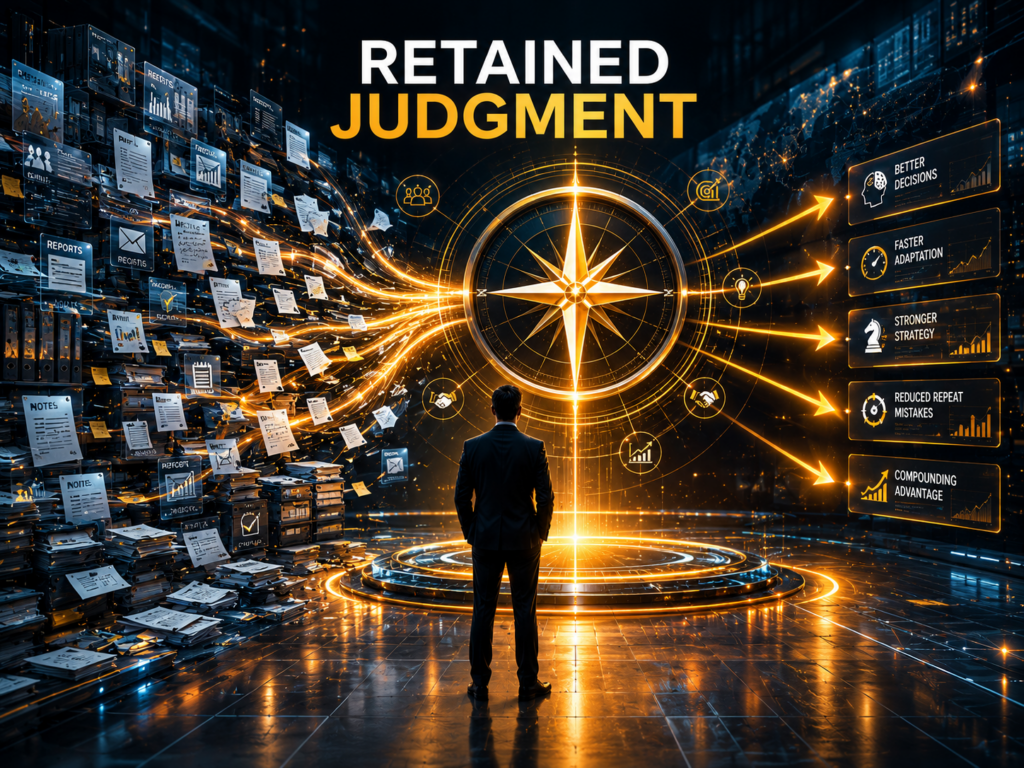
The most valuable asset inside a business is not data.
It is retained judgment.
Data explains what happened.
Judgment determines what happens next.
This is where many businesses misunderstand AI.
They believe the advantage comes from generating more information.
Information is becoming abundant.
Judgment remains scarce.
The company that preserves judgment improves decisions faster.
The company that improves decisions faster compounds faster.
This is the hidden connection between learning, memory, and growth.
Learning matters because it improves decisions.
Memory matters because it preserves learning.
Decision quality matters because it compounds.
A single decision rarely creates a competitive advantage.
Thousands of improved decisions do.
Companies that compound effectively create feedback loops around decisions rather than merely tracking results.
They ask:
What did we expect?
What happened?
What did we learn?
What changes next?
Over time, these organisations become increasingly difficult to compete against because they are not simply accumulating information.
They are accumulating judgment.
The goal is not perfection.
The goal is adaptation.
Smart companies do not avoid mistakes. They convert mistakes into assets.
Pro Tip
Treat every major decision as training data for the future organisation.
Competitors can copy products, strategies, and even technology. They struggle to copy years of accumulated decision intelligence.
The Future Belongs to Companies That Learn Faster Than Competitors
The next competitive advantage may not be scale.
It may be learning speed.
Information is abundant.
Technology is increasingly accessible.
Expertise is becoming easier to acquire.
The scarce resource is organisational adaptation.
Adaptive organisations improve decision quality faster than their environment changes.
The businesses that thrive will not necessarily have the most data.
They will have the strongest systems for converting knowledge into action.
That requires a different leadership mindset.
Less focus on collecting information.
More focus on preserving and applying learning.
The future belongs to organisations that remember.
Not because memory itself creates value.
Because memory allows intelligence to accumulate.
And accumulated intelligence becomes increasingly difficult to compete against.
Pro Tip
Measure how quickly lessons become operational changes. Learning speed is a strategic metric.
Every quarter spent relearning old lessons is a quarter competitors spend advancing.
Conclusion
Many business owners feel trapped inside a cycle that is difficult to explain.
The team works hard.
The company grows.
Yet the same challenges keep resurfacing.
The same conversations keep happening.
The same friction keeps returning.
What feels like a growth problem is often a learning problem.
More specifically, it is a retention problem.
The encouraging news is that this changes the solution.
You do not need infinitely smarter people.
You do not need endless meetings.
You do not need more information.
You need a system that converts experience into organisational intelligence.
The companies that dominate the next decade may not be the ones with the biggest teams, the largest budgets, or the newest technology.
They may simply be the organisations that stop forgetting.
That is the real promise of AI-powered organisational learning.
Not automation.
Not productivity.
Not efficiency.
Accumulation.
The ability to build on yesterday instead of recreating it.
Most businesses spend years becoming experienced.
Very few spend years becoming wiser.
The difference is not what they learn.
It is what they remember.
You can continue operating in a cycle where knowledge disappears, decisions repeat, and growth relies on individual memory.
Or you can build a business where every lesson strengthens the next decision.
One path compounds effort.
The other compounds intelligence.
Only one gets easier with time.
FAQs
AI-powered organisational learning is the process of capturing business knowledge, decisions, and outcomes so they can improve future decision-making. The goal is not more information but better organisational memory.
Why do growing companies repeat the same mistakes?
Most companies generate learning but fail to retain it. When lessons remain trapped inside individuals or isolated systems, organisations repeatedly pay the cost of relearning.
How is organisational memory different from documentation?
Documentation stores information. Organisational memory preserves context, reasoning, and decision history. One records events; the other improves future judgment.
Why is experience alone not enough?
Experience only creates value when it becomes accessible to the wider organisation. Knowledge that remains dependent on individuals creates operational fragility and scaling limitations.
What is the biggest hidden cost of organisational forgetting?
The largest cost is duplicated thinking. Teams spend time rediscovering insights, revisiting decisions, and solving previously solved problems instead of advancing the business.
How does organisational learning create competitive advantage?
Competitive advantage emerges when lessons accumulate faster than competitors can replicate them. Better retained intelligence leads to better decisions, and better decisions compound over time.
What should leaders focus on first?
Focus on identifying where valuable knowledge disappears after decisions are made. The fastest improvement often comes from reducing knowledge loss before increasing knowledge acquisition.
Beyond Learning: Three Ideas That Change How You See Growth
Most leaders assume knowledge creates advantage.
That assumption feels obvious. It is also increasingly incomplete.
Knowledge is everywhere. Expertise is more accessible than ever. Information is abundant. Yet many businesses still struggle to create durable advantages from what they know.
The deeper question is not how knowledge is acquired.
It is how knowledge survives.
The following ideas challenge some of the most common assumptions about growth, learning, and competitive advantage.
Your Company Is Not Forgetting By Accident
Many leaders treat knowledge loss as an unfortunate side effect of growth.
It is not.
It is often a predictable outcome of organisational design.
If knowledge consistently disappears, the system is functioning exactly as designed. The organisation was built to process work, not preserve learning.
Consequence: The business continues paying for the same lessons repeatedly.
Meetings Are Not Communication Events
Most teams view meetings as coordination mechanisms.
A more useful lens is to view meetings as intelligence-generation events.
The decision is not the most valuable output.
The reasoning behind the decision is.
Years later, the rationale often becomes more valuable than the outcome itself because it teaches future teams how to think.
Consequence: The organisation keeps repeating discussions that should already be settled.
The Most Valuable Asset Is Not Data
Many businesses believe their advantage sits inside customer data, operational data, or market data.
A stronger perspective:
The most valuable asset is accumulated judgment.
Data explains what happened.
Judgment determines what happens next.
Organisations that preserve judgment build a form of intelligence competitors struggle to copy because it is embedded in thousands of decisions.
Consequence: Growth remains dependent on individual expertise rather than organisational capability.
Other Articles
Scaling Without Losing Organizational Knowledge
Converting Meeting Notes Into Business Intelligence
Meeting Intelligence Architecture for Operational Continuity