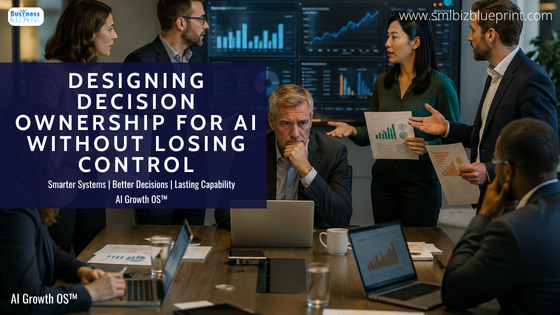

Learn how business leaders redesign decision architecture so AI accelerates execution while humans retain responsibility for judgment, risk, and direction.
AI changes business architecture by increasing decision velocity, making clear decision ownership more important than ever.
A decision ownership framework for AI defines which decisions AI can execute, where human judgment remains essential, and the thresholds that trigger escalation, allowing businesses to automate confidently without weakening accountability or strategic alignment.
Instead of focusing on tools or workflows, successful AI-enabled businesses redesign decision architecture so every automated action reinforces governance, reduces founder dependency, prevents organisational drift, and creates a more predictable, scalable operating model.
Most AI failures are not technology failures.
They are decision ownership failures.
A business introduces AI to improve speed.
Marketing begins using AI to create campaigns. Sales deploys AI to qualify leads. Operations automate approvals. Customer service installs intelligent assistants.
Every department becomes more efficient.
Six months later, leadership discovers something unexpected.
The business is moving faster, but it is no longer moving together.
The first warning rarely appears on a dashboard. It appears in conversations. Two department heads confidently explain opposite decisions, both believing they are following company policy.
Marketing optimises lead volume. Sales optimise conversions. Operations protect capacity. Customer service prioritises response times.
AI performs exactly as instructed, yet the organisation becomes less aligned because each function is optimising its own objective.
This rarely announces itself as a crisis.
It usually appears as small contradictions. Marketing promises something sales cannot deliver. Operations introduces a policy that customer service unknowingly overrides. Finance questions discounts that sales believed were acceptable.
Every team believes it is following the same strategy, yet customers experience four different businesses.
The assumption was that AI would improve execution.
The real challenge was that no one redesigned decision ownership before increasing decision velocity.
That is the structural weakness most organisations fail to recognise.
The Hidden Cost of Undefined Decision Ownership
Growing businesses rarely struggle because too few decisions are being made.
They struggle because ownership becomes increasingly ambiguous as complexity grows.
Before AI, this ambiguity was often hidden.
Employees slowed down. Managers stepped in. Founders reviewed proposals. Questions accumulated in inboxes. Decisions waited for meetings.
The delays were frustrating, but they concealed structural weaknesses.
Before AI, uncertainty usually looked like waiting. After AI, uncertainty looks like conflicting decisions arriving faster than leadership can explain them.
Instead of exposing uncertainty through waiting, it exposes uncertainty through inconsistent action.
One of the first signs is rarely a catastrophic decision.
It is that two capable people begin making different decisions while genuinely believing they are following the same business rules.
An AI system cannot interpret organisational intent unless that intent has already been designed into the business.
Without clear ownership, AI simply accelerates inconsistency.
The hidden cost is not incorrect automation.
It is strategic drift.
Founders often notice this when they start asking, “Why did we approve that?” only to discover nobody can explain who actually owned the decision.
Each isolated decision appears reasonable.
Collectively, those decisions move the organisation away from its intended direction.
Many leadership teams respond by reviewing prompts, changing models, or replacing software.
They diagnose a technology problem.
The actual problem is not the AI.
It is that the organisation never redesigned how decisions move, who owns them, or when authority changes as business conditions change.

The Architectural Principle
Ask five executives who owns customer discount approvals or strategic exceptions, and many growing businesses receive five different answers.
Some are routine.
Some require judgement.
Some create a competitive advantage.
The objective is not to automate every decision.
The objective is to design an ownership architecture that ensures every decision is made at the appropriate level of intelligence.
Execution decisions can often be delegated.
Most organisations already delegate work. Very few deliberately delegate decisions.
Operational optimisation may be shared between people and AI.
Strategic judgement remains under human ownership.
Exceptions move upward through predefined escalation paths.
Instead of asking whether AI should make a decision, leaders begin asking a more valuable question.
Who owns this decision, and under what conditions may that ownership be delegated?
That question changes the entire conversation.
Instead of debating AI capability, leadership begins designing organisational capability.
The answer rarely depends on technology.
It depends on how decisions are designed to flow through the organisation.
Decision ownership becomes an operating system rather than an organisational chart.
Signal Logic Creates Stability
Ownership only works when it is supported by operational signals.
Every delegated decision requires measurable conditions that determine whether automation proceeds independently or requests human intervention.
Experienced operators eventually stop asking whether AI made the right decision. They ask why the system believed the decision was within its authority.
The specific signals differ between organisations, but the architectural logic remains the same.
The system continuously monitors business conditions.
Every business already has invisible thresholds. The problem is they usually exist inside experienced employees rather than inside the operating system.
Revenue thresholds.
Margin variation.
Customer risk.
Compliance exposure.
Inventory constraints.
Brand impact.
Service capacity.
Confidence scores.
Historical success rates.
These signals provide information.
They do not provide authority.
Authority comes from the ownership architecture built around those signals.
Experienced operators eventually notice something interesting.
The businesses that trust AI the most are rarely the ones with the fewest controls.
They are usually the ones with the clearest ownership boundaries.
Because everyone understands where automation stops and leadership begins.
Consider an AI pricing system.
It adjusts discounts automatically within predefined commercial limits.
As long as profitability, customer fit, and commercial policy remain inside agreed thresholds, execution continues without interruption.
The moment those thresholds are exceeded, the decision moves automatically to commercial leadership.
Nothing has failed.
The system has simply recognised that the decision has crossed an ownership boundary.
This distinction is fundamental.
Thresholds are not there to control AI.
They define where decision ownership changes.
That transforms AI from an autonomous actor into a disciplined participant inside a broader business architecture.

Installing the Control Layer
Governance often begins as an attempt to reduce risk. Within months, it quietly becomes another approval queue.
That simply recreates the bottlenecks AI was introduced to remove.
Control does not require more approvals.
It requires better boundaries.
A well-designed control layer answers four questions.
Which decisions may AI execute independently?
Which measurable thresholds determine when normal execution no longer applies?
Who owns each exception?
How are outcomes captured so future decisions become more accurate?
Notice what this architecture achieves.
Execution is delegated.
Accountability is not.
AI performs work.
People remain responsible for business outcomes.
That distinction prevents one of the most common governance failures in AI-enabled organisations.
Responsibility is never transferred simply because execution has been automated.
Ownership remains visible even when work becomes invisible.
A useful test is surprisingly simple.
When AI recommends or executes a decision, can every leader immediately answer four questions:
Who owns this decision?
What signal changes ownership?
Who reviews the outcome?
What happens if the decision is wrong?
If those answers are unclear, the business has an ownership gap—not an automation gap.
Reducing Cognitive Load Instead of Increasing Oversight
One of the unintended consequences of poor AI implementation is founder overload.
One of the clearest signs of poor AI architecture is when founders spend less time approving work but more time checking whether AI made the right recommendation.
Many leaders assume greater automation requires greater supervision.
The opposite is true.
If automation creates additional monitoring responsibilities, the architecture has failed.
Founders often discover this unexpectedly.
They remove ten operational approvals, only to replace them with twenty AI notifications asking whether the system made the right recommendation.
Nothing has improved.
The approval queue has simply become a monitoring queue.
Strong decision ownership allows leaders to stop reviewing routine operational decisions.
Instead, leadership attention moves toward meaningful exceptions where experience and judgement create the greatest value.
The organisation shifts from approval management to exception management.
Signal logic determines what the business notices.
Exception management determines what leadership notices.
That distinction allows executive attention to become increasingly focused as operational complexity grows.
Architecture determines where attention flows.
Attention determines leadership effectiveness.
What This Means in Practice
Imagine a business receiving hundreds of sales enquiries each week.
Previously, every proposal above a certain value required founder approval.
The intention was to protect quality.
The outcome was delay.
By late each week, proposals accumulated faster than approvals. Sales stopped asking for commercial exceptions because experience told them the answer would arrive tomorrow.
Customers interpreted the silence as hesitation rather than internal process.
The founder became the system’s largest bottleneck.
Rather than asking AI to replace founder judgement, the business redesigned decision ownership.
Proposal generation became automated.
Pricing recommendations used historical outcomes.
Commercial risk was evaluated against predefined thresholds.
If proposals remained within agreed profitability, delivery capacity, and customer fit criteria, they progressed automatically.
If margins fell below acceptable limits, contractual risk increased, or strategic customers required exceptions, the proposal moved directly to the responsible decision owner.
Notice what changed.
The technology did not create the capability.
The ownership architecture did.
AI simply executed the decision logic that leadership had already designed.
The same logic applies beyond sales.
Marketing can publish within agreed brand and commercial boundaries. Operations can commit resources within defined capacity limits. Customer success can resolve issues within delegated authority. Finance can approve routine expenditure within defined thresholds.
Each function moves faster because everyone is operating from the same ownership model rather than creating independent rules.

From Department Optimisation to System Integrity
Many AI initiatives succeed inside individual departments yet fail to improve the business as a whole.
Marketing creates campaigns faster.
Finance produces reports sooner.
Operations automate scheduling.
Each project delivers local efficiency.
Overall performance barely changes.
This is where many AI programmes stall.
Leadership sees successful projects but cannot explain why overall organisational performance feels largely unchanged.
Departments optimise locally.
Businesses compete systemically.
Decision ownership provides the architecture that connects isolated capabilities.
Marketing understands when campaigns require commercial approval.
Sales understands when pricing exceeds delegated authority.
Operations recognise when customer commitments exceed delivery capacity.
Finance monitors meaningful exceptions rather than every transaction.
Every function follows the same decision logic.
Instead of disconnected automation, the organisation develops coordinated intelligence.
Consistency builds trust.
Trust enables speed.
Speed becomes sustainable because governance scales alongside execution.
The Stability Outcome
Growth rarely fails because organisations cannot move fast enough.
Growth fails because increasing complexity gradually erodes coordination.
Decision ownership provides the stabilising structure that complexity demands.
It reduces organisational drift because every significant decision has a clearly defined owner.
It increases predictability because escalation follows predefined rules rather than individual interpretation.
It strengthens structural integrity because every automated action remains connected to strategic accountability.
Marketing and sales become more aligned because lead qualification, pricing, customer commitments, and operational capacity all operate within the same ownership framework.
Revenue becomes more predictable because decision logic remains consistent throughout the customer journey.
This is the real implication of AI-enabled business design.
Competitive advantage does not come from automating more work.
It comes from designing an organisation where ownership remains clear as execution becomes increasingly autonomous.
Stable decision ownership does more than reduce risk.
It creates a foundation that every future AI capability can build upon without introducing new organisational ambiguity.
Over time, something else happens.
New AI capabilities become easier to introduce because the organisation no longer has to redesign governance every time a new tool appears. The ownership model already exists.
Each new capability strengthens the same system instead of creating another disconnected process.
Technology increases speed.
A well-designed decision architecture ensures that every new capability strengthens the system instead of fragmenting it.
Businesses that understand this distinction will not simply automate processes.
They will redesign how decisions move through the organisation.
That is how AI becomes a source of stability instead of complexity.
And that is how businesses build organisations that become progressively more capable as every new AI capability reinforces the last, rather than creating another disconnected automation.
FAQs
A decision ownership framework defines who owns each business decision, which decisions AI may execute, and when authority must escalate to a human. Its purpose is to preserve accountability as automation increases decision speed. Begin by mapping decisions rather than selecting AI tools.
Why isn’t workflow automation enough?
Workflow automation improves execution, but it does not define who is responsible when circumstances change. Without clear ownership, AI simply accelerates existing inconsistencies. Before automating any process, identify the decision owner behind every major business outcome.
Which decisions should remain under human control?
Strategic decisions involving business direction, significant financial risk, customer commitments, legal obligations, or brand reputation should remain under human ownership. AI performs best when operating within clearly defined boundaries. Separate execution from judgment instead of attempting to automate both.
How do decision thresholds improve AI governance?
Decision thresholds establish measurable limits that determine when automation continues independently and when human intervention is required. These thresholds transform governance from constant supervision into structured exception management. Define thresholds based on business risk, not software capability.
How does decision ownership reduce founder dependency?
Many founders become approval bottlenecks because ownership has never been distributed systematically. A decision ownership framework delegates routine execution while reserving leadership attention for high-impact exceptions. The result is less operational interruption and more strategic capacity.
What role do signals play in an AI-enabled business?
Signals provide the information that determines whether a decision remains within delegated authority or requires escalation. Examples include margin variation, customer risk, capacity constraints, confidence levels, or compliance exposure. Focus on identifying the signals that predict business risk before designing automation around them.
How does decision ownership improve growth stability?
Consistent ownership creates consistent decisions across marketing, sales, operations, and customer service. That consistency reduces organisational drift, improves predictability, and ensures automation strengthens the business instead of creating disconnected optimisation. Growth becomes more stable because every automated action remains connected to business objectives.
Other Articles
Meeting Intelligence Architecture for Operational Continuity