
Why automation fails without rules—and how AI enforces scalable decisions
Automation doesn’t create leverage in mid-sized companies—clear decision rules do.
AI decision systems scale consistent decision logic across your business, turning variable outcomes into predictable ones.
Without structured decision architecture, automation amplifies inconsistency, slows growth, and erodes control.
Most mid-sized companies believe they have an execution problem. The symptoms suggest it: inconsistent results, stalled deals, fluctuating performance, and teams that appear busy but not aligned.
The default response is predictable—add more automation, introduce new tools, tighten workflows.
That response fails because it operates at the surface.
The real issue is not execution. It is decision architecture.
At this stage of growth, businesses are no longer constrained by effort.
They are constrained by how decisions are made. Decisions exist, but not consistently. Criteria are applied, but not explicitly. Teams act, but not from the same logic.
Outcomes vary depending on who makes the call.
That variability is not random. It is structural.
The hidden tension is the gap between activity and predictability. Work is happening. Systems are running. But results cannot be forecast with confidence because the underlying decision logic is fragmented.
One team qualifies leads one way. Another interprets value differently. A third escalates based on instinct rather than thresholds.
Everything depends on interpretation.
Most teams misdiagnose this as a communication problem. Or a capacity issue. They respond by increasing alignment—more meetings, more reporting, more oversight.
But alignment doesn’t remove interpretation. It multiplies it.
The system remains unstable.
The failure point is simple: decisions are being made repeatedly instead of being designed once and enforced.
That distinction determines whether a business scales—or stalls.
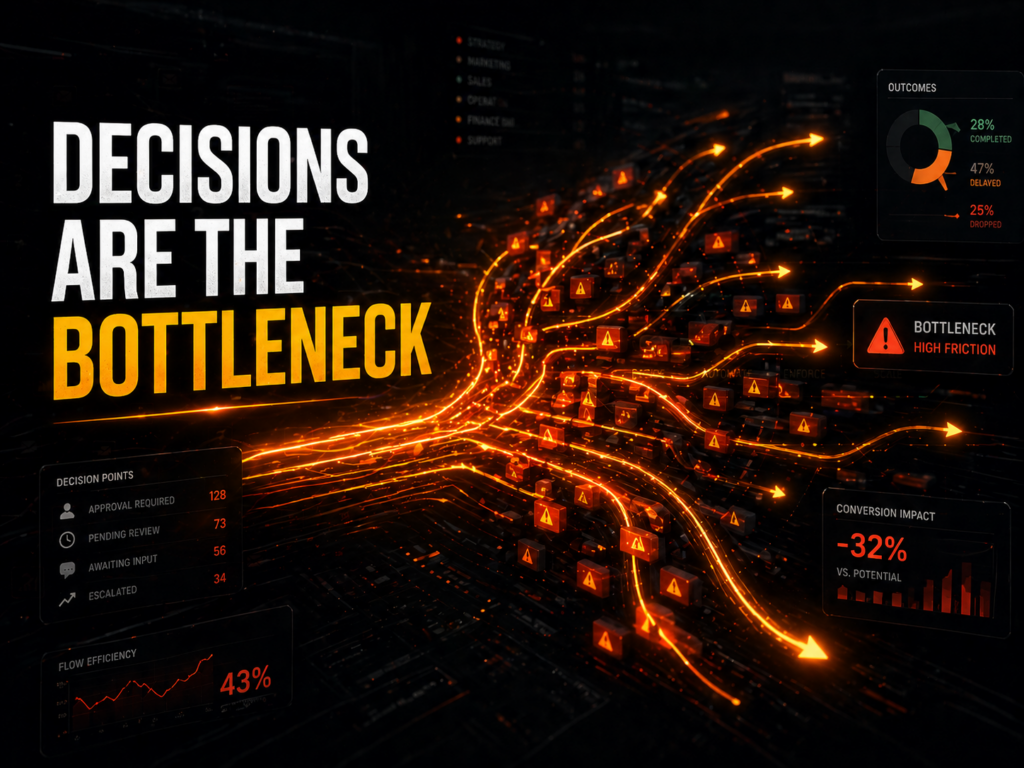
When decisions remain informal, they become bottlenecks. Not because people lack capability, but because they must resolve ambiguity in real time.
This slows execution, increases cognitive load, and introduces inconsistency into every core function.
The financial impact compounds quietly.
Revenue becomes less predictable. Conversion rates fluctuate without clear cause. Customer experience varies. Teams revisit the same decisions repeatedly, reducing operational efficiency.
These are not isolated inefficiencies. They are systemic leaks.
Leverage is not created by accelerating execution. It is created by removing repeated decision-making.
Once a decision is defined as a rule—clear conditions, clear outcomes—it no longer requires interpretation. It becomes part of the system.
This is where AI becomes structurally relevant.
Not as a thinking tool. As an enforcement layer.
AI applies defined rules consistently across all inputs. It does not reinterpret or drift. It executes logic at scale.
Sales applies the same qualification logic every time. Marketing operates against defined criteria. Operations escalates based on thresholds, not judgment.
The business stops behaving like a collection of individuals. It starts behaving like a system.
Ignore this shift, and complexity compounds.
As the business grows, decision volume increases. Without structure, the burden on individuals rises. More coordination is required. More oversight is needed.
Growth slows—not because of market limits, but because the business cannot decide fast enough.
The resolution is not incremental. It is structural.
From repeated decisions to defined rules.
From interpretation to enforcement.
From automation stacks to decision systems.
He had built 14 automations in his CRM. Every trigger worked. Every sequence fired.
But conversion stayed flat. Late one night, staring at dashboards, he realised the problem—each automation was executing a different version of “qualified.” The system wasn’t broken. It was inconsistent.
He stopped building workflows and started defining rules. That’s when results stabilised—and he stopped second-guessing every report.
Automation Scales Tasks, Not Decisions
Automation multiplies execution—not judgment.
And if that sounds obvious, it’s not—because most businesses are doing the opposite.
Workflows trigger. Emails send. Leads route. Tasks move.
But none of that defines what should happen. It only accelerates whatever logic already exists.
Automation doesn’t create leverage—it locks in whatever decision quality already exists.
If that logic is unclear, automation doesn’t fix it. It spreads it.
System definition: Automation is a force multiplier on existing decision quality—not a creator of it.
Consequence: If decisions are inconsistent, automation scales inconsistency faster than outcomes.
That’s why workflows look clean while results feel unstable.
One lead converts. Another disappears. Same system. Different interpretation upstream.
In a $5M–$20M business, this shows up everywhere. Sales teams qualify differently. Marketing adjusts messaging mid-cycle. Operations escalates inconsistently.
You don’t have an execution problem. You have multiple versions of “what good looks like.”
Most businesses assume automation creates leverage. It doesn’t. It assumes clarity.
When clarity is missing, automation creates noise—just faster.
Diagnostic trigger: If two similar leads are handled differently—or your team debates what should happen—you don’t have a process problem. You have an undefined decision.
The longer this continues, the more performance depends on individuals instead of infrastructure.
That doesn’t scale. It fragments.
Every automated action built on unclear logic compounds inconsistency across your system.
Pro Tip
Write your top 3 automation rules in plain language.
If two people would apply them differently, you haven’t defined them—you’ve described them.

Why Growing Companies Hit Decision Bottlenecks
Growth exposes what was never defined.
At smaller scale, decisions happen informally. Founders step in. Teams ask. Context fills the gaps.
Then volume increases—and everything slows.
Deals stall. Teams hesitate. Approvals stack up.
The instinct is to blame workload.
That’s not the constraint.
System definition: A decision bottleneck occurs when criteria for action are undefined, forcing escalation.
Consequence: Work slows not because people are inefficient—but because they are unsure.
This is why deals feel close but stall.
Your team isn’t lacking capability. They’re lacking clarity.
They don’t know exactly where the boundary is. What qualifies? When do we push? When do we walk away?
So they pause.
Or they guess.
And guessing creates variability.
At this stage, hesitation is more expensive than mistakes—but your system is designed to create hesitation.
Most businesses try to fix this with communication. More meetings. More documentation.
But communication doesn’t scale clarity. It distributes interpretation.
Diagnostic trigger: If your team asks the same “should we?” question more than once a week, that decision is not systemised—it’s being rebuilt every time.
The longer this continues, the more your business slows under its own complexity.
You’re not running out of capacity—you’re running into undefined decisions.
Every unclear decision increases hesitation, delays outcomes, and quietly trains your team to avoid ownership.
Pro Tip
Track every “should we?” question for one week.
Each repeated question is a missing rule—not a communication problem.
Decision Rules: The Real Source of Business Leverage
Leverage comes from deciding once—not repeatedly.
Every workflow exists to resolve a decision. If that decision is unclear, the workflow is just movement without direction.
System definition: A decision rule defines clear conditions and outcomes, removing the need for interpretation.
Consequence: Without rules, every action requires rethinking—slowing execution and introducing variability.
Decision rules compress complexity.
They turn ambiguity into binary outcomes: proceed or don’t, escalate or resolve.
That’s leverage.
The goal is not to make better decisions repeatedly—it’s to remove the need to make them at all in repeat scenarios.
If a decision happens more than once, it should not exist as a decision anymore.
It should exist as a rule.
In practice, this means your sales team applies criteria—not judgment. Marketing executes defined hypotheses—not shifting ideas. Operations escalates based on thresholds—not instinct.
This is why your pipeline looks strong but doesn’t convert consistently.
Because without rules, every stage is subjective.
Most businesses resist rules because they feel rigid.
But rules don’t reduce flexibility. They remove friction.
They eliminate repeated thinking.
Diagnostic trigger: If outcomes vary under similar conditions, your business is not learning—it is reinterpreting.
The longer this is delayed, the more growth depends on individual judgment.
That doesn’t compound.
Every repeated decision drains time and introduces variability that compounds across your system.
Pro Tip
Start with high-frequency decisions, not complex ones.
Leverage comes from removing repetition—not solving edge cases.
She ran a $12M services business where every deal felt close—but half stalled.
Her team followed “best judgment,” which meant different criteria on every call. Once they defined three non-negotiable qualification rules, everything changed. Fewer deals entered the pipeline—but more closed.
She stopped chasing volume and started trusting the system.
How AI Enforces Decision Consistency at Scale
Most businesses expect AI to improve their decisions.
What it actually does is expose how inconsistent those decisions already are.
AI is not the intelligence. It is the enforcement layer.
System definition: AI enforces decision rules consistently across all inputs without deviation.
Consequence: Without enforcement, even strong rules degrade through human variation.
Humans interpret. They adjust. They improvise.
That’s useful in edge cases—but destructive in repeat scenarios.
AI applies logic exactly as defined. Every time.
No drift. No fatigue.
Clarification: AI does not improve your decisions—it removes the variability in how they are applied.
Most businesses apply AI to broken systems and expect improvement.
But AI amplifies whatever logic it’s given.
If rules are unclear, it scales confusion. If rules are precise, it scales clarity.
That’s the leverage point.
Without enforcement, decision quality degrades over time—even if your rules start strong.
Pro Tip
Don’t apply AI to improve decisions.
Apply it to decisions that should never vary.
Designing Decision Rules Across Core Functions
Rules don’t fail in isolation. They fail in misalignment.
Most businesses define decisions within functions. Sales has one logic. Marketing another. Operations a third.
That creates hidden friction.
System definition: Decision architecture aligns rules across functions to create a unified system of action.
Consequence: Without alignment, functions optimise locally but reduce overall system performance.
Marketing generates leads sales doesn’t trust. Sales closes deals operations struggles to deliver. Operations escalates issues leadership didn’t anticipate.
Not because people are wrong. Because rules don’t connect.
When each function defines its own version of success, the business doesn’t scale—it fragments.
Designing decision rules means defining thresholds across the entire system.
What qualifies a lead?
When does a deal progress?
When does an issue escalate?
These are structural decisions.
Most businesses patch symptoms instead of aligning logic.
At this point, growth doesn’t break your operations.
Misaligned decisions do.
You’re not managing departments—you’re designing a system that decides.
Misaligned rules silently reduce conversion, delivery quality, and trust across teams.
Identifying and Fixing Decision Gaps in Your Business
Decision gaps don’t look like errors.
They look like inconsistency.
One deal closes quickly. Another drags. Same conditions—different outcomes.
System definition: A decision gap is where action depends on interpretation rather than defined criteria.
Consequence: Outcomes become unpredictable, making performance impossible to scale reliably.
Most businesses look at metrics. But metrics show results—not causes.
Decision gaps sit upstream.
You find them where teams hesitate, escalate, or produce inconsistent outcomes.
This is why your sales team keeps re-explaining the same thing on calls.
Because the logic isn’t standardised.
Diagnostic trigger: If two similar scenarios produce different outcomes—and no one can explain why—you are not measuring performance. You are observing inconsistency.
Fixing this requires defining the rule—not improving execution.
Not every decision should be optimised. Some should be constrained.
Because optimisation introduces variation. Constraint creates stability.
Every unresolved decision gap removes your ability to forecast performance with confidence.
Pro Tip
Look for inconsistent outcomes before you look at performance metrics.
Variation is the signal—metrics are just the result.
From Automation Stack to Decision System Architecture
Most businesses think they have systems.
They don’t. They have stacks.
A stack is a collection of tools. A system is a structure of decisions.
System definition: Decision system architecture integrates rules, workflows, and enforcement into a unified model.
Consequence: Without it, tools operate independently—creating fragmentation instead of leverage.
Stacks require management. Systems create flow.
Instead of layering tools, decision systems define how outcomes are produced.
What triggers what. Under which conditions. With what results.
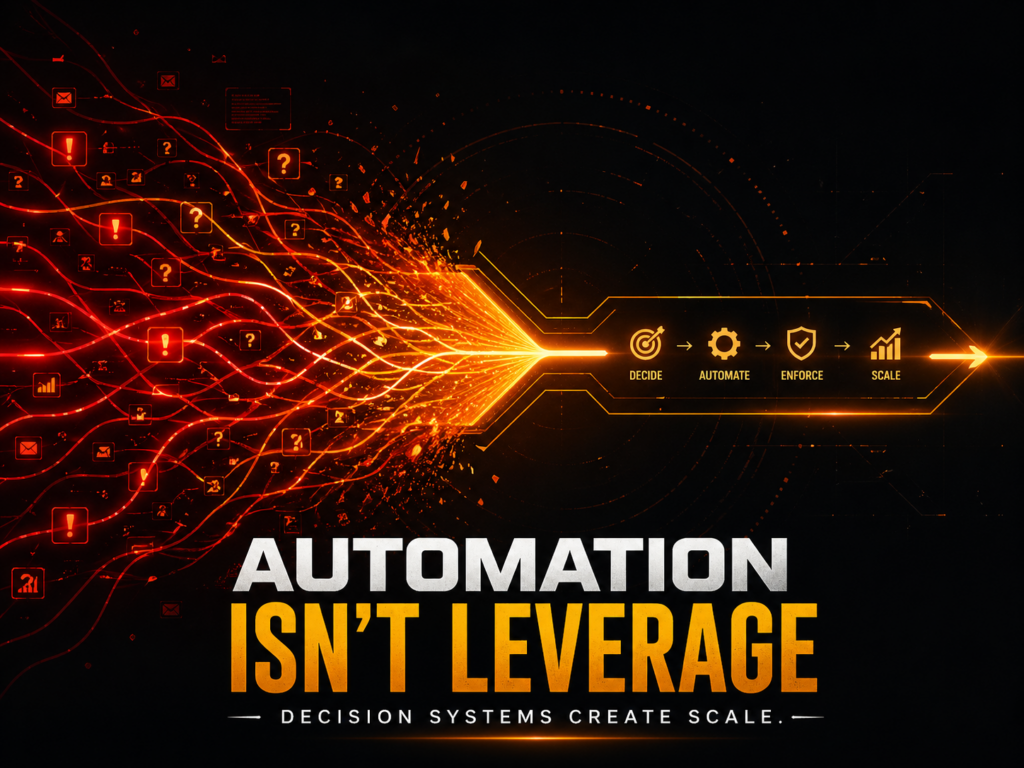
Then automation executes. AI enforces.
Most businesses reverse this—and complexity grows.
You didn’t build a system. You accumulated tools.
Each new tool adds another layer of interpretation unless decisions are already defined.
A real system feels different.
Fewer decisions. Faster movement. Predictable outcomes.
The longer you operate with a stack mindset, the more growth depends on coordination instead of structure.
That doesn’t scale.
Without decision architecture, every new tool increases complexity faster than capability.
Pro Tip
Before adding any new tool, define the decision it’s supposed to enforce.
If the decision isn’t clear, the tool will add complexity—not capability.
Most businesses don’t scale because they never decide what a decision is.
They automate activity, track performance, and hire capability—but leave the core logic undefined. The shift isn’t technological. It’s structural.
The moment decisions become rules, growth stops feeling unpredictable—and starts feeling designed.
Conclusion
You don’t have an automation problem.
You have a decision problem.
Your business is moving—but not consistently. Acting—but not predictably.
That’s the cost of undefined decisions.
Relief comes when decisions stop being made in real time—and start being defined in advance.
When rules replace interpretation.
When AI enforces consistency.
When the system decides—not individuals.
You don’t scale by doing more—you scale by deciding once and enforcing it everywhere.
At this stage, growth doesn’t stall because of market limits.
It stalls because your business cannot decide fast enough.
Right now, your business is working harder than it needs to. Not because of effort—but because it hasn’t decided what matters.
The choice is simple:
Continue managing inconsistency.
Or build the system that removes it
Action Steps
Identify repeated decision points
List 5–10 decisions your team made more than twice last week. If you can’t define them clearly, they are not systemised. The consequence is ongoing inconsistency and wasted cognitive effort.
Convert decisions into rules
Define conditions and outcomes precisely. If two people would interpret it differently, it’s not a rule. The consequence is continued variation in execution.
Align rules across functions
Map one end-to-end journey and ensure all teams apply the same logic. The consequence is reduced friction and improved conversion flow.
Separate decision design from execution
Define rules before embedding them into systems. Otherwise, you automate flawed logic. The consequence is fragile systems that break under scale.
Use AI to enforce decisions
Apply AI only after rules are stable. AI enforces consistency, not creativity. The consequence is predictable outcomes.
Audit inconsistencies weekly
Every escalation is a missing rule. Capture it, define it, remove it. The consequence is continuous system improvement.
FAQs
What is an AI decision system?
A system where defined decision rules are enforced consistently using AI, removing variability from execution.
Why doesn’t automation improve results?
Because it scales tasks, not decision quality. If logic is unclear, inconsistency increases.
How do decision rules create leverage?
They eliminate repeated thinking and standardise action, enabling faster, consistent execution.
Where should businesses start?
Start with high-frequency decisions that create friction—these deliver immediate leverage when defined.
What role does AI play?
AI enforces decision rules at scale, ensuring consistent execution across the business.
What happens without decision systems?
The business depends on individual judgment, leading to inconsistency and slower growth.
Bonus Section — The Shifts Most Businesses Avoid
Most businesses don’t have too many decisions.
They have too few defined ones.
You Are Not Overworked — You Are Over-Deciding
Every time your team re-decides something, your system proves it hasn’t learned.
Repeated decisions are not work. They are structural failure.
Your team isn’t overloaded. It’s fragmented.
What continues if you don’t change this: activity increases, but momentum never builds.
Consistency Creates More Growth Than Optimisation
You cannot optimise what you cannot repeat.
And you cannot repeat what you haven’t defined.
Without consistency, you’re refining noise.
What continues if you don’t change this: effort increases, but results remain unstable.
Constraint Is Acceleration
Constraint does not reduce capability—it removes hesitation.
When decisions are defined, execution speeds up.
The more constrained your core decisions are, the faster your system moves.
What continues if you don’t change this: your business stays reactive instead of controlled.
Other Articles
Decision Intelligence in Business: From Data to Action