
The best operators know automation can scale strategic weakness as fast as efficiency.
Most businesses automate too early and accidentally scale weak decisions, unclear processes, and operational blind spots.
The smartest companies do not automate everything — they protect human judgment in areas involving trust, ambiguity, positioning, and strategic change.
AI works best as an execution layer that increases awareness and decision quality, not as a replacement for leadership thinking.
Most businesses are not overwhelmed because they lack tools. They are overwhelmed because every new tool quietly expands the number of decisions the business is making without them.
That is the real tension underneath automation.
You install AI to speed up lead handling. Marketing launches campaigns faster. Support tickets close faster. The CRM fills with activity. Yet somehow the business feels heavier.
Managers trust dashboards more than conversations. Teams follow workflows nobody remembers designing. Prospects receive follow-ups on time and still disappear quietly.
Because automation did not remove complexity. It operationalised it.
Most companies treat automation as a labour problem: remove repetitive work, save time, reduce pressure. But automation is not primarily a productivity layer.
It is an enforcement layer. It locks business logic into systems and repeats it at scale — whether the underlying thinking is strong or weak.
And most companies automate before they achieve strategic clarity.
That is why businesses with healthy revenue can still feel operationally fragile. Customer journeys become technically optimised but emotionally flat. Teams stop questioning systems because the workflow already “decides.”
This is why your sales team keeps re-explaining the same thing on calls. The business is scaling activity without scaling understanding.
The companies winning with AI are not automating the most. They are automating selectively. They understand some decisions compound value when systemised — and others become dangerous the moment human judgment disappears.
That distinction matters now because AI accelerates operational speed faster than leadership maturity in most companies.
The wrong process executed perfectly is still a liability.
And increasingly, AI executes perfectly.
The Real Purpose of Automation Is Enforcement, Not Efficiency
Automation is usually framed as an efficiency tool. That framing misses the real shift happening underneath.
Automation is a commitment device.
Once a workflow becomes automated, the business stops reconsidering it. Assumptions harden into infrastructure. Teams follow the process because “that’s how the system works now.”
That changes the role automation plays inside a company.
If your onboarding process creates confusion, automation spreads confusion faster. If your qualification logic filters out strong-fit buyers, AI rejects them consistently at scale.
Businesses think they are optimising operations when they are actually institutionalising blind spots.
The hidden danger is cognitive decay. Teams stop interrogating workflows once systems appear stable. Leadership starts managing dashboards instead of operational reality.
Then market conditions shift while the automation keeps enforcing yesterday’s assumptions.
That is not operational maturity.
It is drift.
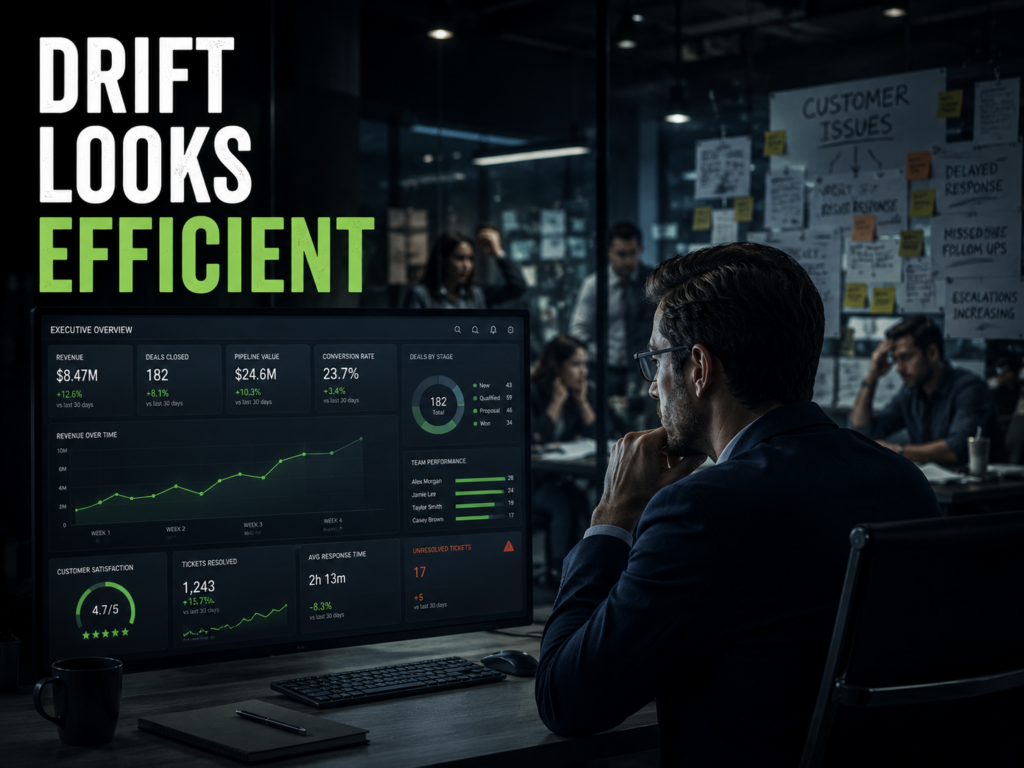
The dangerous part is that drift looks efficient for a long time.
And operational drift compounds quietly. It shows up as rising acquisition costs, slower approvals, declining referral quality, and teams escalating exceptions nobody fully understands anymore.
The systems still look “efficient” because the metrics were designed around throughput, not judgment quality.
One overlooked truth: automation redistributes authority. Quietly. Whoever designs the workflow effectively becomes the long-term decision-maker long after the original thinking stops being questioned.
Nobody questions the workflow because nobody remembers who built it.
That should concern leadership teams more than efficiency gains excite them.
The smartest companies treat automation as policy architecture, not software implementation. Every automated workflow is a belief about how the business should behave under pressure.
The operations manager thought the new automation stack had fixed the sales process. Follow-ups went out faster, reporting cleaned itself up, and the team stopped missing reminders.
Three months later, close rates dropped anyway. Reviewing sales calls late one evening, he realised the system had removed the pauses where reps used to detect hesitation and uncertainty.
The business became more efficient at moving prospects forward before trust actually existed.
He stopped worshipping workflow speed and started protecting decision quality instead.
The longer this goes unquestioned, the more companies confuse system stability with business health.
Pro Tip
Before automating a workflow, ask: Would I still trust this logic if market conditions changed tomorrow?
Durable businesses optimise for adaptability first, efficiency second.
Why Over-Automation Creates Strategic Blind Spots
Over-automation rarely feels dangerous while it is happening. It feels responsible.
Dashboards improve. Response times shrink. Leaders regain time. But underneath those gains, the business loses direct contact with reality.
Human friction is often treated as operational waste. Sometimes it is intelligence.
The hesitation in a sales call. The unusual customer complaint. The instinct that a prospect sounds uncertain despite fitting the ICP perfectly.
These moments look inefficient from a systems perspective. They are not. They are signals.
Automation removes signals because signals slow systems down.
This is where conventional automation thinking breaks down. Most advice assumes processes are already strategically sound before they are automated.
In reality, many mid-sized businesses are running inherited logic from earlier growth stages — outdated positioning, legacy sales assumptions, weak qualification criteria.
Automation freezes those assumptions into infrastructure.
This is why deals feel close but stall. Your CRM may show healthy pipeline activity while AI-generated follow-ups miss emotional hesitation entirely. Support workflows hit response targets while customer trust quietly erodes.
The issue is not that AI lacks intelligence. The issue is that businesses mistake measurable behaviour for complete reality.
Executives slowly start managing what the dashboard can see.
Customer hesitation disappears because hesitation is difficult to measure. Relationship damage appears three quarters later inside retention numbers nobody immediately connects back to the workflow.
Teams become good at feeding systems instead of reading situations.
Many companies automate because leadership clarity stopped evolving. Instead of refining positioning, they automate lead generation harder. Instead of fixing management quality, they automate accountability tracking.
Systems become substitutes for difficult operational conversations.
Some friction should remain visible because visibility is how businesses stay adaptive.
Pro Tip
Audit every automation by asking: What signal are we losing by removing human involvement here?
Sometimes the friction is the diagnostic system.

The Business Decisions That Should Stay Human-Led
Some decisions become more valuable precisely because they resist standardisation.
Hiring is one example. AI can rank applicants and predict behavioural fit. Useful. But great hiring often involves recognising capability before data validates it.
Some of the best operators look inefficient on paper because their value emerges through judgment, adaptability, or tension tolerance.
The same applies to pricing. Businesses automate pricing decisions based on historical conversion patterns, then slowly erode their strategic positioning.
The system optimises for what converted before, not what strengthens leverage now.
Customer conflict is another area companies automate too aggressively.
Automated resolution systems reduce ticket load but remove the moments where trust is actually built. People rarely remember seamless transactions. They remember being understood during friction.
And most automated systems are designed to remove friction quickly, not interpret it carefully.
That sounds efficient until your highest-value customers stop escalating problems altogether because they no longer believe anyone inside the business is actually paying attention.
This is why your pipeline looks strong but does not convert consistently. Many companies automated communication sequencing before deeply understanding buyer psychology.
Prospects receive technically correct messaging without emotional relevance.
The CRM says the lead was nurtured. The buyer still felt rushed.
The businesses scaling well with AI treat human judgment like capital allocation. They deploy it selectively where interpretation creates disproportionate value: leadership, negotiation, positioning, customer trust, escalation, and ambiguity.
Mature operators stop asking, Can AI do this? They ask, What happens to organisational intelligence if humans stop thinking here?
Operational efficiency will become common. Judgment quality will not.
Pro Tip
Keep humans closest to decisions involving ambiguity, trust, and strategic positioning.
Once judgment leaves those areas, commoditisation usually follows.
How AI Systems Reinforce Bad Logic at Scale
AI does not create most operational problems. It exposes them.
Businesses often assume AI will compensate for weak processes. In reality, AI magnifies process integrity. If the underlying logic is flawed, the system becomes a force multiplier for confusion.
Take lead qualification. Many companies train AI using historical “successful” customers. Sounds intelligent. Except historical data reflects old positioning, previous market conditions, and outdated leadership assumptions. The AI inherits those biases automatically.
Over time, the company becomes increasingly efficient at attracting yesterday’s ideal customer.
The same thing happens in customer service. If the company fundamentally treats support as a cost centre, AI will optimise for ticket deflection and containment.
Metrics improve while customers feel managed instead of understood.
AI did not create the bad experience. It industrialised the philosophy behind it.
That is the overlooked danger.
The workflow quietly teaches the company what matters.
If speed is rewarded, teams optimise for speed. If ticket closure matters more than trust recovery, employees eventually feel the difference — even if leadership never says it out loud.
This is where many businesses misread the shift entirely. They think AI adoption creates competitive advantage on its own. It does not.
AI lowers the cost of execution across the market, which means weak positioning, shallow trust, and unclear strategy become visible faster because operational polish no longer hides them.
This is why your pipeline looks healthy while conversions weaken. The process keeps moving even when confidence disappears.
One uncommon but important truth: AI systems also reinforce internal politics. Metrics-driven automation quietly favours measurable departments over functions creating long-term intangible value like trust, positioning, or customer loyalty.
Then short-term optimisation starts steering the business.
A founder running a $12M services company automated nearly every customer touchpoint within a year — onboarding, check-ins, support routing, renewals.
Operationally, everything looked cleaner. But referrals slowed. Customers complied with the process without feeling connected to the company.
The shift happened when leadership rebuilt human checkpoints into high-trust moments instead of automating them away entirely. The systems stayed fast, but the business started feeling human again.
She stopped scaling interactions and started scaling confidence.
Pro Tip
Before deploying AI, identify the belief system hidden inside the workflow.
AI does not just automate tasks — it automates priorities.
A Better Model: Automate Execution, Not Judgment
The future is not human businesses competing against AI businesses.
It is businesses with strong judgment outperforming businesses with stronger automation.
Execution should absolutely be automated aggressively: reporting, scheduling, workflow coordination, repetitive communication, administrative processing.
These activities consume cognitive energy without creating strategic advantage.
But judgment should become more concentrated, not less.
The mistake many companies make is automating the interpretation layer alongside execution. They let systems determine lead quality, customer urgency, escalation priority, even strategic forecasting.
Eventually leadership becomes dependent on machine-mediated understanding of reality.
That dependency becomes dangerous under changing conditions.
Judgment is not pattern recognition alone. Judgment involves context sensitivity, contradiction handling, emotional interpretation, and restraint under uncertainty.
AI can process information faster than humans. It still struggles to determine which variables matter most when environments shift unpredictably.
The better model is asymmetric.
Use AI to compress operational friction so humans can spend more time interpreting high-leverage decisions. Let systems surface anomalies instead of suppressing them.
Preserve deliberate human checkpoints inside critical workflows — not as bureaucracy, but as intelligence collection points.
A simple operational rule helps here:
automate repetition
escalate ambiguity
preserve interpretation
audit assumptions quarterly
Most companies reverse the order.
They automate first.
Then try to recover judgment later once the systems become difficult to challenge politically.
The strongest companies are not building fully autonomous systems. They are building systems that increase leadership awareness density.
Mature operators stop measuring automation volume. They start measuring decision quality under pressure.
Pro Tip
Automate everything that reduces cognitive waste.
Protect everything that strengthens strategic awareness. Efficiency compounds. Judgment compounds faster.
How High-Performing Companies Design Human-in-the-Loop Operations
Most companies misunderstand “human-in-the-loop.”
They treat humans like emergency overrides after automation fails. High-performing businesses design human involvement as part of the intelligence architecture itself.
Humans are not there to babysit the machine. They are there to continuously refine the company’s understanding of reality.
Weak systems eliminate variation entirely. Strong systems surface variation faster so humans can interpret it.
Consider sales operations. Average companies automate follow-ups until conversations become predictable.
Sophisticated companies use AI to detect hesitation patterns and stalled momentum earlier, then route those moments to experienced humans capable of nuanced interpretation.
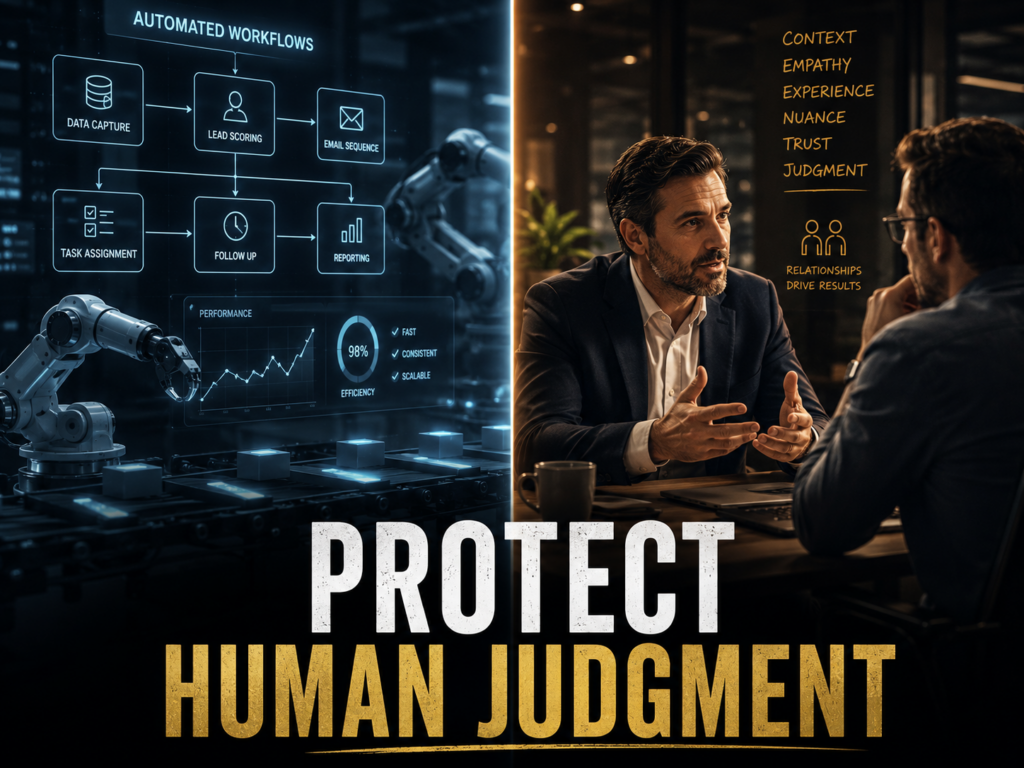
The machine handles consistency. Humans handle ambiguity.
The same principle applies internally. Strong companies build review loops where humans regularly challenge system assumptions. Metrics are treated as signals, not truth.
Teams are rewarded for identifying automation failures early instead of protecting system stability politically.
Managers start defending systems instead of investigating outcomes.
This is where many automation cultures quietly fail. They optimise for smoothness over awareness.
And smooth systems hide decay well.
Especially when revenue is still growing.
That is why many companies do not recognise the problem until referrals soften, sales cycles stretch, and managers start escalating edge cases nobody knows how to handle anymore.
Walk through most companies today and you will find teams managing software behaviour instead of customer reality.
People optimise dashboards while frontline confusion quietly compounds underneath. The dangerous part is that the systems often look successful while strategic awareness deteriorates in the background.
The companies that survive the AI shift will not be the ones with the most automation. They will be the ones that still know how to think when the automation stops making sense.
The companies gaining leverage from AI are not removing humans from operations. They are repositioning humans closer to high-value thinking.
Pro Tip
Design workflows where AI accelerates human insight instead of replacing human involvement.
The future advantage is not automation alone. It is amplified judgment.
Conclusion
Most businesses think the automation question is about capability.
What can AI do? What tasks can we remove? How fast can operations become more efficient?
Those are surface-level questions.
The deeper question is this: what kind of company are you building when decision-making becomes infrastructural?
Because every automated workflow eventually shapes culture. It influences how teams think, how customers experience the business, and how leadership interprets reality.
Over time, companies stop noticing the difference between operational convenience and strategic wisdom.
That is where the danger begins.
The problem is not AI. The problem is automating before clarity exists.
Automating before positioning matures. Automating before leadership understands which forms of friction are actually carrying intelligence.
The result is businesses that move faster while understanding themselves less.
But there is another path.
The strongest companies are not resisting automation.
They are refusing unconscious automation.
There is a difference.
One path scales operational activity.
The other scales judgment.
Only one of those compounds well when markets become unstable.
Right now, most businesses are drifting toward systems that decide more than leadership realises. The longer that continues, the harder strategic control becomes to reclaim later.
Your current operational state is not fixed. It is a design choice.
You can keep building a business that automates confusion faster every quarter.
Or you can build one that becomes sharper, clearer, and more adaptive every time AI enters the system.
That choice is still available today.
Action Steps
Audit Every Automation for Embedded Assumptions
Identify what belief each workflow is enforcing: speed, cost reduction, lead volume, or customer trust. If leadership does not consciously define those priorities, the software will operationalise accidental strategy instead.
Separate Execution Work From Judgment Work
Automate repetitive execution aggressively, but preserve human oversight anywhere context changes quickly — pricing, hiring, escalation, negotiation, or strategic positioning. Businesses become fragile when systems inherit decisions that still require adaptive thinking.
Reintroduce Human Visibility Into Critical Workflows
Install review checkpoints where leaders manually inspect anomalies and emotionally significant interactions. If every workflow becomes invisible behind dashboards, leadership slowly loses contact with operational reality.
Measure Signal Loss, Not Just Efficiency Gains
Do not evaluate automation solely through time saved or response speed. Track what operational awareness disappears after implementation: customer nuance, objection patterns, or team judgment quality.
Treat AI Systems as Governance Infrastructure
Every automated workflow becomes a recurring policy decision executed at scale. Weak governance multiplied through automation creates institutional confusion faster than manual operations ever could.
Design Human-in-the-Loop Operations Intentionally
Use humans as interpretation points inside systems, not emergency overrides after failure. High-performing companies position people closest to ambiguity and strategic exceptions because that is where leverage still compounds.
FAQs
What should never be automated in business?
Decisions involving trust, ambiguity, strategic positioning, pricing, hiring judgment, and customer conflict should remain human-led. Automate execution first, not interpretation.
Why can automation hurt business performance?
Automation amplifies existing business logic. If the underlying process is weak or unclear, AI scales those weaknesses faster and more consistently.
How do you know if your business is over-automated?
Warning signs include emotionally flat customer experiences, teams blindly following workflows, and leadership relying entirely on dashboards for decision-making.
Should AI replace human decision-making?
No. AI should support decision-making by accelerating execution and surfacing patterns. High-value decisions still require human context, adaptability, and judgment.
What is the biggest mistake companies make with AI automation?
Most businesses automate before refining strategy, positioning, or operational clarity. This hard-codes immature thinking into infrastructure.
What does “human-in-the-loop” actually mean?
It means preserving human judgment inside critical workflows instead of removing it completely. The goal is maintaining strategic awareness where ambiguity still matters.
Other Articles
Build AI Systems That Eliminate Decision Fatigue