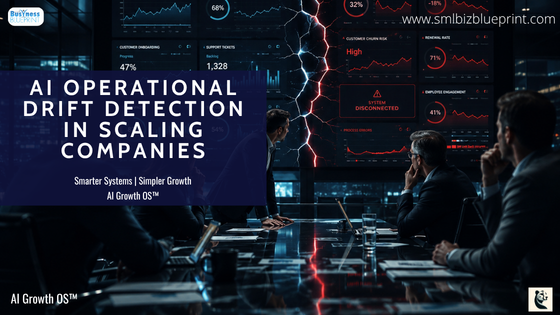

How growth-stage businesses use AI enforcement systems to preserve execution quality, protect deal integrity, and prevent operational misalignment before it compounds
AI operational drift detection helps scaling companies identify when sales, marketing, and operational execution begin separating from strategic intent.
Instead of using AI only for productivity, high-growth businesses are installing AI enforcement layers that monitor behavioural signals, detect workflow deviation, and preserve deal integrity before operational instability compounds.
This creates stronger alignment across revenue systems, improves predictability, and reduces the hidden cost of unmanaged growth complexity.
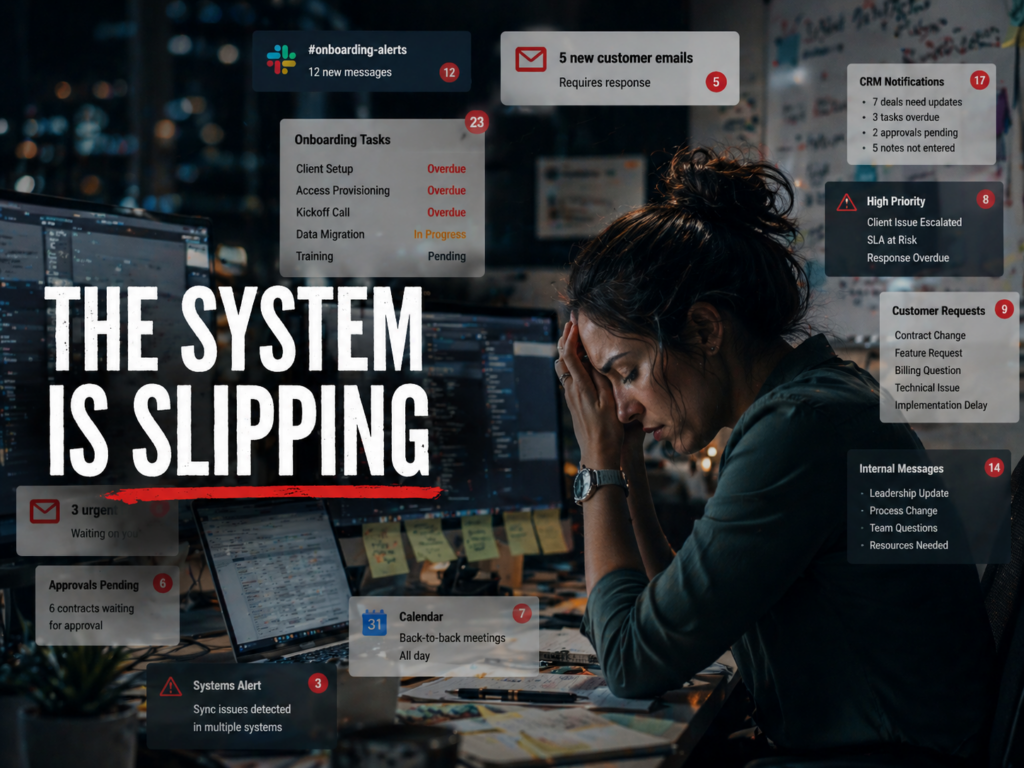
Operational breakdown rarely looks dramatic in the beginning.
Sales still close.
Marketing still generates leads.
Revenue still grows.
But underneath the surface, the business starts behaving differently than leadership intended.
Sales teams begin optimising for close rate instead of customer fit. Marketing increases lead volume, but downstream retention weakens. Operations compensate for inconsistent promises through manual intervention.
Eventually, leadership meetings stop focusing on growth strategy and start becoming debates about whose numbers can still be trusted.
From the outside, the company still appears successful.
Inside the system, drift has already started.
This is one of the defining structural problems in companies between $5M and $20M in revenue. Not because leadership lacks intelligence or effort, but because the business has crossed the threshold where human coordination alone can no longer preserve operational alignment.
Most companies misdiagnose the problem completely.
They assume they need tighter accountability, better communication, or more oversight. So leadership adds another approval layer, another dashboard, another reporting process. Everyone becomes busier. Nobody becomes more aligned.
Because operational drift is rarely a people problem first.
It is a systems architecture problem.
As businesses scale, execution naturally begins separating from intent. Departments optimise around local incentives. Exceptions accumulate. Teams adapt around operational pressure instead of strategic alignment.
Over time, the company stops operating like a unified system and starts operating like disconnected functions managing independent realities.
That fragmentation creates hidden cost long before it appears in financial reporting.
Customer acquisition quality declines while CAC rises.
Forecasting becomes less reliable because pipeline quality no longer predicts retention outcomes accurately.
Operations absorb increasing amounts of exception handling.
Management overhead expands faster than operational leverage.
The dangerous part is that most of this deterioration remains invisible while topline growth still looks healthy.
That is why operational drift compounds so aggressively.
Businesses often detect the financial consequences months after the behavioural patterns causing them have already become normalised inside the organisation.
The companies that scale predictably are not necessarily the companies with the best people or the fastest growth.
They are the companies that preserve alignment as complexity increases.
Increasingly, that requires AI.
Not as a productivity tool.
As an enforcement layer.
The Architectural Problem
Every scaling company eventually encounters the same structural reality:
Growth increases operational entropy.
More people create more interpretation. More workflows create more variance. More customers create more exceptions.
As complexity expands, strategic intent weakens as it moves through departments and operational layers.
This creates compounding fragility.
A sales exception changes onboarding requirements. Onboarding adjustments increase delivery strain. Delivery strain impacts customer experience. Retention pressure then influences future sales behaviour.
The organisation slowly adapts around distortion.
Most operators only notice the problem once outcomes deteriorate:
Margins compress.
Retention becomes unstable.
Forecasting loses reliability.
Operational friction expands across departments.
By that stage, teams are usually compensating manually just to maintain baseline performance.
But drift starts much earlier.
It starts at the signal layer.
The earliest indicators are usually behavioural inconsistencies:
Sales conversations begin sounding different depending on which rep handles the account.
Lead qualification standards vary between teams.
Proposal structures change without leadership awareness.
Marketing campaigns generate “qualified” leads that operations would never have approved upfront.
Manual overrides increase across onboarding and delivery workflows.
Escalations start clustering around specific customer categories.
These signals matter because they reveal something deeper:
The business is no longer executing consistently against the assumptions the company was designed around.
This is where most automation strategies fail.
Companies automate workflow execution before establishing systems that preserve alignment. As a result, they scale inconsistency faster.
Automation without enforcement does not create operational leverage.
It creates operational acceleration without coherence.

The Architectural Principle
AI operational drift detection is fundamentally an entropy reduction system.
Its purpose is continuity enforcement.
The architecture exists to preserve strategic intent as operational complexity increases.
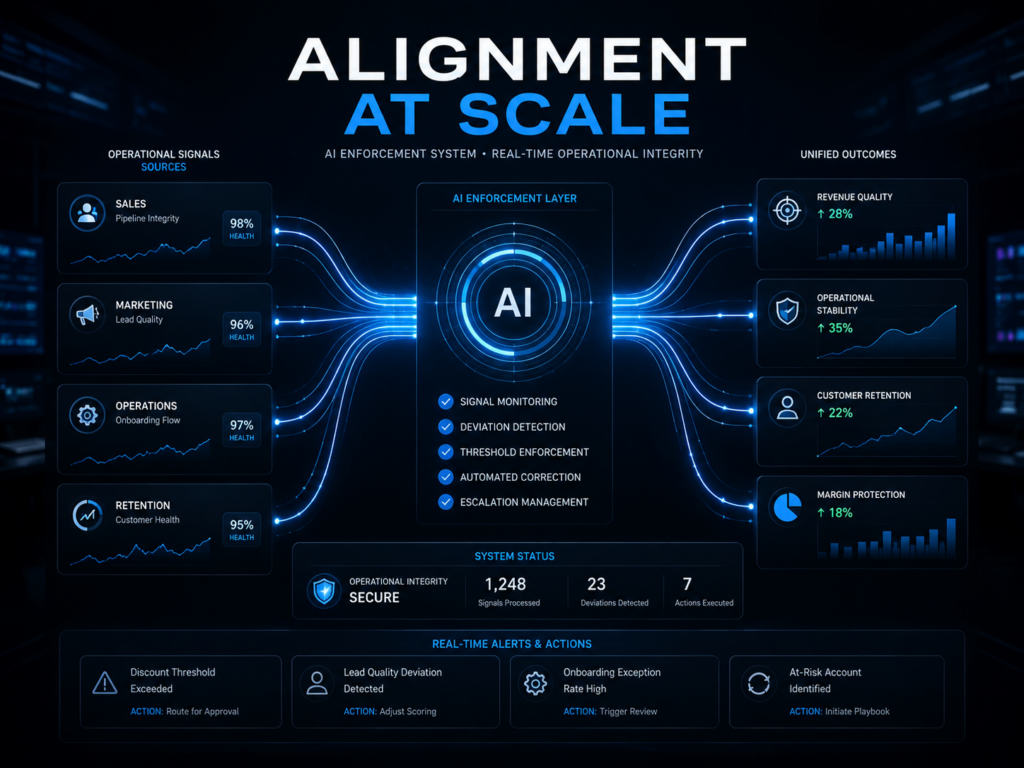
That requires four capabilities:
Signal visibility.
Threshold definition.
Automated correction.
Escalation logic.
Most workflow automation systems only handle execution. They move information, trigger tasks, or reduce manual labour.
Very few systems evaluate whether operational behaviour remains aligned with business objectives over time.
That distinction changes the role AI plays inside the organisation.
AI becomes strategically valuable because it can continuously evaluate patterns across operational behaviour in ways human management cannot sustain consistently.
Not just isolated actions.
Patterns.
Variance.
Contradictions.
Deviation over time.
Human judgment still matters. What changes is when leadership intervenes. Instead of discovering instability after departments begin compensating manually, the system surfaces deviation earlier — before operational deterioration spreads.
That reduces the delay between deviation, detection, and correction.
Which changes the economics of scale.
Without enforcement architecture, complexity increases management burden. Leadership spends more time reconciling contradictions, validating data, and manually restoring alignment between departments.
With enforcement architecture, the business develops embedded continuity systems capable of reinforcing operational coherence automatically.
This reduces executive cognitive load while increasing operational predictability.
That is the real strategic role of AI inside scaling companies.
Not just automation.
Continuity preservation.
The Signal Logic
Effective drift detection depends on defining operational integrity clearly.
Most companies never do this formally.
They define goals.
They define KPIs.
But they rarely define the behavioural conditions that determine whether growth remains healthy underneath the metrics.
An AI enforcement layer continuously evaluates operational behaviour against predefined standards.
Those signals may include:
Lead qualification consistency.
Sales call deviations from approved positioning.
Proposal discount thresholds.
Client-fit scoring changes.
Escalation frequency.
Onboarding exception rates.
Retention deterioration linked to acquisition source.
Operational response times across departments.
The purpose is not surveillance.
The purpose is preserving alignment between strategic intent and operational execution.
Not all variance is dangerous. Healthy systems require flexibility. But once operational behaviour exceeds acceptable thresholds, the organisation needs predefined response logic.
That response may involve:
Correction.
Containment.
Escalation.
For example:
One sales rep consistently closes faster by positioning implementation differently than the rest of the team. Close rates improve temporarily.
Six months later, retention quietly weakens because customer expectations were never aligned properly during acquisition.
Or marketing continues generating “high-quality” leads that sales accepts, but onboarding teams repeatedly escalate because those accounts require excessive customisation to succeed operationally.
Those are not isolated workflow problems.
They are integrity failures inside the revenue system.
An enforcement layer detects these patterns early and initiates predefined responses automatically.
If proposal discounts exceed tolerance thresholds for a specific customer segment, contracts may route for executive approval before closing.
If qualification criteria are repeatedly skipped during sales conversations, review workflows and coaching interventions may trigger automatically.
If certain acquisition channels consistently produce low-retention customers, budget allocation may shift before revenue quality deteriorates further.
If onboarding exceptions rise beyond acceptable limits, operational leadership receives escalation alerts before delivery strain spreads system-wide.
What this means in practice is simple:
Leadership stops discovering instability late and starts managing deviation early.
Most businesses currently operate with delayed visibility. They discover problems after retention weakens, margins compress, or operational strain reaches teams downstream.
By then, the organisation is already compensating manually.
Drift detection changes that sequence.
The system surfaces behavioural deterioration before financial deterioration becomes visible.
That allows leadership to stabilise growth earlier, faster, and with less organisational friction.
The Automation Layer
Most companies implement automation backwards.
They focus on automating tasks before identifying which operational conditions actually require enforcement.
As a result, they create faster workflows without improving structural integrity.
A properly designed AI enforcement layer works differently.
It begins with one operational question:
What conditions indicate the business is moving out of alignment?
From there, automation handles three responsibilities:
Detection.
Containment.
Escalation.
Consider a mid-market services company scaling aggressively through outbound sales.
Initially, growth is driven by founder proximity and strong sales judgment. Over time, additional sales hires optimise for speed and volume.
Qualification discipline weakens. Customer expectations become inconsistent. Delivery teams compensate downstream through exceptions and manual recovery work.
Revenue still grows.
But leadership starts noticing something subtle.
Forecast meetings become debates about deal quality instead of pipeline confidence.
Operations no longer trust what sales commits upstream.
Customer success teams quietly inherit the cost of misalignment after contracts close.
Margins weaken underneath the revenue growth.
An AI enforcement layer may monitor:
Call transcripts against approved positioning frameworks.
Lead-scoring consistency across sales teams.
Proposal deviation patterns.
Onboarding modification rates by acquisition source.
Retention probability shifts linked to deal characteristics.
The system is not replacing the sales process.
It is preserving the integrity of the sales process as scale increases.
When predefined thresholds are crossed, corrective actions occur automatically.
High-risk deals route for leadership review.
Misaligned lead categories are deprioritised.
Escalation tickets are generated before onboarding instability spreads.
Sales enablement prompts appear when qualification gaps become repetitive patterns.
Marketing attribution adjusts based on downstream retention quality rather than lead volume alone.
This creates continuity between acquisition quality, operational capacity, delivery performance, and retention outcomes.
That continuity becomes strategically important because growth amplifies whatever the system tolerates.
If inconsistency is tolerated, scale compounds fragmentation.
If alignment is enforced, scale compounds operational intelligence.
That distinction changes competitive advantage.
The Stability Outcome
The immediate value of operational drift detection is not efficiency.
It is predictability.
Predictability changes how leadership operates.
When executives trust the integrity of operational signals, decision-making becomes faster, calmer, and more strategic.
Fewer resources are consumed reconciling contradictions between departments. Fewer meetings exist purely to restore alignment after operational breakdowns occur.
This matters because leadership attention becomes the most constrained resource inside scaling businesses.
Every unresolved inconsistency consumes cognitive bandwidth.
Every downstream exception increases management drag.
Without enforcement systems, growth amplifies organisational noise.
With enforcement systems, growth strengthens operational intelligence.
That changes how revenue architecture behaves.
Marketing becomes accountable not just for lead volume, but for downstream customer quality.
Sales becomes accountable not just for close rate, but for retention alignment and operational fit.
Operations gain earlier visibility into acquisition risks before delivery instability spreads.
The business develops closed-loop operational accountability instead of isolated departmental optimisation.
Over time, this improves forecasting reliability, stabilises margins, reduces operational friction, and lowers the amount of management intervention required to sustain growth.
The companies that scale effectively over the next decade will not simply be the ones automating the most work.
They will be the ones preserving alignment under increasing complexity.
That is the deeper shift happening underneath AI adoption right now.
The advantage is moving away from basic workflow automation.
Basic automation will become expected infrastructure.
The strategic advantage is shifting toward enforcement intelligence:
The ability to detect deviation early, preserve continuity across operational layers, and maintain deal integrity as scale compounds complexity.
Operational drift can never be eliminated completely. Complex systems will always produce variation.
The objective is not rigid control.
It is managed adaptability without structural degradation.
AI operational drift detection gives businesses a mechanism for achieving that balance.
Instead of relying entirely on management oversight to preserve alignment, the organisation develops embedded correction systems capable of reinforcing strategic intent continuously.
That reduces drift.
It increases predictability.
And it strengthens structural integrity across marketing, sales, operations, and delivery as the business scales.
FAQs
What is AI operational drift detection?
AI operational drift detection is the process of monitoring operational behavior for deviations from strategic intent, qualification standards, and execution consistency. Its purpose is not task automation alone, but continuity enforcement across sales, marketing, and operations as complexity increases.
Why do scaling companies experience operational drift?
Operational drift occurs when growth increases faster than the organization’s ability to preserve alignment between teams, decisions, and workflows. Most businesses mistake this for a people problem when the real issue is missing enforcement architecture and weak signal visibility.
How does AI help preserve deal integrity?
AI preserves deal integrity by detecting patterns that indicate misalignment before contracts close or operational strain appears downstream. This includes monitoring qualification gaps, discount inconsistencies, onboarding exceptions, and customer-fit deterioration across revenue workflows.
What signals should businesses monitor to detect drift early?
The most important signals are behavioural, not financial. Companies should monitor qualification consistency, proposal variance, onboarding exceptions, escalation frequency, customer retention quality, and deviations in sales or marketing messaging before those issues appear in revenue metrics.
What is the difference between automation and enforcement architecture?
Automation executes tasks. Enforcement architecture ensures those tasks remain aligned with business intent over time. Companies that only automate workflows often scale inconsistency, while companies that install enforcement systems scale operational coherence.
Does operational drift detection reduce leadership workload?
Yes. Drift detection reduces executive cognitive load by identifying deviations early instead of forcing leadership teams to manually discover operational breakdowns after they spread. This allows leadership attention to move from reactive correction toward strategic direction.
How does AI operational drift detection improve growth stability?
It improves stability by reducing the delay between deviation, detection, and correction. As operational signals become visible earlier, businesses gain stronger predictability across acquisition, delivery, retention, and revenue performance without relying on additional management layers.
Other Articles
Build AI Systems That Eliminate Decision Fatigue