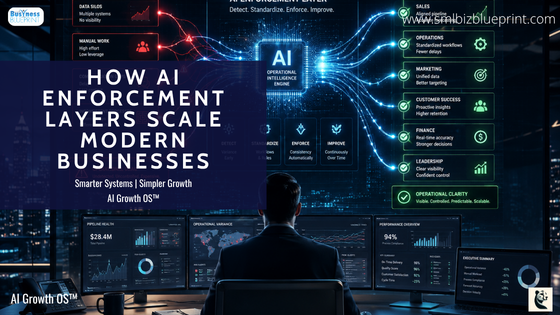

The shift from isolated automation tools to AI systems that enforce accountability and operational discipline.
Most businesses do not struggle because of poor automation — they struggle because operational inconsistency compounds faster than leadership can manually correct it.
AI enforcement layers solve this by reinforcing standards, decision logic, and execution quality continuously across sales, marketing, operations, and management systems.
The companies scaling cleanly are not simply automating tasks; they are building AI-driven business systems that reduce variance, preserve operational discipline, and protect clarity as complexity increases.
Businesses rarely break through one catastrophic operational failure.
They erode through accumulated inconsistency.
Sales qualification shifts between teams. Reporting becomes interpretive instead of reliable. Marketing optimizes for lead volume while operations absorb poor-fit clients downstream.
Managers start manually checking work they used to trust the system to handle.
Most companies describe this as “growing complexity.”
Usually, it is structural inconsistency spreading faster than leadership can correct manually.
Traditional automation was built around activity coordination. Faster workflows. Better reporting visibility. More efficient execution.
But operational scale is not primarily limited by activity speed.
It is limited by decision consistency.
That is the hidden tension inside many $5M–$20M businesses right now.
Revenue may continue growing while operational confidence quietly weakens underneath.
Leaders feel it before they can fully explain it.
Forecasts become less trustworthy. Customer experience becomes uneven. Teams interpret priorities differently. Managers spend more time resolving misalignment between departments instead of moving the business forward strategically.
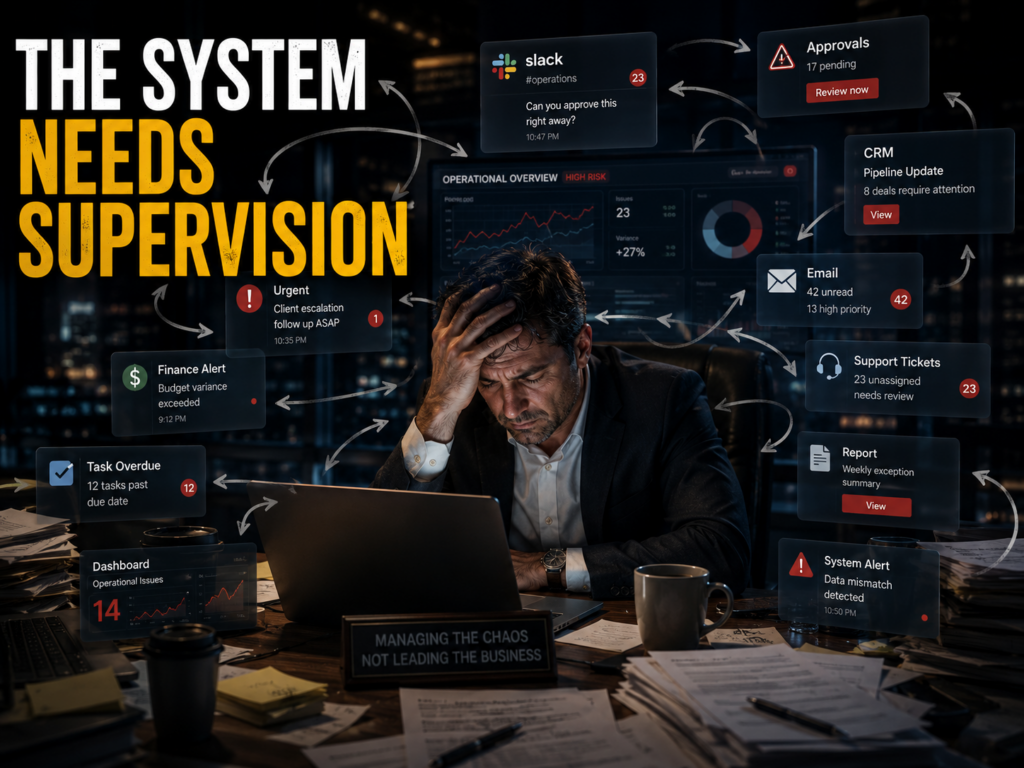
The organisation becomes dependent on supervision.
That dependency creates fragility.
Operational quality starts living inside specific individuals instead of inside the system itself. Sales performance depends on experienced reps. Customer retention depends on a few operators catching problems early.
Strategic alignment depends on executives repeatedly stepping into operational decisions that should already operate predictably.
Most businesses do not recognise this immediately because growth can temporarily hide operational drift.
But eventually leadership starts carrying the burden emotionally.
More approvals.
More check-ins.
More escalation.
More “just making sure.”
The business slows itself trying to preserve quality manually.
Most AI conversations completely misread this problem.
The market frames AI as a productivity layer: faster execution, lower labor costs, accelerated workflows.
Those gains matter.
But the larger shift is operational.
AI is becoming an enforcement layer.
Not simply executing tasks, but continuously reinforcing operational standards, workflows, pricing discipline, qualification logic, reporting consistency, and organisational alignment across the business.
That changes the strategic role of AI entirely.
The advantage is no longer automation alone.
It is operational coherence.
And operational coherence compounds commercially.
One inconsistent qualification process distorts forecasting. One weak onboarding sequence damages retention months later. One sales team discounting outside company standards compresses margins across the business.
The damage spreads operationally before it appears financially.
That is why inconsistency becomes so expensive at scale.
An AI enforcement layer reduces organisational drift by standardising how critical decisions are made as complexity increases.
It reinforces workflows, monitors deviation patterns, preserves institutional knowledge, and surfaces instability before leadership experiences the downstream consequences directly.
That creates a different kind of company.
Not necessarily faster.
More stable under pressure.
This is where many businesses remain exposed. They continue implementing isolated AI tools without redesigning the operational architecture underneath them. Marketing adopts AI separately. Sales experiments independently. Operations build disconnected automations.
The result is artificial intelligence layered onto fragmented business logic.
That does not create leverage.
It amplifies inconsistency.
The businesses scaling successfully with AI are approaching this differently.
They define which operational behaviours cannot afford interpretational drift — qualification standards, onboarding discipline, pricing boundaries, escalation thresholds — then build systems that reinforce those standards continuously.
That is the real shift happening underneath the market right now.
Not from humans to AI.
From supervision-dependent businesses to enforcement-driven systems.

The Problem With Traditional Business Automation
Traditional automation was designed around tasks.
Modern businesses fail around decisions.
That distinction matters more than most leaders realise.
For years, automation software promised efficiency through workflow shortcuts: automated emails, CRM triggers, onboarding sequences, reporting systems. And those tools did improve operational speed.
But they never solved the deeper problem.
Businesses do not become inconsistent because they lack automation.
They become inconsistent because human interpretation keeps changing the system.
One sales rep qualifies differently than another. Marketing generates leads sales does not trust. Operations document processes nobody follows consistently.
Managers compensate manually for invisible gaps between teams.
The result is not sudden failure.
It is slow strategic erosion.
The system definition is simple: traditional automation executes predefined actions, but it does not govern decision quality.
That is why companies with hundreds of automations still feel chaotic internally.
The default approach fails because it assumes process breakdown happens at the workflow layer.
Most breakdown happens at the behavioural layer.
Businesses spend years automating activity while ignoring enforcement. Teams continue making inconsistent decisions inside automated environments because the business never defined which decisions must remain operationally consistent.
So the CRM updates automatically, but lead qualification still changes between reps.
The onboarding sequence runs automatically, but implementation quality still varies between teams.
Complexity scales faster than clarity because the workflow became automated while the operational logic remained unstable.
This is why your sales team keeps re-explaining the same thing on calls.
Not because the team lacks skill. Because the business has failed to standardise operational interpretation.
A business without enforcement architecture slowly turns managers into human middleware.
And eventually leadership becomes the operational bottleneck.
Strong operators do not scale businesses by controlling more people. They scale businesses by reducing behavioural variance across systems.
The longer this stays unresolved, the more the company becomes dependent on supervision instead of structure. That creates fragility disguised as growth.
Pro Tip
Don’t audit where your workflows are automated. Audit where interpretation changes between people. That is where operational drift is already costing revenue.
Scale problems are rarely process shortages. They are enforcement failures.
He thought the business had a communication problem, so he added more meetings.
Monday sales syncs became Wednesday pipeline reviews. Slack channels multiplied. Reporting expanded. Three months later, the team was talking more than ever and execution still felt inconsistent.
The shift came when he realised the business wasn’t lacking communication — it was lacking enforced operational logic.
He stopped managing conversations and started redesigning the system itself.
What an AI Enforcement Layer Actually Is
Most businesses think AI should do work.
The more important role is making sure work happens correctly.
An AI enforcement layer is not another tool sitting beside the business. It is a governing layer sitting across the business — continuously reinforcing operational standards, priorities, workflows, and decision logic.
Not replacing humans.
Constraining inconsistency.
The system definition is simple: an AI enforcement layer reduces operational drift by standardising how critical decisions get made across the business.
That matters because most operational problems do not begin as catastrophic failures.
They begin as small inconsistencies repeated hundreds of times.
A rep skips qualification steps to move a deal faster.
Discounting expands outside acceptable boundaries because nobody reinforces pricing discipline consistently.
An onboarding team inherits clients sales never properly aligned operationally.
Managers compensate manually until the business starts feeling heavier than it should.
This is how entropy actually enters organisations.
Quietly.
Traditional management tries solving this through oversight: more meetings, more approvals, more reporting layers.
But human enforcement does not scale cleanly under complexity.
AI changes that equation because it can continuously monitor patterns, flag deviation, reinforce workflows, preserve institutional knowledge, and surface operational drift before leadership feels the commercial consequences.
This is the overlooked shift:
AI is becoming organisational memory with enforcement capability attached to it.
That is far more important than automation alone.
Because automation speeds activity.
Enforcement stabilises quality.
For example, most CRMs store sales data passively.
An AI enforcement layer actively evaluates whether qualification standards are being followed, whether proposals are moving forward without proper stakeholder alignment, whether pricing behaviour is drifting outside company norms, and whether onboarding risks are increasing before churn appears months later.
That changes management itself.
Leaders stop spending time manually correcting recurring execution problems and start governing system integrity instead.
Sophisticated businesses are not built on talented individuals alone.
They are built on systems that preserve quality under pressure.
The longer institutional knowledge stays trapped inside people instead of systems, the more fragile the business becomes under turnover, growth, or market stress.
Pro Tip
Before implementing AI, define what “good execution” actually means operationally. AI amplifies structure.
If standards remain vague, AI will scale ambiguity faster than humans ever could.
The operations director of a growing services company noticed something strange: their best month and worst month used almost identical lead numbers.
Same market. Same team size. Same offer. The difference was execution drift between departments nobody had measured directly.
Once they standardised qualification logic, onboarding sequencing, and reporting interpretation across teams, forecasting stabilised within a quarter.
The business stopped feeling unpredictable and started feeling governable.
How AI Enforces Operational Consistency Across Teams
Most operational problems are not communication problems.
They are interpretation problems disguised as communication problems.
Leadership says one thing. Sales hears another. Marketing optimises for lead volume while operations absorb downstream friction. Customer success inherits clients who were never aligned properly in the sales process.
Everyone believes they are aligned because everyone uses similar language.
Underneath, the business is operating from different decision frameworks.
That is where operational drag begins.
The system definition is simple: operational consistency exists when the same business logic gets reinforced across departments without requiring constant managerial correction.
Very few companies actually achieve this.
Most achieve temporary alignment maintained through executive pressure.
That works for a while.
Then complexity increases.
AI enforcement changes the mechanism entirely because it creates persistent operational reinforcement between teams, systems, and decisions.
Imagine a company positioning itself as premium in marketing while sales quietly expand discounting to close deals faster. Leadership often treats this as a sales management issue.
It isn’t.
It is an enforcement architecture failure.
The business allowed competing operational incentives to coexist without systemic correction.
An AI enforcement layer can detect this divergence automatically by analysing sales behaviour, pricing patterns, customer objections, onboarding outcomes, and retention signals together — not as isolated reports, but as connected operational signals.
That changes how businesses govern quality.
Not through periodic reviews.
Through continuous alignment.
And continuity matters more than intensity in scaling environments.
Most companies do not notice execution drift until forecasting starts becoming emotional instead of mathematical.
That is usually the signal.
Disciplined businesses do not rely on motivation to maintain standards. They design systems where deviation becomes visible quickly and difficult to sustain quietly.
The overlooked insight is that AI enforcement does not primarily increase speed.
It decreases variance.
And reduced variance creates predictability. Predictability creates trust. Trust creates leverage.
Most revenue leakage comes from inconsistent execution long before it comes from bad strategy.
Pro Tip
Measure operational inconsistency, not just productivity.
If two reps produce completely different customer experiences from the same process, the process is not operationally real yet.

The Difference Between Automation Tools and AI Operating Systems
Most companies are building collections of tools.
Very few are building operational intelligence.
Automation tools execute isolated functions. AI operating systems govern interconnected business behaviour.
That is a completely different category.
The system definition is simple: an AI operating system coordinates decision logic across the business instead of automating disconnected tasks independently.
Most businesses still think horizontally.
Automate marketing.
Automate onboarding.
Automate reporting.
But companies do not fail because individual tasks remain manual. They fail because departments optimize separately without shared operational logic.
That fragmentation creates what looks like growth on paper but feels chaotic internally.
Many businesses are automating fragmentation.
Marketing automates lead generation independently. Sales automate follow-up independently. Operations automate onboarding independently.
But no system governs whether those decisions reinforce each other commercially.
So the business becomes faster locally while becoming less coherent globally.
That is why leadership teams often feel disappointed after investing heavily into automation.
The promised leverage never fully materialises because disconnected automation increases operational noise when no governing intelligence layer exists above it.
And this has competitive consequences.
Coherent businesses adapt faster because they spend less time reconciling internal inconsistency. Their forecasting stabilises faster. Their coordination costs stay lower. Their customer experience becomes more predictable under scale pressure.
Fragmented businesses slow down as complexity increases.
Not because the market moved faster.
Because internal friction compounded quietly underneath growth.
For example, instead of marketing optimising purely for lead volume, an AI operating system evaluates lead quality based on downstream conversion behaviour, onboarding friction, customer retention, and profitability simultaneously.
That changes incentives.
The system starts optimising for business outcomes instead of departmental metrics.
This is why your pipeline can look healthy while conversion quality weakens underneath.
The systems generating leads and the systems evaluating customer quality are operating independently.
The future competitive advantage of AI is not intelligence itself.
It is organisational synchronisation.
Strong businesses are not collections of high performers. They are systems where decisions reinforce each other instead of competing silently underneath the surface.
Pro Tip
Stop asking “What can AI automate?” Start asking “Where does operational logic break between departments?”
That is where an AI operating system creates disproportionate strategic advantage.
Why Most AI Implementations Fail to Scale
Most AI implementations fail because businesses install intelligence into broken systems and expect intelligence to compensate for operational incoherence.
It never does.
AI does not remove disorder.
It exposes it faster.
The system definition is simple: AI scales the quality of the operational architecture it is inserted into.
If standards are unclear, AI accelerates inconsistency.
If departments operate from competing incentives, AI increases noise instead of clarity.
This is why many businesses quietly abandon AI projects after the initial excitement fades.
The technology worked.
The system did not.
Most AI projects fail before implementation even starts.
The business never decided which operational behaviours must remain consistent under growth pressure.
Leadership asks:
“What AI software should we use?”
Wrong question.
The real question is:
“Which operational decisions create downstream instability when they vary between people, teams, or departments?”
That is where enforcement architecture creates leverage.
Qualification standards.
Pricing discipline.
Proposal quality.
Escalation thresholds.
Customer onboarding consistency.
Businesses that scale AI successfully identify the operational behaviours that cannot afford interpretational drift — then reinforce those standards systemically.
That reframes the entire implementation process.
Because AI only becomes transformative when the business first defines the decision architecture it wants reinforced.
Without that, companies end up with disconnected pilots, scattered automations, low adoption, and teams reverting back to manual workarounds.
Not because employees resist AI.
Because the business failed to operationalise clarity before scaling intelligence.
Many implementations also optimise for local efficiency instead of systemic coherence. Marketing uses AI differently than sales. Operations build separate workflows. Leadership receives fragmented visibility across fragmented systems.
Every department improves individually, while the business becomes harder to synchronise collectively.
The companies scaling AI successfully are not the ones moving fastest.
They are the ones thinking structurally before deploying tactically.
Pro Tip
Before implementing another AI tool, document the operational standards your business currently depends on informally.
If your best practices only exist inside people, AI cannot reinforce them consistently at scale.
Some businesses are quietly becoming harder to scale every year while believing they are becoming more sophisticated.
More software. More dashboards. More automations. More management layers. But underneath the expansion is growing operational fragmentation disguised as modernisation.
The companies that survive the next decade will not necessarily be the smartest — they will be the most coherent.
Conclusion
Most businesses are not struggling because people lack effort.
They are struggling because the system keeps allowing inconsistency to survive.
That is the deeper operational truth underneath missed forecasts, management fatigue, customer experience drift, and execution breakdowns leadership teams keep trying to solve manually.
For years, businesses treated scale as a hiring problem, a productivity problem, or a visibility problem.
Increasingly, it is becoming an enforcement problem.
The businesses scaling cleanly today are not simply moving faster. They are reducing operational entropy faster than competitors. Their systems reinforce priorities continuously.
Standards survive beyond individual managers. Decision quality becomes more predictable across departments.
That changes everything.
Because predictable execution creates strategic freedom.
And strategic freedom is what most owners actually want — even if they describe it differently.
More clarity.
Less operational drag.
Fewer preventable fires.
A business that does not depend on constant supervision to maintain quality.
This is the relief AI enforcement layers actually offer.
Not just efficiency.
Trust in the system itself.
Strong businesses are not the ones where leadership carries the operational burden indefinitely. Strong businesses are the ones where the system protects standards even under pressure.
And that creates a difficult but necessary decision point.
Because the longer operational consistency depends entirely on people, the more fragile growth becomes. More revenue simply creates more coordination pressure, more managerial exhaustion, and more execution drift.
Your current state is not permanent.
It is architectural.
Which means it can be redesigned.
The choice now is whether to keep scaling complexity manually — or begin building a business where operational discipline becomes systemic, durable, and continuously reinforced.
Action Steps
Audit where operational interpretation changes between people
Identify where sales qualification, onboarding, reporting, or client handling varies significantly depending on the employee involved. If interpretation remains person-dependent, scale will increase operational noise instead of leverage.
Define the operational standards your business actually depends on
Document the non-obvious rules top performers follow instinctively across sales, delivery, communication, and decision-making. AI can only reinforce logic that has been structurally clarified.
Measure variance, not just productivity
Track where outcomes differ dramatically across departments or customer touchpoints rather than only measuring output volume. Variance reveals hidden entropy inside the system.
Build AI around reinforcement instead of replacement
Use AI to preserve workflows, priorities, and operational discipline rather than simply removing labour. Businesses scale through repeatable quality, not isolated efficiency gains.
Align departmental incentives to shared business outcomes
Ensure marketing, sales, operations, and customer success optimise toward the same operational logic rather than isolated metrics. Disconnected incentives create internal competition disguised as performance.
Reduce managerial dependency systematically
Identify where leadership repeatedly intervenes to preserve quality or execution consistency. Constant executive correction signals weak enforcement architecture.
FAQs
What is an AI enforcement layer in business?
An AI enforcement layer continuously reinforces operational standards, workflows, and decision logic across the company. Unlike traditional automation, it governs consistency rather than simply executing tasks.
Why do most automation systems fail to improve scalability?
Most automation systems optimise isolated workflows without addressing behavioural inconsistency between teams and decisions. This creates faster operations but fragmented execution.
How does AI improve operational consistency?
AI improves consistency by monitoring patterns, reinforcing workflows, identifying deviation, and preserving shared operational logic across departments.
What is the difference between AI automation and an AI operating system?
AI automation handles individual tasks. An AI operating system coordinates operational logic and decision-making across the business.
Why does operational inconsistency become expensive as companies grow?
Small inconsistencies compound into forecasting instability, customer experience drift, and management fatigue as operational complexity increases.
Where should businesses implement AI enforcement first?
Start where inconsistency directly impacts revenue, customer trust, or decision quality — usually sales qualification, onboarding, reporting, or customer communication.
Can AI replace managers in modern businesses?
AI does not replace leadership judgment. It reduces the need for constant operational correction by reinforcing standards continuously.
Bonus Section: The Deeper Shift Most Businesses Still Haven’t Seen
Most leaders still think AI adoption is a technology conversation.
It isn’t.
It is an organisational design conversation disguised as software implementation.
That misunderstanding is why many businesses feel simultaneously excited and disappointed by AI. The tools work. The outputs improve. But the business itself still feels operationally heavy underneath.
Because the deeper issue was never labour alone.
It was structural coherence.
Your business is probably overvaluing flexibility
Many companies celebrate flexibility when they should be protecting operational clarity. Teams improvise constantly. Sales reps personalise everything. Managers adapt processes in real time.
Underneath, it creates interpretational chaos.
Strong businesses do not scale because everyone works differently. They scale because critical decisions stop varying unnecessarily.
If this does not change, leadership will keep mistaking managerial involvement for operational control.
Most businesses are not suffering from lack of data — they are suffering from lack of enforced meaning
Modern companies are drowning in visibility while starving for coherence.
Dashboards multiply. Reporting expands. Meetings increase. Yet leaders still feel uncertain about what is actually happening operationally.
The issue is not information scarcity.
It is interpretational fragmentation.
The businesses pulling ahead are reducing ambiguity faster than competitors, not simply collecting more intelligence.
If this continues unresolved, teams will keep operating from different versions of reality while leadership assumes alignment exists.
The future advantage of AI may be emotional stability inside leadership teams
Operational inconsistency creates cognitive exhaustion. Leaders carry unresolved uncertainty constantly:
Are standards holding?
Is execution slipping?
Will quality survive growth?
Most executives normalize this tension because it accumulates gradually.
But AI enforcement reduces invisible managerial anxiety by making operational systems more trustworthy.
Leadership regains confidence not because people became perfect, but because the business becomes structurally coherent.
If nothing changes, growth will continue increasing operational pressure faster than leadership resilience can absorb it.
Other Articles
Build AI Systems That Eliminate Decision Fatigue