
Turn constant interruptions into structured, high-impact decisions
The Decision Queue Method helps busy operators stop reacting to every request and instead structure how decisions are captured, prioritised, and resolved.
By separating decision input from decision processing, it reduces bottlenecks, improves clarity, and increases decision quality.
The result is a business that scales through structured thinking—not constant interruption.
You’re not short on ideas. You’re short on clear decisions.
Your day isn’t breaking because of effort—it’s breaking because everything demands a decision at once. Slack messages. Team questions. Client issues. Half-finished plans waiting for calls you haven’t made.
It feels like progress because you’re constantly responding. But nothing moves forward cleanly.
You’re not overloaded. You’re undecided—and it’s costing you more than you think.
The cost isn’t obvious at first. It shows up as stalled projects, hesitant teams, and deals that drift instead of closing. What looks like “busy leadership” is often just decision congestion.
Left long enough, this doesn’t just slow growth—it distorts it. You start optimising for movement, not outcomes.
Most operators try to fix this with better prioritisation, tighter calendars, or delegation. That assumes the problem is time management. It’s not.
It’s structure.
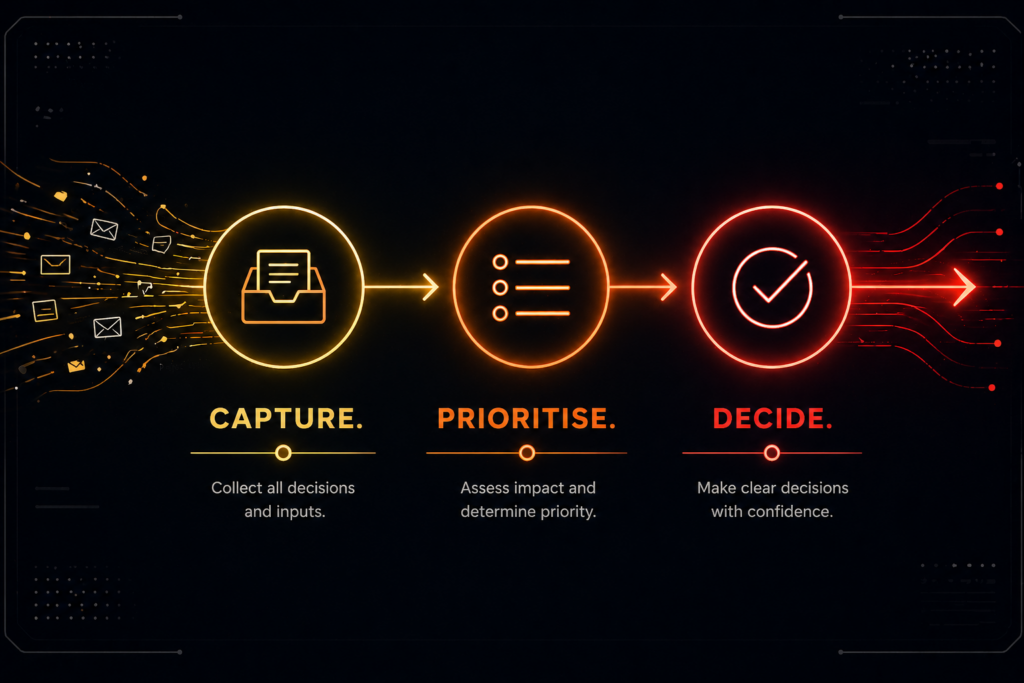
You’re making decisions in the order they appear—not in the order they matter.
That’s the flaw.
The Decision Queue Method flips this. It doesn’t help you do more—it changes how decisions enter and move through your business.
Instead of reacting, you create a system where decisions are captured, staged, and resolved based on impact—not noise.
From interruption → controlled flow
From reaction → structured clarity
From operator → decision architect
Because leverage isn’t in working harder. It’s in deciding better—and at the right time.
He used to pride himself on being “fast.” Every message got an immediate reply.
Every decision handled on the spot. By Friday, he couldn’t remember what he’d actually decided—only that everything felt fragmented. The shift came when he realised speed wasn’t solving anything—it was scattering his thinking.
He stopped reacting and started structuring decisions—and finally felt in control again.
What Is the Decision Queue Method?
The decision queue method is simple—and uncomfortable: you stop making decisions the moment they appear.
Instead, non-critical decisions are captured into a structured queue and processed later in focused blocks.
Right now, decisions arrive randomly and get handled immediately. That creates fragmentation. You switch context, default to fast answers, and lock in choices before you’ve seen the full picture.
That’s where rework begins—quietly, expensively, and often invisibly.
It separates input (requests) from processing (decisions). That separation creates space—space to think, compare, and prioritise properly.
A decision made at the wrong time is often worse than no decision.
Because it locks you into a path before you understand its consequences—and forces downstream teams to work around incomplete thinking.
The queue introduces controlled delay. Not procrastination—timing.
There’s a second layer most miss: the queue becomes a visibility system.
Patterns emerge:
recurring decisions
dependency points
what actually drives outcomes
That awareness changes how you operate—and what you choose to remove entirely.
You’re no longer reacting to decisions—you’re designing how decisions get made.
The longer decisions stay unstructured, the more your business scales confusion instead of clarity—and confusion compounds faster than revenue.
Pro tip
Don’t optimise for speed.
Optimise for decision quality per unit of attention. Speed follows structure.

Why Most Operators Are Stuck in Reactive Decision Loops
Most operators think they’re decisive. They’re not. They’re responsive.
Responsiveness feels productive because you’re always answering something. But it creates a system where decisions are driven by who asks loudest—not what matters most.
Here’s the loop:
Your team escalates decisions
You respond quickly
That trains more escalation
Your day fills with low-leverage decisions
Now your highest-value thinking never happens. And the decisions that actually grow the business? They get delayed, diluted, or never made at all.
This is why your sales team keeps re-explaining the same thing on calls.
Because upstream decisions were rushed—or never fully made.
The issue isn’t workload. It’s decision architecture failure.
You’ve built a system where decisions flow upward by default—because no one is clear where they should actually be resolved.
Delegation alone doesn’t fix this. If the system lacks clarity, you’re just spreading confusion faster.
The uncomfortable truth:
If your team constantly needs your decisions, you’ve built dependency—not scale.
The decision queue breaks this loop. It forces clarity before action—and exposes where decisions should never have reached you in the first place.
Operators react. Builders design systems that reduce the need to react.
The longer you stay reactive, the more your business becomes limited by your availability—not your strategy—and that ceiling arrives earlier than expected.
Pro tip
Track how many decisions you make daily that could have been pre-defined.
That number is your real bottleneck.
What Decisions Belong in a Queue vs Immediate Action
Not all decisions should wait. Structure only works if it’s applied selectively.
The distinction isn’t urgency—it’s impact and reversibility.
Immediate decisions:
Time-sensitive and irreversible
Low-impact and easily reversible
Everything else belongs in the queue.
This middle category is where most mistakes happen.
Decisions that:
affect multiple teams
shape direction
require context
Yet they’re made quickly because they feel small in the moment.
They’re not. They’re just poorly framed.
This is why deals feel close but stall.
Because decisions around pricing or positioning were made in fragments—without full context.
The queue protects these decisions from premature closure. It creates space to gather inputs, compare trade-offs, and see second-order effects before committing.
Most operators collapse complexity too early. They “keep things moving” but create downstream friction that shows up weeks later as confusion, rework, or stalled execution.
Speed only matters if direction is correct.
You don’t rush decisions. You stage them for precision.
Every rushed strategic decision becomes a hidden execution tax—paid later in misalignment, lost deals, and slowed momentum.
Pro tip
If a decision will still matter in 30 days, it belongs in the queue.
How to Prioritise Decisions When Everything Feels Urgent
When everything feels urgent, nothing has been ranked properly.
Urgency is not importance—it’s unfiltered input.
The decision queue shifts the question:
Not “What needs attention now?”
But “What creates the most leverage if resolved correctly?”
This reframes prioritisation around impact—not interruption.
A simple lens:
High impact + irreversible → prioritise
High impact + reversible → test
Low impact → batch or delegate
The real shift is psychological. You stop treating urgency as truth—and start treating it as a signal that needs validation.
Fast responses often mean shallow thinking.
This is why your pipeline looks strong but doesn’t convert consistently.
Because key decisions were prioritised by pressure—not weight.
The queue introduces friction where needed. It slows you just enough to think clearly—and removes the false urgency that distorts your focus.
That tension is necessary.
You don’t manage time—you allocate decision energy.
If everything stays urgent, your best decisions never get the attention they require—and those are the ones that determine growth.
Designing a Simple Decision Queue System That Actually Works
Most systems fail because they try to be complete. The decision queue works because it stays minimal.
You don’t need complexity. You need consistency.
Core structure:
Capture every non-urgent decision
Categorise by context
Process in scheduled blocks
That’s it.
Example: A pricing change request comes in Tuesday. It’s logged, tagged as “strategic,” and reviewed Friday alongside pipeline data—not decided mid-meeting without context.
The power comes from execution discipline—not system design.
Most operators resist this—not because it’s hard, but because it breaks the habit of reacting. And without that habit, their day feels slower—until results start compounding.
A key rule:
Decisions must move through the system faster than they arrive.
If not, you’ve created backlog—not clarity. And backlog is just delayed indecision with a different label.
Set fixed decision windows. Protect them. Treat them like revenue-generating time—because the quality of these decisions determines how revenue actually moves.
She had a full pipeline and constant activity—but deals kept stalling.
Decisions were being made, but never in full context. When she introduced a decision queue, everything slowed for a week—then accelerated.
Fewer decisions, better timing, cleaner execution. She stopped chasing outcomes and started designing them.
You build systems that think with you—not systems that depend on you.
Without structure, decisions scatter. With structure, they compound into execution clarity—and that’s what scales.
Pro tip
Make your queue visible to your team.
Transparency reduces unnecessary escalation.
Where Decision Bottlenecks Form—and How to Eliminate Them
Bottlenecks rarely sit at the strategic level. They form in repeated, unresolved decisions.
These create drag:
unnecessary approvals
unclear ownership
missing criteria
The queue exposes this.
You start seeing patterns:
decisions bouncing between people
items sitting unresolved
recurring dependencies on you
That visibility is uncomfortable—but necessary. Because what you see here is where execution is actually slowing down.
Most bottlenecks are design flaws:
too much centralised authority
no decision rules
Elimination means pushing decisions down—with clarity.
Not delegation. Structured distribution.
Because without rules, distribution creates inconsistency. With rules, it creates speed.
You remove yourself as the bottleneck by redesigning the flow—not by working harder.
Every unresolved decision slows multiple teams—and that delay compounds into missed opportunities and reduced output.
Pro tip
If a decision happens twice, create a rule so it doesn’t require you again.

Using AI to Accelerate and Optimise Your Decision Queue
AI doesn’t replace decisions—it prepares them.
Most people use AI at the output layer. That’s surface-level. That’s not leverage. That’s speed applied to the wrong layer.
The real leverage is upstream—before the decision is made.
AI can:
pre-analyse decisions
highlight trade-offs
cluster similar items
suggest prioritisation
Now you start with structured insight—not a blank page.
This improves both speed and quality.
But there’s a trap.
If your system is broken, AI scales bad decisions faster. It doesn’t fix noise—it amplifies it.
Order matters:
Structure first → AI second
Most businesses don’t fail because of bad decisions. They fail because of poorly timed ones.
A good decision made too early creates as much damage as a bad one. Once you see that, you stop asking “What’s the right move?” and start asking “Is this the right moment to decide?”
That’s when control returns.
You don’t use AI to think for you—you use it to think faster and clearer.
Your decision capacity is your growth ceiling. AI expands it—but only if the system is sound.
Pro tip
Use AI to generate decision briefs, not answers.
Conclusion
You don’t have a time problem. You have a decision flow problem.
Right now, decisions enter randomly, get handled inconsistently, and create friction you can’t fully see. It feels like growth pressure—but it’s structural inefficiency.
The decision queue changes that.
It introduces order. It slows you down where it matters—and speeds everything else up.
Relief comes from clarity. When decisions are staged and prioritised, your business moves cleaner and faster—with fewer stalls, less rework, and more consistent outcomes.
You stop being the person who answers everything—and become the system that resolves what matters.
But this only works if you act.
Because the longer you stay reactive, the more your business depends on your availability instead of your thinking—and that dependency becomes your growth ceiling.
Most of this won’t get implemented.
This isn’t a productivity tweak. It’s a structural shift.
You can keep reacting.
Or you can design how decisions flow.
One keeps you busy.
The other makes you effective.
Your current state isn’t fixed.
Change the flow—and you change the business.
Stay in the loop, or step out and design it.
Action Steps
Capture every non-urgent decision into a single queue
Stop making decisions in real time unless critical. This protects attention and improves clarity. If you don’t capture consistently, decisions stay fragmented—and fragmented decisions weaken execution.
Define what qualifies as “immediate” vs “queued”
Filter based on impact and reversibility, not urgency. This prevents premature strategic decisions. Without this filter, you’ll continue reacting instead of structuring.
Schedule fixed decision-processing blocks
Batch decisions into protected sessions. This improves quality through context. Without consistent processing, your queue becomes backlog.
Rank decisions by future impact
Prioritise based on downstream effect, not pressure. This ensures high-leverage decisions are addressed first. Otherwise, your best opportunities get delayed.
Eliminate recurring decision patterns
Turn repeated decisions into rules or delegated ownership. This removes bottlenecks. If ignored, you stay stuck solving the same problems.
Use AI to prepare decisions
Leverage AI for analysis and structuring, not final answers. This speeds thinking without reducing quality. Without structure, AI amplifies noise.
FAQs
What is the main purpose of the decision queue method?
To separate decision input from decision-making so you stop reacting and start deciding with structure.
How do I know which decisions should go into the queue?
If it’s not time-critical and still matters in 30 days, queue it.
Won’t delaying decisions slow down my business?
No—structured delay improves decision quality and prevents downstream friction.
How does the decision queue reduce bottlenecks?
It exposes where decisions get stuck and reduces unnecessary escalation.
What role does AI play in this system?
AI prepares decisions by structuring inputs and highlighting trade-offs.
How often should I review my decision queue?
2–3 structured sessions per week to maintain flow.
What’s the biggest mistake people make?
Optimising for speed instead of structure.
Other Articles
The Cost of Delayed Decisions in Competitive Markets