
Learn how lagging metrics create false control and what decision intelligence adds instead.
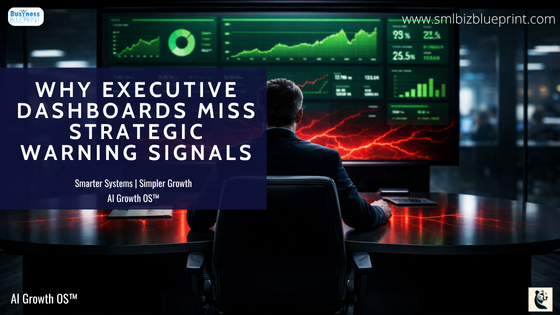
Executive dashboards miss strategic warning signals because they display settled outcomes rather than emerging business drift.
The structural failure is not reporting quality but the absence of decision architecture that converts weak signals into thresholds, ownership, and response logic.
Strategic control begins when leaders stop treating visibility as strategy and start designing how the business responds before KPIs visibly decline.

The structural fragility is not poor reporting. It is the absence of a response architecture above reporting.
Most leadership teams misdiagnose this because the surface symptom looks like an analytics problem. Metrics feel too backward, dashboards too static, meetings too interpretive.
So the organisation invests in more visibility. But visibility does not solve delayed response. It often masks it.
The hidden operational tension sits between recognition and authority. Teams notice weak signals—slower replies, repeated objections, proposal revision loops, onboarding friction—but no threshold defines when these observations must trigger action.
This creates a dangerous pattern: repeated recognition without behavioural change.
The financial cost compounds quietly.
Sales leadership keeps revisiting forecast confidence while qualification quality erodes. Marketing protects lead volume while opportunity quality declines underneath. Operations teams normalise manual workarounds because the exceptions do not yet move executive KPIs.
By the time the dashboard confirms the problem, the business has already paid in lost velocity, margin leakage, wasted spend, and preventable churn.
The operational cost is just as serious. Leadership meetings become interpretation environments. Teams spend time explaining the past instead of governing the next move.
Cognitive load rises because decisions remain dependent on senior judgment rather than system logic. Growth amplifies the problem: complexity expands faster than leadership bandwidth.
The architectural reframe is precise: strategic control is a response-design function, not a reporting function.
The business does not need more effort. It needs structural rules that determine what changes when early conditions shift. Weak signals must connect to thresholds, ownership, escalation logic, and cross-functional consequences.
This is the missing operating layer above dashboards.
Once this layer exists, reporting becomes useful again. Metrics stop being the centre of executive control and return to their correct role: evidence inputs into a larger decision system.
The consequence of ignoring this redesign is predictable. Founders remain the final escalation point. Teams develop awareness without permission. Strategic drift compounds beneath the appearance of discipline.
The required shift is structural redesign: move from state visibility to decision architecture so the business can detect and respond before economics confirm the damage.
Why Dashboards Create Visibility Without Better Decisions
Dashboards create visibility, but visibility alone does not improve strategic leverage.
The default assumption is seductive: if leadership can see the business clearly, it can steer it effectively. The flaw is that dashboards are state-display systems. They render stable snapshots of what has already happened. Strategy governs momentum, not state.
System definition: dashboards are retrospective state renderers; strategic systems are directional change detectors.
Real-world consequence: leaders intervene after economics have already shifted.
This is how the failure appears in real businesses.
Marketing celebrates volume while lead intent quality deteriorates. Sales sees healthy pipeline coverage while later-stage deals lose speed. Operations reports SLA compliance while exception frequency rises around the same customer journeys.
The dashboard is accurate, but the strategic read is wrong.
The overlooked issue is that dashboards shape executive attention. What gets visualised gets discussed. What gets discussed feels important. This means reporting UX can quietly dictate strategy priorities, even when the real risk lives outside the visible layer.
Monday 7:30 a.m., the dashboard looked perfect—green pipeline, stable CAC, forecast on plan.
By Thursday, three “sure” deals had slipped for reasons no KPI had surfaced: slower replies, repeated legal loops, missing champions. The mistake was trusting the board pack more than the behavioural drift beneath it.
He stopped managing reports and started managing transition states.
Serious operators do not manage what is visible; they manage what is beginning to move.
The longer visibility is mistaken for leverage, the more strategic drift compounds behind polished reporting.
Pro Tip
Audit every dashboard metric against one question: what decision changes if this moves 10%?
If no action is obvious, the metric is informing observation, not strategy. The edge is not more data—it is faster conviction.

The Hidden Problem: Lagging Metrics Miss Strategic Shifts
Lagging metrics do not capture where risk begins. They capture where risk finishes.
Revenue, CAC, churn, close rate, NPS—these are outcome reflections. They matter, but they are economic residue.
Strategic risk forms earlier in transition states: slower response times, proposal revision loops, stakeholder drop-off, repeated onboarding exceptions, unusual objection patterns.
System definition: lagging metrics measure settled outcomes, not active behavioural drift.
Real-world consequence: the business absorbs weeks of hidden deterioration before leadership recognises the pattern.
This is why your sales team keeps re-explaining the same thing on calls.
The default approach fails because it assumes material risk will announce itself as KPI movement. It rarely does. Weak signals cluster before metrics collapse.
Businesses do not fail from missed outcomes; they fail from ignored transition states.
That overlooked middle layer is where decision intelligence lives.
High-control leaders notice pattern drift before performance confirms it.
One quarter of delayed recognition at your scale distorts hiring, spend pacing, forecasting confidence, and cash planning.
Pro Tip
Track pre-KPI frictions—reply lag, stakeholder drop-off, exception frequency, revision cycles.
Strategy improves when you detect behaviour before it becomes economic.
How False Confidence Delays Executive Action
False confidence is more expensive than uncertainty.
At least uncertainty invites inquiry. False confidence suppresses escalation.
This is what polished dashboards often create: a completed picture that feels sufficient enough to delay harder questions. Stable reporting is mistaken for stable causality.
System definition: false confidence emerges when stable reporting masks unstable causal drivers. In plain terms, the dashboard shows where the business is, not where it is drifting.
Real-world consequence: leadership delays intervention until optional problems become forced decisions.
A direct challenge: if your leadership meeting starts with dashboard review and ends without explicit decision triggers, it is reassurance theatre, not strategy.
This is where the cultural cost compounds. Teams learn that issues only become “real” when they surface in executive reporting, so frontline tension gets translated into commentary instead of escalation.
Over time, this trains a political habit: people present stable narratives longer than they should because the system rewards clean reporting over early contradiction.
Marketing defends MQL volume while sales distrusts lead quality. Customer success explains “temporary” churn anomalies for months. Operations absorbs manual exceptions that never reach the board pack.
Because the dashboard still trends inside tolerance, no one feels licensed to escalate.
This is why deals feel close but stall.
The deeper lens is inversion: stop asking what the dashboard confirms and start asking what it systematically excludes.
What recurring friction is teams now treating as normal?
What leadership issue keeps returning with different language?
Where has “let’s keep monitoring it” become a substitute for authority?
Those moments are rarely operational noise. They are signs the business has normalised delayed intervention as process discipline.
Leaders who scale beyond instinct learn to distrust polished certainty.
Every month false confidence persists, the business teaches itself that noticing problems carries no operational consequence. That is how delayed escalation becomes culture.
Pro Tip
Start leadership reviews with dashboard contradictions—signals from the field that conflict with the reported story.
Strategic clarity grows faster through tension than consensus.
What Decision Intelligence Adds Above Dashboards
Decision intelligence begins at the moment a metric should change behaviour.
The missing layer is not more analytics. It is decision architecture: the system that links weak signals to thresholds, ownership, and response pathways.
System definition: decision intelligence converts signal detection into predefined strategic moves.
Real-world consequence: teams observe deterioration repeatedly without coordinated response.
This changes how the category itself should be understood:
Strategy is not insight generation; it is response system design.
Metrics are evidence, not decisions.
Escalation speed matters more than dashboard sophistication.
The strategic unit is not the metric. It is the trigger.
Marketing no longer waits for CAC inflation; declining lead-to-opportunity speed shifts spend automatically. Sales does not wait for quarterly win-rate drops; stalled legal cycles trigger deal desk intervention. Ops no longer waits for SLA misses; repeated exception types force workflow redesign.
A mid-market operator kept revisiting churn only after renewal numbers dropped.
The shift came when the team tracked support tone changes and onboarding exceptions three weeks earlier. What changed was not effort, but escalation design.
They stopped reacting to churn and started governing retention drift.
Mature businesses scale through codified judgment, not heroic interpretation.
Once decisions are pre-linked to signals, executive cognitive load drops and response speed compounds.
Pro Tip
For every major KPI, define the decision-before-the-metric—the behavioural threshold that must trigger action earlier.
Foresight is rarely prediction; it is structured escalation.
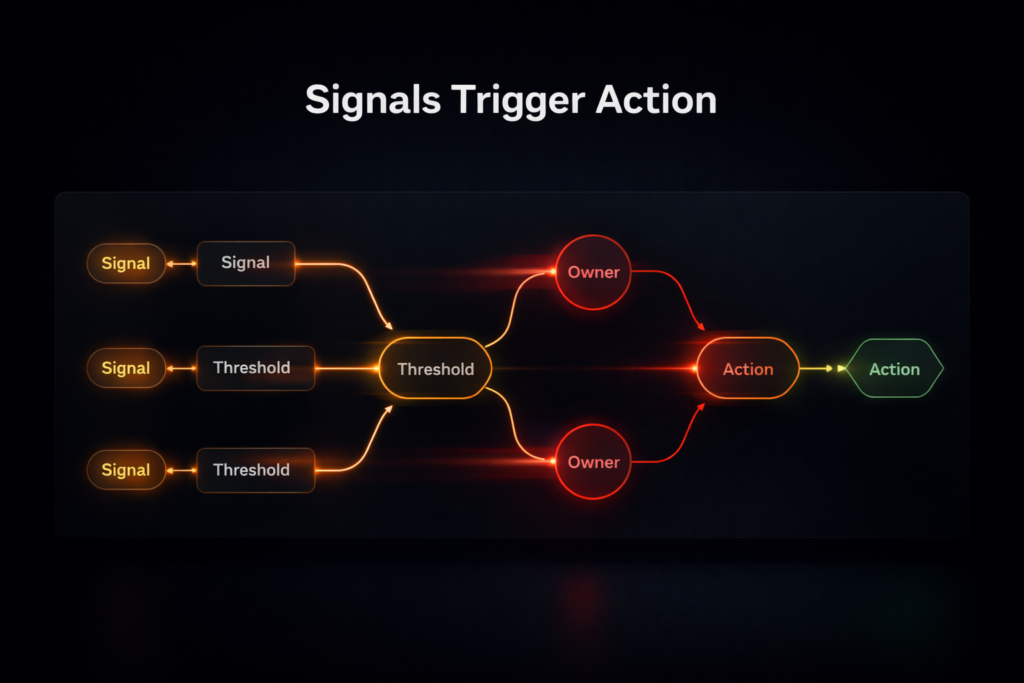
Building Signal Thresholds, Ownership, and Response Logic
A signal without ownership is trivia.
Most businesses notice weak signals. They still fail because no threshold defines when recognition becomes authority.
System definition: thresholds convert ambiguity into action authority.
Real-world consequence: teams keep discussing the same risks while performance decays.
The architecture is simple:
signal
threshold
owner
response logic
cross-functional consequence
This is where founder instinct must become system memory. At $10M+, complexity outgrows personal sensing. Judgment must be externalised into repeatable operating logic.
This is what you are doing wrong and why it matters: if the default response to drift is “let’s keep watching it,” the business is training passivity.
This is why your pipeline looks strong but doesn’t convert consistently.
The companies that scale cleanly operationalise judgment before complexity forces it.
Repeated leadership discussions without thresholds teach the organisation that awareness carries no consequence.
Pro Tip
Build thresholds around rate-of-change, not absolute values.
Strategic risk usually emerges through acceleration, not magnitude.
How Growing Companies Turn Signals Into Strategic Control
Strategic control is not certainty. It is reducing the distance between detection and coordinated response.
System definition: control is the speed and consistency with which weak signals become aligned action. In practice, it means predefined rules for when to act, who acts, and what changes.
Real-world consequence: long loops create drift across sales, marketing, and operations.
The business often knows before the system moves.
Marketing sees message fatigue before sales scripts evolve. CS notices onboarding confusion before process ownership changes. Finance spots DSO creep before account workflows adjust.
The better lens is clear: control is a systems property, not a leadership trait.
What changes organisationally when this loop is designed well is significant.
Founder escalations drop because authority is already distributed through thresholds. Teams spend less time re-explaining the same friction across functions because ownership transfers are predefined.
Capital allocation improves because spend shifts happen earlier, before KPI deterioration forces defensive cuts.
This is where scaling businesses either fragment or compound. Without designed response loops, growth multiplies misalignment faster than leadership can manually correct it.
The next level of leadership is designing businesses that can think before you do.
The longer the signal-to-action loop, the more growth amplifies fragmentation. The financial consequence is slower correction, wasted spend, and delayed cross-functional movement at exactly the scale where timing matters most.
Pro Tip
Map one end-to-end signal pathway this quarter—from weak signal to final response owner.
Clarity compounds when the business learns how to move as one organism.
The Shift From Reporting Systems to Decision Systems
The future is not better dashboards. It is businesses designed as decision systems.
Dashboards still matter, but they must sit below the layer that truly drives strategic control: trigger logic, ownership architecture, and escalation design.
System definition: a decision system is a business where information changes behaviour by design.
Real-world consequence: businesses that stay in reporting mode scale complexity faster than capability.
The shift is foundational: stop asking what should be measured and start asking what should automatically change when weak signals emerge.
The most dangerous businesses are not the ones with poor reporting.
They are the ones with beautiful dashboards and slow escalation logic. The numbers create emotional comfort while the system quietly loses responsiveness.
Mature leaders learn to distrust polished calm.
At your scale, complexity is no longer a side effect. It is the main opponent.
Pro Tip
Redesign your weekly leadership cadence around decisions made, not dashboards reviewed.
Momentum follows changed behaviour, never improved visibility.
Conclusion
The frustration was never missing data. It was the illusion of control created by settled metrics while strategic risk formed underneath.
That tension is optional.
Once dashboards return to their proper role—as evidence inputs rather than strategic control systems—the business changes shape.
Decisions no longer wait for visible damage. Weak signals connect to thresholds, ownership, and response logic early enough to protect momentum.
The cost of inaction is already real: slower sales corrections, recurring operational friction, misallocated spend, and leadership teams that mistake late decisions for discipline.
Stay in reporting mode, and growth itself becomes the force that makes the business harder to trust.
There is relief on the other side. When judgment is codified into signal pathways, the business moves earlier, cleaner, and with less founder drag.
Identity anchor: The strongest companies are not the ones with the best dashboards—they are the ones that convert weak signals into decisive movement.
Your current state is not the price of scale. It is an outdated system design.
Stay stuck in polished hindsight, or step into strategic control now.
Action Steps
Audit every KPI against a decision trigger
Define what leadership action should change before the KPI visibly moves. This matters strategically because it converts hindsight into governance. The consequence is earlier intervention and lower correction cost.
Build pre-KPI signal layers
Track behavioural drift: reply lag, stalled approvals, exception clusters, revision loops. This matters because transition states reveal instability first. The decision consequence is faster cross-functional correction.
Assign ownership to weak signals
Every recurring signal needs a named owner and escalation authority. Strategically, this removes political hesitation. The consequence is that drift stops becoming recurring discussion.
Set rate-of-change thresholds
Govern acceleration, not only magnitude. This matters because strategic risk emerges through momentum shifts. The decision consequence is acting on drift velocity before KPI damage.
Redesign leadership meetings around triggered decisions
Replace dashboard review as the centrepiece with breached thresholds and actions triggered. This matters because it compresses interpretation cycles. The consequence is less executive fatigue and faster response speed.
Map one signal-to-action pathway this quarter
Choose one critical pathway and codify it fully. This matters because control scales through repeatable loops. The consequence is a business that learns before the founder must intervene.
FAQs
Why don’t dashboards improve strategy on their own?
Because dashboards describe state, not momentum. The immediate decision path is to define what actions must trigger before KPIs visibly deteriorate.
What are strategic warning signals?
Weak behavioural shifts—deal ageing, response delays, repeated exceptions—that appear before financial outcomes move. The decision path is to operationalise them into thresholds.
Why is false confidence dangerous?
Stable reporting can suppress escalation urgency while underlying drivers worsen. The decision path is to review contradictions between field reality and dashboard stability.
What is decision intelligence in practical terms?
It is the operating layer linking signals to thresholds, ownership, and response logic. The decision path is to map one KPI to its pre-KPI trigger system.
How do we make this scalable beyond the founder?
Externalise judgment into thresholds and escalation logic. The decision path is to codify founder instinct into cross-functional ownership rules.
Bonus Insight: What Most Leaders Still Get Wrong
Most leaders still believe better visibility creates better control. It doesn’t. Visibility without intervention logic simply improves the quality of hindsight.
The deeper truth is that strategic slowness is usually a systems design issue disguised as reporting maturity. The business feels disciplined because the dashboards are polished, while decision latency quietly compounds underneath.
1) Your dashboards may be training passivity
This is what you are doing wrong and why it matters: when every issue must first become a KPI movement, the organisation learns to wait for evidence instead of governing drift.
Consequence: delayed reaction becomes culture.
2) Exceptions are often more strategic than averages
The average hides where the system is changing. Repeated “edge cases” often contain the earliest strategic truth.
Consequence: the business keeps scaling blind spots.
3) Founder instinct must become system memory
The strongest operators often still rely on gut recognition. The unconventional shift is to convert instinct into explicit thresholds and ownership logic.
Consequence: complexity outgrows judgment.
Other Articles
Decision Intelligence in Business: From Data to Action