

Build an early-warning decision layer that surfaces demand shifts, competitor moves, and risk patterns before dashboards confirm them.
An AI signal capture system strengthens market intelligence by detecting weak shifts in demand, pipeline confidence, competitor movement, and operational lag before they appear in lagging KPIs.
Its real advantage is not better reporting, but faster strategic correction through governed thresholds, escalation logic, and automated response routing that preserves decision freshness.
For $5M–$20M businesses, this reduces drift across marketing and sales, improves forecast predictability, and reinforces growth stability as complexity increases.

The Structural Failure: Response Latency Hidden as Reporting
The failure rarely begins in the dashboard.
It begins in the space between market movement and organisational response.
A $5M–$20M business rarely suffers from lack of data. It suffers from delayed interpretation.
The market moves in weak signals first—slower reply velocity, rising objection repetition in sales calls, declining second-touch engagement, unusual competitor messaging shifts, widening deal age variance, and customer hesitation around budget timing.
None of these signals alone appears catastrophic. Together, they form a structural warning.
Most teams misdiagnose this as a reporting problem.
They add more dashboards, expand attribution layers, or request cleaner KPI definitions. But the deeper weakness is architectural: the business has no intelligence layer capable of converting fragmented signal drift into governed strategic response.
The result is system fragility.
Marketing continues optimizing campaigns that are already losing resonance.
Sales continues forecasting from pipeline volume while deal confidence decays.
Leadership sees the effect only when lagging revenue confirms the damage.
By then, the response window has narrowed.
This is not a visibility issue.
It is response latency embedded into the operating system of the business.
The Hidden Cost: Decision Staleness and System Drift
The cost rarely appears as one dramatic failure.
It appears as drift.
Positioning slowly separates from live market demand.
Sales narratives remain anchored to objections that existed one quarter ago.
Campaign spend compounds behind channels whose efficiency is already deteriorating.
Pipeline value appears stable while conversion probability silently weakens.
The hidden cost is not just missed opportunity. It is decision staleness.
Every executive decision made from expired signal conditions introduces structural mismatch between reality and action.
That mismatch compounds across functions.
Marketing generates demand against outdated assumptions.
Sales sequences prioritize accounts with weakening intent.
Customer success forecasts expansion against sentiment patterns already in decline.
Finance protects budgets based on confidence intervals that no longer hold.
The consequence of inaction is not immediate collapse.
It is a slow reduction in predictability.
Growth begins to feel inconsistent, not because the team is underperforming, but because the system is making high-confidence decisions on low-freshness intelligence.
This is where market intelligence architecture becomes an implementation layer of AI growth architecture rather than a research discipline.

The Architectural Principle: The Strategic Signal Integrity Loop
The principle is continuity enforcement through signal visibility and escalation layering.
The goal is not to know more.
The goal is to reduce entropy between external change and internal decision logic.
This can be understood as the Strategic Signal Integrity Loop:
signal emergence, confidence convergence, correction routing, and forecast stabilisation.
Without this loop, valid processes continue executing against expired assumptions, and organisational confidence compounds around stale market truth.
Every growth system degrades when the latency between signal emergence and executive interpretation becomes too wide. This creates organisational entropy: teams continue executing valid processes against invalid assumptions.
An AI signal capture system exists to compress that latency.
Its architectural purpose is fourfold.
First, it creates signal visibility by unifying weak external and internal indicators that normally remain isolated across CRM, campaign systems, customer conversations, and market-facing channels.
Second, it reduces cognitive load by removing the need for leaders to manually infer patterns across fragmented data points.
Third, it contains bottlenecks by routing anomalies to the decision layer closest to the leverage point rather than forcing every issue upward into leadership.
Fourth, it reinforces continuity by ensuring the business responds to directional shifts before they become financial outcomes.
This is not automation for efficiency.
It is automation as structural integrity.
The system is designed to preserve strategic coherence while the environment changes.
The Signal Logic: Convergence Thresholds and Decision Rights
The logic begins with signal classes, not dashboards.
The system watches for movement in four categories.
Demand signals.
These include changes in inbound inquiry quality, pricing sensitivity language, shortened research cycles, unusual increases in dormant lead reactivation, or abrupt traffic shifts around competitor comparison pages.
Pipeline signals.
These include stage aging anomalies, stalled proposal movement, declining multithreaded stakeholder engagement, repeated procurement delays, and forecast confidence divergence between reps and historical close behaviour.
Market signals.
These include competitor repositioning, messaging frequency changes, hiring shifts in adjacent categories, customer language drift in reviews, regional demand softening, and search volatility around new budget-risk framing.
Operational signals.
These include rising sales handoff lag, delayed campaign iteration cycles, content production bottlenecks, and growing response-time variance between teams.
Thresholds matter less as static numbers and more as deviation logic.
A single anomaly rarely triggers action.
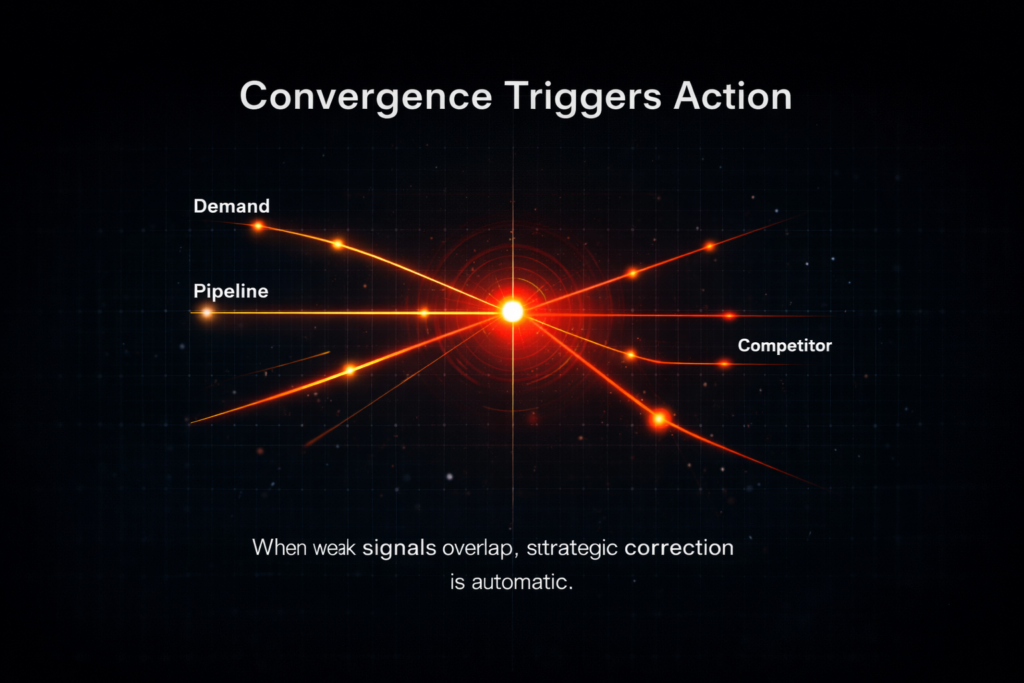
The architecture responds to convergence.
For example, if proposal aging increases 18 percent, competitor pricing pages spike in visibility, and call transcripts show a repeated procurement hesitation theme across two weeks, the system interprets not isolated variance but market-condition shift probability.
That is the threshold.
Not one KPI moved.
But three independent signals now imply the same directional risk.
What this means operationally is that threshold design should protect leadership attention, not maximise alert volume.
Once convergence crosses the intervention boundary, the decision path should already be pre-assigned to the owner with the shortest correction loop.
The automated decision layer then determines the response path.
Should the issue route to sales enablement for narrative correction?
Should campaign messaging be reweighted toward ROI-risk language?
Should leadership receive a strategic pricing pressure alert?
Should forecast confidence be temporarily discounted?
The decision logic is probabilistic, not binary.
Its purpose is to preserve response quality while reducing delay.
The Automation Layer: Correction Routing and Escalation Control
Only after the architecture is clear does the automation layer become useful.
The implementation layer operates as a correction and control system.
When convergent weak signals cross the confidence threshold, the automation layer installs three forms of control.
Detection control.
Signals are continuously captured from internal systems and external market surfaces. The automation layer normalises these into comparable movement patterns rather than raw source-specific metrics.
Interpretation control.
Conditional logic evaluates whether the movement is noise, cyclical variation, or structural change. This is where escalation rules matter. Repeated low-confidence anomalies may stay local. Cross-functional signal convergence routes upward.
Response control.
Once confidence exceeds the intervention threshold, the system triggers predefined strategic corrections.
An example implementation might work like this.
If outbound reply rates decline for enterprise accounts while deal-stage aging rises beyond normal variance and competitor pricing language shifts toward risk-sharing models, the system routes an escalation to the revenue architecture layer.
The trigger is not channel underperformance.
The trigger is signal convergence around perceived commercial risk.
The response may automatically adjust messaging tests, flag pricing objection libraries for sales leadership review, temporarily reroute ABM spend toward higher-conviction segments, and downgrade forecast certainty assumptions used in weekly executive planning.
At the leadership level, this changes the quality of intervention.
Instead of reacting to missed numbers, leaders intervene at the assumption layer where instability first forms.
What This Means in Practice: Founder-Level Translation
What this means in practice is simple:
your business stops waiting for lagging KPIs to grant permission to adapt.
Instead of discovering market shifts in monthly reviews, the organisation receives governed early warnings while the correction window is still open.
Marketing does not continue scaling spend into deteriorating resonance.
Sales does not continue trusting inflated pipeline optics.
Leadership does not overcommit based on stale confidence.
The business begins to operate with a live strategic nervous system.
That changes the emotional reality of growth.
Instead of growth feeling fragile, leadership confidence becomes rooted in signal freshness.
Instead of teams debating whose dashboard is correct, they align around which structural pattern now requires intervention.
This reduces executive fatigue because fewer decisions begin from ambiguity.
The Stability Outcome: Predictability Through Drift Reduction
The ultimate outcome is drift reduction.
System drift occurs when marketing, sales, and leadership operate from different assumptions about current market conditions.
An AI signal capture architecture closes that gap.
It reinforces structural integrity by ensuring that demand generation logic, sales conversion logic, and executive planning logic are continuously calibrated against the same live directional inputs.
This increases predictability in three ways.
First, it reduces decision latency.
The business responds while weak signals are still useful.
Second, it improves forecast realism.
Pipeline confidence is continuously stress-tested against live market behavior.
Third, it strengthens continuity across growth functions.
Marketing messaging, sales narratives, and leadership priorities remain aligned to the same evolving external truth.
This is the real implementation layer of AI growth architecture.
Not software.
Not dashboards.
Not isolated automations.
It is the installation of a governed intelligence layer that protects the business from making expensive decisions under stale assumptions.
That is how automation reinforces growth stability.
Not by replacing operators.
By preserving structural coherence as the market changes.
For a business operating between $5M and $20M, that coherence is often the difference between scaling momentum and invisible strategic drift.
The businesses that grow predictably are rarely the ones with the most data.
They are the ones whose systems know how to detect change early, escalate intelligently, and correct before instability spreads across marketing and sales.
That is what structural integrity looks like in modern growth architecture.
And once installed, it becomes one of the few advantages that compounds as complexity increases.
FAQs
What should a business monitor first in an AI signal capture system?
Start with demand quality, pipeline aging variance, and repeated objection language across sales calls. These signals surface structural market change earlier than revenue dashboards because they move closer to buyer intent. The immediate decision path is to route convergent movement in these three signals to weekly leadership review before forecast assumptions are locked.
How should thresholds be defined without creating alert noise?
Use convergence thresholds across independent signal classes rather than single-metric triggers. This reduces false positives because isolated anomalies rarely justify executive intervention, while multi-source alignment indicates directional change with higher confidence. The immediate decision path is to escalate only when at least three signals move in the same direction inside the same decision cycle.
What decisions should the automation layer handle?
Automate correction routing, forecast confidence adjustments, and messaging reweight recommendations. The reason is to preserve strategic freshness without forcing leadership to manually interpret weak signals under time pressure. The immediate decision path is to automate intervention pathways while reserving pricing, segmentation, and budget shifts for executive approval.
How does this architecture reduce drift between marketing and sales?
Unify both functions around the same live signal logic instead of separate lagging KPIs. This reduces cross-functional mismatch because messaging changes, pipeline risk scoring, and campaign priorities are recalibrated from shared market truth. The immediate decision path is to make signal convergence the governing input for both demand and revenue planning meetings.
How does this improve forecast predictability?
Continuously stress-test pipeline confidence against live demand, competitor, and objection signals. This improves realism because forecast models adapt before stage-based optimism compounds into revenue misses. The immediate decision path is to apply automatic confidence discounts whenever signal divergence exceeds historical conversion variance.
How can leadership decide when to escalate versus keep correction local?
Escalate only when signal convergence implies structural market change rather than workflow-level variance. This preserves executive attention because most isolated execution issues can be corrected inside the functional layer. The immediate decision path is to send local anomalies to channel owners, but route cross-functional convergence to the revenue or strategy leadership layer.
What is the fastest way to create stability from this system?
Install a correction loop tied to weekly decision cadence, not monthly reporting cycles. The reason is that signal half-life decays quickly, and delayed interpretation turns intelligence into stale reporting. The immediate decision path is to align detection, escalation, and response rules to the same weekly operating rhythm used for forecast and pipeline review.
Other Articles
Decision Intelligence in Business: From Data to Action