
Turn real-time market signals into clear, fast course correction before revenue is impacted
An AI competitive intelligence system detects early competitive signals, applies defined thresholds, and triggers structured responses before revenue is impacted.
Instead of relying on delayed reports, it converts market movement into immediate decision pathways through automated escalation and routing.
This creates a control layer that reduces strategic drift, increases decision speed, and stabilises growth under competitive pressure.
Structural Failure: Where Competitive Awareness Breaks
At the $5M–$20M stage, most businesses believe they are competitively aware.
They track competitors. They review lost deals. They analyse campaigns. They monitor pricing shifts.
On the surface, nothing is missing.
But the system is structurally incomplete.
Competitive intelligence exists as a passive layer. It informs discussion, but it does not drive response. It surfaces after movement has already occurred. It explains outcomes instead of shaping them.
This is the failure.
Not a lack of data. A lack of conversion from signal to action.
Awareness is mistaken for control. In reality, awareness without response is delayed reaction.
And delayed reaction introduces drift.
Hidden Cost: The Price of Signal Lag
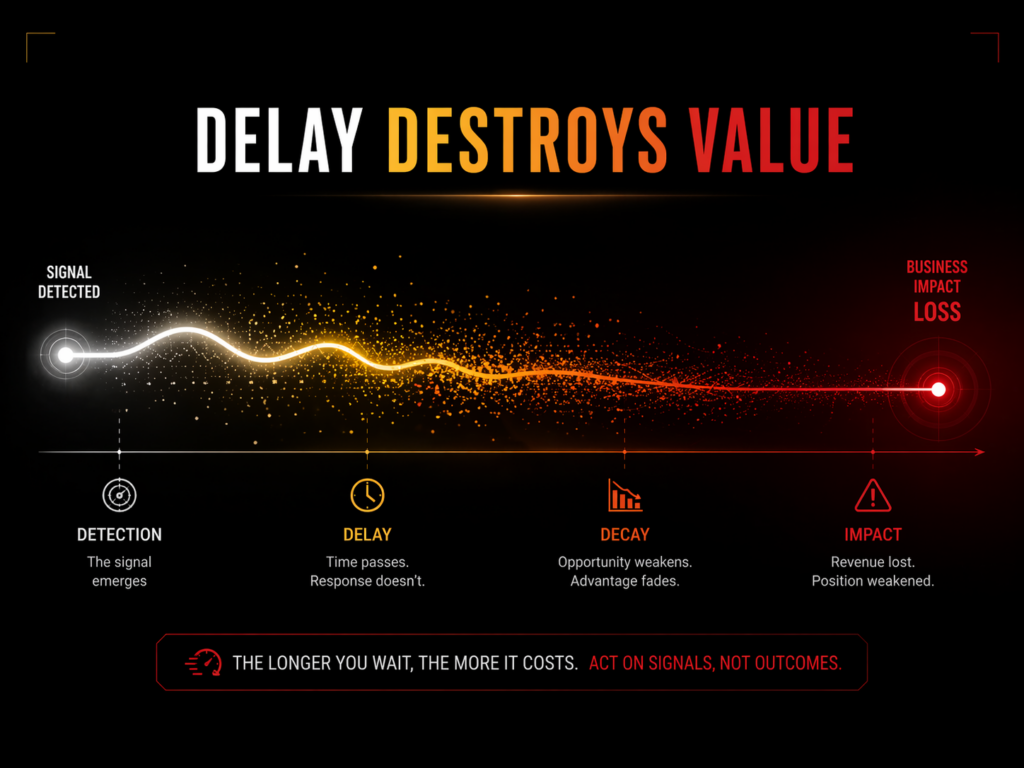
The impact does not arrive as a single event.
It accumulates.
Messaging starts to feel slightly misaligned. Win rates decline gradually. Sales cycles extend. Marketing performance flattens.
This is where most teams misdiagnose the problem.
Each signal is small enough to rationalise.
A campaign underperformed. A segment cooled. Execution slipped.
But the pattern is consistent: the business is responding after the market has already shifted.
This is signal lag.
It creates a gap between what is happening externally and how the business is operating internally.
That gap distorts decision-making.
You see this most clearly when pricing pressure appears in deals before any internal pricing discussion has occurred, or when competitors reposition before your messaging is reviewed.
What appears as isolated inefficiency becomes systemic misalignment. Strategy is adjusted based on outdated conditions. Teams optimise for a version of the market that no longer exists.
The cost is not missed information.
It is delayed interpretation and inconsistent response.
Left unchecked, this compounds into structural weakness across marketing, sales, and positioning.
Architectural Principle: From Awareness to Control
The correction is not better reporting. It is architectural.
An AI competitive intelligence system is not a dashboard layer. It is a control layer.
Its role is to maintain alignment between external market movement and internal decision-making.
Two principles underpin this.
Signal visibility.
The system detects competitive movement early, before it surfaces in lagging metrics. It identifies directional shifts, not just outcomes.
This means seeing competitor pricing changes in deal feedback before they impact win rates, or identifying messaging overlap before engagement declines.
Escalation layering.
Signals are not left for interpretation. They are routed into defined decision pathways, with clear ownership and response expectations.
Together, these reduce entropy.
Without them, teams interpret signals inconsistently. Decisions are delayed, diluted, or missed entirely. The organisation drifts under external pressure.
With them, the business maintains coherence. Competitive pressure is absorbed and responded to in a controlled way.
This is not about predicting the future.
It is about reducing the gap between signal emergence and decision response.

Signal Logic: Defining What Matters
The system only works if signal logic is precise.
Most businesses collect data. Few define what qualifies as a signal.
Four elements matter.
What signals are detected.
These are early indicators of competitive movement. Not generic metrics, but directional changes.
Examples include shifts in competitor positioning, increased outbound activity in a target segment, pricing adjustments, or recurring patterns in lost deals tied to a specific competitor.
If the signal does not indicate a change in market behaviour, it is not actionable.
What thresholds matter.
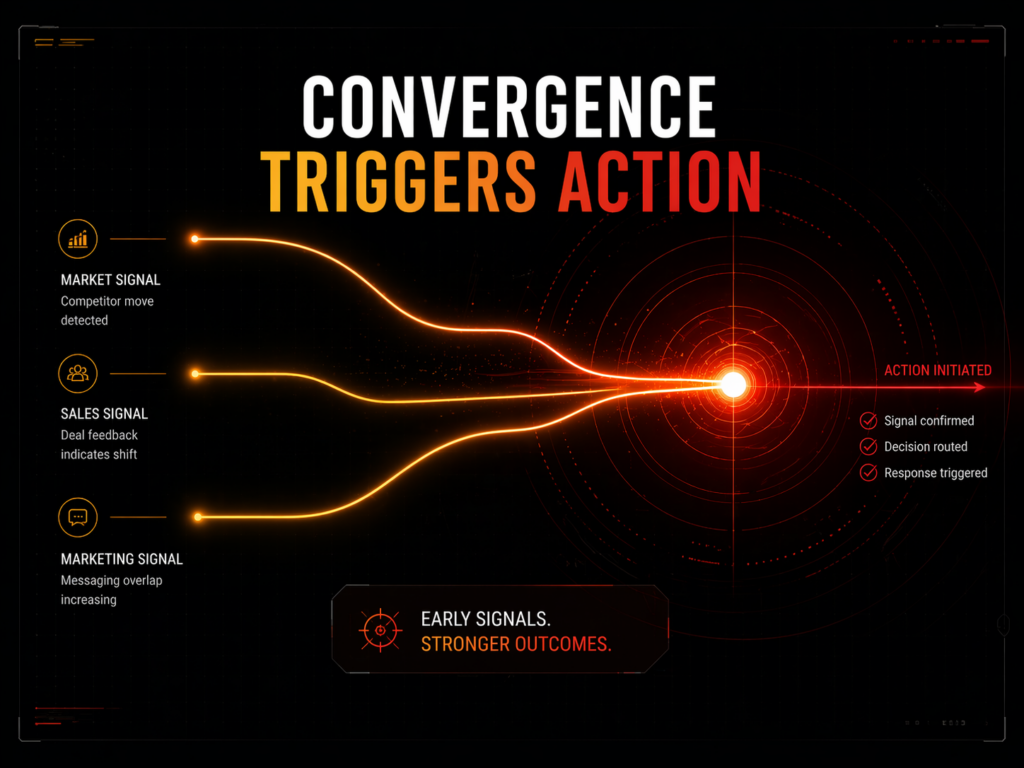
Single data points are rarely meaningful. The system defines convergence.
One lost deal is noise. A cluster of losses tied to the same competitor, combined with pricing pressure and messaging overlap, becomes a trigger.
This is where most systems fail — they react to isolated data instead of defined patterns.
Thresholds convert data into decision conditions.
What decisions are initiated.
The system does not automate strategy. It automates response initiation.
When thresholds are met, predefined actions are triggered. This may include a messaging review, pricing analysis, campaign adjustment, or escalation to leadership.
If a signal does not trigger a response, it has no operational value.
The objective is consistency, not autonomy.
What correction layer is installed.
Every triggered action feeds into a feedback loop. The system monitors outcomes and adjusts thresholds or responses over time.
This closes the gap between signal, decision, and result.
Without this loop, the system reverts to passive observation.
Automation Layer: Enforcing Response Integrity
Once signal logic is defined, automation becomes the enforcement mechanism.
Not to replace judgment, but to remove dependence on attention.
The automation layer ensures that signals are detected, routed, and acted on without delay.
Detection.
The system continuously monitors defined inputs. CRM data, marketing performance, competitor activity, and sales feedback are scanned for emerging patterns.
It is not waiting for reports. It is identifying shifts as they form.
This is the difference between reviewing outcomes and observing movement in real time.
Routing.
When thresholds are met, signals are directed to the appropriate function.
Marketing signals trigger campaign or messaging review. Sales signals inform enablement or positioning. High-impact signals escalate to strategic oversight.
This removes ambiguity. Teams do not decide whether something matters. The system has already defined it.
Escalation.
For high-confidence signals, response is enforced.
This may involve triggering structured reviews, initiating cross-functional workflows, or elevating decisions to leadership within a defined timeframe.
Escalation is embedded, not optional.
This is where most businesses fail — signals are seen, but not acted on with urgency or structure.
Without this layer, signals rely on human prioritisation. And prioritisation is inconsistent under pressure.
With it, response becomes structural.
What This Means in Practice
This system changes how competitive pressure is experienced.
Signals no longer appear as surprises in quarterly reviews. They surface as controlled inputs, with defined meaning and response.
When a competitor shifts positioning, the system detects overlap early. When that shift begins to influence deal outcomes, thresholds are reached. When thresholds are met, response is triggered.
The founder is not searching for signals.
They are receiving structured escalations with context and defined options.
The decision is no longer whether something is happening.
It is how to respond within a clear window.
This is where the shift becomes visible.
Meetings move from debating whether something matters to deciding how to respond. Teams stop interpreting signals and start executing against them.
Leadership moves from reactive interpretation to controlled intervention.
Resolution: Stability Through Structured Response (Refined Section)
The outcome is not speed for its own sake.
It is stability.
Drift is reduced because the system continuously realigns with external conditions.
Predictability increases because signals are processed consistently, not subjectively.
Marketing and sales remain aligned because both operate from the same signal framework, not independent interpretations.
Decisions happen earlier, with clearer context and less noise.
The business does not eliminate uncertainty.
It contains it.
The distinction becomes clear over time.
Most businesses react to outcomes. Structurally sound businesses act on signals before those outcomes fully materialise.
An AI competitive intelligence system, designed as an implementation layer, reinforces structural integrity.
Signals are detected early. Responses are triggered consistently. Feedback loops refine the system over time.
The advantage is not more information.
It is the ability to act with clarity before misalignment compounds.
And over time, that becomes a defining characteristic of how the business grows.
FAQs
What is the core purpose of an AI competitive intelligence system?
It converts competitive signals into structured decision triggers, not just insights. This ensures the business responds before impact shows up in revenue metrics. If signals are not tied to action, the system remains observational and ineffective.
How do I decide which competitive signals actually matter?
Focus on signals that indicate directional change—such as repeated lost deals, pricing shifts, or messaging overlap. Combine multiple signals into thresholds to avoid reacting to noise. If a signal cannot trigger a decision, it should not be prioritised.
What should happen when a signal threshold is reached?
The system should initiate a predefined response, such as a pricing review or messaging adjustment. This removes reliance on ad hoc decision-making and ensures consistent action. If no action is triggered, the signal has no operational value.
How does automation improve competitive decision-making?
Automation enforces detection, routing, and escalation without delay or bias. It ensures signals are not missed or deprioritised under pressure. If response depends on human attention alone, signal lag will persist.
How does this system reduce strategic drift?
By continuously aligning internal decisions with external market movement. Signals are processed in real time, preventing the business from operating on outdated assumptions. Without this, misalignment compounds quietly across teams.
How should marketing and sales use the same signal framework?
Both functions must respond to shared signals with predefined actions. Marketing adjusts positioning, while sales adapts messaging and enablement based on the same triggers. If each team interprets signals independently, alignment breaks down.
How do I know if the system is working effectively?
Look for faster response times, improved win rates, and reduced lag between signal detection and action. The system should show clear feedback loops between signals and outcomes. If decisions still feel reactive, the architecture is incomplete.
Other Articles
Why Executive Dashboards Miss Strategic Warning Signals