

Build systems that capture lessons, fix root causes, and improve every decision cycle.
Businesses stop repeating the same mistakes at scale by building systems that capture lessons, expose root causes, and improve future decisions.
Recurring business mistakes usually happen because growth multiplies weak decision architecture, unclear ownership, and uncaptured learning.
The solution is not more effort; it is a business memory system that turns operational friction into compounding advantage.
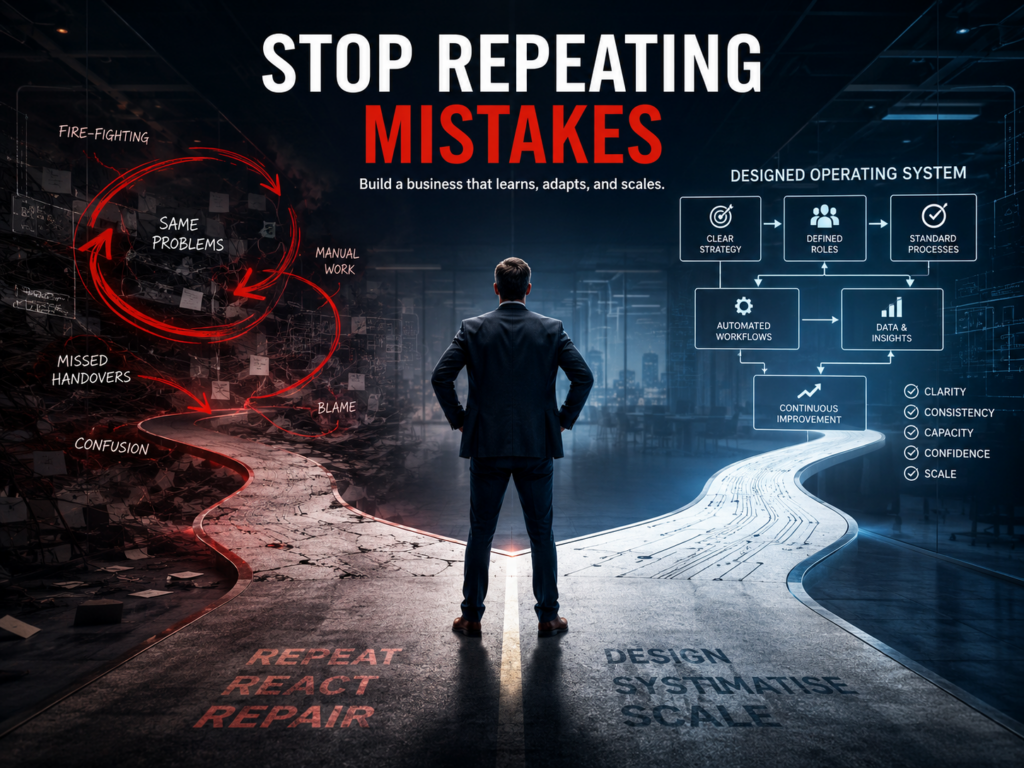
Most businesses do not repeat mistakes because their teams are careless. They repeat mistakes because the business has no reliable mechanism for converting experience into better future decisions.
That is the structural failure.
At $5M–$20M turnover, the business is usually too large to run on founder memory and too small to have mature institutional learning systems.
The owner still sees the patterns, but no longer sees all of them in time.
Sales hears the same objections. Marketing keeps producing campaigns that generate attention without enough conversion. Operations keeps solving delivery issues manually.
Leadership keeps revisiting problems that were supposedly fixed months ago.
You can see it in the Monday meeting. Everyone knows the same handover failed again. Sales says the client was urgent. Delivery says the scope was unclear. Finance says the margin is thinner than expected.
The owner asks for better communication. Everyone agrees. Nothing structural changes.
The hidden tension is that the business is working hard, but not necessarily getting wiser.
Most teams misdiagnose this as an accountability, discipline, communication, or process problem. Those may be symptoms. They are rarely the core failure.
The deeper issue is that the business has not made learning structural. Lessons are discussed, but not captured.
Problems are fixed, but not converted into prevention. Decisions are made, but the reasoning behind them is not preserved for the next cycle.
The result is operational amnesia.
A business has only learned something when the lesson changes how future work happens without relying on the same person remembering it. Until then, the knowledge lives inside individuals, not inside the operating system of the business.
This matters financially because repeated mistakes are not isolated costs. They compound.
A weak handover creates rework. Poor qualification creates low-quality pipeline. Unclear positioning creates longer sales cycles. Inconsistent onboarding creates avoidable customer friction. Vague ownership creates leadership drag.
Each issue consumes time, attention, margin, and trust.
The cost is not just the mistake. The cost is paying for the same lesson repeatedly.
The architectural principle is simple: recurring mistakes are downstream of decision architecture.
Decision architecture is the way your business shapes choices before people are under pressure. It includes the rules, signals, ownership lines, incentives, and feedback loops that make certain decisions more likely than others.
If the same mistakes keep appearing, the business should not begin by asking who failed.
It should ask what conditions made the mistake likely. What information was missing? What decision rule was unclear? What feedback was ignored? What ownership line was blurred? What signal was visible but not acted on?
This reframes the work. The objective is not to make people try harder. The objective is to redesign the system so that better decisions become easier, faster, and more repeatable.
More effort will not solve a memory problem. More meetings will not solve a decision architecture problem. More tools will not solve a learning system problem.
The business needs a structural redesign.
Why Businesses Repeat the Same Mistakes as They Grow
Businesses repeat mistakes because growth increases activity faster than it increases learning.
At $5M, the owner can often see enough of the business to catch patterns personally. They know which leads are weak, which clients need more education, which staff member needs clearer direction, and where the bottlenecks sit.
At $10M or $20M, that visibility breaks.
More people are making decisions. More customers are entering the system. More offers, channels, suppliers, tools, meetings, and exceptions appear. The business becomes louder. Not necessarily smarter.
The default response is to add control: more reporting, more check-ins, more approvals, more management layers. But control is not the same as learning. Control slows the mistake down. Learning removes the conditions that keep producing it.
System definition: If a mistake is solved only at the event level, it will return at the pattern level.
A missed follow-up is not just a missed follow-up. It may reveal a weak CRM process, unclear sales ownership, poor lead qualification, or no standard for what happens after a discovery call.
The rep adds a note. The manager asks for better follow-up. The opportunity still sits in the same pipeline stage next month because no one changed the rule for what happens after interest is shown.
A late delivery is not just a late delivery. It may reveal capacity blindness, weak handover points, or promises being made by sales that operations cannot fulfil.
Real-world consequence: The business keeps treating recurring patterns as isolated incidents.
This is why your sales team keeps re-explaining the same thing on calls. The market has already told you what it does not understand, but the business has not converted that signal into better messaging, better sales assets, or better qualification.
The longer this stays the same, the more growth feels like pressure instead of progress. Revenue rises, but so does drag. The owner becomes the memory of the business.
A founder once spent three Friday afternoons fixing the same delivery issue with three different clients.
Same desk. Same late-afternoon call. Same tight voice from the client asking why the timeline had changed. Each time, the team treated it as a client-specific problem.
The shift came when they realised the issue was not delivery at all; sales was promising timelines operations had never agreed to. The relief was immediate: the problem moved from blame to design.
They stopped managing exceptions and started building a business that could see itself.
Pro tip
Do not ask, “Who made the mistake?” first. Ask, “What did the system fail to make obvious?”
The deeper edge is not blame. It is visibility.
The Real Problem: No System for Capturing Learning
Most businesses do not lack lessons. They lack a place for lessons to go.
Every week, the business produces intelligence.
Sales calls reveal objections. Customer complaints reveal expectation gaps. Staff questions reveal unclear processes. Delivery delays reveal capacity limits. Lost deals reveal weak positioning. Rework reveals missing standards.
But most of that intelligence evaporates.
It gets trapped in meeting notes, inboxes, call recordings, dashboards, team chats, or the owner’s head. People talk about it. They agree it matters. Then the business moves on.
System definition: Learning that is not captured becomes personality-dependent.
If Sarah remembers the client issue, it gets handled. If the owner remembers the sales objection, it gets addressed. If the operations manager remembers the workaround, the team avoids the mistake.
But the business itself has not learned. A person has.
A business has only learned something when the lesson changes how future work happens without relying on the same person being present.
This is where growing companies fool themselves.
They confuse discussion with learning. They confuse awareness with improvement. They confuse “we talked about this” with “the system now prevents this.”
Real-world consequence: The same lesson keeps needing to be rediscovered by different people in different departments.
Marketing learns one thing. Sales learns another. Operations absorbs the pain. Leadership sees the symptoms. But no shared learning layer connects them.
This is why deals feel close but stall. The business has heard the hesitation before, but the insight has not been translated into sharper positioning, better proof, clearer proposals, or stronger follow-up logic.
Midway through growth, the owner faces an identity choice: you are either the person who keeps rescuing the business from its own forgetfulness, or the person who builds a business that remembers.
Every uncaptured lesson becomes future waste. It returns as another meeting, another delay, another avoidable conversation, another margin leak.
Pro tip
Create a decision memory habit. After every recurring issue, capture three things: what happened, why it happened, and what must change in the system so it is less likely next time.
The asset is not the note. The asset is the upgraded decision.

How Growth Turns Small Mistakes Into Recurring Patterns
Growth does not create entirely new problems. It exposes the problems that were previously small enough to survive.
A vague handover at $5M is annoying. At $15M, it becomes a delivery risk.
A weak sales qualification process at $5M creates a few poor-fit clients. At $20M, it fills the pipeline with opportunities that consume time but do not convert cleanly.
A founder making exceptions at $5M feels responsive. At $12M, it teaches the team that standards are negotiable.
System definition: Scale multiplies whatever is already embedded.
If the business has clear standards, scale multiplies consistency. If the business has unclear ownership, scale multiplies confusion.
If the business has strong feedback loops, scale multiplies learning. If the business relies on heroics, scale multiplies exhaustion.
This is where the default approach fails. Most owners wait until the problem becomes painful before they redesign the system. By then, the mistake is no longer a mistake. It has become behaviour. It has become expectation. It has become culture.
Culture is often just repeated operating logic with a story attached.
If people learn that urgent work always overrides important work, they stop protecting important work. If they learn that the loudest customer gets the most attention, they stop trusting the service model. If they learn that leadership changes priorities every week, they stop taking strategy seriously.
Real-world consequence: The business becomes less predictable as it grows.
Marketing launches campaigns without enough sales feedback. Sales closes work that delivery cannot support. Operations creates workarounds that leadership never sees. Finance reports margin pressure after the behaviour causing it has already spread.
This is why your pipeline looks strong but doesn’t convert consistently. The pipeline may not be the problem. The conversion system around it may be carrying old mistakes at higher volume.
Small mistakes are cheaper when they are still small. Once they become patterns, you are no longer fixing an error. You are rewiring a habit.
Pro tip
Look for repeat frequency, not drama.
The most dangerous mistakes are not always the biggest. They are the ones that happen quietly, often, and without triggering redesign.
Why Teams Fix Symptoms Instead of Root Causes
Teams fix symptoms because symptoms are visible, urgent, and emotionally satisfying.
Root causes are slower. They require honesty. They often reveal that the business is rewarding the behaviour it claims to dislike.
A customer complains, so the team responds faster. A project runs late, so someone works overtime. A proposal stalls, so sales follows up again. A staff member is confused, so the manager explains it one more time.
All of that can be useful. None of it necessarily fixes the system.
System definition: When urgency is rewarded more than prevention, the business trains people to become excellent firefighters.
This is one of the most expensive forms of competence. The team gets good at saving the day. Leadership praises the effort. Customers may even be retained.
But the underlying cause remains untouched.
Then the same problem returns.
Here is the direct challenge: if your business keeps celebrating rescue, it may be quietly avoiding redesign.
That does not mean people are doing the wrong thing. It means the organisation has made short-term relief easier than structural improvement. And when everyone is busy, relief wins.
Real-world consequence: The business becomes dependent on individual effort instead of systemic reliability.
In sales, this appears as reps manually overcoming the same objections because the positioning has not been fixed.
In marketing, it appears as campaigns that generate attention but not qualified demand because the message is unclear.
In operations, it appears as senior people constantly stepping in because process gaps were never closed.
Repeated symptoms are not interruptions to the business. They are messages from the business.
A late project is information. A confused customer is information. A stalled deal is information. A repeated staff question is information.
The question is whether the business converts that information into a better system or burns it as another busy week.
Symptom-fixing creates emotional exhaustion. People feel productive, but the business does not become more capable.
Pro tip
Separate containment from correction. Containment asks, “How do we handle this today?” Correction asks, “What must change so this does not keep needing attention?”
Leaders who confuse the two stay trapped in operational noise.
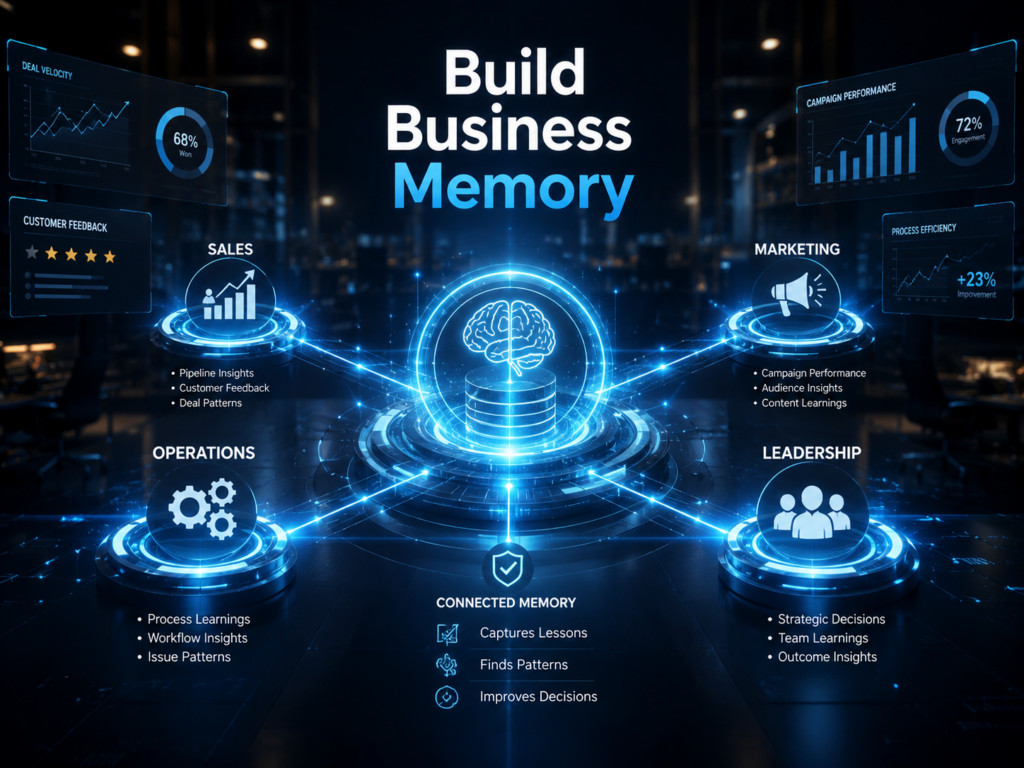
The Decision Architecture Behind Repeat Mistakes
Every repeated mistake is downstream of a decision system.
Not always a formal one. Sometimes the decision system is hidden. It lives in assumptions, incentives, defaults, approval habits, meeting rhythms, data gaps, and the way people interpret urgency.
But it is still there.
System definition: Decisions repeat when the conditions that produce them remain unchanged.
Take poor-fit leads. They rarely enter the business because one person made one bad call.
They enter because the CRM marks interest as opportunity, the sales target rewards volume, the qualification standard is loose, and the team is under pressure to keep the pipeline looking healthy.
Everyone is behaving rationally inside a flawed system.
That is decision architecture.
If sales keeps accepting poor-fit leads, look at the qualification rules, commission incentives, revenue pressure, and the language used to define a “good opportunity.”
If marketing keeps producing content that does not convert, look at how topics are chosen, how customer insight is captured, and whether performance data changes future briefs.
If operations keeps missing handovers, look at where responsibility transfers and what information is required before work moves forward.
The mistake is rarely isolated. It is usually designed into the environment.
A business does not rise to the quality of its intentions. It falls to the quality of its decision architecture.
That sentence should sting a little.
Because most businesses are full of good intentions. They want better communication, better accountability, better follow-up, better customer experience, better execution.
But intention does not scale. Architecture does.
Decision architecture means the business has defined how good decisions are made before pressure arrives. It clarifies what information matters, who owns the decision, what trade-offs are acceptable, what signals trigger escalation, and how learning feeds back into the next cycle.
Without that, the business improvises under pressure. And improvisation becomes inconsistent at scale.
Real-world consequence: Leaders get pulled into too many decisions, managers hesitate, teams wait, customers feel inconsistency, and margin leaks appear later.
Repeated mistakes are not just operational problems. They are strategic leakage. They show where the business has not made thinking explicit.
The owner’s judgement cannot remain the operating system forever. At some point, the business needs embedded logic, not constant intervention.
Pro tip
Document decision rules, not just processes.
A process tells people what steps to follow. A decision rule tells them how to think when the situation is not clean. That is where scale becomes safer.
How to Build Systems That Improve Over Time
A system improves over time when feedback changes the next action.
That sounds obvious. Most businesses do not operate that way.
They collect feedback, but do not use it.
They review performance, but do not redesign behaviour. They discuss problems, but do not change the conditions that created them. They install tools, but leave the thinking untouched.
System definition: Improvement compounds only when learning is captured, translated, and embedded.
Captured means the insight is recorded somewhere reliable.
Translated means the insight is converted into a change: a better script, clearer qualification rule, revised checklist, stronger onboarding sequence, improved offer, updated SOP, sharper dashboard, or new escalation trigger.
Embedded means the change becomes part of how work happens by default.
That is the difference between a business that reacts and a business that evolves.
For a $5M–$20M business, this does not need to be complicated.
Start with the recurring mistakes that cost the most time, money, trust, or attention. Look across sales, marketing, operations, and leadership. Ask where the same friction keeps appearing.
Then build a simple learning loop:
Identify the repeated issue.
Diagnose the root cause.
Decide what system needs to change.
Assign ownership.
Review whether the change reduced recurrence.
Store the lesson where future decisions can use it.
Real-world consequence: Without this loop, the business keeps paying for learning without keeping the asset.
AI can strengthen this loop when used properly. Not as a gimmick. Not as a content shortcut. As a memory and reasoning layer.
It can summarise sales call patterns, detect recurring customer objections, classify operational issues, compare project delays, and help leadership see patterns faster.
But the principle comes first. Tools do not create learning. They accelerate the system you already design.
Every week without a learning loop adds more invisible debt. The business gets busier, but not necessarily wiser.
A $12M service business kept losing momentum after strong discovery calls.
The CRM looked healthy, but the same stage kept going stale: proposal sent, no clear next action, no internal trigger, no reason captured when the buyer went quiet. The team assumed the issue was follow-up discipline, but the pattern showed prospects were leaving calls without a clear buying path.
Once the business captured objections, tightened qualification, and redesigned the proposal handover, the sales process felt less like pursuit and more like progression.
The owner stopped chasing confidence and started building it into the system.
Pro tip
Build the loop before buying more tools. Technology only compounds what the business knows how to repeat.
If your learning process is weak, automation spreads weakness faster.
Turning Recurring Problems Into Compounding Advantage
The goal is not to eliminate every mistake. That is fantasy.
The goal is to make every meaningful mistake improve the business.
That is compounding advantage.
Most companies think advantage comes from better people, better products, better marketing, or better technology. Those things matter.
But over time, one of the strongest advantages is a business that learns faster from reality than its competitors do.
System definition: When every mistake upgrades the system, the business becomes more capable with each cycle.
A lost deal improves qualification. A customer complaint improves onboarding. A delivery delay improves capacity planning. A confusing handover improves workflow design. A repeated objection improves messaging. A failed campaign improves market understanding.
Nothing is wasted.
In an ordinary business, mistakes create frustration. In a learning business, mistakes create assets.
This does not make failure comfortable. It makes it useful.
Real-world consequence: Competitors can pass you without being more talented. They simply learn faster.
Compounding advantage is not dramatic at first. It looks like fewer repeated questions. Cleaner handovers. Better-fit leads. Shorter sales cycles. More accurate promises. Faster onboarding. Stronger managers. Less founder dependency. Decisions that improve because the business has memory.
Then one day, the gap is obvious.
The business feels calmer. Not because there is less work, but because less work is wasted. The team is not constantly rediscovering the same lessons.
Customers feel the consistency. Leaders see patterns earlier. Growth becomes less chaotic.
The next stage of growth will not forgive the same operating habits as the last one. What got you here may keep you moving, but it may also keep you repeating.
The most dangerous businesses are not the chaotic ones.
They are the ones that look organised while repeating the same expensive patterns under a layer of meetings, dashboards, and capable people.
The shift is uncomfortable: order is not the same as intelligence.
A business becomes powerful when its systems learn faster than its people forget.
Pro tip
Treat recurring problems as strategic inventory. Each one contains a system upgrade waiting to be extracted. The companies that win are not the ones with no friction.
They are the ones that convert friction into capability.
Conclusion
Repeating business mistakes at scale is not a character flaw. It is a system flaw.
That matters because system flaws can be redesigned.
If the same issues keep returning, the business is not asking for more pressure.
It is asking for better memory, clearer decision rules, stronger feedback loops, and a more honest relationship with root causes.
The frustration you feel is not random. It is information. The delays, stalled deals, repeated customer issues, unclear handovers, and leadership bottlenecks are all pointing to the same deeper problem: the business has outgrown informal learning.
The relief comes when you stop treating every mistake as a fresh emergency.
You can build a business where lessons do not disappear.
Where sales objections sharpen messaging. Where operational breakdowns improve the process. Where customer friction upgrades onboarding. Where leadership decisions become easier because the system carries more of the thinking.
That is the emotional shift: from carrying the business in your head to building a business that can think with you.
The cost of doing nothing is not just another mistake. It is another cycle of avoidable effort. Another week where smart people solve the same problem twice. Another quarter where growth adds complexity but not capability.
Your current state is optional.
You can keep managing the same patterns with more effort, more meetings, and more personal intervention.
Or you can start building systems that capture lessons, fix root causes, and improve every decision cycle.
One path keeps the business dependent on memory, urgency, and rescue.
The other turns friction into clarity, and clarity into power.
Action Steps
Start where the same issue has appeared three times in the last quarter. Repetition is the signal. Cost is the priority filter.
Identify the mistakes that repeat, not the ones that feel loudest.
Frequency reveals system weakness better than drama. The decision consequence is that leadership stops chasing isolated fires and starts seeing which patterns quietly drain margin, time, and trust.
Separate containment from correction.
Containment solves today’s issue; correction changes the system that produced it. The decision consequence is that teams stop confusing responsiveness with improvement.
Capture the lesson before the business moves on.
Every recurring issue should produce a clear record of what happened, why it happened, and what must change. The decision consequence is that learning stops depending on individual memory.
Convert recurring problems into decision rules.
A process tells people what to do; a decision rule tells them how to think under pressure. The decision consequence is that fewer issues escalate to leadership because the business has embedded logic.
Review whether the fix reduced recurrence.
A fix is not proven because it was implemented; it is proven when the pattern weakens. The decision consequence is that the business measures learning by reduced repetition, not completed tasks.
Build a shared learning layer across sales, marketing, and operations.
Most repeated mistakes sit between departments, not inside one team. The decision consequence is that customer signals, sales objections, and delivery friction become connected intelligence instead of scattered noise.
FAQs
Why do businesses keep repeating the same mistakes?
Businesses repeat mistakes when lessons are discussed but not embedded into systems. The immediate decision path is to stop treating each issue as isolated and identify the pattern producing it.
How do you stop repeating business mistakes at scale?
You stop repeated mistakes by capturing lessons, diagnosing root causes, and changing the decision rules or processes that allowed the issue to recur. The next move is to build a learning loop around the most expensive recurring problems.
What is business memory?
Business memory is the system that preserves lessons, decisions, root causes, and operational signals so future work improves. Without it, the business depends on individuals remembering what the organisation should already know.
Why does growth make mistakes worse?
Growth multiplies whatever is already embedded in the business. If ownership, handovers, qualification, or feedback loops are weak, scale turns small gaps into recurring operational drag.
What is decision architecture in business?
Decision architecture is the structure that shapes how decisions are made: ownership, information, incentives, rules, escalation points, and feedback. If repeated mistakes continue, the decision architecture is usually unclear or misaligned.
Why is fixing symptoms not enough?
Symptom-fixing creates temporary relief but leaves the cause untouched. The decision path is to separate immediate containment from structural correction.
How do recurring problems become a competitive advantage?
Recurring problems become advantage when each one upgrades the system. A business that learns faster from friction builds stronger processes, clearer decisions, and more reliable growth over time.
Bonus Section – 3 Unconventional Shifts That Change How You See Repeated Mistakes
Most leaders are trying to reduce mistakes. That is the first problem.
A growing business should not aim to become mistake-free. It should aim to become mistake-intelligent.
The real failure is not that something went wrong. The real failure is when the business receives useful information and does not change because of it.
You are treating repeated problems as interruptions, not evidence.
This is what you are doing wrong: you keep asking how to get back to normal instead of asking what normal is revealing.
A repeated problem is not an interruption to the business. It is the business showing you its operating logic. If the same handover fails, the same customer gets confused, or the same deal stalls, the system is producing that outcome with some level of consistency.
If you do not change this, the business will keep converting useful signals into another busy week.
Your best people may be hiding your weakest systems.
Strong people often compensate for weak architecture. They remember the exceptions, rescue the client, explain the process, chase the follow-up, and protect the business from consequences that should have forced redesign.
That feels like strength. It can become dependency.
The better lens is to ask where the business only works because a capable person is carrying invisible complexity. That is not resilience. That is fragility with a talented face.
If you do not change this, growth will keep increasing the load on the same people until performance becomes personal endurance.
A mistake is not fully resolved until it changes future behaviour.
Most businesses close the issue when the customer is handled, the project is delivered, or the team has been briefed.
That is closure at the event level. It is not closure at the system level.
The deeper standard is this: the mistake is only resolved when the next similar situation is handled better by default.
That is where the business starts to mature. Not because it becomes perfect, but because it becomes harder to fool twice.
If you do not change this, the business will keep mistaking relief for progress.
Other Articles
From Task Automation to AI Decision Architecture