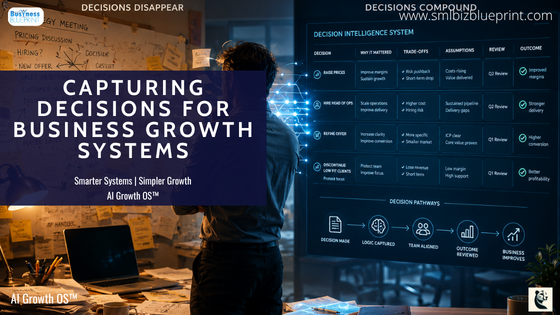

How decision history becomes a compounding advantage for scaling companies.
Capturing decisions for business growth means recording what was decided, why it was decided, what trade-offs were accepted, and what happened next.
This turns decision history into reusable business intelligence, reducing repeated debates, founder dependency, and inconsistent execution.
When structured properly, captured decisions also give AI the context it needs to analyse patterns across strategy, sales, operations, hiring, and customer experience.
Your business is not only losing time in meetings. It is losing the thinking that happened inside them.
A pricing decision gets made. A hiring call gets debated. A customer issue exposes a weakness in delivery. A sales objection reveals something the market does not understand.
Everyone nods, someone says “good point,” the team moves on, and within two weeks the reasoning has vanished.
The decision may still exist. The logic behind it does not.
That is the hidden cost most growing businesses never measure. Decisions are treated as moments instead of assets. They happen, shape the business, then disappear into memory, Slack threads, meeting notes, email chains, and half-remembered conversations.
Here’s how that shows up: two managers handle the same customer issue differently, sales discounts because they don’t understand the pricing logic, delivery bends rules nobody can explain, and leadership becomes the place every unclear decision returns to.
At $5M–$20M turnover, this becomes dangerous. The business is too complex to run on instinct alone, but not always structured enough to preserve its own intelligence. Growth creates more decisions. More decisions create more ambiguity. Ambiguity quietly taxes every department.
Capturing decisions for business growth systems changes the frame.
The point is not to create more documentation. That is the default mistake. The point is to build decision memory: a system that records what was decided, why it was decided, what assumptions were used, what trade-offs were accepted, and what happened afterwards.
A business that captures decisions does not just move faster. It learns cleaner. It improves judgment. It gives AI something useful to analyse.
You are not just building a company that executes.
You are building a company that remembers why it moves.
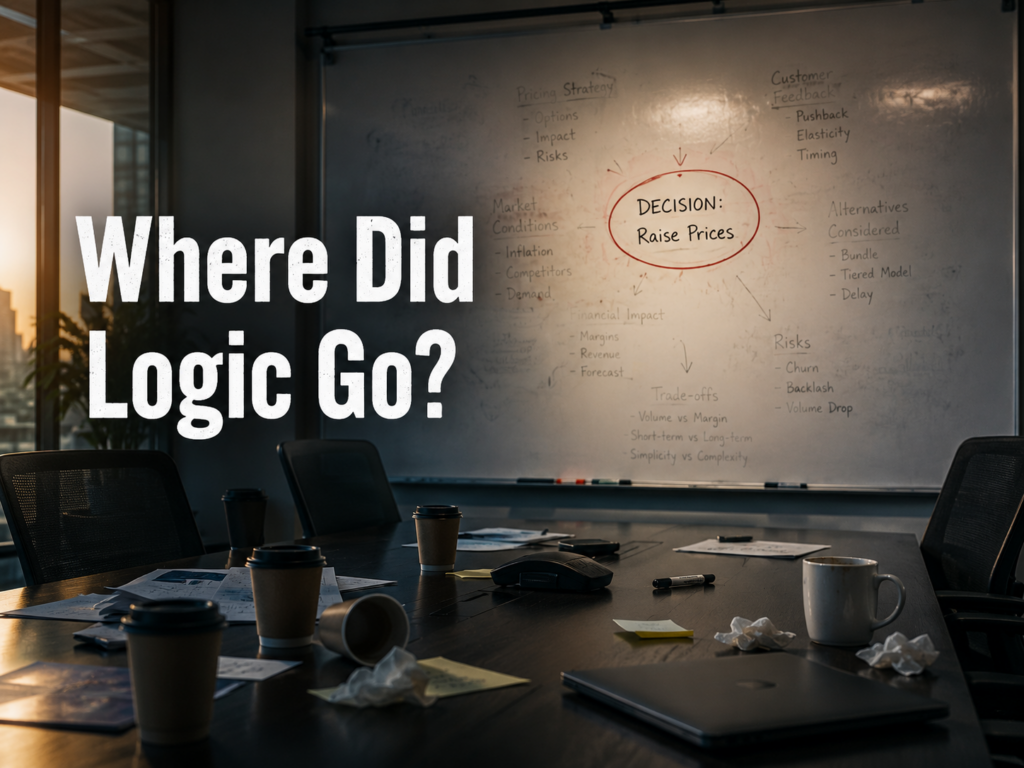
Why Business Decisions Disappear After They Are Made
Business decisions disappear because most companies capture outcomes, not reasoning.
They record the final call: raise prices, hire the manager, change the offer, shift the sales process, launch the campaign, delay the project.
But they rarely capture the argument that produced the decision: the assumptions, constraints, risks, rejected alternatives, and pressure in the room.
That matters because the reasoning is where the intelligence lives.
The default approach fails because it assumes the decision itself is enough. It is not. A decision without context becomes a loose fact.
Six months later, someone asks, “Why did we do it this way?” and the answer becomes vague. “I think margins were tight.” “Maybe sales needed it.” “Wasn’t that after the client issue?”
Now the business is not learning from history. It is reconstructing history.
That is expensive.
This is why your sales team keeps re-explaining the same thing on calls. The business heard the objection before, discussed it before, maybe even solved it before, but the decision never became reusable knowledge. It stayed trapped in the moment.
The longer this stays the same, the more leadership becomes the archive. The owner remembers why things happened. The senior manager remembers the trade-off. Everyone else operates with fragments.
That is not scale. That is the founder becoming the filing cabinet.
A founder once left a Monday morning strategy meeting feeling relieved because the team had finally agreed on the pricing direction.
Three months later, the same argument returned in a Slack thread nobody wanted to reopen, only louder this time, because nobody could remember the trade-off that made the decision make sense.
The shift came when they realised the problem was not alignment in the meeting — it was memory after the meeting. They stopped treating decisions as conversations and started treating them as assets.
Every undocumented decision increases the amount of context your team needs from you later. Growth should reduce reliance on founder memory, not deepen it.
Pro tip
Don’t capture decisions as notes. Capture them as reusable judgment.
Documentation stores information; decision capture preserves the logic your business needs to think better next time.
What Decision Capture Means in a Growing Business
Decision capture means turning important business choices into structured intelligence.
It is not meeting minutes. It is not a task list. It is not a folder full of documents nobody opens. Those tools may record activity, but they rarely explain judgment.
A captured decision answers five questions:
What did we decide?
Why did we decide it?
What alternatives did we reject?
What assumptions are we relying on?
When will we review the outcome?
That is the minimum useful unit.
In a growing business, this matters because decisions become more distributed.
The owner is no longer in every conversation. Managers make calls. Sales adapts messaging. Operations changes process. Marketing tests angles. Customer success handles exceptions.
Each department makes decisions that shape the business, but those decisions often stay local.
That creates drift.
One team thinks the priority is speed. Another thinks it is margin. Another thinks it is customer experience. None of them are wrong in isolation. But without captured decision logic, the business starts operating from competing interpretations.
Most companies try to fix this with more communication. More meetings. More updates. More reporting. But more communication does not fix missing logic. It just spreads confusion faster.
Decision capture creates a shared source of logic.
If you decide to stop serving a certain customer segment, the decision record should explain why: low margin, high support load, poor retention, weak strategic fit. That record then informs marketing, sales qualification, onboarding, pricing, and customer success.
Now the decision travels.
A decision should not end in the room where it was made. It should become part of how the business operates.
Growth exposes inconsistency. The more people making decisions without shared logic, the more your business starts behaving like several smaller businesses under one brand.
Pro tip
Build a decision capture habit around moments of trade-off.
Ordinary updates tell people what changed; captured decisions teach them how the business thinks.

How Captured Decisions Become Reusable Business Knowledge
Captured decisions become reusable knowledge when they are connected to future action.
A decision sitting in a document is not knowledge yet. It is stored information. It becomes knowledge when someone can use it to make a better call, avoid a repeated mistake, explain a strategic choice, train a manager, brief a new hire, or guide AI analysis.
Most business knowledge systems are built around static information: policies, SOPs, templates, training videos, reports. Useful, but incomplete. They explain what the business currently does. They rarely explain how the business learned to do it that way.
Decision capture fills that gap.
A normal SOP update might say: “Add a kickoff checklist.” A captured decision would say: “We added a kickoff checklist because clients were unclear on ownership, response times, and first milestones. The risk is adding admin burden. Review in 60 days against support tickets and time-to-value.”
That is reusable.
A future manager can understand not just the process, but the thinking behind the process. AI can later analyse whether the assumption was correct. The team can see whether the decision solved the real problem or merely created a cleaner-looking workflow.
This is why your pipeline looks strong but doesn’t convert consistently. The business may have made smart decisions about positioning, qualification, follow-up, or offer structure, but if those decisions were never captured and connected, the sales system keeps relying on individual interpretation.
Reusable knowledge reduces interpretation load. It gives the business a memory that can be searched, reviewed, challenged, and improved.
A growing service business was losing hours each week to repeated delivery questions.
The team had SOPs, but no record of why certain delivery rules existed, so managers kept bending them under pressure.
Once they began capturing the reasoning behind key operational decisions, new managers stopped asking for permission on every exception.
They became less dependent on the founder and more confident in the logic of the business.
Every valuable lesson that stays informal has to be rediscovered under pressure. That costs time, confidence, and margin.
Pro tip
Link every major decision to the system it affects.
Knowledge compounds only when it can move across the business without losing its meaning.
Why Decision History Improves Future Judgment
Decision history improves judgment because it exposes patterns that memory edits out.
People remember decisions emotionally. They remember the pressure, the conflict, the win, the failure, the person who argued hardest, or the result that followed.
But memory is selective. It smooths over uncertainty. It rewrites confidence. It forgets what was unknown at the time.
A decision history gives the business something more honest.
It shows what the team believed before the outcome was visible.
That is powerful because judgment does not improve by celebrating wins or blaming losses.
It improves by comparing assumptions against reality. What did we think would happen? What actually happened? What did we miss? What signal did we ignore? What constraint mattered more than expected?
This is where most companies fail. They review performance, but not thinking. They ask, “Did it work?” That is too shallow. A better question is, “Was our reasoning sound, even if the outcome was affected by conditions we could not control?”
A business can make a good decision that produces a poor result because the market shifted. It can also make a weak decision that produces a good result because timing saved it.
Without decision history, the business learns the wrong lesson from both.
At $5M–$20M, this matters because leadership decisions become more expensive. A bad hire costs more. A weak offer confuses more prospects. A pricing mistake affects more revenue. A delivery decision creates more downstream pressure.
You cannot afford to learn only from outcomes.
You are no longer the person who must have every answer; you are the builder of a business that improves how answers are formed.
The next major decision will be shaped by the quality of your last recorded lesson. If nothing was recorded, your team is guessing with confidence.
Pro tip
Review decisions after enough time has passed for consequences to appear.
Better judgment comes from studying the gap between intention and impact.
How AI Can Analyse Patterns Across Past Decisions
AI becomes useful when it has decision context, not just business data.
Most companies want AI to improve operations, marketing, sales, and strategy, but they feed it surface-level inputs: reports, transcripts, dashboards, documents, campaign results.
That can help, but it misses the layer that explains why the business acted the way it did.
AI does not create clarity from chaos; it amplifies the quality of the system underneath it.
AI needs to see the trail: what was decided, what was assumed, what was rejected, and what happened later. Without that trail, it can summarise the business, but it cannot really learn how the business thinks.
When decisions are captured consistently, AI can identify patterns humans struggle to see. It can detect repeated assumptions. It can compare decisions across departments. It can show where the business keeps accepting the same trade-off. It can flag when a decision contradicts previous strategic logic.
That is not automation. That is decision intelligence.
AI might reveal that the business repeatedly chooses speed over margin, then later deals with delivery strain. Or that pricing decisions are often made reactively after customer pushback. Or that hiring decisions rely too heavily on urgency instead of capability gaps.
This is why deals feel close but stall. The business may be making disconnected decisions across offer, follow-up, qualification, proof, and urgency.
Each decision seems reasonable alone. Together, they create friction the buyer can feel.
The uncommon angle most people overlook is that decision capture creates better AI memory.
Not memory as in storage. Memory as in strategic continuity. AI can only help a business think better if the business gives it the raw material of thinking: decisions, assumptions, trade-offs, outcomes, and review points.
Without that, AI becomes a faster assistant working inside the same fog.
With it, AI becomes a pattern detector across the business.
The businesses that benefit most from AI will not be the ones with the most tools. They will be the ones with the cleanest decision architecture.
Pro tip
Capture decisions in a consistent format before trying to analyse them with AI.
AI does not create clarity from chaos; it amplifies the quality of the system underneath it.

The Compounding Advantage of a Decision Capture System
A decision capture system compounds because every recorded decision improves the next layer of business thinking.
At first, the value seems small. One decision record. One pricing note. One hiring rationale. One explanation of why a process changed. It may not feel transformative.
But compounding systems rarely feel powerful at the start.
The advantage appears when decision records accumulate. Patterns emerge. Assumptions repeat. Weaknesses become visible. New managers learn faster. AI analysis becomes sharper. Strategy reviews become more grounded.
The business stops relying on whoever remembers the story best.
That is leverage.
The default approach treats growth as more activity: more campaigns, more hires, more tools, more meetings, more dashboards. But more activity without better decision memory creates a heavier business, not a smarter one.
A decision capture system asks a different question: how do we make the business more intelligent every time it makes a meaningful choice?
That question changes everything.
It turns leadership conversations into assets. It turns mistakes into structured learning. It turns customer friction into market intelligence. It turns internal debate into reusable logic. It turns AI from a task engine into a strategic layer that can analyse how the business thinks over time.
Most businesses do not fail to learn because they lack intelligence.
They fail to learn because their intelligence is trapped in moments that are never preserved. A meeting can feel productive and still leave no usable memory behind.
The businesses that scale with less friction are not always the ones making better decisions today — they are the ones making today’s decisions useful tomorrow.
A compounding business does not just do more. It learns with less waste.
That is the better lens.
Your business is already producing decision intelligence every week. The question is whether you are capturing it or letting it evaporate.
Pro tip
Start with high-consequence decisions: pricing, hiring, positioning, delivery, customer fit, and operational trade-offs.
The goal is not to document everything. The goal is to preserve the decisions that shape future performance.
Conclusion
Most growing businesses do not have a decision problem. They have a memory problem.
They make important calls every week, but the thinking behind those calls disappears. Then the same debates return. The same mistakes resurface in new language. The same pressure lands back on leadership.
The business keeps moving, but it does not always get smarter from the movement.
That is the frustration.
The relief is that this can change without turning the company into a bureaucracy. Capturing decisions for business growth systems is not about writing more. It is about preserving the logic that already exists inside your best conversations.
What was decided. Why it mattered. What was rejected. What was assumed. What happened next.
That is how decision history becomes a compounding advantage.
It gives your team context without needing constant explanation. It gives managers a clearer way to think. It gives AI better material to analyse. It gives the business a way to learn from its own judgment instead of relying on memory, instinct, or whoever was in the room.
The emotional contrast is simple.
You can keep running a business where important decisions vanish after they are made, where leadership carries the context, where teams repeat old debates, and where AI is asked to create clarity from incomplete inputs.
Or you can build a business that remembers.
A business that captures its reasoning. Reviews its assumptions. Learns from its trade-offs. Improves its judgment. Scales with less hidden friction.
Your current state is not fixed.
The confusion may feel normal now. It is not permanent.
Start by capturing the next five high-consequence decisions your business makes: pricing, hiring, positioning, delivery, and customer fit.
Stay stuck repeating what the business already learned, or start turning every important decision into future advantage.
Action Steps
Capture the reasoning behind every high-consequence decision
Record the decision, the reason, the rejected alternatives, the assumptions, and the review point. Strategically, this prevents the business from losing the logic behind important calls. If the reasoning is not captured, the team will eventually reopen the same debate.
Separate decision capture from ordinary meeting notes
Meeting notes record discussion; decision capture preserves judgment. Scaling businesses do not need more information — they need clearer logic that can be reused across teams. Vague notes create interpretation; structured decisions create alignment.
Link each decision to the system it affects
Attach decisions to pricing, hiring, sales, delivery, customer fit, marketing, or operations. This turns decisions into operational intelligence instead of isolated leadership moments. Disconnected decisions create drift; connected decisions improve execution.
Review decisions against outcomes
Set a review point so the business can compare what it expected with what actually happened. Judgment improves when assumptions are tested, not when outcomes are casually remembered. Unreviewed decisions become opinion; reviewed decisions become learning.
Use decision history to train managers and teams
Give leaders access to past decisions so they can understand how the business thinks, not just what it does. This reduces founder dependency and speeds up decision quality across the company. Without shared logic, managers make locally reasonable but strategically inconsistent calls.
Prepare decision records for AI analysis
Use a consistent format so AI can detect patterns across assumptions, trade-offs, repeated risks, and recurring bottlenecks. AI cannot create strategic clarity from scattered fragments. Poor decision memory limits AI to summarising activity instead of improving business judgment.
FAQs
What is decision capture in business?
Decision capture is the practice of recording what was decided, why it was decided, what alternatives were rejected, and what outcome followed. Start with high-consequence choices, not every minor task.
Why is decision capture important for business growth?
Decision capture helps a growing business preserve judgment as decisions become more distributed across teams. Without it, the business relies too heavily on founder memory, repeated explanations, and inconsistent interpretation.
How is decision capture different from meeting notes?
Meeting notes record what was discussed; decision capture records the logic behind the final call. If the decision affects pricing, hiring, sales, delivery, or customer experience, it needs a decision record, not just a meeting summary.
How can captured decisions improve future judgment?
Captured decisions allow the business to compare assumptions against outcomes. The decision path is to review whether the reasoning was sound, not just whether the result was good or bad.
How can AI help with decision capture?
AI can analyse decision records to find repeated assumptions, recurring trade-offs, and patterns across departments. The key is to give AI structured decision history, otherwise it only sees activity without understanding the logic behind it.
What decisions should a business capture first?
Start with decisions that affect revenue, margin, customer experience, hiring, delivery, positioning, or operational capacity. These decisions shape future performance, so losing the reasoning behind them creates the highest cost.
What happens if a business does not capture decisions?
The same debates return, teams interpret strategy differently, and leadership becomes the only reliable source of context. The decision path is either to keep relying on memory or build a system that preserves business judgment.
Other Articles
From Task Automation to AI Decision Architecture