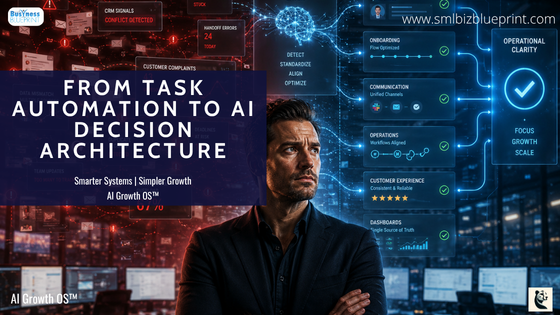

The real advantage of AI comes from enforcing operational alignment, not accelerating fragmented workflows.
Most businesses fail with AI automation because they automate fragmented workflows instead of enforcing operational alignment.
AI decision architecture creates consistency across sales, operations, and customer execution by reducing variance in how decisions are made inside the business.
The companies gaining the most leverage from AI are not simply automating tasks faster — they are building operational systems that preserve strategic intent at scale.
Most businesses do not become operationally unstable all at once. The instability accumulates quietly through small inconsistencies repeated across thousands of decisions.
A sales process handled differently by each rep. Customer onboarding dependent on interpretation. Marketing generating demand disconnected from operational capacity. Managers manually correcting the same execution failures every week while calling it leadership.
Growth hides these problems temporarily. Revenue creates tolerance for operational inefficiency, so leadership assumes the system is functioning.
But as businesses scale, execution expands faster than visibility. Teams optimise locally while the organisation becomes increasingly incoherent globally.
This is the structural failure most companies misdiagnose.
They believe the issue is productivity, so they pursue more automation. Faster reporting. Faster communication. Faster workflows. Faster lead response.
But speed does not create operational coherence. It amplifies whatever operational logic already exists.
If standards are inconsistent, automation scales inconsistency. If decision-making is fragmented, AI compounds fragmentation at machine speed.
Businesses often feel operationally heavier after implementing AI because the issue was never lack of activity. It was unmanaged variance.
Most organisations still operate through human interpretation instead of structured operational architecture. Critical decisions depend on tribal knowledge, emotional judgment, historical habits, or managerial discretion.
The business behaves differently depending on who executes the work or how much pressure the organisation is under at the time.
That instability creates hidden operational drag.
Leadership meetings become debates about whose numbers are correct.
Sales commits revenue operations cannot fulfil confidently. Customer success inherits expectations nobody operationally approved. Managers spend increasing amounts of time translating between departments instead of improving the system itself.
Execution quality becomes dependent on oversight instead of infrastructure.
Eventually the business stops scaling cleanly.
This is the hidden cost most companies never model correctly: operational inconsistency compounds financially long before it becomes visible structurally.
Margins compress. Forecasting becomes less trustworthy. Decision fatigue spreads across leadership. The business becomes emotionally expensive to operate.
The market framing around AI worsens this problem because AI is still discussed primarily as a productivity layer. That framing traps businesses at the tool level instead of the systems level.
The deeper shift is structural.
AI is becoming an enforcement layer for operational alignment.
Not enforcement in the bureaucratic sense. Enforcement in the systems sense.
An enforcement layer ensures the organisation behaves according to strategic intent repeatedly across workflows, customer interactions, and operational decisions. It reduces variance between what leadership believes the business is doing and what the business is actually doing.
This changes how scale works.
Historically, businesses scaled through supervision. More complexity meant more managers, more approvals, more coordination layers. But human interpretation does not compound efficiently.
Decision architecture does.
Decision architecture embeds strategic logic directly into the operational system itself.
Qualification standards, escalation logic, operational thresholds, prioritisation rules, and customer experience standards become structurally enforced instead of informally interpreted.
The business becomes more coherent under pressure instead of less coherent during growth.
That distinction matters because future competitive advantage will increasingly come from operational alignment, not execution volume alone.
As AI lowers the cost of execution across industries, businesses will lose differentiation through activity alone. The remaining advantage will belong to organisations capable of maintaining strategic coherence while operating at speed.
This requires redesign, not more effort.
More supervision cannot permanently stabilise fragmented systems. More automation cannot repair undefined operational logic.
The architecture itself must change.
That is the transition from task automation to AI decision architecture.

The Hidden Problem With Most AI Automation
Most AI automation projects fail because businesses automate motion instead of operational logic.
The market treats automation as though efficiency alone creates scale. It does not. Efficiency only increases throughput. Throughput without alignment creates distortion.
That is the hidden problem.
Businesses install AI to speed up lead response times, automate customer communication, or generate reporting faster. But underneath those workflows, the organisation still lacks agreement on what “good execution” actually means.
Every automation layer becomes another interpretation layer.
The system moves faster while leadership loses trust in the outputs.
Automation increases the speed of execution. Decision architecture controls the quality and consistency of execution.
Most companies never separate the two.
They automate fragmented sales processes, inconsistent onboarding standards, disconnected customer handoffs, and reactive marketing operations. Then they wonder why the business feels noisier after implementation.
Because AI exposed operational drift that already existed.
What most businesses call “scaling problems” are often standardisation problems disguised as growth complexity.
This is why your sales team keeps re-explaining the same thing on calls.
Not because the reps are weak. Because the organisation itself has not operationalised a consistent decision structure customers can move through predictably.
An overlooked consequence: operational inconsistency creates emotional fatigue inside organisations, not just inefficiency.
Employees constantly reinterpret processes, priorities, exceptions, and customer expectations. Leadership becomes the bottleneck because nobody trusts the system enough to execute autonomously.
Eventually, the business depends on human memory instead of institutional intelligence.
That does not scale.
Disciplined businesses do not scale through more activity. They scale through fewer contradictory decisions.
The longer this remains unresolved, the more operationally expensive the business becomes without obvious visibility into why.
Revenue may continue growing temporarily. Margins usually tell the truth first.
AI adoption is accelerating faster than operational maturity. Businesses automating fragmented systems today are scaling confusion into permanent infrastructure.
Pro Tip
Do not ask, “What tasks should we automate?”
Ask, “What operational decisions must remain consistent regardless of who executes them?”
Because the real leverage is not task removal. It is variance reduction.
By 11:30pm, the founder was still inside the CRM manually fixing lead stages his team had already updated twice that day.
He had spent six months automating sales workflows, but forecasts kept changing and nobody trusted the numbers anymore. The turning point came when he realised the automation was not broken — the operational logic underneath it was.
He stopped adding tools and started redesigning decision standards. The business became quieter almost immediately.
Why Automating Broken Processes Creates More Complexity
Businesses assume complexity comes from growth. Often it comes from inconsistency multiplied over time.
Most automation projects fail because companies optimise local efficiency while ignoring system-wide coherence. One department optimises for speed. Another optimises for flexibility. Another optimises for volume.
Nobody optimises for alignment across the business.
So AI becomes a fragmentation amplifier.
Every workflow contains embedded assumptions about priorities, standards, timing, and acceptable decisions. AI executes those assumptions repeatedly whether they are strategically correct or not.
A marketing team automates lead generation without refining qualification logic. Sales inherits low-intent leads at higher volume. Pipeline visibility improves superficially while close rates decline underneath.
This is why your pipeline looks strong but does not convert consistently.
The system is optimising for the wrong signal.
Most businesses still believe automation failure is a tooling problem. Usually it is a systems-definition problem. The organisation never clarified what the workflow was supposed to protect operationally in the first place.
So teams optimise activity while degrading decision quality underneath.
Another overlooked reality: operational consequences travel slowly. Businesses experience the damage downstream, far away from the original workflow decision that created it.
Poor qualification logic eventually distorts forecasting. Weak onboarding standards eventually damage retention. Inconsistent escalation decisions eventually increase support costs and customer distrust.
The business experiences these failures months later and rarely traces them back to the original operational assumptions.
AI exposes organisational truth faster than humans are emotionally prepared to confront it. Weak standards become visible. Undefined ownership becomes visible. Strategic contradictions become visible.
AI does not create operational dishonesty. It removes the ability to hide it behind manual friction.
Strong operators do not scale through more activity. They scale through fewer interpretive gaps.
The longer fragmented workflows remain automated, the more operational debt accumulates beneath the appearance of innovation. Eventually leadership spends more energy stabilising the system than expanding the business.
Every week this stays partially automated without alignment, operational trust deteriorates invisibly. Customers feel it before dashboards reveal it.
Pro Tip
Before automating any workflow, identify what “failure” looks like three departments downstream.
AI systems rarely break where they are installed. They break where their assumptions collide with reality.

What an AI Enforcement Layer Actually Does
Most people misunderstand enforcement because they associate it with restriction.
Operational enforcement is not about limiting people. It is about reducing strategic drift.
An AI enforcement layer ensures the business behaves according to its own operating logic consistently across departments, workflows, customer interactions, and operational decisions.
Not occasionally. Repeatedly.
An enforcement layer translates strategic standards into repeatable operational behaviour across the organisation.
This changes how businesses should think about AI entirely.
A properly designed AI enforcement layer does not merely automate lead follow-up. It enforces qualification logic, response timing standards, escalation pathways, pricing boundaries, and customer routing rules simultaneously.
That is not productivity software. That is operational governance.
This is why deals feel close but stall.
Marketing communicates one value proposition. Sales reframes it differently. Operations introduces new constraints after the sale.
Customers experience cognitive friction even when individual teams perform well.
The business becomes strategically noisy.
Most businesses do not notice this immediately because individual teams still appear competent in isolation. The breakdown only becomes obvious when customers move between departments.
One overlooked advantage: AI enforcement layers stabilise execution during organisational stress. Humans make inconsistent decisions under pressure, fatigue, urgency, and overload. Strong systems reduce emotional variability across the organisation.
That matters during growth because growth naturally increases variance.
Strong operators do not rely on heroic employees to maintain standards. They build systems that protect standards automatically.
Businesses dependent on memory, interpretation, and constant oversight eventually become difficult to scale cleanly.
Businesses operationalising consistency through AI will eventually outperform businesses still dependent on discretionary execution.
Not because they are smarter. Because they are structurally more stable.
Pro Tip
Treat AI less like labour replacement and more like institutional memory with enforcement capability.
Memory without enforcement becomes documentation. Enforcement creates operational reality.
How AI Decision Architecture Standardises Execution
Decision architecture is the real product businesses are building now, whether they realise it or not.
Every company already has decision architecture. Most of it is accidental.
Pricing exceptions approved emotionally. Customer issues handled differently depending on workload. Sales discounts driven by quarter-end pressure instead of strategic fit.
Those are all decision systems. Just unstable ones.
Decision architecture is the structure that determines how operational choices are made, prioritised, escalated, and repeated inside a business.
Most businesses do not fail from lack of intelligence. They fail from inconsistent application of intelligence.
Executives often believe strategy is clear because leadership understands it internally. But strategy only becomes real when operational decisions consistently reflect it at execution level.
Otherwise the company is running multiple competing businesses under one brand.
AI decision architecture closes that gap by embedding strategic priorities directly into operational workflows.
Lead scoring reflects profitability instead of vanity metrics. Escalation logic reflects retention economics instead of emotional reactions. Sales recommendations align with fulfilment capacity.
Leadership reporting becomes more trustworthy because operational definitions stop changing between departments.
The business starts behaving coherently.
Meetings change too. Teams spend less time debating what is happening operationally and more time deciding what to do next strategically.
That sounds small until you realise how many leadership teams spend entire meetings reconciling conflicting interpretations of reality instead of making decisions. Operational ambiguity quietly consumes strategic capacity.
One overlooked truth: businesses often treat inconsistency as a people problem when it is actually an architectural problem. Different employees making different decisions usually means the system failed to define decision criteria clearly enough.
AI exposes ambiguity brutally because systems require explicit logic humans previously compensated for informally.
Mature businesses do not scale by adding more supervision. They scale by reducing interpretive gaps.
The longer businesses operate without structured decision architecture, the more leadership energy gets consumed resolving preventable contradictions instead of making strategic decisions.
As AI lowers execution costs across industries, operational coherence will become a larger competitive advantage than raw activity volume.
Pro Tip
Map where your business repeatedly depends on tribal knowledge to maintain quality.
That is usually where decision architecture is weakest—and where AI enforcement creates the highest leverage.
The operations director thought the onboarding problem was a staffing issue because customers kept escalating confusion during implementation.
But every department was interpreting “client-ready” differently. Once the business enforced one operational definition across sales, onboarding, and delivery workflows, support tickets dropped and implementation speed increased without hiring additional staff.
The business did not become more productive first. It became more aligned.
The Shift From Productivity Tools to Operational Governance
The AI market is still selling productivity. The real transformation is governance.
Most companies use AI like a smarter intern: generating content, summarising meetings, automating admin work. Useful? Yes. Strategic? Rarely.
Productivity tools improve outputs locally. Operational governance shapes how the business behaves systemically.
Operational governance maintains alignment between strategic intent and day-to-day execution.
Without governance, scale naturally produces divergence.
Growth increases operational entropy faster than leadership visibility. By the time problems appear financially, the operational behaviour causing them is already deeply embedded.
AI governance changes this because it creates real-time enforcement between strategic standards and operational execution.
Not through surveillance. Through structured operational logic.
That distinction matters because most businesses still assume management exists primarily to coordinate people.
Increasingly, management value shifts toward designing decision systems that maintain alignment without constant intervention.
Interpretive coordination is quietly becoming less valuable than operational clarity.
Many leadership teams are not psychologically prepared for this shift yet because they still measure managerial value through oversight instead of systems design.
An uncommon insight: the companies benefiting most from AI governance may not be the fastest-moving companies. They may be the companies with the highest operational complexity relative to leadership visibility.
The issue is no longer labour efficiency. It is organisational signal integrity.
In practical terms, this means leadership can trust forecasting more consistently, customer experience becomes less dependent on individual employees, and operational quality becomes more stable during periods of growth or staffing change.
Operators who scale successfully do not merely increase execution speed. They protect strategic coherence under pressure.
The longer businesses treat AI as tactical productivity infrastructure instead of governance infrastructure, the more exposed they become to hidden operational drift competitors may eventually eliminate structurally.
AI-native competitors are not simply moving faster. Many are building structurally cleaner businesses from the beginning.
Pro Tip
Do not measure AI success only through time saved. Measure it through reduction in operational variance.
Stable execution creates trust internally and externally.
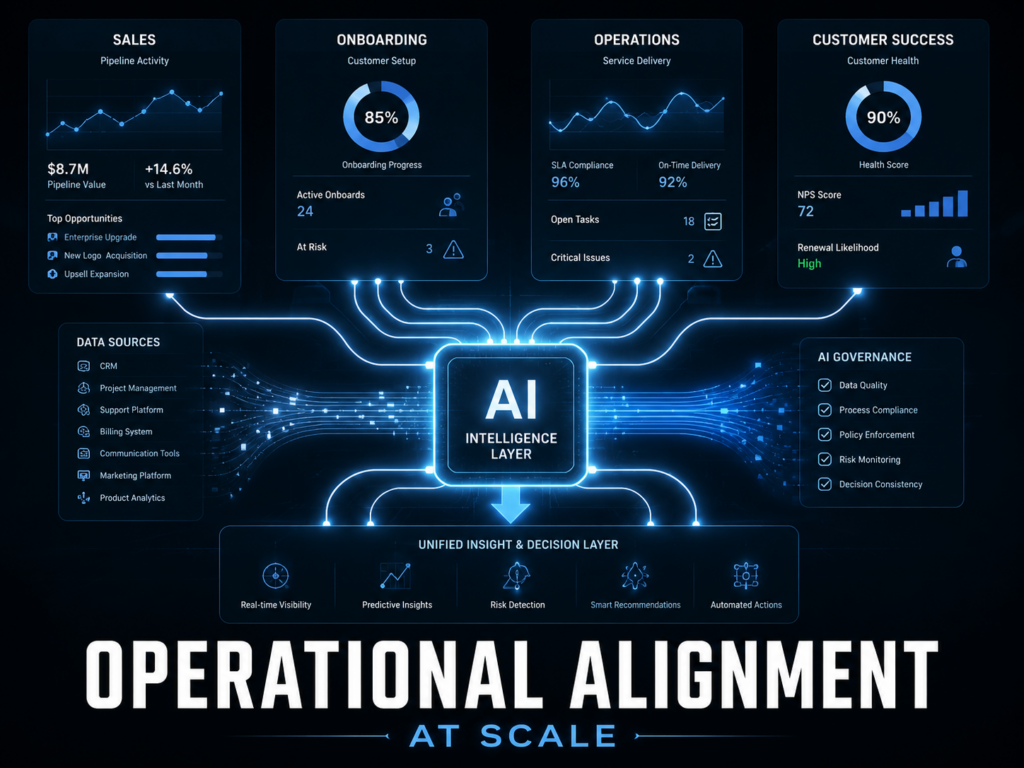
Where Businesses Should Apply AI Enforcement First
Most businesses apply AI where work feels repetitive. That is usually the wrong starting point.
The best place to apply AI enforcement is where inconsistency creates downstream operational consequences.
High-leverage AI enforcement targets operational bottlenecks where small decision inconsistencies compound into financial or organisational instability later.
This is why sales qualification is often a better starting point than content generation.
A weak blog post rarely damages a company materially. Weak qualification logic poisons forecasting, onboarding accuracy, staffing decisions, and retention simultaneously.
The consequences travel across the organisation.
Businesses often deploy AI too late in workflows instead of earlier at decision-entry points. They automate outputs after poor assumptions already entered the system.
That limits leverage dramatically.
Strong businesses do not merely optimise activity. They control where operational entropy enters the system.
If your business still depends on managers manually correcting recurring operational mistakes every week, you do not have a scaling model. You have human damage control disguised as management.
Eventually it breaks.
The longer operational inconsistency remains embedded at core decision points, the more expensive growth becomes—even when revenue increases.
Pro Tip
Find the process where managers regularly say things like, “just handle this one manually.”
That is usually where operational standards are weakest and where AI enforcement creates disproportionate leverage.
Some of the most operationally fragile businesses look impressive from the outside.
Revenue is growing. Teams are busy. Dashboards are full. But internally, managers spend their days correcting preventable inconsistencies nobody formally solved.
The strongest companies often feel almost uneventful operationally. Less correction. Less interpretation.
Quiet is usually a systems signal.
Conclusion
Most businesses think they are struggling with execution overload. Many are actually struggling with operational inconsistency hidden beneath growth.
More automation feels productive. More dashboards feel intelligent. But fragmented operational logic continues leaking trust, clarity, and profitability quietly underneath.
Eventually the organisation becomes difficult to manage not because people are failing—but because the system itself produces contradiction faster than leadership can resolve manually.
Some businesses never realise this is happening because revenue continues growing while operational quality quietly deteriorates underneath.
That is the real cost.
The opportunity now is larger than productivity improvement.
AI allows businesses to move beyond task acceleration into operational alignment. Beyond isolated automation into decision architecture. Beyond reactive management into enforceable strategic coherence.
Strong businesses are not built on constant managerial intervention. They are built on systems that preserve strategic intent consistently at scale.
Your current operational state is not fixed. It is architectural.
Which means it can be redesigned.
The longer fragmented execution remains normal, the more growth becomes emotionally draining and structurally unstable. But businesses willing to rethink AI as operational governance—not just automation—have an opportunity most competitors still cannot see clearly.
You can keep scaling complexity manually.
Or you can build a business that thinks coherently at scale
Action Steps
Audit where operational decisions vary most
Identify where different employees make different decisions under similar conditions. This reveals where operational logic is undefined or unstable.
Map downstream consequences before automating workflows
Trace how one operational decision affects sales, onboarding, fulfilment, retention, and reporting downstream. Poor decision architecture compounds invisibly before it appears financially.
Replace tribal knowledge with enforceable standards
Document how critical decisions should actually be made across pricing, escalation, qualification, and customer handling. Human memory does not scale cleanly.
Prioritise AI enforcement at high-variance decision points
Apply AI where inconsistency creates downstream instability, not merely where work feels repetitive.
Measure variance reduction instead of time saved
Track consistency of execution, forecast reliability, and customer transition quality. Productivity metrics alone hide operational instability.
Design systems that preserve strategic intent under pressure
Build operational logic that remains stable during rapid growth, staffing changes, or market volatility.
FAQs
What is AI decision architecture?
AI decision architecture standardises how business decisions are made across workflows, teams, and customer interactions by embedding strategic logic directly into operational systems.
Why do most AI automation projects fail?
Most projects fail because businesses automate fragmented processes without first defining operational standards.
What does an AI enforcement layer actually do?
It enforces standards, escalation logic, prioritisation rules, and execution consistency across the organisation.
How does operational inconsistency affect growth?
It weakens forecasting, increases leadership fatigue, damages customer trust, and compresses margins over time.
Where should businesses apply AI enforcement first?
Start where inconsistent decisions create downstream operational instability—usually qualification, onboarding, and customer escalation workflows.
Does AI replace human judgment?
No. Strong systems reduce repetitive interpretive decisions so human judgment can focus on strategic situations.
What is the real competitive advantage of AI?
Operational coherence. As execution becomes cheaper across industries, businesses maintaining strategic alignment will outperform fragmented competitors.
Bonus Insight: The Businesses Losing Control Usually Look “Efficient” First
Most businesses do not collapse into chaos visibly. They drift into incoherence gradually.
More dashboards. More approvals. More coordination layers. Teams become increasingly productive individually while the organisation becomes harder to align collectively.
This is what many businesses are doing wrong:
they optimise local performance while weakening systemic coherence.
AI Will Expose Organisational Sloppiness Faster
AI removes the manual friction that previously concealed weak standards, conflicting incentives, and undefined ownership.
The consequence if this does not change:
the business becomes faster at producing operational distrust.
Human Flexibility Is Often Operational Ambiguity
Businesses frequently defend inconsistency as “adaptability.” In reality, much of it is unmanaged interpretation.
The consequence if this does not change:
growth keeps increasing coordination cost faster than profitability.
The Future Advantage Is Cleaner Decisions, Not Faster Decisions
Execution speed eventually commoditises. Cleaner decision architecture compounds longer.
The consequence if this does not change:
leaders stay trapped inside operational maintenance instead of strategic expansion.
Other Articles
Build AI Systems That Eliminate Decision Fatigue