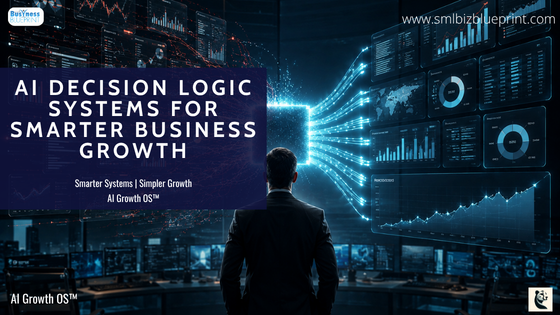

How businesses use AI enforcement layers to filter signals, prioritise actions, and increase conversion probability across operations.
AI decision logic systems help businesses reduce operational drift by enforcing consistent, probability-based decisions across marketing, sales, and operations.
Instead of automating isolated tasks, these systems continuously filter high-value signals, prioritise actions, and trigger corrective workflows that improve conversion predictability and growth stability.
For businesses scaling beyond founder-led execution, AI becomes an enforcement layer that protects system integrity, reduces cognitive overload, and increases organisational consistency at scale.

The Structural Failure Most Businesses Misdiagnose
Most businesses do not stall because they lack leads, data, or activity.
They stall because their operating system cannot distinguish between noise and signal consistently at scale.
At $5M–$20M in revenue, the issue is rarely visibility. The business already has dashboards, CRMs, reporting systems, automation workflows, and operational oversight. Marketing generates campaigns. Sales generates activity. Leadership reviews forecasts constantly.
The breakdown begins when different departments start making contradictory prioritisation decisions from the same customer signals.
Marketing calls the lead qualified because engagement is high. Sales dismisses it because response timing looks weak. Leadership sees the opportunity again three weeks later during forecast discussions after momentum has already disappeared.
No one is technically wrong.
That is the problem.
Each function optimises correctly within its own context while the overall system becomes less coherent.
Two sales managers reviewing the same pipeline should not produce different prioritisation outcomes. In many growing businesses, they do.
One pushes the largest deal.
Another pushes the loudest prospect.
A third escalates whichever opportunity the founder mentioned in the last meeting.
Over time, operational judgement decentralises faster than decision standards.
The result is not a dramatic collapse. It is a gradual erosion.
High-intent opportunities receive inconsistent follow-up.
Low-probability leads absorb disproportionate attention.
Forecast accuracy weakens.
Teams stay operationally busy while conversion efficiency declines.
Most businesses respond by increasing activity.
More reporting.
More meetings.
More automation.
More oversight.
But the business does not need more motion.
It needs a decision architecture capable of enforcing consistent operational logic across the organisation.

The Hidden Cost of Decision Drift
Decision drift compounds quietly because it rarely appears as a single failure event.
Instead, the organisation starts compensating manually for missing system clarity.
Sales leaders override lead routing because they no longer trust prioritisation quality.
Operations teams protect capacity defensively because incoming demand feels unpredictable.
Founders start reviewing deals deeper in the pipeline because forecast confidence keeps slipping.
Most founders can feel this breakdown long before they can explain it.
That is usually when leadership meetings become reconciliation exercises between competing versions of reality.
Marketing reports strong engagement.
Sales reports weak conversion quality.
Operations reports delivery pressure.
Finance reports unstable forecasting.
Everyone is reporting accurately from their own vantage point while the system itself loses coherence.
The hidden cost is not only wasted labour. It is cognitive overload spread across the organisation.
As complexity increases, teams spend more time interpreting signals than acting decisively on them. Attention fragments across inconsistent urgency standards, reactive escalation, and competing interpretations of value.
The business stops knowing what deserves attention.
This is where many growth-stage companies plateau.
Not because demand disappeared.
Because decision quality stopped scaling with operational complexity.
The Architectural Principle: AI as an Enforcement Layer
Most AI discussions focus on acceleration.
Faster content generation.
Faster workflows.
Faster responses.
But acceleration without enforcement increases instability.
The highest-leverage use of AI is not task automation. It is operational enforcement.
AI decision logic systems continuously reinforce how the business prioritises, routes, escalates, and responds to changing conditions.
That distinction matters because human coordination becomes less reliable as complexity increases.
Priorities shift under pressure. Teams interpret the same operational conditions differently. Escalation standards change depending on who is making the judgement call that day.
AI enforcement layers stabilise those inconsistencies by evaluating operational signals against predefined business logic continuously.
This reduces organisational entropy.
Instead of relying on individuals to manually interpret every lead, opportunity, escalation, or operational risk condition, the system continuously filters and prioritises activity based on probability-weighted criteria.
More automation alone does not solve the problem. Consistent operational behaviour does.
That changes AI from a productivity layer into a structural control mechanism.
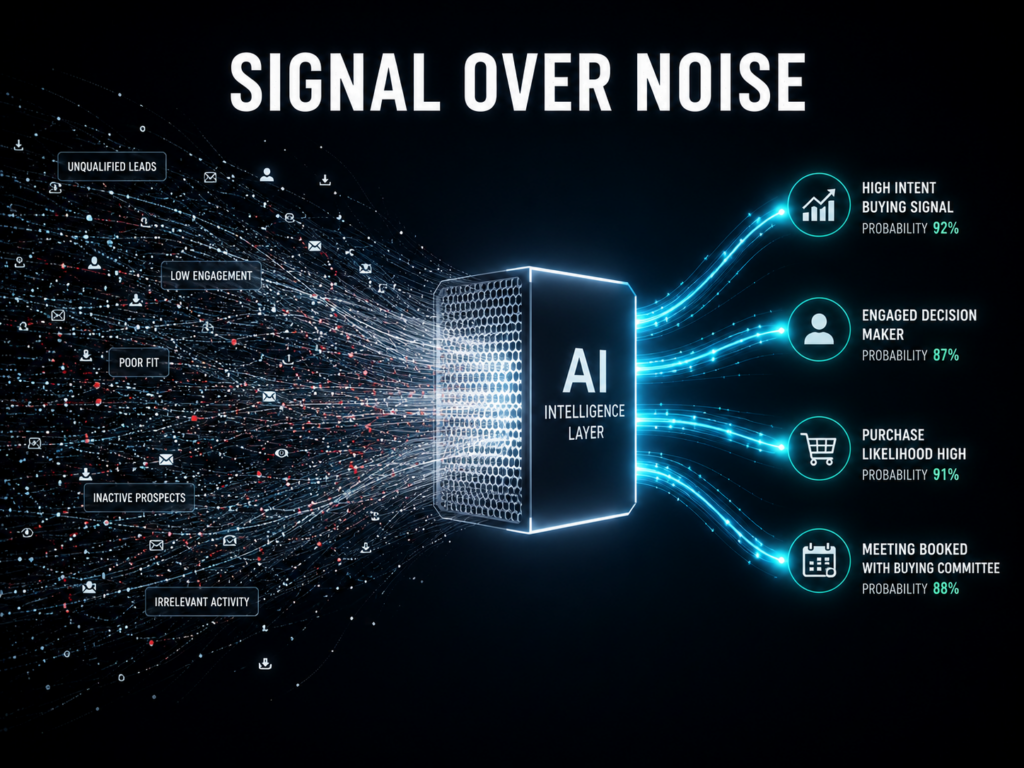
The Signal Logic Behind Stable Growth
Every business already generates signals.
The problem is that most businesses lack a system for distinguishing between high-value signals and operational noise.
Certain behavioural patterns correlate strongly with conversion probability, retention likelihood, operational strain, or expansion opportunity. Others create activity without meaningful commercial value.
Strong decision systems separate the two.
An AI decision logic layer evaluates signals across multiple dimensions simultaneously:
Lead source quality.
Sales-cycle velocity.
Proposal engagement behaviour.
Response latency.
Repeat buying signals.
Operational capacity thresholds.
Deal progression consistency.
Individually, these signals provide fragments of information.
Together, they establish probability conditions.
A prospect opening a proposal five times in one afternoon matters. A prospect downloading three generic resources over six months usually does not. Most businesses treat both as engagement.
This changes how the business allocates attention.
The system is no longer asking:
“Did the prospect submit a form?”
It is asking:
“Does this behavioural pattern indicate rising conversion probability above an actionable threshold?”
That threshold becomes the enforcement trigger.
When proposal engagement spikes while sales-cycle velocity compresses below historical averages, the system can elevate response priority automatically and redirect senior sales capacity before momentum decays.
The business stops reacting to activity volume and starts reacting to weighted probability.
Low-signal activity is deprioritised.
High-intent behaviour is escalated.
Stalled opportunities trigger intervention pathways automatically.
This reduces cognitive load while improving operational consistency across teams.
More importantly, it prevents interpretive drift from spreading through the organisation.
The Automation Layer: Installing Correction Logic
Once signal logic is clearly defined, automation becomes an enforcement mechanism rather than a convenience feature.
This is where many businesses fail.
They automate visible workflows while leaving invisible decision logic untouched.
As a result, they accelerate inconsistency instead of stabilising the business.
A properly designed implementation layer installs correction logic directly into operational workflows.
If a prospect demonstrates multiple high-intent buying signals within a compressed timeframe, the system increases response priority, routes the opportunity toward senior sales capacity, and temporarily suppresses lower-probability lead handling.
If proposal engagement declines after a late-stage sales interaction, the system initiates a recovery sequence automatically instead of waiting for manual follow-up.
If acquisition campaigns generate engagement without downstream conversion progression, the system flags signal distortion between marketing messaging and actual buyer intent.
If operational capacity approaches instability thresholds, acquisition pacing adjusts automatically to protect delivery continuity before service quality deteriorates.
The principle matters.
The automation is not merely executing tasks.
It is protecting system integrity.
By the time a founder starts manually reviewing late-stage deals every Friday night, the system has already stopped trusting its own prioritisation logic.
The organisation no longer depends entirely on individuals detecting every deviation manually. The enforcement layer monitors for drift conditions continuously and applies corrective routing logic before instability compounds.
That creates resilience through coordination consistency.
Not because humans disappear from the system.
Because humans no longer carry the full burden of operational interpretation themselves.
What This Means in Practice
What this means in practice is that the business begins operating according to predefined probability logic instead of reactive judgement.
Instead of SDRs manually triaging every inbound lead equally, response allocation becomes dynamically prioritised according to behavioural intent signals.
Forecast conversations stop sounding like negotiations between departments. The numbers stabilise because the prioritisation logic stabilises first.
Operational bottlenecks become visible earlier because escalation thresholds surface instability while corrective action is still manageable.
Leadership gains leverage because fewer decisions require manual reconciliation across disconnected teams.
This fundamentally changes the role of leadership.
Founders spend less time correcting operational drift manually and more time refining the logic governing the system itself.
That transition matters because the business moves from people-dependent execution toward architecture-dependent stability.
Why Most Automation Projects Fail
Most automation projects fail because they optimise activity instead of operational coherence.
The business installs tools without establishing enforcement standards governing how decisions should be prioritised, escalated, or corrected.
As automation volume increases, operational noise increases with it.
Notifications multiply.
Workflows fragment.
Teams lose visibility into which signals actually matter.
Automation without governing logic amplifies instability.
This is why many businesses feel simultaneously over-automated and under-coordinated.
The issue is rarely the software itself. The problem is the absence of a decision architecture connecting the system together.
AI growth systems only become strategically valuable when automation reinforces principles such as:
Probability management.
Signal visibility.
Escalation layering.
Bottleneck containment.
Continuity enforcement.
Cognitive load reduction.
Without those principles, automation becomes disconnected activity operating at higher speed.
The Stability Outcome
The long-term value of AI decision logic systems is not speed.
It is stability.
Stable businesses scale differently because operational consistency becomes enforceable instead of dependent on constant human correction.
Lead quality becomes more predictable.
Sales prioritisation becomes more accurate.
Operational strain becomes visible before failure conditions emerge.
Revenue forecasting becomes more reliable.
Most importantly, growth stops depending entirely on executive intervention to maintain alignment.
Signals stop being interpreted differently across teams, which means escalation happens earlier, correction happens faster, and leadership spends less time manually forcing coordination.
Over time, this creates structural integrity across the growth system.
Marketing improves because attention allocation becomes more intelligent.
Sales improves because high-probability opportunities receive disproportionate focus.
Operations becomes more resilient because delivery pressure is monitored dynamically instead of reactively.
Leadership gains clarity because decision quality becomes measurable instead of anecdotal.
This is the real implementation layer of AI growth architecture.
Not workflow automation alone.
Operational enforcement.
The businesses that scale sustainably over the next decade will not be the ones with the most automation.
They will be the ones with the strongest decision architecture.
FAQs
What is an AI decision logic system in business operations?
An AI decision logic system continuously evaluates operational signals against predefined business rules to reinforce consistent decision-making. Instead of relying on manual interpretation across teams, it prioritises high-probability actions automatically, reducing drift and improving forecasting stability.
How is AI decision logic different from standard automation?
Traditional automation executes tasks after a trigger occurs, while AI decision logic evaluates probability, context, and signal quality before enforcing an action. The difference is architectural: one accelerates activity, the other stabilises operational behaviour across the business.
Why do growing businesses struggle with signal filtering?
As businesses scale, teams generate more data, more workflows, and more competing interpretations of urgency and opportunity quality. Without a unified enforcement layer, low-signal activity consumes attention while high-intent opportunities decay inside fragmented systems.
What signals matter most in conversion probability management?
The highest-value signals are behavioural patterns that correlate with buying intent, operational risk, or customer expansion likelihood. Examples include engagement compression, proposal interaction behaviour, response latency, and sales progression consistency across defined thresholds.
How does AI reduce operational decision fatigue?
AI reduces cognitive overload by continuously filtering, routing, suppressing, and escalating decisions based on predefined logic. This prevents teams from manually evaluating every lead, escalation, or opportunity, allowing leadership to focus on system optimisation instead of constant intervention.
Why do many automation projects fail to improve growth stability?
Most automation projects optimise isolated workflows without defining the decision architecture behind them. This creates fragmented systems that increase operational noise rather than reinforcing consistency, prioritisation, and organisational alignment.
What does “AI as an enforcement layer” actually mean?
It means AI continuously monitors operational conditions and applies correction logic when thresholds or probability conditions change. In practice, the system reinforces prioritisation rules, escalation pathways, and continuity controls automatically, reducing reliance on reactive human coordination.
Other Articles
AI Decision Systems for Mid-Sized Growth Companies