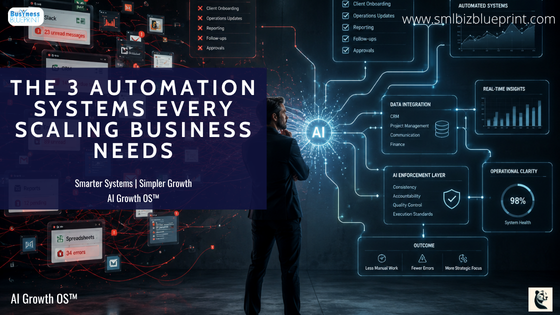

How AI agents create operational consistency, accountability, and execution leverage.
Most businesses automate tasks but still struggle to scale because operational inconsistency—not workload—is the real bottleneck.
The three automation systems every scaling business needs are task automation, workflow automation, and AI enforcement systems that reinforce standards, accountability, and execution quality across the company.
Businesses that use AI agents for business operations as operational architecture—not just productivity tools—scale with less leadership drag, clearer decisions, and stronger execution consistency.
Most businesses do not have a workload problem. They have a coordination problem.
At $5M–$20M in revenue, the business often looks successful from the outside. Revenue is growing. The team has expanded. New systems are installed.
Yet internally, execution feels heavier every quarter. Managers repeat the same instructions.
Sales conversations restart from zero. Leads slip because follow-up depends on memory instead of systems.
Someone is always checking Slack after hours because the handoff still feels fragile. A founder refreshes dashboards late at night, not because the numbers are unavailable, but because nobody fully trusts them.
Everyone is busy. Nobody feels ahead.
The default response is predictable: add more software. More automations. More dashboards. Businesses assume operational clarity will emerge automatically once information moves faster.
It rarely does.
Because most automation was designed to move tasks—not enforce standards.
That is the hidden failure inside many scaling companies. Workflows trigger correctly while execution quality deteriorates underneath them. Teams operate differently across departments. Accountability becomes inconsistent. Founders slowly become the manual coordination layer holding everything together.
Growth starts creating drag instead of leverage.
The real issue is not efficiency. It is operational variance.
This is why many businesses scale revenue while quietly losing control of execution quality.
Complexity expands faster than clarity. And the longer this stays unresolved, leadership gets trapped inside operational correction loops instead of strategic direction.
The next generation of automation is different. Not because AI is “smarter,” but because it can reinforce operational intent continuously across the business.
That changes the role of AI completely.
Not as a chatbot. Not as a productivity trick.
As operational architecture.
Because eventually every scaling business reaches the same uncomfortable realisation: growth without enforcement creates chaos.

Why Most Business Automation Fails to Scale
Most business automation fails because it automates activity instead of behaviour.
Companies automate lead routing, onboarding emails, reporting workflows, approvals, notifications. Useful? Yes. Strategic? Usually not.
Because the real bottleneck inside scaling businesses is rarely task movement. It is inconsistent execution.
A lead gets assigned automatically—but nobody follows up properly. A proposal gets generated instantly—but sales positioning changes depending on the rep. SOPs exist—but managers enforce them differently under pressure.
The workflow functions technically while the business fragments operationally underneath it.
A lot of businesses think they have systems. What they actually have is software sitting on top of inconsistent behaviour.
This is why automation often creates the illusion of maturity without the reality of control.
Most people frame automation as an efficiency problem: save time, reduce admin, eliminate repetitive work. But time is rarely the true scaling constraint. Cognitive fragmentation is.
Leaders constantly context-switch because standards are not self-maintaining. Every inconsistency flows upward. Founders become the enforcement layer manually.
That is not scale. That is dependency disguised as growth.
This is why your sales team keeps re-explaining the same thing on calls. Not because they lack talent—but because knowledge is not reinforced structurally across the business.
The better lens is this: automation should reduce operational variance, not just labour.
Once you understand that, different questions emerge.
Where does decision drift happen?
Where does accountability weaken?
Where does execution quality depend too heavily on memory?
Those are the real leverage points.
He thought the business needed more software because the team kept missing follow-ups and internal deadlines.
So he added dashboards, automations, and another project management platform. Three months later, the team was still overwhelmed—just inside a more complicated system.
The shift came when he realised the issue was not visibility but inconsistent operational expectations. He stopped collecting tools and started designing enforcement.
That was the first month leadership felt lighter instead of louder.
Operational inconsistency compounds silently. Revenue can still grow while margins, responsiveness, and execution quality deteriorate underneath it.
Pro Tip
Audit where leadership repeatedly intervenes manually.
Those intervention points reveal where your business lacks enforcement systems—not where it lacks talent.
The First Layer: Task Automation
Task automation is operational hygiene—not transformation.
Automating repetitive actions like scheduling, reporting, invoicing, lead tagging, or onboarding admin creates immediate relief because humans are unreliable at maintaining repetitive precision over time.
But task automation alone does not scale a company. It stabilises operational entropy temporarily.
That distinction matters.
Many businesses automate admin work and expect operational clarity to follow automatically. Instead, a deeper problem becomes visible: inconsistent judgment.
Customer experience still varies. Sales conversations still drift. Managers still interpret standards differently. The business becomes faster without becoming clearer.
Fast confusion is still confusion.
A sales coordinator manually correcting CRM records every Friday is no longer an admin inconvenience. It is evidence the operational system cannot maintain integrity without human repair work.
This is where many automation projects stall. Businesses automate what feels annoying instead of what creates leverage.
One overlooked truth: task automation exposes leadership weaknesses.
Once repetitive work disappears, managers can no longer blame operational noise for poor execution. Strategic ambiguity becomes visible.
This is why deals feel close but stall. The workflow exists. The execution logic does not.
The strongest companies do not ask:
What can we automate?
What operational behaviours must stay consistent as complexity grows?
What should never rely on memory again?
That is a more mature automation conversation.
The companies benefiting most from AI agents for business operations are not necessarily the most technical companies. They are the companies willing to redesign operational assumptions from first principles.
Every week manual work remains inside core workflows, your business leaks attention. And attention—not time—is the real growth constraint inside scaling companies.
Pro Tip
Do not automate based on irritation alone.
Automate based on recurrence frequency multiplied by operational risk.

The Second Layer: Workflow Automation
Workflow automation is where businesses start coordinating decisions instead of isolated tasks.
Most companies believe they already have workflow automation because systems are connected technically. Usually, they only have information movement.
A workflow is not a sequence of tasks. It is a sequence of decisions.
That changes everything.
Strong workflow automation reduces ambiguity between departments. Sales knows exactly when a lead becomes qualified. Operations knows when delivery risk increases. Customer success sees retention threats before clients complain.
Weak workflows create dependency loops instead. Marketing blames sales. Sales questions lead quality. Leadership meetings become interpretation battles instead of decision systems.
And then companies blame communication.
It is rarely communication. It is fragmented operational architecture.
The overlooked purpose of workflow automation is trust compression. Scaling businesses reduce the number of decisions that require interpersonal clarification.
That is what creates speed.
Most businesses do not realise how much managerial energy gets burned translating between departments until the founder disappears for a week.
This is why your pipeline looks strong but doesn’t convert consistently. The business tracks movement instead of commitment signals.
A stronger workflow system does not merely push work forward. It interprets behavioural thresholds, detects operational risk, and escalates inconsistencies before leadership notices revenue impact manually.
For example: if a high-value lead goes untouched for 24 hours, pricing objections spike across multiple calls, or onboarding timelines begin slipping, the system should not simply log activity. It should surface risk patterns automatically before operational drift becomes financial damage.
That is the real distinction between workflow visibility and workflow intelligence.
That is where AI agents become strategically different from traditional automation.
Midway through growth, every business faces the same identity question: are you building a company that runs through people—or through principles?
A 14-person sales team looked productive on paper.
CRM activity was high, meetings were happening, proposals were going out. But conversion rates kept stalling unpredictably, and managers spent hours reviewing deals manually every week.
Once the business implemented AI-based qualification and follow-up enforcement across the pipeline, execution became consistent enough to diagnose real problems clearly.
The team stopped improvising around the process and started trusting the system behind it.
Operational fragmentation compounds faster than revenue growth. The larger the business becomes, the more expensive unclear handoffs become.
Pro Tip
Map where decisions currently require meetings.
Those points usually indicate missing workflow logic.
The Third Layer: AI Enforcement Systems
This is the layer most businesses still do not recognise.
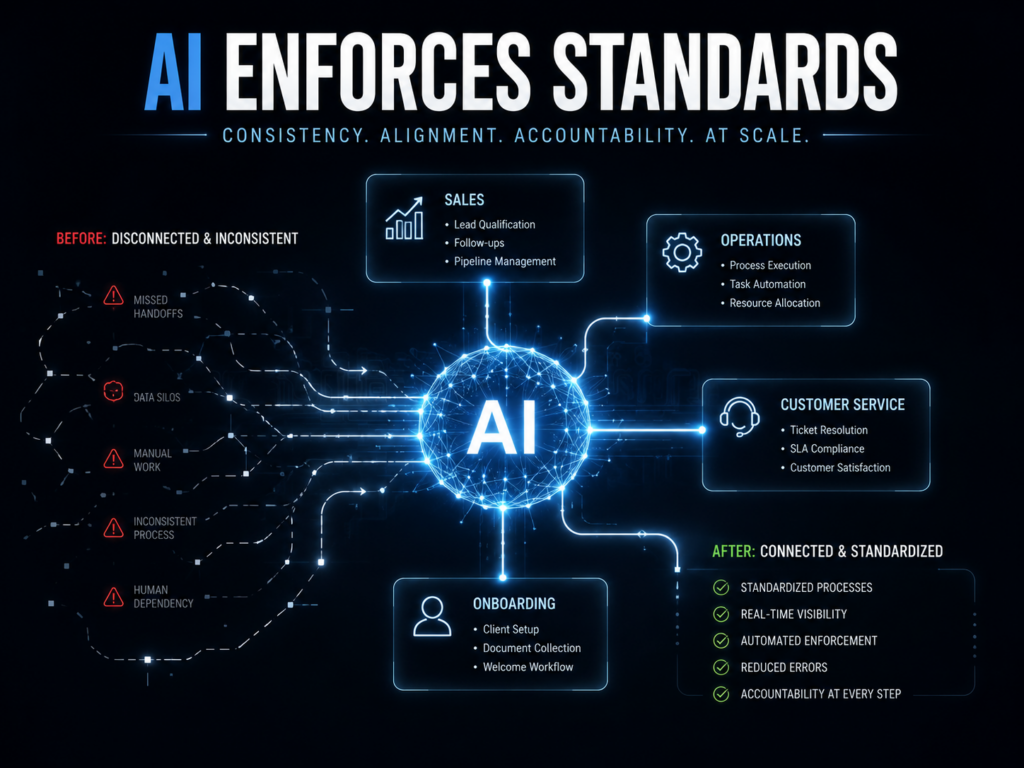
AI enforcement systems are not automation tools. They are operational governance systems.
Traditional automation executes instructions. AI enforcement systems reinforce standards continuously.
For example: most sales managers review calls manually after problems appear. An AI enforcement layer can evaluate conversations continuously against qualification frameworks, detect pricing hesitation, flag inconsistent messaging, and escalate coaching opportunities automatically.
Not to replace leadership. To extend it structurally.
That matters because scale breaks wherever oversight becomes inconsistent.
Most operational problems are not caused by lack of knowledge. Teams usually know what to do. The breakdown happens through execution drift over time.
Standards decay. Follow-up weakens. Messaging fragments. Managers interpret processes differently under pressure.
Humans naturally drift toward variability. Businesses need reinforcement systems.
This is the part conventional automation misses entirely.
The deeper issue inside scaling companies is not process inefficiency. It is standard erosion.
An AI enforcement system acts like an organisational nervous system. It detects deviations early, reinforces operational memory, and creates continuity between leadership intent and daily execution.
Not surveillance. Alignment.
Many companies call their culture “high accountability.” In reality, they have managers manually compensating for weak systems.
The practical impact is measurable.
Sales cycles shorten because qualification standards stop drifting between reps. Client onboarding becomes more predictable because execution checkpoints are reinforced automatically.
Managers spend less time auditing behaviour manually and more time improving strategic outcomes.
That changes the economics of scale.
The companies that scale cleanly over the next decade will not necessarily have the most advanced AI. They will have the clearest operational logic.
Most companies do not scale through systems. They scale through invisible heroics hidden inside experienced employees.
Someone remembers the missing detail. Someone catches the mistake late at night. Someone manually reconnects departments before clients notice the friction.
Businesses often call this “culture.” Sometimes it is operational fragility wearing a positive label.
Companies that install enforcement architecture early will scale with lower managerial drag, faster execution loops, and more stable operational quality than competitors still relying on human memory.
Pro Tip
Define what “good execution” actually means operationally before introducing AI systems.
AI cannot reinforce vague standards.
How to Prioritise Automation Across a Growing Company
Most companies prioritise automation backward.
They automate what feels painful instead of what creates strategic leverage.
That mistake matters because not all friction should disappear. Some friction reveals operational weakness. Remove it too early and the business loses visibility before it gains clarity.
The correct question is not:
“What can we automate?”
It is:
“Where does inconsistency create compounding business risk?”
That shifts automation from convenience thinking into operational architecture.
Usually, the highest-leverage opportunities sit inside departmental handoffs:
marketing to sales
sales to delivery
delivery to retention
That is where interpretation errors multiply fastest.
One hard truth: if managers spend every day manually chasing accountability, the operational architecture is broken.
Because accountability enforced through human persistence does not scale.
Strong businesses create environmental accountability instead.
Expectations become measurable automatically. Deviations surface automatically. Managers stop policing behaviour manually and start improving systems structurally.
The prioritisation mistake many businesses make is automating reporting visibility before standardising execution quality.
Leadership gets more dashboards, more analytics, more alerts—but the operational behaviour underneath remains unstable.
Visibility is not the same as stability.
This is why operations teams still spend hours manually cleaning CRM data before reporting meetings. The business appears systemised while relying on hidden repair work underneath.
Scaling businesses eventually stop thinking like operators and start thinking like institutional designers.
Different mindset. Different systems. Different outcomes.
Poor automation prioritisation creates technical debt disguised as progress. Every disconnected tool added without strategic alignment increases future complexity.
Pro Tip
Prioritise automations that reduce leadership intervention frequency—not just admin workload.
Conclusion
Most business owners are not struggling because they lack ambition, intelligence, or work ethic.
They are struggling because the business no longer behaves predictably at scale.
That creates a specific kind of exhaustion. Leaders recheck work manually. Meetings expand. Follow-up becomes relentless. Growth creates coordination drag instead of momentum.
Some founders eventually realise they built a company that only works when they are watching it constantly.
That is the real cost of weak operational architecture.
The market often frames automation as a productivity conversation. It is too small a lens.
The deeper opportunity is operational coherence: building systems that preserve standards, reinforce accountability, and reduce dependency on human memory as complexity increases.
Task automation removes repetitive friction. Workflow automation coordinates decisions. AI enforcement systems stabilise execution quality across the organisation.
Together, they create continuity between leadership intent and operational reality.
The longer this stays unresolved, the more growth amplifies inconsistency instead of leverage. More revenue creates more oversight. More staff creates more coordination drag.
Eventually leadership becomes trapped in continuous correction.
But your current operating model is not permanent.
Disciplined businesses are not built by working harder inside broken systems. They are built by designing environments where clarity compounds automatically.
That is the real shift.
Stay stuck managing operational drift manually—or build systems that enforce clarity before complexity outruns the business entirely.
One path creates heavier growth.
The other creates leverage.
Action Steps
Audit Where Leadership Repeatedly Intervenes
Identify the approvals, escalations, and corrections leadership handles manually. These patterns reveal where operational consistency still depends on human oversight instead of embedded systems.
Separate Repetitive Work From Judgment-Based Work
Automate repetitive operational tasks first, but isolate areas where execution quality varies between people. That is where workflow instability begins.
Redesign Workflows Around Decision Thresholds
Stop treating workflows as information transfers. Define what conditions trigger escalation, qualification, approval, or intervention automatically.
Build AI Enforcement Into Core Revenue Processes
Use AI agents to reinforce standards inside sales, onboarding, service delivery, and retention workflows. The goal is continuity—not surveillance.
Prioritise Automations Based on Compounding Risk
Prioritise areas where inconsistency creates downstream revenue loss, customer friction, or execution drift across teams.
Treat Every Automation Decision as Organisational Design
Every automation shapes how decisions behave inside the business over time. Strong companies design systems that preserve clarity as complexity increases.
FAQs
What are the three automation systems every scaling business needs?
Task automation, workflow automation, and AI enforcement systems. Together, they reduce repetitive labour, coordinate decisions, and reinforce execution standards consistently across the business.
Why do most business automation projects fail?
Because they automate activity instead of operational behaviour. Information moves faster, but execution quality remains inconsistent.
What is an AI enforcement system?
An AI enforcement system monitors operational consistency against defined standards and workflows. It reinforces execution quality instead of simply triggering tasks.
How do AI agents improve business operations?
AI agents reduce operational inconsistency by reinforcing workflows, detecting execution gaps, and preserving continuity as complexity increases.
What should businesses automate first?
Start with repetitive operational tasks that consume attention without requiring judgment. Then focus on high-risk handoffs between departments.
Why does scaling create operational chaos?
Scaling increases interpretation points across the business. Without systems that reinforce standards structurally, leaders become the manual coordination layer.
What is the difference between workflow automation and operational architecture?
Workflow automation moves processes forward. Operational architecture ensures decisions, standards, and execution quality remain consistent as the business grows.
Other Articles
AI Decision Systems for Mid-Sized Growth Companies