
Why growing companies repeat mistakes, lose context, and weaken decisions—and how to build systems that compound learning instead.
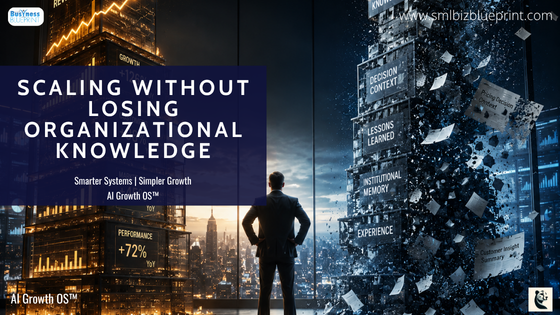
Growing companies lose organizational knowledge when decisions, context, and lessons learned fail to scale with the business.
The deeper problem is not missing documentation—it is declining decision quality caused by weakening organizational memory.
Companies that scale successfully build systems that preserve reasoning, reuse experience, and turn learning into a compounding competitive advantage.
Most growing businesses believe they have an execution problem when they actually have a memory problem.
Revenue grows. Teams expand. Systems become more sophisticated. Yet leadership notices the same pattern returning.
Decisions take longer. Managers revisit previously solved problems. Sales repeats old mistakes. Operations rebuilds fixes that once existed. The company is larger, but it is not necessarily becoming more intelligent.
The common diagnosis is communication.
The structural reality is different.
The business is scaling activity faster than it is scaling intelligence.
This matters because organizations do not operate on information alone. They operate on judgment. Judgment determines pricing decisions, hiring choices, customer strategy, operational priorities, and resource allocation.
When organizational memory weakens, judgment becomes more dependent on individual people and less supported by accumulated learning.
Most teams misdiagnose the problem because the symptoms appear scattered.
Sales sees inconsistent conversion. Marketing sees repeated campaign lessons. Operations sees process drift. Leadership sees bottlenecks and decision fatigue. Each looks like a separate issue.
Often, they share the same root: the business is failing to preserve the reasoning behind what it learns.
The hidden operational tension is simple.
Growth creates more learning than the organization can absorb.
Every customer call, failed campaign, hiring mistake, pricing adjustment, delivery issue, and strategic decision produces knowledge. But unless that knowledge is captured with context, it disappears into meetings, inboxes, Slack threads, dashboards, and individual memory.
The organization becomes experienced without becoming structurally wiser.
Most companies respond with more documentation. More SOPs. More playbooks. More folders. More tools.
That helps, but it does not solve the deeper problem.
Documentation stores actions. Organizational memory stores reasoning.
One tells people what happened. The other explains why it happened.
This distinction is the architectural reframe. A business does not create durable advantage by storing more information. It creates durable advantage by preserving decision context so future decisions improve.
The financial cost of ignoring this is rarely labelled as knowledge decay. It appears as slower onboarding, duplicated work, stalled deals, inconsistent delivery, repeated leadership conversations, overdependence on key people, and strategic hesitation.
The business pays for the same lesson multiple times.
The solution is not more effort. It is structural redesign.
A scaling company must build systems that capture, structure, retrieve, and improve organizational learning. Not everything needs to be preserved. But decisions that shape revenue, customers, operations, people, and strategy need memory.
The companies that win long term are not necessarily the ones that know the most.
They are the ones that forget the least.
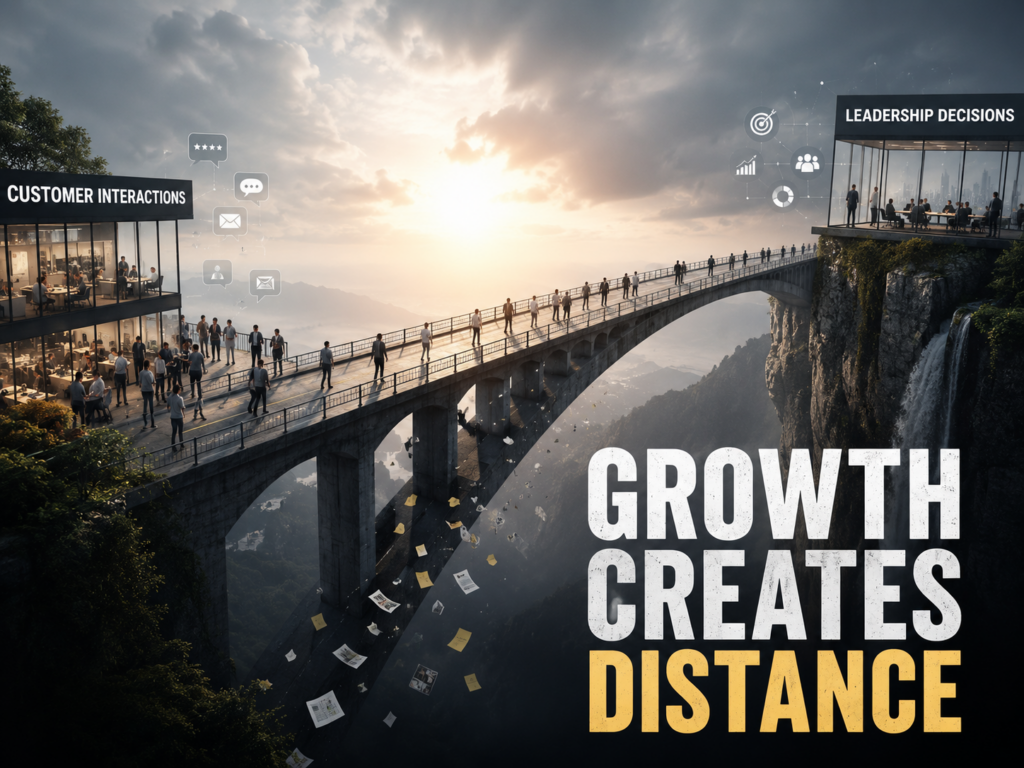
Growth Creates Distance
Most people think growth creates complexity.
That is only partially true.
Growth creates distance.
Distance is the mechanism that quietly drives organizational knowledge loss.
When a business is small, learning spreads naturally. Founders hear customer feedback directly. Teams sit close together. Decisions remain connected to outcomes. Knowledge moves because people move together.
Then growth arrives.
Departments emerge. Managers appear. Systems multiply. Teams specialize.
The business becomes operationally stronger while becoming cognitively fragmented.
Important lessons now have to travel.
This is the first principle most businesses miss:
Growth does not create complexity. Growth creates distance.
Distance between decisions and outcomes.
Distance between teams and customers.
Distance between experience and memory.
Distance is not the enemy.
In fact, distance is the price of scale.
You cannot build a fifty-person business where everyone sees everything. Nor should you try.
The real challenge is making learning travel faster than the distance you are creating.
Every layer added to an organization creates another opportunity for context to disappear.
A pricing decision survives.
The reasoning behind it often does not.
A marketing lesson remains valuable.
The people who learned it may have moved on.
An operational improvement still shapes daily work.
The story behind its creation may be gone.
The organization retains outputs while losing understanding.
Knowledge leakage occurs when organizational learning travels slower than organizational growth.
This is where repeated mistakes begin.
Not because people are careless.
Because context no longer travels effectively.
This is why your sales team keeps re-explaining the same thing on calls. This is why onboarding takes longer than expected. This is why experienced employees often feel irreplaceable.
They are not just carrying workload.
They are carrying memory.
The longer this remains true, the more the business depends on individual recollection rather than institutional intelligence.
Scale amplifies every weakness in how a company learns. If learning moves slowly today, growth will not solve the problem.
Growth will magnify it.
Pro Tip
Watch for repeated conversations.
If teams keep debating the same issue, the problem may not be indecision. The business may have lost access to its own reasoning.
Late one Friday afternoon, a founder sat through a pricing discussion that felt strangely familiar.
Thirty minutes in, he realized the team had reached the same conclusion eighteen months earlier. The decision had not vanished. The reasoning had.
That was the moment he stopped assuming experience accumulates automatically and started treating memory as a system.
Why Experience Does Not Automatically Become Intelligence
Experience is not intelligence.
Experience is raw material.
Intelligence is processed experience.
This is where many growing businesses fool themselves. They assume that because the company has existed longer, served more customers, and survived more problems, it must be wiser.
But time does not automatically create organizational intelligence. It only creates more events.
A business can spend ten years in a market and still repeat the same mistakes if it does not convert experience into usable learning.
The real chain looks like this:
Experience becomes context.
Context becomes memory.
Memory improves decisions.
Break any link and learning disappears.
A failed campaign creates experience. But if the team does not capture why it failed, what was assumed, what the market showed, and what should change next time, that experience never becomes intelligence.
It becomes a story. Maybe a frustration. Maybe a comment in a meeting. Then it fades.
The same is true in sales. A team may learn through hundreds of calls that a specific type of prospect rarely converts. But unless that insight changes qualification, messaging, follow-up, and forecasting, the business has not learned structurally. Individual salespeople may know it. The system does not.
Organizational intelligence is created when experience is captured with context and made available to future decisions.
The consequence of getting this wrong is painful. The business becomes experienced at the individual level but immature at the system level.
That is why new hires repeat old mistakes. They enter the company after the lesson was learned but before the lesson was encoded. They inherit procedures without judgment. They see the current process but not the scars that shaped it.
Most people do not realise how much business knowledge is tacit. It sits inside pattern recognition, instinct, and judgment.
Experienced people know which client warning signs matter. They know which operational shortcuts create problems later. They know which deals look good but drain capacity.
But if that knowledge remains intuitive, it remains fragile.
Experience that stays inside individuals cannot compound. It can only be borrowed while those individuals are present.
Pro Tip
After major projects, capture three things: what the team believed, what actually happened, and what should change.
That turns experience into reusable intelligence.

Knowledge Decay Is Really Decision Decay
Most businesses think they have an information problem.
They don’t.
Information is abundant.
Judgment is scarce.
The real issue is not missing information. It is weakening decision quality.
This is the second principle that changes how the problem should be understood:
Knowledge decay is really decision decay.
The visible symptom is forgotten information.
The real consequence is poorer choices.
Every business operates as a prediction engine.
Pricing predicts customer behavior.
Hiring predicts future performance.
Marketing predicts market response.
Operations predicts delivery outcomes.
The quality of those predictions depends on accumulated learning.
When learning disappears, prediction quality declines.
Watch what happens when judgment weakens.
Managers escalate decisions.
Sales cycles lengthen.
Hiring becomes cautious.
Teams ask for more approval.
Leadership becomes a bottleneck.
Nothing breaks.
Everything slows.
Decision decay occurs when past learning no longer improves future judgment.
The consequence is not simply inefficiency.
It is strategic drag.
This is why deals feel close but stall. The business learned something important about customer objections, but the lesson never became part of the sales system.
This is why your pipeline looks strong but fails to convert consistently.
This is why operational improvements struggle to spread.
The organization paid for the lesson.
Then forgot it.
Every mistake in business has a cost. Many are worth paying because they generate learning.
But when learning disappears, the cost becomes pure waste.
More importantly, decision decay changes the economics of growth.
Revenue becomes harder to scale because each layer of complexity requires rediscovering lessons the business already earned.
Margins compress because execution absorbs avoidable friction.
Leadership capacity shrinks because judgment remains concentrated instead of distributed.
Markets reward learning speed.
The businesses that learn fastest are often the businesses that remember best.
Pro Tip
Build decision reviews into major initiatives.
The goal is not accountability. The goal is preserving judgment so future decisions start from a higher level.
Why Documentation Does Not Create Memory
When leaders see knowledge loss, they usually ask for more documentation.
That response is understandable.
It is also incomplete.
More SOPs, manuals, folders, wikis, and playbooks can help organize work. But they do not automatically create organizational memory.
Documentation can tell people what to do without helping them understand why it matters.
This is the failure of the default approach.
Documentation stores actions.
Organizational memory stores reasoning.
A documented sales process may explain how to qualify a lead. It may not explain the years of customer learning behind the qualification criteria.
A documented onboarding process may list steps. It may not explain which failure points those steps were designed to prevent.
When reasoning disappears, documentation becomes brittle.
People follow the process until conditions change. Then they either improvise without context or escalate decisions back to leadership.
This is how documentation-heavy companies still become founder-dependent.
They have instructions.
They do not have judgment transfer.
There are three layers to understand.
Data stores facts.
Documentation stores actions.
Organizational memory stores reasoning.
Most companies have more data than they can interpret and more documentation than people want to read. What they lack is the third layer: preserved decision context.
Organizational memory is the structured preservation of why decisions were made, what assumptions shaped them, and what outcomes followed.
The consequence of getting this wrong is compliance without intelligence.
Teams may appear aligned because they follow the same process. But they are not truly aligned if they do not understand the logic behind the process. They cannot adapt intelligently. They can only repeat.
This is where many businesses mistake order for capability.
A tidy folder is not a learning system.
A process manual is not institutional wisdom.
Ss the business grows, rules without reasoning become harder to maintain. People need more than instructions. They need decision context that helps them think well when the situation changes.
Pro Tip
Add a “Why This Exists” section to every critical process.
The reason behind the process often remains valuable longer than the process itself.
Building Organizational Memory
The goal is not to capture everything.
That creates noise.
The goal is to preserve what improves future decisions.
Most organizations approach knowledge as a storage problem.
The better question is different:
What learning would make the business smarter if it were available six months from now?
That question changes the system.
Organizational memory is not an archive.
It is a decision asset.
The purpose is not preservation for its own sake. The purpose is improving future judgment.
The most valuable organizational memory captures four things:
The context.
The reasoning.
The action.
The outcome.
Most companies preserve only one.
The action.
That is why learning rarely compounds.
A business builds organizational memory when it preserves the decision context behind important choices and makes that learning reusable.
The consequence of failing to do this is that every team becomes partially blind.
Sales sees one reality. Operations sees another. Marketing learns lessons that never influence customer service. Leadership receives summaries without context.
The organization becomes experienced.
But not necessarily intelligent.
This is the identity shift:
Smart companies solve problems.
Intelligent companies remember how they solved them.
The founder cannot remain the memory layer forever. If growth depends on leadership constantly providing historical context, intelligence has not scaled.
Dependency has.
Pro Tip
Start with recurring decisions. If a decision repeatedly influences revenue, customers, hiring, or delivery, it deserves a memory trail.
A growing services business kept struggling with new manager onboarding.
Each manager was capable, yet the same operational mistakes kept appearing. The shift came when the company began capturing decision context beside its core processes.
New managers stopped inheriting tasks alone and began inheriting judgment.
Compounding Intelligence Is The Real Competitive Advantage
Most businesses think experience is an asset.
It isn’t.
Preserved experience is an asset.
Experience alone expires surprisingly fast.
This is where competitive advantage actually emerges.
Every company accumulates experience.
Very few accumulate wisdom.
The strongest companies are not information-rich.
They are learning-rich.
Information is available to everyone. Reports, tools, consultants, software, frameworks, and AI systems can all be purchased.
Accumulated judgment cannot.
Competitors can copy your pricing.
They can copy your technology.
They can copy your website.
They can copy your process.
What they cannot easily copy is years of preserved decision context.
That is where the moat exists.
Compounding intelligence occurs when past learning continuously improves future decision quality.
One business treats every challenge as new.
Another connects the challenge to everything it has already learned.
One reacts.
The other recognizes patterns.
Over time, the gap widens.
The consequence of missing this is not merely slower growth.
It is weaker defensibility.
The organization keeps moving but never becomes substantially harder to compete against.
Most leaders assume scale creates advantage.
Scale can create advantage.
But scale without intelligence often creates fragility.
More people.
More systems.
More handoffs.
More places for context to disappear.
The real advantage is not size.
It is accumulated judgment.
Technology is becoming easier to access. Intelligence is becoming harder to replicate.
The companies that preserve learning will increasingly outperform companies that merely accumulate activity.
Pro Tip
Treat organizational learning like a strategic asset.
Review it, maintain it, and deliberately reinvest it into future decisions.
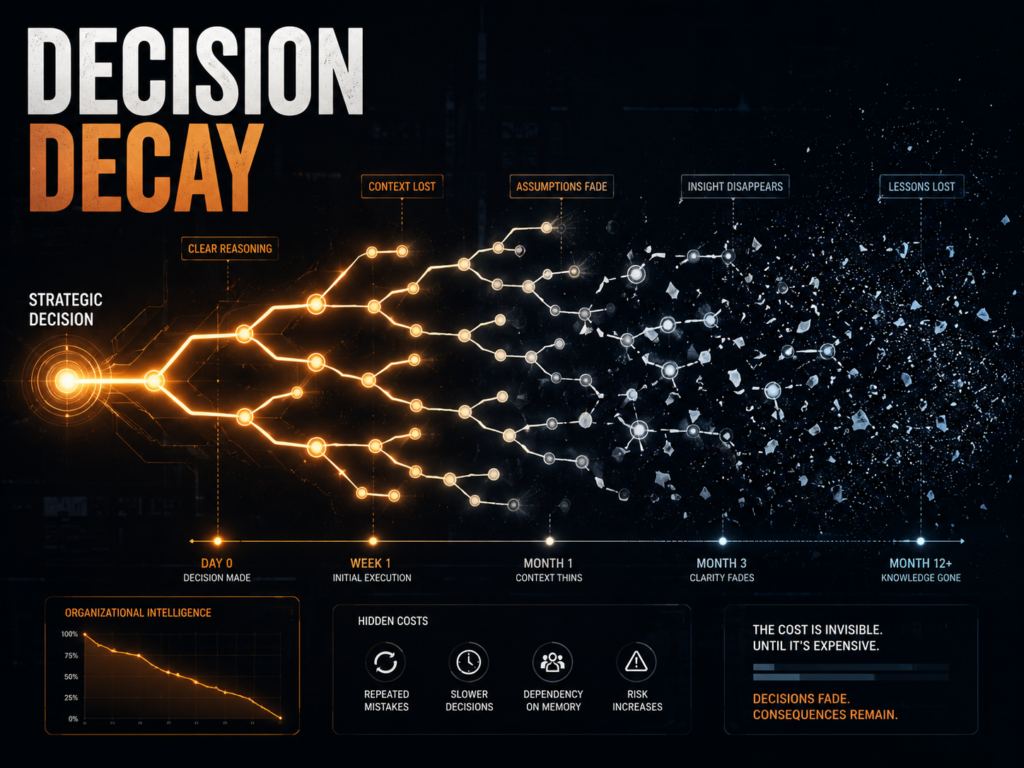
Why AI Makes Organizational Memory More Valuable Than Ever
For decades, knowledge loss created inefficiency.
AI changes the equation.
Now knowledge loss creates intelligence limits.
Many businesses believe AI will solve their knowledge problems.
In reality, AI often exposes them.
AI is fundamentally a context amplifier.
It can only reason with the context it receives.
Weak context produces generic outputs.
Rich context produces strategic outputs.
This is the shift most organizations have not fully recognized.
The future advantage will not belong simply to businesses using AI.
It will belong to businesses with the strongest organizational memory for AI to work from.
AI performance improves when organizational memory provides richer decision context, clearer patterns, and stronger business-specific learning.
A business with preserved customer insights can improve sales performance faster.
A business with documented decision reasoning can generate stronger strategic recommendations.
A business with captured operational lessons can automate with fewer blind spots.
The issue is not the tool.
The issue is the memory layer beneath the tool.
Businesses with weak memory will get generic answers faster.
Businesses with strong memory will create strategic leverage.
That is a very different outcome.
Organizations are rushing to adopt AI. Many have not built the context infrastructure that makes AI genuinely valuable.
The businesses preserving reasoning today will gain disproportionately more value from AI tomorrow.
Pro Tip
Before automating a process with AI, capture the judgment behind the process.
Automation without context scales activity. Automation with context scales intelligence.
Two businesses can have similar revenue, similar talent, and access to the same technology.
One becomes sharper each year while the other keeps fighting familiar problems. The difference is rarely intelligence at the individual level. It is whether yesterday’s learning survives long enough to improve tomorrow’s decisions.
One company scales activity. The other scales understanding.
Conclusion
If growth feels heavier than it should, the issue may not be effort.
It may not be talent.
It may not even be strategy.
The business may simply be forgetting too much of what it has already learned.
That is the quiet frustration inside many growing companies. They keep moving, but the movement costs more than it should.
They keep deciding, but decisions carry too little memory. They keep hiring, documenting, and implementing systems, yet the founder still becomes the person who explains why things are the way they are.
The relief comes from recognizing that this is optional.
Organizational knowledge does not have to decay. Experience does not have to disappear. Context does not have to remain trapped inside individual people.
A business can be designed to remember.
That changes the nature of growth.
Instead of repeating lessons, the company builds on them. Instead of scaling dependence, it scales judgment. Instead of using AI on fragmented information, it gives AI a stronger context layer to work from.
This is the deeper identity shift.
A mature business does not rely on memory.
It builds memory.
Most businesses compete for customers, talent, and attention. The best businesses also compete for accumulated intelligence.
Everyone gains experience.
Very few organizations gain wisdom.
The companies that win long term are not the ones that know the most. They are the ones that forget the least.
One path compounds friction.
The other compounds intelligence.
The current state is not fixed.
You can keep paying for the same lessons, or you can build a business that remembers.
Action Steps
Audit Repeated Decisions
Identify decisions that are being revisited every quarter or every year. Repetition often signals missing organizational memory rather than poor execution. The decision consequence is that strategic energy gets consumed solving old problems instead of creating new advantages.
Capture Decision Context
Record assumptions, alternatives considered, and expected outcomes beside major decisions. Context allows future teams to understand reasoning instead of blindly inheriting conclusions. The decision consequence is stronger judgment when conditions change.
Identify Knowledge Concentration Risks
Map where critical operational knowledge lives inside specific individuals. Strategic resilience improves when intelligence is distributed across systems rather than trapped in people. The decision consequence is less dependency when key employees leave or roles change.
Create Feedback Loops
Review important decisions after implementation and document actual outcomes. Learning compounds when prediction and reality are connected. The decision consequence is that future decisions become evidence-informed rather than memory-dependent.
Build Retrieval Before Expansion
Make critical knowledge easy to access before creating more documentation. Stored information has little value if it cannot influence future decisions. The decision consequence is faster execution with less repeated explanation.
Measure Learning Velocity
Track how quickly lessons learned in one part of the business influence other teams. Organizational intelligence grows when learning travels faster than complexity. The decision consequence is reduced operational drift and stronger cross-functional alignment.
FAQs
What is organizational knowledge decay?
Organizational knowledge decay occurs when decision context, lessons learned, and operational reasoning disappear over time. The decision path is to preserve the thinking behind important decisions, not just the final actions.
Why does knowledge decay happen as companies grow?
Growth increases distance between people, decisions, outcomes, and context. The decision path is to reduce that distance through systems that capture and transfer learning.
Is documentation enough to prevent knowledge loss?
No. Documentation stores actions, but it often misses reasoning. The decision path is to add context, assumptions, and outcomes to critical processes.
How does knowledge decay affect business performance?
It weakens decision quality, slows execution, increases repeated mistakes, and creates dependence on key people. The decision path is to identify where the business keeps recreating knowledge instead of reusing it.
What is organizational memory?
Organizational memory is the structured preservation of decision context, lessons learned, and reasoning. The decision path is to build memory around recurring high-value decisions first.
How does AI change the importance of organizational memory?
AI amplifies the context it receives. The decision path is to strengthen organizational memory before expecting AI to improve strategy, automation, or execution.
What creates a compounding knowledge advantage?
Compounding knowledge advantage occurs when past learning improves future decisions. The decision path is to capture outcomes, review decisions, and make learning reusable across teams.
Bonus Insight: Three Ways To Think About Knowledge That Most Businesses Miss
Most leaders believe knowledge is something the business has.
A better view is that knowledge is something the business either preserves or loses every day.
That distinction changes the conversation. The goal is not to collect more information. The goal is to stop organizational amnesia from weakening future decisions.
These three shifts challenge how most businesses think about knowledge, learning, and AI.
Your Biggest Risk Is Not Employee Turnover. It Is Decision Turnover.
Most businesses track employee retention. Few track whether important decisions remain understandable six months later.
This is what you are doing wrong: preserving decisions while losing the logic behind them.
When reasoning disappears, teams inherit conclusions without the conditions that created them. The result is strategic drift disguised as continuity.
If this does not change: the business keeps following decisions it no longer understands.
Every Business Has A Learning Supply Chain
Companies manage supply chains for products, customers, cash flow, and delivery.
Almost nobody manages the movement of learning.
Yet learning also has sources, bottlenecks, storage points, transfer points, and failure points. If customer insight never reaches marketing, or operational lessons never reach leadership, the learning supply chain is broken.
If this does not change: knowledge continues accumulating locally while value stalls globally.
Future AI Performance Depends On Past Human Thinking
Many organizations believe AI will solve their knowledge problems.
Often, AI will expose them.
AI depends on context. A business with weak memory gives AI weak inputs. A business with preserved reasoning gives AI a strategic foundation.
If this does not change: technology scales faster than intelligence.
Other Articles
How to Stop Repeating Business Mistakes at Scale