
How automation protects process integrity, reduces drift, and reinforces reliable growth execution.
AI-powered operational stability is the practice of using automation to enforce business standards, detect operational drift, and maintain consistent execution as a company scales.
Rather than focusing on task automation alone, stability-focused systems monitor critical signals, apply predefined thresholds, and trigger corrective actions before small deviations become larger operational failures.
This approach helps growing businesses improve
The Hidden Cost of Operational Drift
Most businesses do not break because they lack effort.
They break because they lose consistency.
At $5M to $20M in revenue, growth introduces a different challenge. More customers, more employees, more service lines, and more decisions increase complexity faster than most operating models can absorb.
The common response is to add management layers, more meetings, more reporting, or additional oversight.
Yet these interventions rarely address the underlying issue.
The real problem is often operational drift.
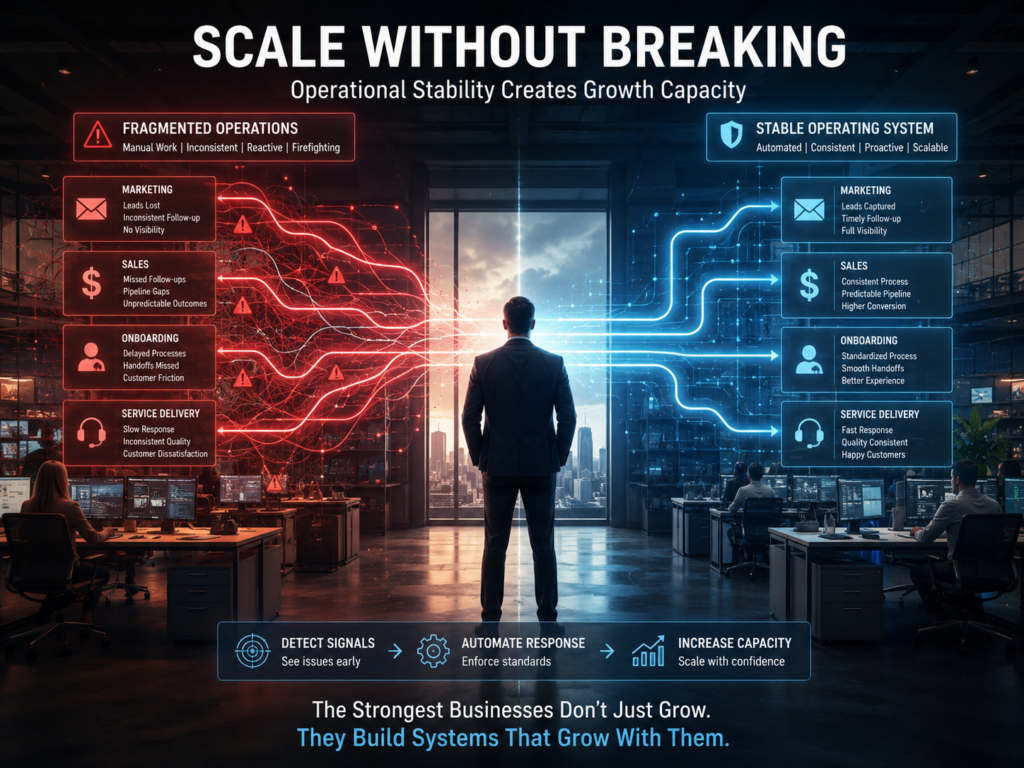
Operational drift occurs when execution gradually moves away from the intended way the business is supposed to operate.
Qualification standards change. Follow-up timing becomes inconsistent. Escalations happen unevenly. Customer experiences vary depending on who is involved.
The business continues functioning, but structural integrity begins to weaken.
Most leadership teams miss this because they are measuring outputs while the failure is occurring inside the system itself.
Revenue may still be growing.
Customers may still be buying.
Dashboards may still look healthy.
But underneath the surface, the business is becoming harder to manage.
Managers spend more time checking than improving.
Teams spend more time clarifying than executing.
Knowledge becomes trapped inside individuals instead of embedded inside systems.
A surprising number of businesses can double revenue while simultaneously weakening the operating system that produced it.
Eventually, leadership concludes they have a people problem.
In reality, they have a system stability problem.
The Complexity Trap
As businesses scale, complexity compounds faster than headcount.
Every new channel generates more signals.
Every new hire introduces variation.
Every new product creates exceptions.
Every new customer segment adds additional decision paths.
The challenge is not the volume of work.
It is the volume of decisions.
Without a mechanism for maintaining consistency, complexity creates uncertainty.
Sales opportunities remain untouched longer than expected.
Projects move forward with incomplete information.
Customer requests wait for responses.
Processes designed to create reliability begin producing variability.
Two customers can buy the same service and receive entirely different experiences simply because different people handled the process.
The organization gradually shifts from executing systems to supervising exceptions.
Managers become professional escalators. Their week fills with checking, chasing, clarifying, and resolving issues that should have been handled by the operating system itself.
This is where many automation conversations begin in the wrong place.
The objective is not to automate activity.
The objective is to preserve consistency as complexity increases.
Most businesses assume growth is constrained by demand.
In reality, many growth-stage companies are constrained by absorption capacity—the ability of the operating system to handle additional complexity without degrading performance.
When standards depend on memory, supervision, and individual effort, growth eventually creates instability.
Operational stability increases the organization’s capacity to absorb volume without sacrificing consistency.

The Architectural Principle: Continuity Enforcement
Most discussions about automation focus on productivity.
The more important question is stability.
Every business has an intended operating model.
Leads should move through defined stages.
Customers should receive consistent experiences.
Escalations should occur under specific conditions.
Critical decisions should follow established criteria.
As complexity grows, maintaining those standards becomes increasingly difficult.
This is fundamentally a continuity problem.
Without enforcement mechanisms, organizations become dependent on memory, vigilance, and individual discipline to maintain consistency.
That creates fragility.
Many leadership teams believe additional management oversight solves this problem.
In practice, it often delays recognition.
More supervision can temporarily mask instability without removing the underlying causes. The system still depends on people noticing problems rather than preventing them.
Automation becomes valuable when it reinforces standards automatically.
Its purpose is not to replace judgment.
Its purpose is to ensure the organisation behaves consistently regardless of workload, staffing changes, or management attention.
This is where AI-powered operational stability begins.
Signal Logic Before Automation
Most businesses try to automate processes before defining the conditions that require intervention.
As a result, they automate activity rather than outcomes.
The first question should never be:
“What should we automate?”
The first question should be:
“What signals indicate the system is drifting?”
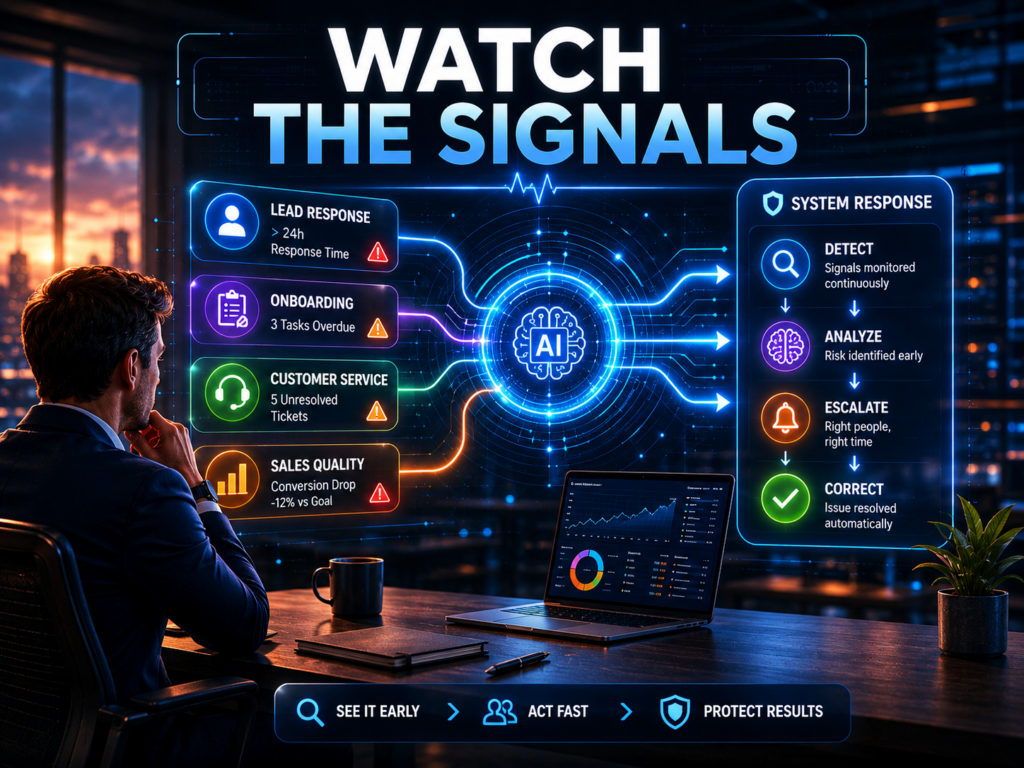
Every business generates signals.
Sales pipelines generate movement signals.
Marketing generates engagement signals.
Customer service generates response signals.
Operations generate completion signals.
The challenge is identifying which signals reveal increasing risk.
A qualified lead sitting untouched for seven days is a signal.
An onboarding process exceeding acceptable timeframes is a signal.
A project progressing without required approvals is a signal.
Declining conversion quality is a signal.
None of these events are the problem themselves.
They are indicators that the system is moving away from its intended state.
This distinction matters because signals transform management from observation into architecture.
Most businesses operate as collections of activities.
High-performing businesses operate as systems of detection, interpretation, and response.
The difference is significant.
One organization discovers problems after performance declines.
The other identifies emerging issues while corrective action is still inexpensive.
Signal visibility is often the difference between predictable growth and constant firefighting.
Once signals are identified, thresholds must be defined.
Thresholds determine when intervention becomes necessary.
This is where operational standards become executable logic.
Without thresholds, teams rely on judgment calls and reactive management.
With thresholds, businesses create predictable control mechanisms.
The Control Layer
Once signals and thresholds are established, automation becomes strategically useful.
Consider a sales process where qualified opportunities must receive follow-up within twenty-four hours.
If that condition is missed, the system detects the deviation.
The objective is not to replace the salesperson.
The objective is to protect the operating standard.
The lead may be reassigned.
An escalation may be triggered.
A manager may receive visibility.
Additional actions may occur if further thresholds are breached.
The same logic applies across marketing, onboarding, service delivery, and operations.
When critical conditions move outside acceptable boundaries, the system responds according to predefined rules.
This is where automation moves beyond efficiency.
It becomes an enforcement mechanism.
The business no longer relies exclusively on people remembering what should happen. The operating system actively protects the standards that leadership has already defined.
Founder-Level Translation
What this means in practice is simple.
Your business should not depend on people remembering what must happen next.
It should not require managers to discover problems after they have already become expensive.
It should not rely on constant supervision to maintain standards.
Instead, the system should continuously monitor the conditions that matter most.
When those conditions move outside acceptable limits, corrective action should occur automatically.
Leadership’s role shifts from policing execution to improving architecture.
That shift creates leverage.
Not because fewer people are involved.
Because fewer failures are allowed to compound unnoticed.
The highest-leverage leaders eventually spend less time managing exceptions and more time improving the conditions that produce results.
A Practical Example
Imagine a growing professional services firm.
Marketing generates leads across multiple channels.
Sales qualifies opportunities.
Delivery teams manage onboarding and implementation.
As growth accelerates, leadership notices declining consistency.
Conversion rates fluctuate.
Customer experiences vary.
Pipeline performance becomes harder to predict.
The instinct is to add more management oversight.
However, analysis reveals a different issue.
Lead response times vary significantly.
Qualification criteria are applied inconsistently.
Onboarding milestones are missed.
Customer communication standards are not being followed uniformly.
These are not isolated failures.
They are signals of operational drift.
A stability-focused automation architecture begins by monitoring those conditions.
Lead response exceeds twenty-four hours.
Required qualification data is missing.
Onboarding stages remain incomplete beyond defined thresholds.
Customer communication commitments are missed.
When those conditions occur, escalation pathways activate automatically.
Visibility increases.
Ownership is clarified.
Corrective actions begin.
The objective is not to remove people from the process.
The objective is to ensure standards remain intact regardless of workload or complexity.
The impact extends beyond operational consistency.
Management spends less time chasing exceptions.
Forecasting becomes more reliable.
Customer outcomes become more predictable.
New team members become productive faster because standards are enforced by the system rather than learned through trial and error.
The organization gains the ability to absorb higher volumes of demand without proportionally increasing oversight costs.
New opportunities no longer require equivalent increases in management attention.
What began as a stability initiative becomes a growth capacity advantage.
The business is no longer scaling effort.
It is scaling its ability to absorb complexity.
The Outcome: Predictable Growth Through Stability
Growth exposes weaknesses.
Weaknesses become instability when systems lack enforcement mechanisms.
This is why AI-powered operational stability matters.
Growth eventually stops being constrained by effort.
It becomes constrained by consistency.
Organisations that scale effectively are not necessarily the most automated.
They are the most predictable.
When signal detection, threshold management, escalation logic, and continuity enforcement work together, operational drift becomes easier to identify and correct.
Marketing performs more predictably because standards remain intact.
Sales performs more reliably because opportunities receive consistent treatment.
Operations remain stable because execution follows defined pathways.
Leadership gains confidence because system behaviour becomes measurable and repeatable.
Most importantly, structural integrity improves.
Complexity can increase without creating chaos.
Volume can increase without reducing quality.
Growth can occur without sacrificing consistency.
And that changes more than operational performance.
It improves forecasting accuracy.
It reduces revenue leakage.
It lowers the management overhead required to scale.
It increases the organisation’s ability to grow without introducing proportional risk.
Over time, operational stability becomes a competitive advantage because consistency scales more effectively than effort.
Businesses that master this shift create a different type of growth engine. They do not grow because they work harder. They grow because their standards survive scale.
Most businesses believe growth is created by generating more demand.
Sustainable growth comes from increasing the system’s capacity to absorb it.
Operational stability is not the reward for scaling.
It is what makes scaling possible.
That is the true role of automation within a modern AI Growth Architecture.
Not a tool for doing more work.
A mechanism for preserving how the business operates as complexity increases.
Operational stability is ultimately the ability to scale without losing yourself in the process.
FAQs
What is AI-powered operational stability?
AI-powered operational stability is the use of AI and automation to maintain consistent execution across a business. The objective is not simply efficiency but continuity enforcement, ensuring processes, decisions, and standards remain aligned as complexity increases.
How is operational stability different from traditional automation?
Traditional automation focuses on completing tasks faster. Operational stability focuses on detecting drift, enforcing standards, and triggering corrective actions when business performance begins moving outside acceptable operating conditions.
What is operational drift and why does it matter?
Operational drift occurs when execution gradually diverges from the intended operating model. Left unchecked, it creates inconsistent customer experiences, unreliable reporting, weakened accountability, and less predictable growth outcomes.
What signals should businesses monitor to improve operational stability?
Businesses should monitor signals that indicate deviation from expected performance, such as lead response delays, incomplete qualification data, onboarding bottlenecks, missed service milestones, or declining conversion quality. These signals provide early visibility into emerging system weaknesses.
Why do many automation projects fail to deliver long-term value?
Many projects automate activities without defining the signals, thresholds, and governance rules that maintain system integrity. As a result, automation accelerates existing inconsistencies rather than reinforcing operational standards.
How does AI improve predictability in marketing and sales?
AI can continuously monitor performance conditions, identify deviations, and trigger escalation or correction workflows before problems compound. This reduces variability in lead management, customer communication, and pipeline progression, creating more reliable outcomes.
What should leaders focus on before implementing automation?
Leaders should first define the operating standards they want to protect, the signals that indicate drift, and the thresholds that require intervention. Once those elements are clear, automation can function as an enforcement layer rather than simply another productivity tool.
Other Articles
AI Decision Logic Systems for Smarter Business Growth