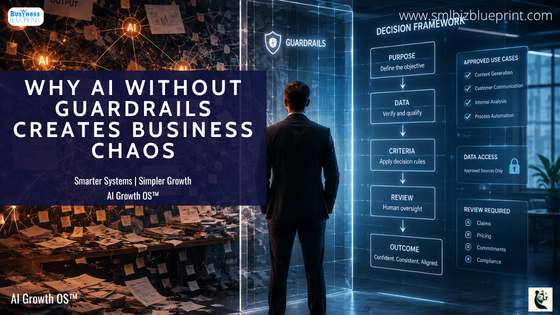

How to stop AI from spreading inconsistency across teams, tools, and decisions.
AI without guardrails creates business chaos because it speeds up decisions before the business has defined who owns them, what standards they must follow, and where human approval is required.
The real risk is not just bad AI output; it is operational drift across sales, marketing, customer experience, and internal workflows.
AI guardrails turn automation into controlled leverage by making business rules, decision rights, and quality standards executable.
AI is already inside your business, whether you have formally approved it or not.
Someone in marketing is using it to write campaign copy. Someone in sales is using it to draft proposals. Someone in operations is using it to summarise documents, build spreadsheets, or automate admin.
On the surface, that looks like progress. Faster work. Lower friction. More output.
But the real problem is not whether your team is using AI. The problem is that AI is now shaping decisions without a clear operating standard.
That is where the risks of AI without guardrails begin to show up. Not as one dramatic failure. More often, it appears as small inconsistencies that compound.
A proposal goes out with the wrong promise. A campaign sounds different from your actual positioning. A team member automates a process no one has reviewed. A customer receives an answer that is confident but commercially wrong.
Here’s how that shows up in your business: more rework, more second-guessing, more approval bottlenecks, more customer confusion, and more leadership time spent cleaning up decisions that should never have moved that far downstream.
The cost is not just messy output. It is margin leakage: time spent correcting work, deals slowed by inconsistent messaging, and leaders pulled back into decisions the system should already control.
The default approach is to treat AI like a productivity tool. Give people access. Encourage experimentation. Hope common sense fills the gaps.
That approach fails because AI does not just speed up tasks. It speeds up judgment. It scales assumptions. It gives weak processes more reach.
The better lens is this: AI guardrails are not restrictions. They are decision architecture.
A serious operator does not chase automation. A serious operator builds control before scale.
What AI Guardrails Actually Mean in Business
AI guardrails are the rules, boundaries, permissions, and decision standards that determine how AI is allowed to operate inside the business.
Most companies reduce guardrails to tool rules: don’t paste sensitive data, check the output, avoid risky claims. Useful, but incomplete.
The resistance usually comes from a reasonable place. Business owners do not want AI rules to make the company slower, stiffer, or less creative.
But the opposite of guardrails is not freedom. It is ambiguity. And ambiguity does not empower good people; it forces them to guess.
Real guardrails answer harder questions.
What can AI decide on its own? What can it draft but not approve? What data can it access? Which customer-facing messages require review? Which claims are off-limits? What tone, pricing logic, escalation path, compliance rule, or brand standard must it follow every time?
Without those answers, AI becomes a mirror for whoever is using it.
One employee uses AI to sound more persuasive. Another uses it to cut corners. Another uses it to automate a process they do not fully understand.
None of them are trying to damage the business. That is the uncomfortable part. The chaos often comes from good people using powerful tools inside unclear systems.
Guardrails stop every employee from inventing their own version of how the business thinks.
They give the business a way to say: this is how we decide, this is how we communicate, this is what must be checked, and this is what must never be compromised.
Most people don’t realise the guardrail is not mainly for the AI. It is for the business. It forces leadership to define standards that were previously living in people’s heads.
A business owner let the team “experiment freely” with AI because it felt modern, efficient, and harmless.
Three weeks later, the sales deck, email follow-up, and website copy were all saying slightly different things.
The shift came when they realised the tool was not the problem; the missing standard was.
They stopped treating AI like a shortcut and started treating it like a system that needed rules.
Because every AI workflow you add without guardrails increases the surface area for misalignment.
Pro Tip
Start by documenting decision rights, not tool rules.
The deeper question is not “which AI tools can we use?” It is “which decisions are we willing to let AI influence, and under what conditions?”

Why Fast AI Adoption Creates Operational Chaos
Fast AI adoption creates chaos because speed exposes weak operating discipline.
Before AI, slow processes created accidental control. A campaign took time to write. A proposal took time to assemble. A report took time to prepare.
That delay gave people space to notice errors, question assumptions, and escalate decisions.
AI removes that delay.
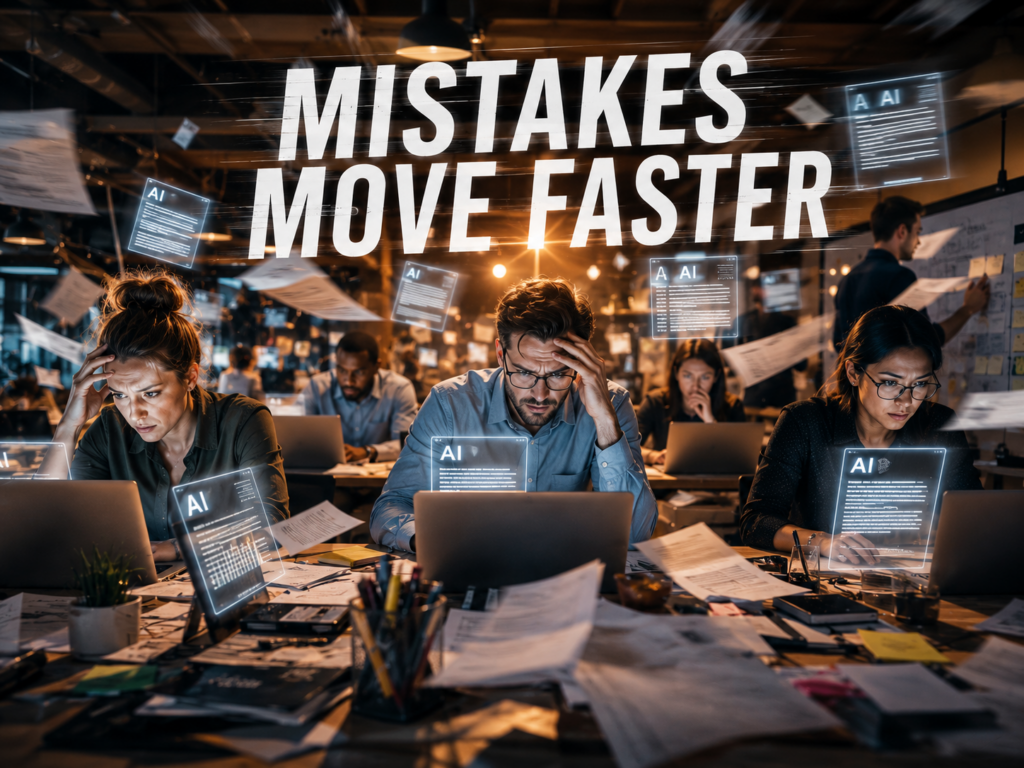
That sounds like efficiency. Sometimes it is. Sometimes it is just mistakes moving faster.
Now a junior team member can generate a sales sequence, rewrite an offer, summarise customer feedback, draft a policy, build a workflow, or produce a strategic recommendation in minutes.
That feels efficient. But if the underlying standards are not clear, the business has not gained leverage. It has gained velocity without steering.
This is why the default approach fails. Most companies roll out AI from the bottom up. People find tools. Teams test use cases. Leaders encourage innovation.
Then, after enough inconsistency appears, the business tries to retrofit control.
That is backwards.
You cannot bolt governance onto chaos and expect clarity. By then, habits have formed. Workarounds exist. Data has moved. Customers may have already seen the inconsistency.
A growing business is especially vulnerable because it is big enough to have complexity but often still informal enough to rely on tribal knowledge.
The founder knows the standard. The senior team knows the nuance. But the system does not.
AI does not respect tribal knowledge. It only follows what has been made explicit.
This is why your sales team keeps re-explaining the same thing on calls. The message is not embedded deeply enough in the system, so every person interprets it differently.
AI then amplifies those differences.
Because operational chaos rarely announces itself as chaos. It looks like “just a few edits,” “just a quick fix,” or “just one campaign that missed the mark.” But those small corrections are leadership tax.
Pro Tip
Do not measure AI adoption by output volume. Measure it by reduction in rework, fewer escalations, and greater consistency across teams.
Speed is only useful when the direction is already clear.
The Hidden Risks of Uncontrolled AI Use
The hidden risks of uncontrolled AI use are not limited to data leaks, factual errors, or compliance problems.
Those matter. But they are not the whole story.
The deeper risk is that AI quietly changes how decisions are made before leadership has defined the rules. It changes who has influence. It changes what gets approved. It changes how confident weak thinking can sound.
That last one matters.
AI can make an underdeveloped idea sound polished. It can make a risky claim sound reasonable. It can make a shallow strategy sound complete.
If your team lacks strong commercial judgment, AI does not fix that. It can disguise the gap.
When weak thinking sounds polished, it travels further before anyone challenges it. That means more work reaches customers, prospects, and internal teams before the business has tested whether it is true, useful, or aligned.
A team member may ask AI to write a customer email and receive something professional but overpromising. A manager may use AI to summarise performance data and miss the operational context. A marketer may generate content that attracts attention but weakens positioning.
The first sign is rarely a crisis. It is a customer asking for clarification. A sales rep editing around the AI output. A manager saying, “That’s not quite how we say it.”
Small corrections become the operating model.
None of this looks dramatic in isolation. Together, it creates drift.
Brand drift. Process drift. Decision drift. Customer experience drift.
And drift is expensive because it does not feel urgent until the consequences are already visible.
This is why deals feel close but stall. The business sounds confident in one channel, vague in another, and inconsistent in follow-up.
AI may not have created the inconsistency, but without guardrails, it helps spread it.
The behaviour to challenge directly is this: letting every team choose their own AI habits is not empowerment. It is unmanaged delegation.
Because the cost is not one wrong output. It is erosion of trust. Customers feel inconsistency before they can explain it. Teams feel uncertainty before leaders see it in reports.
Pro Tip
Build a risk map around business functions, not tools.
Marketing, sales, operations, finance, and customer service each need different guardrails because each one carries different consequences when AI gets it wrong.
How AI Starts Making Decisions Outside Its Authority
AI starts making decisions outside its authority when the business confuses assistance with permission.
At first, AI is asked to help. Draft this. Summarise that. Suggest options. Rewrite this email. Build a workflow. Find the pattern.
Then the line moves.
The draft becomes the final version. The suggestion becomes the decision. The summary becomes the truth. The workflow becomes the process. The pattern becomes the strategy.
No one formally approved the shift. It just happened because the output was fast, plausible, and convenient.
That is how authority leaks.
AI does not need a job title to influence decisions. It only needs access to the moment before a decision is made.
If your people use AI to frame options, prioritise tasks, interpret customer data, write recommendations, or define next steps, then AI is already inside your decision architecture.
The question is whether it belongs there.
This is not a technology problem. It is an authority problem.
A social caption is not the same as a pricing recommendation. A meeting summary is not the same as a legal position. A customer response is not the same as a strategic pivot.
But without guardrails, AI can treat them all as prompts.
You are not just a business owner adopting AI; you are the architect of how judgment moves through your company.
Because unclear authority creates hidden liability. The longer AI operates in grey areas, the more likely your business is to act on outputs that no one truly owns.
Pro Tip
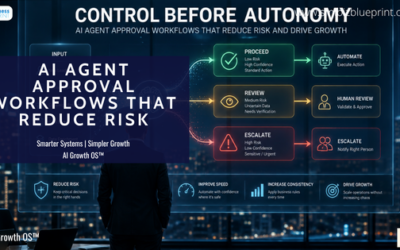
Create an AI authority ladder. Define what AI can do independently, what requires human review, what requires manager approval, and what must stay with leadership.
The deeper lens is control of judgment, not control of software.
How Guardrails Turn AI Into an Enforcement Layer
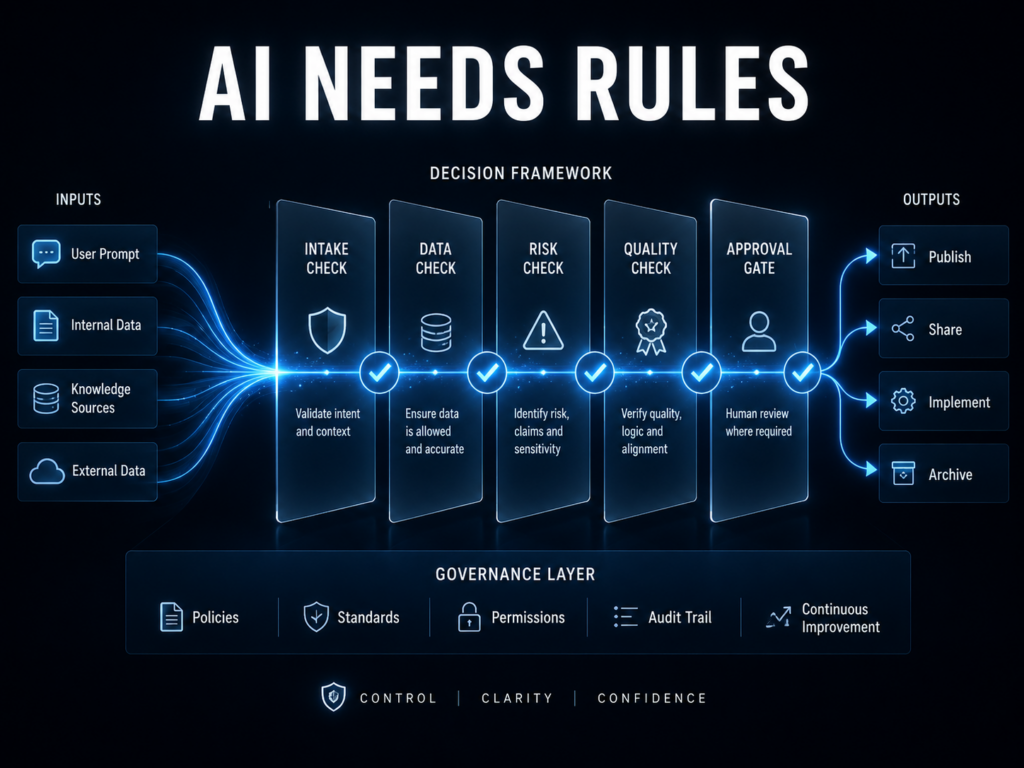
Guardrails turn AI from a loose productivity tool into an enforcement layer for how the business thinks, decides, and acts.
Most people see guardrails as defensive: prevent mistakes, reduce risk, avoid embarrassment. That is useful, but too small.
The real power of guardrails is that they make business standards executable.
If your sales team must qualify leads a certain way, AI can enforce the qualification logic. If your brand must avoid certain claims, AI can flag them before they reach the market. If customer issues need escalation under specific conditions, AI can detect those signals. If proposals must follow pricing rules, AI can check for exceptions.
Before guardrails, AI writes a follow-up email that sounds helpful but skips the qualification standard. After guardrails, it checks the lead stage, applies the right message, flags missing information, and keeps the promise inside the approved boundary.
This is not automation for convenience. This is automation for consistency.
A policy document is passive. A checklist is often ignored. A training session fades.
But an AI system with clear guardrails can sit inside the work itself and ask: does this match the standard? Is this within authority? Is this complete? Does this need escalation?
That is how AI becomes an enforcement layer.
Not by replacing people. By making the operating logic harder to bypass.
A growing service business had plenty of AI activity but no consistency.
Marketing was producing more, sales was moving faster, yet customers were still confused about what the company actually did.
Once they turned qualification rules, offer language, and approval steps into AI guardrails, the noise dropped.
The team stopped chasing output and started operating with shared judgment.
This is why your pipeline looks strong but doesn’t convert consistently. The issue is often not lead volume. It is inconsistency in qualification, follow-up, messaging, and decision discipline.
Because growth does not only require more output. It requires less variation in the moments that matter.
Pro Tip
Turn your best internal standards into AI-readable rules.
The deeper lens is not “how can AI do more?” It is “how can AI make our best way of operating easier to repeat?”
How to Control AI Without Slowing Innovation
You control AI without slowing innovation by separating experimentation from execution.
Most businesses blend the two. That is the mistake.
Experimentation should be open enough to discover better ways of working. Execution should be controlled enough to protect the business. If those two modes are not separated, every experiment risks becoming an unofficial process.
A team member tests an AI workflow. It saves time. Others copy it. Soon it becomes normal.
But no one has checked the data exposure, customer impact, approval logic, brand consistency, or exception handling.
That is not innovation. That is accidental infrastructure.
The better approach is controlled freedom.
Let teams test AI use cases, but define where experiments can happen, what data they can use, what outputs cannot be published, and when a workflow must be reviewed before becoming operational.
Control does not have to mean bureaucracy.
It can mean simple operating rules. Use approved prompts for customer-facing work. Require review for pricing, claims, legal, financial, or strategic outputs. Keep sensitive data out of public tools. Document recurring AI workflows. Assign ownership to every automated process. Review anything that touches the customer journey.
The goal is not to make AI adoption heavy. The goal is to stop the business from confusing speed with maturity.
Because every uncontrolled AI habit becomes harder to unwind once people rely on it.
Pro Tip
Create a sandbox-to-system pathway. Let teams test ideas in a safe zone, then promote only the useful, reviewed, documented workflows into daily operations.
Innovation needs a runway, not a free-for-all.
What Business Owners Should Put in Place Before Scaling AI
Before scaling AI, business owners should put decision infrastructure in place.
Not more tools. Not more prompts. Not another software subscription.
Decision infrastructure.
That means the business has defined where AI belongs, what it can access, how outputs are reviewed, who owns each workflow, and what standards must be enforced.
Without this foundation, scaling AI simply scales uncertainty.
Start with the work that carries the highest consequence: customer communication, sales proposals, marketing claims, pricing logic, lead qualification, operational handoffs, reporting, financial interpretation, and hiring communication.
Then define the rules.
What must AI never do? What can it assist with? What must a human approve? What must be logged? What must be checked against source material? What tone and positioning must be preserved? What data is off-limits? What exceptions require escalation?
These questions are not administrative. They are strategic. They force the business to clarify how it wants to operate.
The next step is ownership. Every AI workflow needs an accountable owner. If no one owns it, no one maintains it. If no one maintains it, it drifts.
That is how AI initiatives fail. Not because the technology is weak, but because the operating model is missing.
The uncomfortable truth is that AI does not make a business more strategic.
It reveals whether strategy was already present. If the company runs on memory, personality, and informal judgment, AI will scale that informality with confidence.
The stronger operator sees guardrails not as control for the tool, but as discipline for the business.
Because AI is already moving faster than most management systems. If you do not define the operating model, your team will create one by habit.
Pro Tip
Build guardrails around decisions before building automations around tasks.
The deeper lens is leverage with accountability. Automation without accountability creates noise. Automation with standards creates scale.
Conclusion
AI without guardrails creates business chaos because it gives speed to systems that have not earned it yet.
If your standards are unclear, AI will not clarify them for you. If your decision rights are informal, AI will blur them further. If your messaging, approvals, workflows, and escalation paths depend on people “just knowing,” AI will expose the weakness.
At first, it may still feel productive. More content. Faster proposals. Quicker summaries. Shorter admin cycles.
But output is not the same as control.
The cost of inaction is not only a bad AI response. It is a business that becomes harder to trust internally.
Teams move faster but not together. Customers hear confident inconsistency. Leaders spend more time correcting work that should have been governed upstream.
There is relief on the other side of this.
When AI has guardrails, the business becomes calmer. Standards become easier to repeat. Decisions become easier to trace. Teams know what AI can do, what it cannot do, and when human judgment must step in.
You are not trying to stop AI. You are trying to make it worthy of the business it is entering.
A serious operator does not hand power to a tool and hope discipline appears. A serious operator builds the conditions where power can be used well.
Your current state is optional. The scattered tools, inconsistent outputs, unclear ownership, and quiet unease around AI do not have to become the way your company scales.
You can stay with fast but fragile adoption.
Or you can build guardrails that turn AI into clarity, consistency, and controlled growth.
Action Steps
Map every active AI use case
Identify where AI is already being used across marketing, sales, operations, finance, and customer service. Strategically, this shows where decision influence has already entered the business. The consequence is clear: either you govern existing usage now, or hidden workflows become unofficial operating systems.
Classify each use case by business risk
Separate low-risk internal support from high-consequence work such as customer communication, pricing, claims, financial interpretation, legal-sensitive content, and strategic recommendations. This matters because not every AI output deserves the same level of control. The decision consequence: govern the areas where a wrong output can damage trust, margin, or liability first.
Define what AI can and cannot decide
Separate tasks AI can draft, suggest, check, approve, or never touch. This matters because AI often moves from assistance to authority without anyone noticing. The decision consequence: unclear authority creates risk; defined authority creates control.
Build approval rules around high-risk outputs
Set review requirements for outputs that affect customers, revenue, compliance, operations, or strategic direction. These areas carry reputational, commercial, and operational weight. If the output can change what the business promises, charges, approves, or escalates, it cannot rely on unchecked automation.
Turn business standards into AI-readable rules
Document tone, positioning, escalation paths, qualification logic, offer boundaries, and approval criteria. Strategically, this moves standards out of people’s heads and into the workflow. The business either scales its best thinking or scales individual interpretation.
Assign ownership and review cadence to every AI workflow
Every recurring AI process needs a named owner responsible for accuracy, maintenance, review, and improvement. Without ownership, workflows drift quietly. Owned systems improve; orphaned systems become operational risk.
FAQs
What are AI guardrails in business?
AI guardrails are the rules, permissions, review points, and decision standards that control how AI is used inside a company. They define what AI can assist with, what humans must approve, and what should never be automated without oversight.
Why does AI without guardrails create chaos?
AI creates chaos when it speeds up work faster than the business can govern decisions, standards, and accountability. The immediate decision path is to identify where AI is influencing customer-facing, financial, operational, or strategic work.
What is the biggest risk of uncontrolled AI use?
The biggest risk is operational drift: teams start using AI in different ways, with different assumptions, standards, and levels of review. That leads to inconsistent messaging, unclear ownership, rework, and weaker trust.
How can a business control AI without slowing innovation?
Separate experimentation from execution. Let teams test AI in a sandbox, but require review before any workflow becomes part of daily operations.
What should business owners put in place before scaling AI?
Business owners should define decision rights, approval rules, data boundaries, workflow ownership, and review cadences. Govern high-consequence use cases first, especially anything touching customers, pricing, claims, or operations.
How do AI guardrails help sales and marketing?
Guardrails keep messaging, qualification, follow-up, offers, and customer promises consistent across channels. This prevents AI from producing more activity while quietly weakening positioning or conversion quality.
Is AI governance only for large companies?
No. Growing businesses need AI governance earlier because informal standards break under scale. The decision is whether to install control while the business is still flexible or wait until inconsistency becomes harder to unwind.
Other Articles
How AI Enforcement Layers Scale Modern Businesses