
Before investing in more AI tools, establish clear ownership for decisions, accountability, and business outcomes.
Who owns AI in an organisation?
The business leader responsible for the outcome should own the decisions AI influences, while leadership owns the overall decision architecture and governance.
Businesses gain lasting value from AI when ownership, accountability, and decision rights are clearly defined before technology is deployed, turning AI from a productivity tool into a strategic business capability.
Most businesses believe their AI challenge is choosing the right technology.
It isn’t.
The real challenge begins the moment AI starts influencing decisions that nobody has formally agreed to own.
At first, the symptoms seem unrelated. Marketing produces more content, but messaging becomes inconsistent. Sales respond faster, yet deals still stall. Operations automates routine work, but executives continue approving the same decisions they’ve always made.
The organisation feels busier, not stronger.
This is the hidden cost of treating AI as a technology project instead of an organisational design challenge.
AI doesn’t change work. It changes where decisions are made.
That single shift explains why AI feels different from every major business technology before it. ERP systems improved information. CRM systems improved customer visibility. Automation improved execution.
AI enters a layer that organisations have historically reserved for people: judgement.
Once the location of decision-making changes, leadership, ownership, and accountability must change with it.
Every new AI tool promises greater productivity, yet productivity alone rarely creates competitive advantage. Businesses grow because they make better decisions—about customers, pricing, hiring, investment, operations, and strategy.
When AI becomes part of those decisions, ownership becomes more important, not less.
Technology can execute work.
It cannot own outcomes.
Ownership is the authority to make a decision—and the responsibility to live with its consequences. AI can assist the first. It can never assume the second.
The mistake many organisations make is appointing AI champions, forming innovation committees, or deploying another platform before deciding who remains accountable for the judgement AI is now influencing. Activity increases. Capability does not.
The businesses pulling ahead are approaching AI differently. They are not simply asking how AI can automate more work. They are asking which business decisions deserve better intelligence and who should own them.
That shift changes the entire conversation.
Instead of organising AI around departments, software, or workflows, they organise it around decisions. Ownership remains clear, accountability remains visible, and AI becomes a capability that strengthens the business rather than another layer of operational complexity.
If your organisation still measures AI by how much work it performs, you’re asking the wrong question.
The better question is this:
Who owns the decisions AI is changing?
Answer that first, and almost every other AI decision becomes easier.

Why AI Ownership Has Become a Leadership Question
Most conversations about AI begin with capability.
Leadership should begin with accountability.
That’s because AI is fundamentally different from previous business technologies. Earlier systems automated execution. AI increasingly influences judgement. It recommends actions, prioritises information, drafts communications, predicts outcomes, and shapes countless decisions throughout the organisation.
The real shift isn’t that AI performs more work. The real shift is that AI increasingly participates in deciding what work should happen next.
Once decision-making moves, organisational design has to move with it.
Many businesses miss this because AI rarely creates immediate failure. Instead, it introduces hundreds of small inconsistencies.
Different departments trust different tools. Teams optimise different objectives. Knowledge fragments across prompts, workflows, and isolated experimentation.
Each decision appears reasonable on its own, yet together they slowly pull the organisation apart.
This is where leadership changes.
Leaders are no longer responsible only for improving processes or managing people. They are responsible for designing how decisions are made, who owns them, and when human judgement should override AI recommendations.
The symptoms rarely announce themselves as an AI problem.
Sales trusts one forecast.
Finance trusts another.
Operations follows a different recommendation again.
On Friday afternoon, the founder spends two hours resolving disagreements that shouldn’t have reached the executive team in the first place.
Six months later, everyone concludes AI hasn’t delivered.
The technology wasn’t the problem.
The business never redesigned who was allowed to decide.
If three managers would answer the same customer question differently because they’re using different AI systems, you don’t have an AI problem. You have a decision ownership problem.
The instinctive response is to improve the technology. But technology isn’t the constraint.
Decision ownership is.
If nobody clearly owns the business judgement AI supports, every implementation creates another layer of ambiguity. Leaders become the default approval point because authority was never redesigned.
The organisation moves faster while remaining just as dependent on executive intervention.
The opportunity isn’t simply deploying AI.
It’s redesigning decision-making.
Every important business decision already has an owner—or should. AI doesn’t remove that responsibility. It increases the quality, speed, and consistency with which that owner can exercise judgement.
Every AI initiative introduces another layer of decision influence. Without clear ownership, complexity compounds faster than capability, leaving leaders with more information but less organisational clarity.
High-performing organisations don’t compete because they have smarter technology. They compete because they make smarter decisions consistently.
Pro Tip
Before approving any AI project, ask one question: Which business decision will this improve? Start with the decision, not the tool.
Competitive advantage comes from improving judgement, not accumulating software.
Every Friday afternoon, the leadership meeting ended with the same feeling: another week of progress, yet nothing seemed to move faster.
New AI tools had reduced hours of manual work, but approvals still piled up on the founder’s desk because nobody knew who could make the final call.
The breakthrough wasn’t buying another platform—it was realising the business had automated work without redesigning ownership.
From that point on, the company stopped chasing efficiency and started building confidence in its decisions.
Why AI Champions Aren’t Enough
When organisations realise AI needs leadership, they often appoint an AI champion.
It feels like the logical answer.
Someone drives adoption, shares success stories, encourages experimentation, and keeps momentum alive. These roles are valuable—but they solve a different problem.
Champions create enthusiasm.
Ownership creates accountability.
Confusing the two is one of the biggest reasons AI initiatives plateau after early success.
A champion can encourage people to use AI.
Only an accountable business owner can ensure AI consistently improves pricing decisions, customer experience, operational performance, or strategic execution.
Most AI champions eventually become translators.
They spend their time explaining AI outputs instead of improving business decisions. That isn’t a failure of leadership—it is evidence that the organisation delegated adoption without redesigning accountability.
The distinction matters because AI is no longer just another productivity tool. It increasingly shapes organisational judgement. Every recommendation, forecast, proposal, and prioritisation influences how decisions are made.
If nobody owns that judgement, responsibility quietly dissolves across departments.
This is where businesses begin experiencing friction they struggle to explain.
Managers double-check AI recommendations because expectations are unclear.
Employees either trust AI too much or ignore it completely.
Executives spend more time reviewing work because authority has never been redefined.
The organisation becomes faster at producing work but no better at deciding what good looks like.
The deeper issue is that businesses often believe governance exists to control AI.
It doesn’t.
Its real purpose is to protect organisational judgement.
Every successful business develops decision patterns over years of serving customers, solving problems, and learning from experience. Those patterns become one of its greatest competitive assets.
AI should reinforce them—not replace them with isolated prompts, disconnected agents, or departmental habits.
This is why deals feel close but stall.
Different parts of the organisation are working from different definitions of value.
AI didn’t create the inconsistency.
It exposed it.
The businesses gaining the greatest advantage from AI aren’t necessarily adopting it faster.
They’re preserving consistent judgement while distributing intelligence across the organisation.
The longer AI remains champion-led instead of ownership-led, the more inconsistency becomes embedded in everyday decisions. By the time customers notice, the ownership problem has already spread.
Great businesses don’t rely on heroes to maintain quality. They build systems that preserve good judgement regardless of who is using them.
Pro Tip
Replace the question “Who will champion this AI initiative?” with “Who owns the business judgement this AI extends?”
Technology creates speed. Clear ownership determines whether that speed produces better decisions—or simply faster inconsistency.

Who Should Actually Own AI?
The question “Who should own AI?” sounds sensible.
It’s also the wrong question.
It assumes AI is something that belongs to a department, like finance belongs to the CFO or infrastructure belongs to IT.
AI doesn’t fit that model.
AI is not a business function.
It is a decision capability.
That distinction changes everything.
Most organisations instinctively place AI under IT because IT manages technology. Others establish an innovation team or centre of excellence to coordinate adoption.
Both approaches solve operational problems, but neither answers the strategic one.
Technology teams should own the platform.
Business leaders must own the decisions.
If AI helps determine pricing, the commercial leader remains accountable for pricing outcomes.
If AI supports customer service, the customer experience leader owns the customer outcome.
If AI improves demand forecasting, operations owns forecast accuracy.
The technology is shared.
Accountability is not.
Here’s a useful way to think about it.
Nobody owns electricity.
Businesses own the processes powered by electricity.
AI is heading the same way.
As AI becomes embedded across every function, asking “Who owns AI?” becomes as unhelpful as asking “Who owns the internet?”
The better question is:
Who owns the decisions this capability is improving?
That also changes the CEO’s role.
The CEO should not become the owner of every AI initiative. The CEO owns something more important: the organisation’s decision architecture.
Their responsibility is ensuring every significant AI-assisted decision has a clearly accountable owner, defined decision boundaries, measurable outcomes, and regular review.
Think about hiring a brilliant executive.
You wouldn’t simply give them access to every system and hope they made good decisions. You would define their authority, responsibilities, objectives, and how success would be measured.
AI deserves the same discipline.
The mistake isn’t believing AI needs management.
The mistake is believing AI changes who is accountable.
It doesn’t.
It reveals whether accountability was ever clearly designed in the first place.
Once ownership is anchored to business outcomes instead of technology, AI stops being “someone else’s project.” It becomes another capability leaders use to fulfil responsibilities they already hold.
Every critical decision without a clear owner eventually returns to executive approval. AI doesn’t remove that bottleneck—it exposes it.
Strong organisations distribute intelligence without distributing accountability.
Pro Tip
Create an AI Decision Register, not an AI Tool Register. Record the business decisions AI supports, the accountable owner, the intended outcome, and where human judgement overrides AI.
Decisions—not software—are what compound competitive advantage.
The Four Layers of AI Ownership
One reason organisations struggle with AI ownership is that they treat ownership as a single responsibility.
It isn’t.
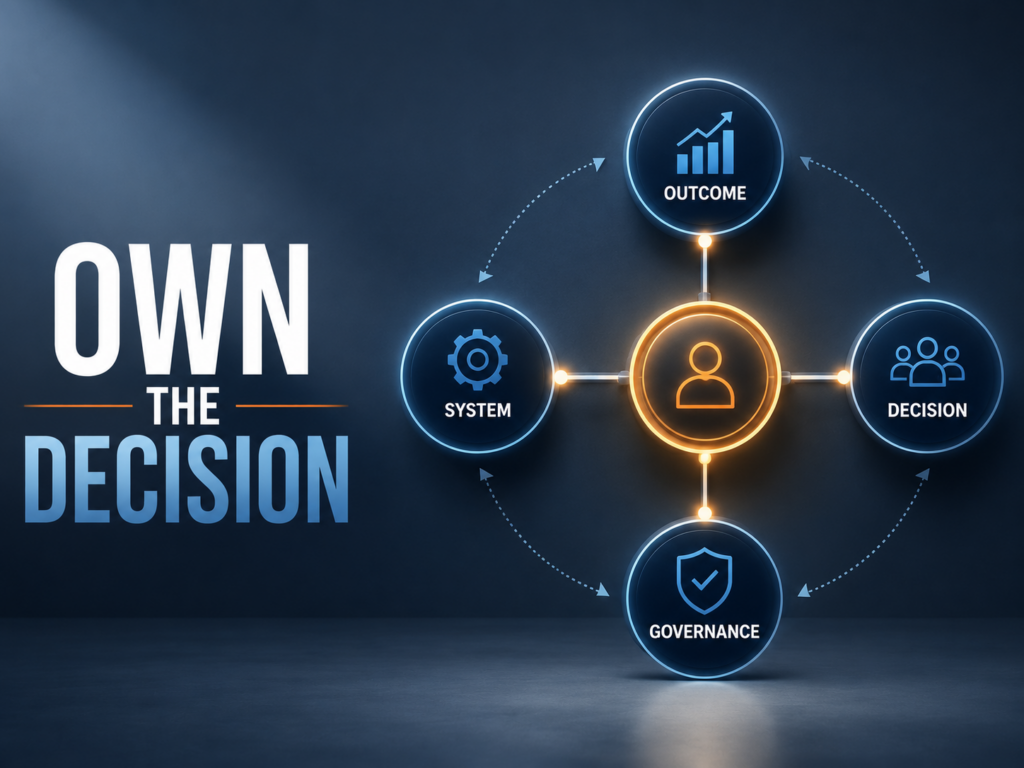
Ownership operates across four distinct layers.
Confuse them, and every discussion about AI becomes unnecessarily complicated because people believe they’re talking about the same thing when they’re actually talking about four different responsibilities.
Think of these together as the AI Ownership Stack. Businesses that scale AI successfully don’t just define ownership—they separate it.
The first layer is Business Outcome Ownership.
Every AI initiative should improve a business outcome: higher margins, faster response times, stronger customer retention, better forecasting, improved cash flow.
Someone must remain accountable for that result regardless of how much AI contributes.
The second layer is Decision Ownership.
This is the layer most organisations overlook.
AI can recommend an action.
It cannot own the consequences.
Someone must still own the judgement behind approving a discount, prioritising a customer, committing additional inventory, or allocating capital.
If that ownership becomes unclear, decision quality quickly becomes inconsistent.
The third layer is System Ownership.
This covers workflows, prompts, agents, integrations, data quality, security, and maintenance. These responsibilities often belong to IT, operations, or digital transformation teams.
But maintaining a system is fundamentally different from owning the business result it supports.
The fourth layer is Governance Ownership.
Governance is often reduced to compliance, privacy, and security.
Those matter.
But strategically, governance exists for a different reason.
It protects organisational judgement.
It asks questions technology cannot answer.
Are decisions still aligned with strategy?
Are different teams applying the same principles?
Has AI introduced behaviours nobody intended?
Are yesterday’s assumptions still producing today’s outcomes?
These questions become more important as AI influences more decisions.
Here’s the overlooked insight.
The greatest risk isn’t that AI will make poor decisions.
It’s that it will make thousands of individually reasonable decisions that gradually drift away from the organisation’s intent.
No single decision creates the problem.
The accumulation does.
That’s why mature organisations don’t simply govern AI.
They govern the quality of the decisions AI helps produce.
When these four ownership layers remain distinct, AI scales clarity. When they blur together, AI scales confusion.
Mature organisations don’t just scale execution. They scale consistent judgement.
Pro Tip
Before approving any major AI initiative, review it against all four layers of the AI Ownership Stack.
If one layer has no clear owner, the technology isn’t your greatest risk—organisational ambiguity is.
A growing manufacturing business had AI helping sales forecasts, production schedules, and customer enquiries, yet every important decision still flowed through one director.
Once the leadership team separated business ownership from system ownership and documented decision boundaries, approvals dropped dramatically while consistency improved across departments. AI didn’t become smarter—the organisation did.
They stopped depending on one leader and started trusting a shared decision system.
How to Assign AI Ownership Without Slowing the Business
One of the biggest misconceptions about AI governance is that more ownership creates more bureaucracy.
In reality, unclear ownership is what creates bureaucracy.
When nobody knows who owns an AI-assisted decision, organisations compensate with more approvals, more meetings, more reviews, and more executive intervention.
Every layer is trying to reduce risk because nobody is certain where authority actually sits.
The result is predictable.
AI makes work faster.
The business becomes slower.
Clear ownership removes that friction because it replaces uncertainty with decision rights.
The mistake most organisations make is starting with AI tools.
They catalogue models, prompts, agents, and automations before asking a far more important question:
Which decisions create most of our business performance?
Very few leadership teams can answer that clearly.
Yet those decisions—not the technology—are where competitive advantage lives.
Most organisations map software before they map decisions.
That’s backwards.
Software changes every few years.
Your most important business decisions should remain remarkably stable.
Once those critical decisions are visible, define four things for each one:
Who owns the decision?
What business outcome is being optimised?
Where can AI act independently?
When must human judgement intervene?
Notice what’s missing.
There is no discussion about prompts.
No debate about language models.
No comparison of AI vendors.
Those become implementation choices after the organisation has designed how decisions should work.
Challenge one common behaviour directly.
If every AI recommendation still ends up waiting for founder approval, you haven’t transformed the business.
You’ve simply created faster paperwork.
The bottleneck hasn’t disappeared.
It has become digital.
This is why your sales team keeps re-explaining the same thing on calls. Every decision that depends on one person’s interpretation prevents the organisation from developing shared judgement.
The longer this stays the same, the more AI increases dependency instead of capability. You gain efficiency without creating leverage.
Organisations that scale successfully don’t remove human judgement. They deliberately decide where it belongs.
Pro Tip
Design decision rights before you deploy AI.
Technology changes quickly; decision architecture should become more valuable every time the business grows.
Signs Your Organisation Doesn’t Really Own Its AI
Most organisations look for technical signs that an AI initiative is failing.
The real indicators are behavioural.
Nobody announces that ownership is unclear.
People simply begin adapting around the ambiguity.
The first sign is inconsistent judgement.
Different departments answer the same customer problem differently because they rely on different AI systems, different prompts, or different assumptions. Individually, each response appears reasonable. Collectively, they erode trust.
A simple diagnostic reveals this quickly.
Ask three managers how an AI-generated customer complaint should be handled.
If you receive three different answers, you’ve just discovered your ownership gap.
The second sign is approval inflation.
Teams generate work faster than ever, yet decisions don’t move any faster. Reports arrive sooner. Recommendations are produced instantly.
But every meaningful decision still waits for executive confirmation.
The organisation accelerated execution while leaving decision-making untouched.
The third sign is fragmented intelligence.
Marketing builds one AI workflow.
Sales creates another.
Operations develops a third.
Each department becomes more efficient, but the organisation becomes less intelligent because knowledge no longer compounds—it splinters.
The fourth sign is invisible strategic drift.
Success becomes measured by AI adoption rather than business judgement. More people use AI. More work gets produced. Yet nobody regularly asks whether decisions remain aligned with strategy or whether different teams are reinforcing the same principles.
This is why deals feel close but stall.
Different parts of the organisation are quietly optimising different definitions of success.
Here’s the deeper consequence.
Poor AI ownership rarely creates catastrophic failure.
It creates thousands of small inconsistencies.
Each one seems insignificant.
Together, they slowly reshape the organisation into something leadership never intended.
That’s why the greatest cost isn’t bad AI.
It’s inconsistent judgement.
Organisational inconsistency compounds just like interest. Small variations in decision quality eventually become measurable differences in customer trust, execution speed, and business performance.
Great organisations aren’t recognised because every decision is identical. They’re recognised because every important decision reflects the same principles.
Pro Tip
Stop auditing your AI tools every quarter. Audit your AI-assisted decisions instead.
If different leaders consistently reach different conclusions from the same information, your ownership model—not your technology—is what needs redesigning.
From AI Adoption to AI Accountability
Most organisations celebrate AI adoption far too early.
They measure licences purchased, prompts created, workflows automated, and hours saved. Those metrics are easy to report because they demonstrate visible activity.
But activity has never been the objective.
Capability is.
This is where many leadership teams unknowingly stop evolving. AI becomes another productivity layer instead of a business capability.
Individual employees become faster, but the organisation doesn’t become more consistent. Knowledge remains fragmented. Judgement varies between departments.
Every success still depends on the people involved rather than the system supporting them.
That isn’t transformation.
It’s acceleration without redesign.
The difference comes down to one question.
Are you measuring AI usage, or are you measuring better decisions?
Adoption asks:
“Are people using AI?”
Accountability asks:
“Is the business making better decisions because AI exists?”
Those questions appear similar.
They measure completely different organisations.
The first measures technology deployment.
The second measures organisational maturity.
This is where the article’s central idea becomes important again.
AI doesn’t change work. It changes where decisions are made.
Once that shift occurs, measuring productivity alone becomes inadequate because the real opportunity is no longer faster execution.
It is higher-quality judgement.
Leadership priorities change accordingly.
You stop asking which departments should adopt AI.
You ask which business decisions deserve better intelligence.
You stop rewarding experimentation for its own sake.
You reward measurable improvements in decision quality.
You stop treating governance as a compliance exercise.
You treat it as protecting the judgement that differentiates your business.
Here’s the strategic consequence.
The AI models available today will become increasingly similar.
Your competitors will have access to the same foundational technology.
What they won’t easily replicate is your decision architecture.
They can’t download your judgement.
They can’t copy the principles your organisation applies consistently.
They can’t buy the discipline of clear ownership.
That’s where competitive advantage is quietly moving.
Businesses that learn faster through better decisions will outperform businesses that simply automate more work.
Every month spent measuring adoption instead of accountability delays the moment AI becomes an organisational capability rather than another software investment.
Enduring organisations don’t scale AI. They scale the quality of the decisions AI helps people make.
Pro Tip
Replace one KPI in your next leadership meeting. Instead of asking “How many people are using AI?”, ask “Which important business decisions measurably improved because AI supported them?”
Productivity is an output. Better judgement is the capability that compounds.
Businesses often believe AI replaces people. In reality, it exposes the quality of the organisation they have already built.
Companies with clear judgement become faster. Companies without it simply become confused more efficiently.
AI rarely creates organisational behaviour—it amplifies it.
The strongest businesses don’t fear AI. They understand what deserves protecting before AI arrives.
Conclusion
For the past two years, the AI conversation has centred on tools.
Which model should you use?
Which workflow should you automate?
Which platform should you buy?
Those questions made sense when AI was new.
They are becoming less important.
The businesses creating lasting advantage are asking a different question.
Who owns the decisions that AI is now helping us make?
Because that is where the real change is happening.
AI doesn’t change work. It changes where decisions are made.
Everything else—ownership, governance, leadership, accountability, and organisational design—is a response to that one structural shift.
When businesses fail to recognise it, AI amplifies existing weaknesses.
Teams become more productive but less aligned. Leaders receive more information but make no fewer decisions. Departments optimise locally while organisational capability quietly declines.
The technology isn’t failing.
The organisation hasn’t been redesigned to use it.
The alternative isn’t more governance, more meetings, or another AI platform.
It’s better decision architecture.
Identify the decisions that matter most.
Assign clear ownership.
Define where AI can act independently.
Protect the judgement that differentiates your business.
Then review outcomes—not activity—and improve the system continuously.
At that point, AI stops being another technology initiative.
It becomes part of how the organisation thinks.
Here’s the strategic shift many businesses still haven’t recognised.
The AI itself is becoming a commodity.
Every competitor will have access to increasingly similar models, agents, and automation platforms.
What won’t become a commodity is an organisation that consistently makes better decisions than everyone else.
The businesses that win won’t necessarily own better AI. They’ll build better decision systems.
That’s a much harder capability to copy.
Businesses that endure don’t accumulate better technology. They build systems that make good judgement repeatable.
Your current situation is not fixed.
If AI still creates uncertainty, duplicated decisions, or constant executive intervention, that isn’t the inevitable cost of adopting new technology.
It’s a design decision—and design decisions can be changed.
You can continue measuring AI by how much work it performs.
Or you can start measuring it by the quality of decisions your organisation becomes capable of making.
One path creates more activity.
The other creates a business that becomes smarter every time it operates.
Choose the one that compounds.
Action Steps
Identify Your Highest-Value Decisions First
List the 15–20 business decisions that create the greatest impact on revenue, profitability, customer experience, or operational performance before reviewing any AI tools. Strategic leverage comes from improving critical decisions, not automating the largest number of tasks. If you skip this step, AI will optimise activity instead of business outcomes.
Assign an Accountable Owner to Every AI-Assisted Decision
For every important decision AI influences, define one accountable business owner—not a department or technology team. Clear ownership protects consistency, accelerates execution, and prevents responsibility being diluted across multiple stakeholders. If everyone owns the decision, no one truly does.
Define Decision Boundaries Before Deploying AI
Document where AI can make recommendations, where it can act autonomously, and where human judgement must remain mandatory. Decision boundaries reduce unnecessary approvals while protecting strategic judgement. Without them, AI simply increases organisational uncertainty at greater speed.
Separate System Ownership from Business Ownership
Differentiate who maintains AI systems from who owns business outcomes. Technology teams should manage reliability, security, and integrations, while operational leaders remain accountable for the results AI helps produce. Confusing these roles creates governance gaps that technology cannot solve.
Measure Decision Quality Instead of AI Adoption
Replace implementation metrics with outcome metrics. Track whether AI is improving forecasting accuracy, pricing consistency, customer decisions, or operational performance rather than simply counting prompts or automations. Businesses that measure adoption improve activity; businesses that measure judgement improve capability.
Review Decision Architecture Quarterly
Treat AI ownership as an evolving operating system rather than a one-time implementation project. As markets, teams, and AI capabilities change, decision ownership should be reviewed to maintain alignment with strategy. Organisations that regularly refine decision architecture compound organisational intelligence instead of organisational complexity.
FAQ
AI itself should not have a single owner. The business leader accountable for each outcome should own the decisions AI influences, while executive leadership owns the overall decision architecture and governance.
Why isn’t an AI champion enough?
AI champions encourage adoption, but adoption alone does not create accountability. Sustainable AI success requires clearly defined decision ownership so responsibility remains consistent as AI becomes embedded across the organisation.
What’s the difference between AI adoption and AI accountability?
AI adoption measures whether people are using AI. AI accountability measures whether AI consistently improves business decisions and produces better organisational outcomes.
Should AI ownership sit with IT?
IT should own infrastructure, security, integrations, and reliability. Business leaders should own the operational decisions and outcomes that AI supports because accountability cannot be delegated to technology.
How do you know if your organisation lacks AI ownership?
Common indicators include inconsistent decisions between departments, increasing executive approvals, duplicated AI workflows, and teams using AI differently without shared decision principles. These behaviours usually signal unclear ownership rather than poor technology.
What should leaders measure instead of AI usage?
Focus on improvements in decision quality, consistency, execution speed, forecasting accuracy, customer outcomes, and business performance. These metrics demonstrate whether AI is becoming a capability rather than simply another productivity tool.
Why is decision ownership becoming more important with AI?
AI increasingly influences how decisions are made rather than simply automating tasks. As decision-making becomes more distributed, clear ownership becomes essential for maintaining accountability, consistency, and strategic alignment.
Other Articles
Business Clarity Before AI: Why Strategy Comes First