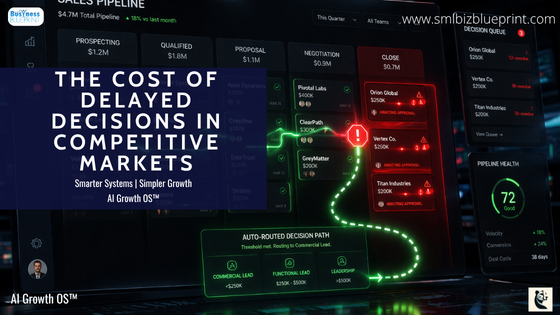

How slow leadership response creates revenue drag, missed timing windows, and hidden operational friction.
Delayed decisions in competitive markets destroy value by allowing timing-sensitive opportunities to decay before action is taken.
The real cost is not slower leadership alone, but system-wide friction that spreads across sales, marketing, and operations before it ever appears in revenue.
Businesses gain an advantage when they redesign decision architecture so market signals convert into action faster than conditions change.

The structural failure is not indecision. It is decision latency embedded into the operating design of the business.
In most growth-stage companies, the fragility begins in the space between signal emergence and organisational movement.
Sales hears the same objection pattern for two weeks. Marketing sees channel efficiency slipping. Customer success notices friction inside onboarding.
These are not isolated data points; they are early system signals. Yet many teams still route them through slow approval chains, subjective interpretation, and executive consensus loops before anything changes.
That delay is where value begins to decay.
Most businesses misdiagnose this as a communication issue, a talent gap, or a leadership habit. Those are downstream symptoms.
The deeper issue is architectural: the business lacks clear logic for how signals become decisions. Escalation thresholds are undefined. Reversible decisions are over-centralised.
Teams wait for certainty where timing matters more than precision.
The first cost is rarely visible in revenue. It appears as workaround labour, duplicated judgment, delayed packaging shifts, and stale frontline behaviour.
Sales invents local pricing logic. Marketing keeps scaling channels that are already losing efficiency. Operations absorbs avoidable exceptions because upstream clarity arrives too late.
This creates a latency tax:
lower close rates from stale responses
higher CAC from delayed channel shifts
margin erosion through inconsistent decisions
executive bandwidth drain from preventable escalations
slower learning cycles across the business
The deeper consequence is trust decay. Teams stop waiting for formal clarity and begin building local shadow systems to preserve momentum.
Short-term throughput survives, but strategic coherence weakens because teams start acting on different versions of the same priority.
This is the real redesign layer: not faster personalities, but clearer pathways from signal → threshold → decision right → frontline behaviour.
Strategic advantage now belongs to the company whose time between market truth and organisational movement is shorter than the market’s rate of change.
He spent three Monday leadership meetings debating a pricing objection trend already visible in ten consecutive sales calls.
By the time the offer changed, the market had normalised around a competitor’s simpler package. The lesson was uncomfortable: the delay was not caution, it was outsourced control.
He stopped protecting certainty and started protecting timing.
Why Slow Decisions Become Expensive in Competitive Markets
The default approach fails because it treats decisions as isolated executive events instead of time-bound market interactions.
A decision creates value only when it changes business behaviour before the market adapts without you. Competitive markets punish latency because buyers, competitors, and channels continue evolving while leadership is still validating the obvious.
The stronger conclusion is this: the market prices hesitation faster than it rewards precision.
In practical terms, this shows up when competitors test new offers while your team is still debating messaging, or when pricing objections surface repeatedly but take a quarter to trigger a packaging shift. By the time leadership acts, buyer expectations have already moved.
The real-world consequence is not simply slower execution. It is lost relevance at the exact edge where leverage was highest.
The hidden cost compounds internally first. Slow decisions force middle layers of the business to create temporary workarounds: discount logic, offer variations, manual service exceptions, inconsistent messaging. These local patches create hidden system debt.
This is why deals feel close but stall.
The overlooked layer is coordination decay. The longer a decision remains unresolved, the more teams build incompatible assumptions around it. By the time leadership moves, the organisation is already fragmented around multiple versions of the future.
If this pattern continues, market speed becomes capped by internal hesitation rather than external demand.

The Hidden Revenue Windows You Lose When Decisions Stall
Revenue rarely disappears dramatically. It leaks through timing gaps.
Every opportunity has a window of disproportionate responsiveness—a period when buyer urgency, competitor weakness, or channel efficiency makes action unusually valuable. Delayed decisions silently close that window.
This is where most reporting systems fail. They measure lost deals, not lost timing leverage.
A sales team may detect objections clustering around implementation risk. Leadership waits until the quarterly review to change packaging. During that delay, recoverable deals go dark and are later categorised as “budget timing” or “not a fit.” The CRM records the outcome, but not the delayed internal response that caused it.
This is why your pipeline looks strong but doesn’t convert consistently.
The uncommon but valid angle is counterfactual revenue: the revenue that only existed if the decision had been made when the signal first appeared. Most dashboards never capture this, which makes the true cost of delay structurally invisible.
The longer this stays the same, the more demand gets misread as market softness instead of response-cycle failure.
How Decision Lag Spreads Across Sales, Marketing, and Operations
Decision lag never stays local. It propagates.
One unresolved leadership choice becomes multiple downstream assumptions. Sales changes its narrative. Marketing keeps scaling outdated positioning. Operations staffs around yesterday’s priorities. The business begins running on asynchronous logic.
The system truth is simple: decision lag behaves like organisational packet loss. Information moves, but coherence doesn’t.
The consequence is that functional performance appears disconnected when the real failure is decision synchronisation.
This is why your sales team keeps re-explaining the same thing on calls.
A hard truth: stop blaming teams for inconsistency when leadership is shipping delayed clarity. Misalignment is often an executive output problem, not a frontline discipline issue.
The hidden risk is trust erosion. Teams stop waiting for formal decisions and start building shadow operating systems. That restores short-term speed, but scaling begins multiplying divergence instead of leverage.
Once shadow decisions become cultural, the business loses the ability to compound learning cleanly.
The Difference Between Strategic Thinking and Decision Paralysis
Strategic thinking expands optionality. Decision paralysis preserves ambiguity.
The mistake is assuming more analysis automatically improves outcomes. In reality, strategy should create clearer thresholds for commitment, while paralysis keeps those thresholds undefined.
The defining statement is this: the purpose of strategy is faster irreversible commitment at the right leverage point.
In business reality, this shows up when leadership repeatedly asks for more data on problems already visible through directional evidence—declining close rates, onboarding friction, rising support escalations.
At that point, the issue is no longer insufficient information. It is refusal to define what evidence is enough.
Waiting feels safe, but in competitive markets it often transfers control to competitors, customers, and rising costs.
Disciplined operators do not wait for certainty. They define decision thresholds before emotion enters the room.
The consequence of leaving this cultural is that ambiguity begins outranking accountability.
How to Measure Decision Velocity Before Growth Slows
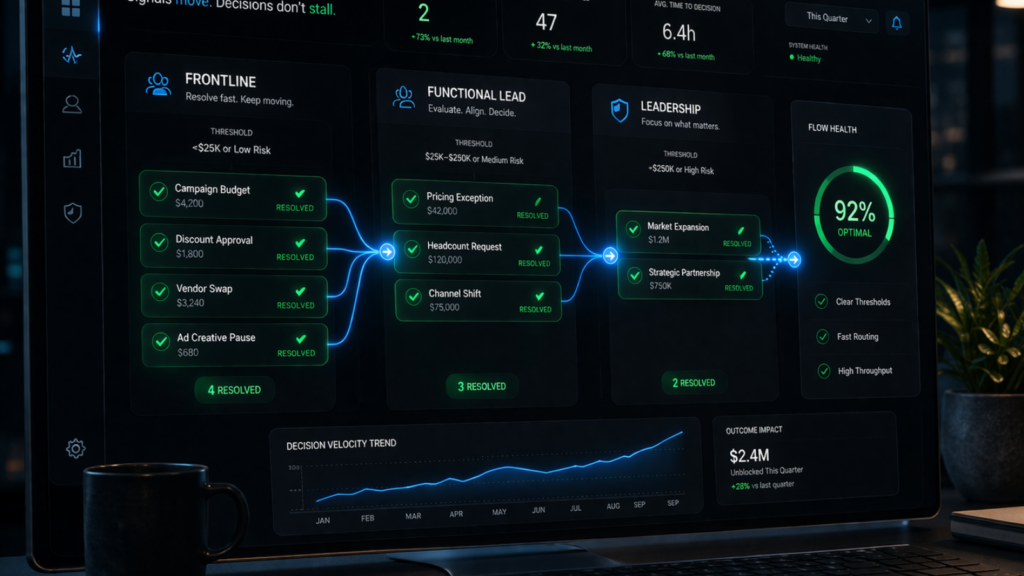
The better move is not simply to decide faster. It is to redesign decision pathways so leadership attention is reserved only for asymmetric, irreversible risk.
High-performing companies reduce latency by shifting recurring judgment into predefined rules, thresholds, and reversible pathways.
This means:
pricing adjustment bands sales can trigger
budget reallocation ranges marketing can execute
service recovery thresholds customer success can own
operational exception limits frontline teams can resolve
The defining distinction here is not speed alone. It is decision-path compression: fewer handoffs between signal and action.
The consequence of ignoring this is founder dependency disguised as quality control.
Every avoidable escalation steals leadership cognition from the decisions only leadership should own.
By the time lag appears in margin or growth rate, the causal chain is already older and more expensive than it seems.
Systems That Reduce Decision Latency Without Lowering Quality
The better move is not simply to decide faster. It is to design the business so fewer decisions require executive escalation.
High-performing companies reduce latency by shifting recurring judgment into predefined rules, thresholds, and reversible pathways.
This means:
pricing adjustment bands sales can trigger
budget reallocation ranges marketing can execute
service recovery thresholds customer success can own
operational exception limits frontline teams can resolve
The key conclusion: speed is a systems property, not a personal trait.
The consequence of ignoring this is founder dependency disguised as quality control.
Every avoidable escalation steals leadership cognition from the decisions only leadership should own.
A founder-led services firm kept escalating every discount, hiring exception, and delivery edge case to the owner.
Once decision rights were redistributed around thresholds, deal cycles shortened and margins stabilised within one quarter. The transformation was not faster leadership—it was a business that no longer needed leadership for every reversible move.
They stopped running on permission and started running on design.
Turning Faster Decisions Into Competitive Advantage
Speed alone is not the advantage. Faster learning loops are.
The edge comes from compressing the cycle between signal, decision, action, feedback, and refinement.
The structural truth: decision speed compounds only when the organization converts outcomes into institutional memory.
In practice, this means:
pricing experiments tighten faster
sales narratives evolve weekly
onboarding friction gets resolved before churn patterns spread
CAC shifts are addressed before inflation becomes normal
The businesses that lead markets are rarely the smartest in isolation. They are the fastest at converting signal into shared judgment.
Markets reward adaptation velocity, not executive confidence.
The businesses that appear “careful” are often just late.
What looks like discipline from the inside frequently looks like irrelevance from the market side.
The shift comes when leaders realise timing is not execution detail—it is part of the decision itself.
Conclusion
The real cost of delayed decisions is not indecision alone. It is the quiet conversion of timing into waste—lost revenue windows, fragmented team behaviour, slower learning loops, and a business that reacts after the market has already moved.
The shift is structural. Once decision speed is understood as system design, the problem stops feeling abstract. It becomes measurable, redesignable, and controllable.
Your current state is optional.
Stay with the default model and the cost compounds invisibly: stalled deals, more internal workarounds, slower response cycles, and leadership attention consumed by preventable escalations.
Or redesign the architecture so market truth becomes an organisational movement before the leverage window closes.
The market will continue moving either way. The only real decision is whether your business moves while it still matters.
Action Steps
1) Build a Weekly Decision Ledger
Track every unresolved decision affecting revenue, CAC, churn, hiring, delivery quality, or margin. Include signal date, owner, leverage area, and deadline. This turns invisible latency into visible management control.
2) Introduce Decision Thresholds Before Reviews
Predefine the triggers that force action: CAC increase, close-rate decline, churn threshold, or onboarding drop-off. This removes emotional delay from performance discussions.
3) Push Reversible Decisions to the Edge
Move discounts, refunds, media shifts, and operational exceptions closer to frontline teams within defined boundaries. Centralise irreversible risk, decentralise reversible adaptation.
4) Track Signal-to-Behaviour Change Time
Do not stop measuring at executive agreement. Track when sales, marketing, or ops behaviour actually changes.
5) Reduce Decision Queue Depth
Limit simultaneous unresolved executive decisions. Fewer active decisions increase leverage and reduce context-switching drag.
6) Add Lost-Timing Reviews to Revenue Postmortems
After missed targets or lost deals, identify which decision arrived too late to preserve leverage.
FAQs
What is the cost of delayed decisions in competitive markets?
Missed revenue windows, lower conversion rates, higher CAC, fragmented execution, and slower adaptation.
Why do delayed decisions hurt sales?
They create stale offers, slow objection handling, pricing lag, and inconsistent messaging that causes deals to stall.
What is decision latency?
The time between signal detection, executive commitment, and frontline behaviour change.
How do you improve decision velocity?
Clarify thresholds, redesign escalation paths, and push reversible decisions closer to the signal source.
What is the hidden cost of slow decisions?
Workaround labour, duplicated analysis, shadow systems, and avoidable margin erosion.
Bonus Section: 3 Unconventional Mental Shifts
Most executives still believe decision quality and decision speed sit in tension.
That assumption is often false.
In well-designed businesses, speed improves quality because faster movement creates faster feedback, and faster feedback sharpens the next judgment cycle.
The deeper issue is not speed. It is whether the organisation is designed to metabolise reality before reality changes shape.
The more confronting truth: many teams are not suffering from bad strategy. They are suffering from slow truth acceptance.
That is the real tension beneath this article.
1 You Are Optimising for Confidence Instead of Leverage
This is what you are doing wrong and why it matters.
Most leaders delay action until they feel internally aligned. But markets do not reward internal confidence. They reward leverage captured at the right moment.
The smarter shift is to optimise for time-sensitive advantage, not psychological comfort.
The best decision is often the one that preserves learning optionality fastest.
Consequence if unchanged: you will keep arriving “right” after the upside has already moved.
Confidence is emotional closure; leverage is economic timing.
2 Your Business Is Probably Running Two Decision Systems
One formal. One shadow.
The formal system is meetings, approvals, dashboards, leadership syncs.
The shadow system is what teams do while waiting:
sales creates new pricing logic, ops builds exception workarounds, marketing changes copy quietly.
This hidden layer is surprisingly helpful as a diagnostic.
Instead of resisting it, study it.
The shadow system reveals where your architecture is too slow for reality.
Consequence if unchanged: shadow logic becomes culture, and culture begins overriding strategy.
Workaround behaviour is often the clearest map of structural friction.
3 The Most Valuable Decision Is the One That Prevents Future Decisions
This is the uncommon shift most leaders overlook.
The highest-leverage decision is not the one that solves today’s issue. It is the one that eliminates an entire class of recurring escalations.
Examples:
pricing rules that remove manual discount approvals
churn recovery playbooks with automatic thresholds
hiring scorecards that reduce founder interviews
onboarding exception frameworks
This is where decision architecture becomes compounding advantage.
Consequence if unchanged: leadership remains the bottleneck disguised as quality control.
Mature systems do not just answer faster—they make fewer questions necessary.
Other Articles
Decision Intelligence in Business: From Data to Action