
Use a simple weekly process to uncover patterns, avoid repeated mistakes, and strengthen decision quality.
A CEO weekly review checklist is most effective when it focuses on capturing lessons, not reporting activity.
The real purpose of a weekly review is to identify patterns, preserve insights, and improve future decisions so learning compounds over time.
Businesses that consistently convert weekly experience into reusable intelligence make better decisions, build stronger systems, and create a long-term growth advantage.
Most business owners think they have a growth problem.
Often, they have a forgetting problem.
Every week your business generates valuable intelligence. Customers reveal buying patterns. Sales calls expose objections. Projects uncover bottlenecks. Employees solve recurring issues. Markets shift in subtle ways.
Then the week ends.
The business keeps moving, but the learning disappears.
After a certain size, I rarely see businesses struggle because they’re missing information. More often they’re drowning in information and starving for retained learning.
The strange part is that nobody notices it happening.
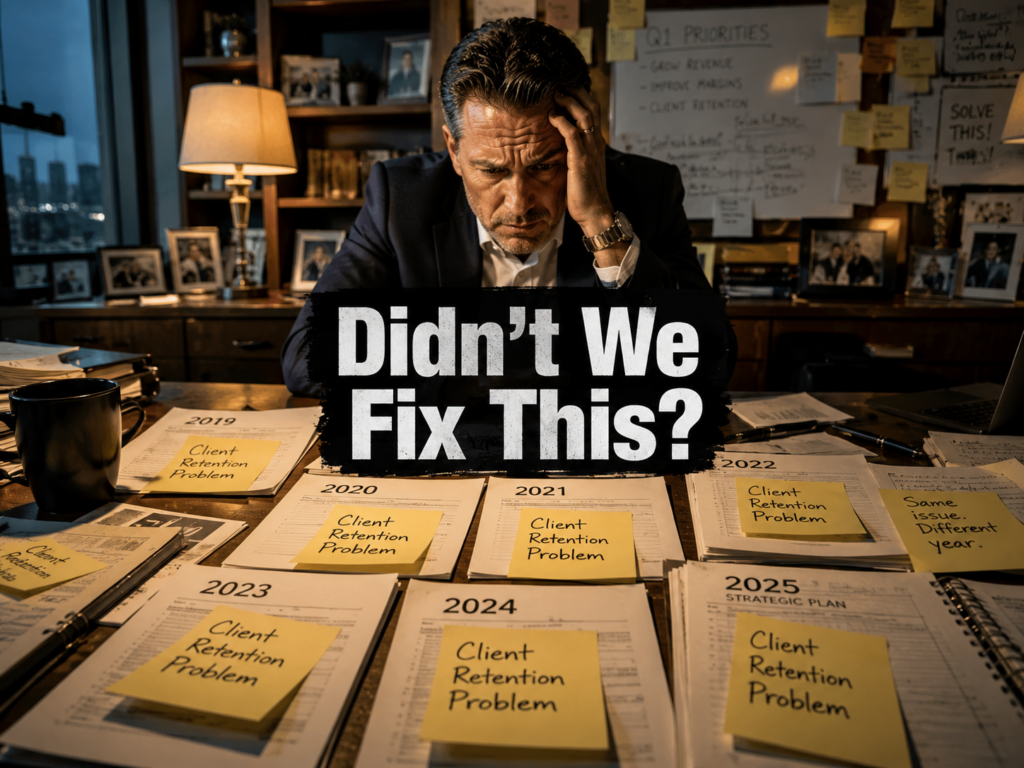
The same issue simply returns under a different name six months later.
At $5M–$20M in revenue, this becomes expensive in ways most leaders never measure. Not because information is missing. Most businesses have dashboards, reports, meetings, and metrics in abundance.
The problem is that information is not the same thing as retained intelligence.
The same hiring mistakes return under different circumstances. The same operational friction reappears in different departments. Strategic discussions feel strangely familiar. Teams keep solving problems they have already solved before.
What looks like a growth challenge is often a learning challenge.
And the cost doesn’t show up neatly on a profit-and-loss statement.
It appears as slower decisions, recurring mistakes, leadership fatigue, and increasing complexity. This is why deals feel close but stall. The business continues collecting experience without converting enough of it into better judgment.
Most weekly reviews accidentally reinforce this problem. They focus on reporting activity rather than preserving learning.
That raises a more useful question:
What if the purpose of a weekly review isn’t to measure performance?
What if its purpose is to improve future decisions?
That shift changes everything.
Because growth does not compound through effort alone. It compounds through learning. Businesses that consistently retain and apply what they learn make better decisions, build stronger systems, and create advantages that become difficult to replicate.
The CEO weekly review checklist is not really a reporting tool.
It is a mechanism for turning experience into an asset.
Why Most Weekly Reviews Fail to Create Real Business Value
Most weekly reviews fail because they focus on outcomes instead of understanding.
Revenue is reviewed. Pipeline is reviewed. Projects are reviewed. Every department reports progress. The meeting feels productive because information was exchanged.
Yet the same conversations often return week after week.
One pattern shows up repeatedly in growing companies.
An issue appears in a leadership meeting. It gets discussed. A decision gets made.
Six months later, the same issue returns wearing a different disguise.
Everyone remembers the problem.
Few people remember the reasoning behind the last decision.
Reporting captures what happened.
Learning captures why it happened.
Those are different activities.
A business can have perfect visibility into performance while learning very little from it. In fact, many growing companies become trapped by information abundance.
More reports are produced. More dashboards are created. More meetings are scheduled.
Decision quality remains largely unchanged.
The hidden assumption is that visibility automatically creates improvement.
It doesn’t.
Improvement comes from identifying the assumptions, patterns, and causes beneath the numbers.
Imagine two businesses both lose an important client.
One records the revenue impact and moves on.
The other investigates the warning signs that were missed, the assumptions that proved wrong, and the process weaknesses that allowed risk to build unnoticed.
Both reviewed the same outcome.
Only one generated intelligence.
This distinction matters because markets reward learning speed more than reporting accuracy.
The businesses that improve fastest are not necessarily the ones with the best data. They are the ones that extract the most meaning from the data they already have.
Leadership teams often mistake familiarity for progress. If the same issue appears in three different meetings over six months, the business isn’t solving it. It’s relearning it.
Most people don’t realise that recurring problems are often evidence of failed learning, not failed execution.
If the same issue returns repeatedly, the lesson was never fully captured.
Every repeated mistake quietly consumes time, energy, and opportunity. The longer learning remains informal, the more growth becomes dependent on memory rather than systems.
Pro Tip:
Spend less time discussing results and more time discussing assumptions.
Metrics describe performance. Assumptions shape future performance.
Every Friday, Michael left his leadership meeting feeling informed.
Revenue was discussed. Pipeline was reviewed. Issues were raised. Yet three months later, he noticed the same problems appearing in different forms.
The shift came when he realized the business wasn’t short on information—it was short on retained learning. He stopped measuring how much the team discussed and started measuring what the company learned.
He became a builder of organizational memory, not just a reviewer of performance.
The Difference Between Reporting and Generating Insight
Insight is not information.
Insight is a change in understanding.
That distinction is easy to overlook because modern businesses are flooded with information. Reports arrive daily. Data accumulates continuously. Dashboards update in real time.
Yet information alone rarely improves decisions.
A sales report showing lower conversion rates is information.
Discovering that prospects consistently hesitate because your value proposition is unclear—that is insight.
One describes reality.
The other changes future behaviour.
The purpose of leadership is not gathering facts. It is reducing uncertainty enough to make better decisions. That means the real output of a weekly review should not be a summary.
It should be a clearer understanding of reality.
One useful test is this:
If a report disappeared tomorrow, would it change how the business operates?
If the answer is no, it was probably information.
If a lesson from that report would alter future decisions, that lesson is the insight.
The danger is that businesses often collect observations without converting them into principles.
Customer complaints remain isolated incidents.
Missed targets remain isolated events.
Project delays remain isolated frustrations.
Nothing gets translated into reusable learning.
I’ve seen leadership teams review the same customer complaint for months without ever extracting the lesson beneath it.
The complaint gets tracked.
The pattern never does.
And only reusable learning travels forward.
This is why your sales team keeps re-explaining the same thing on calls. The business captured interactions but failed to capture the pattern underneath them.
The strategic advantage isn’t having more information.
It is converting information into understanding faster than competitors.
Information accumulates. Insight compounds. One creates complexity. The other creates capability.
Pro Tip:
End every review by completing one sentence: The most important thing we learned this week is…
If the team struggles to answer, the review probably focused on reporting instead of learning.

The 15-Minute CEO Weekly Review Checklist
The most effective weekly review is surprisingly small.
Most weekly reviews should probably be shorter.
Not because leaders are busy.
Because longer reviews often compensate for weaker thinking.
Clarity rarely requires ninety minutes.
Many leaders assume a valuable review must be comprehensive. Every metric is examined. Every issue is discussed. Every department provides updates.
The result is often a longer meeting, not a better one.
The objective is not reviewing the entire business.
The objective is improving future decisions.
A practical CEO weekly review can be built around five questions.
What changed?
Identify anything unexpected. Changes matter because they reveal assumptions that may no longer be valid.
What surprised us?
Surprises expose blind spots. They often reveal reality before dashboards do.
What pattern is emerging?
Individual events create noise. Patterns create insight. The goal is to identify recurring signals before they become recurring problems.
What assumption should change?
Every decision is built on beliefs about customers, markets, operations, or growth. Strong leaders update assumptions faster than competitors.
What system should improve?
Learning only creates value when it changes future behavior. Every meaningful lesson should strengthen a process, framework, checklist, or operating system.
That sequence appears simple.
That is its strength.
The best CEOs are not information managers.
They are pattern recognisers.
Every week this process creates a small improvement in understanding. Individually those improvements feel insignificant.
Collectively they become a competitive advantage.
This is why your pipeline looks strong but doesn’t convert consistently. Activity is being measured, but the lessons hidden within that activity are being ignored.
Most businesses already generate enough learning to grow faster. What they lack is a repeatable mechanism for preserving and applying it.
Pro Tip:
Maintain a separate Decision and Learning Log.
Meeting notes document discussion. Learning logs document intelligence.
The Three Questions That Reveal Your Most Valuable Insights
Most businesses ask too many questions and too few useful ones.
Three questions consistently reveal the highest-value learning.
What surprised us?
Surprises expose assumptions.
When reality differs from expectations, there is usually something worth investigating. Unexpected customer behaviour, unusual sales outcomes, or unforeseen operational issues often reveal opportunities hidden beneath routine reporting.
Most leaders treat surprises as exceptions.
They should treat them as signals.
What pattern is emerging?
Single events rarely matter.
Repeated events do.
A recurring customer objection, hiring challenge, or delivery issue often points to a deeper system constraint. Leadership’s role is not reacting to isolated incidents. It is identifying patterns before they become problems.
What belief should we update?
This is the most important question and the least commonly asked.
Every strategy rests on assumptions. Markets evolve. Customers change. Teams grow. If beliefs remain fixed while reality changes, decision quality deteriorates.
Strong leaders do not protect assumptions.
They update them.
That is what learning actually looks like in practice.
A growing business is not a machine executing a static plan. It is a learning system continuously refining its understanding of reality.
The cost of outdated assumptions is rarely immediate. It accumulates quietly until decisions begin producing weaker outcomes.
Pro Tip:
Keep a running list of surprises.
Patterns often become visible long before traditional performance indicators reveal them.
How to Capture Lessons Before They Disappear
Most business knowledge disappears long before anyone realises it was valuable.
Not because people forget everything.
Because they assume they will remember the important parts.
They rarely do.
As businesses grow, more learning is generated every week. Customer insights. Pricing discoveries. Hiring lessons. Process improvements. Competitive observations.
Without a system, most of it vanishes.
Documentation alone is not the answer.
I’ve walked into businesses with thousands of documents and almost no usable memory.
Information had been stored perfectly.
Understanding had not.
Many organisations already have shared drives full of files nobody revisits. Information has been archived, but intelligence has not been preserved.
There is a difference.
Documentation archives the past.
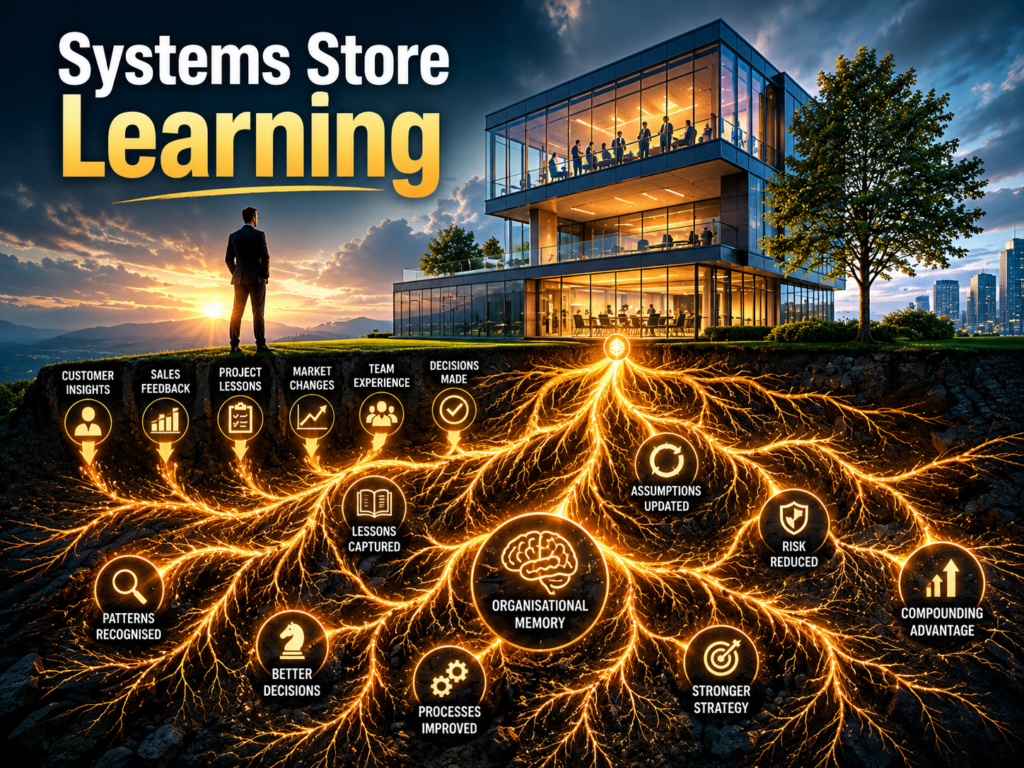
Organisational memory improves the future.
The goal is not capturing everything.
The goal is preserving what changes future decisions.
A simple framework helps:
Situation: What happened?
Insight: What did we learn?
Application: What should change?
The application step is critical.
Without it, lessons remain observations.
Observations create awareness.
Applied learning creates advantage.
Experience benefits the people who had it.
Organisational memory benefits everyone.
Every forgotten lesson creates a future cost. The business eventually pays again for knowledge it already earned once.
Pro Tip:
Build a lessons repository, not a document repository.
Store decisions, assumptions, lessons, and outcomes together so future teams can understand both what happened and why.
Emma ran a growing services business where every customer issue seemed new, even when it wasn’t.
Her team solved problems repeatedly because lessons stayed trapped in inboxes, meetings, and individual experience.
Once she introduced a simple learning repository, recurring issues began declining because the business could finally reuse what it already knew.
She stopped relying on memory and started building intelligence.
Turning Weekly Insights Into Better Decisions and Systems
Insight without implementation has no strategic value.
Many businesses become good at identifying problems but never convert those discoveries into operational improvements.
Learning only matters when behaviour changes.
Every meaningful insight should produce one of three outcomes:
A decision.
A process improvement.
Or a system change.
A useful way to think about systems is this:
Every checklist is stored learning.
Every framework is stored learning.
Every process is stored learning.
Systems are simply lessons that have become operational.
The businesses that scale most effectively rarely have better people.
They have fewer decisions that depend on memory.
That’s a subtle distinction.
It’s also where leverage comes from.
Once learning is embedded into systems, it stops being personal knowledge and starts becoming a business asset. The lesson no longer depends on who remembers it. It becomes transferable, repeatable, and scalable across the organisation.
That matters because intellectual capital is not created when something is learned.
It is created when that learning can be reused.
Strong organisations scale because learning becomes operational.
Exceptional organisations scale because learning becomes an asset.
Growth creates complexity. Systems built from learning create capability. One increases friction. The other reduces it.
Pro Tip:
For every major lesson captured, ask one final question: What system should improve because of this?
That question converts learning into long-term advantage.
The Compounding Advantage of a Consistent Insight Ritual
Most leaders think growth compounds through revenue.
Revenue is simply the visible result.
Learning is the mechanism underneath it.
Every business compounds something.
Some compound complexity.
Some compound recurring mistakes.
Some compound confusion.
The strongest businesses compound learning.
The difference becomes significant over time.
One organisation depends on individual experience.
The other benefits from accumulated intelligence.
That difference eventually changes the economics of competition.
The company that remembers more learns faster.
The company that learns faster adapts faster.
Eventually, this affects customer acquisition, retention, hiring, pricing, and execution.
Competitors see better outcomes.
What they’re actually seeing is accumulated learning expressed through decisions.
What begins as a learning advantage gradually becomes a market advantage.
That is the real advantage of a weekly insight ritual.
Not a better meeting.
A smarter business.
The most effective CEOs eventually stop seeing themselves as managers of activity.
They become architects of organisational learning.
Because competitive advantage is increasingly determined by learning velocity. Not who has the most information, but who can convert information into capability the fastest.
The businesses that dominate tomorrow will not necessarily be those with the most resources. They will be those that learn, retain, and apply knowledge faster than everyone else.
Pro Tip:
Track learning velocity. Measure how many meaningful lessons are captured and implemented each month.
Learning speed is often a leading indicator of future performance.
Two businesses can experience the same year and emerge with completely different futures.
One accumulates activity, the other accumulates understanding. From the outside they look similar—same meetings, same customers, same challenges.
But one becomes increasingly dependent on individual effort, while the other becomes increasingly powered by collective intelligence.
The real divide in business is rarely effort versus laziness; it’s learning versus forgetting
Conclusion
Most CEOs are not suffering from a lack of effort.
They are suffering from a lack of retained learning.
The same discussions reappear. The same mistakes return. The same decisions require the same debates. Valuable experience flows through the business without becoming part of the business.
That creates a hidden tax on growth.
The solution is not more reports, more meetings, or more dashboards.
It is a better mechanism for converting experience into intelligence.
A consistent weekly insight ritual captures learning before it disappears. It transforms observations into lessons, lessons into decisions, and decisions into systems.
Over time, those improvements compound.
I’ve become convinced that the most expensive lessons in business are not the ones you haven’t learned yet.
They’re the ones you’ve already paid to learn and forgot.
That is the real purpose of a CEO weekly review checklist.
Not reporting.
Not administration.
Learning.
The choice is not whether learning happens.
Learning is already happening inside your business every day.
The choice is whether it disappears or compounds.
One path leads to recurring friction, repeated mistakes, and increasing complexity.
The other leads to stronger judgment, better systems, and a business that becomes smarter every week.
Your current state is not permanent.
It is simply the result of what your business remembers today.
You can continue paying for the same lessons repeatedly.
Or you can start compounding them.
Action Steps
Separate reporting from learning.
Review metrics first, then force a discussion about what changed your understanding of the business. Metrics explain performance; insights improve future decisions. If you don’t separate the two, weekly reviews become measurement exercises instead of growth mechanisms.
Create a dedicated Decision and Learning Log.
Capture key decisions, assumptions, lessons, and outcomes in one searchable location. Strategic value comes from preserving reasoning, not just recording conclusions. Without this, the business repeatedly pays for knowledge it has already earned.
End every review with one updated belief.
Identify an assumption about customers, operations, markets, or growth that should change based on recent evidence. Businesses improve when their understanding evolves faster than their environment. If beliefs stay fixed, decision quality eventually declines.
Convert every major insight into a system change.
Ask what process, checklist, framework, automation, or operating procedure should improve because of the lesson learned. Insights only create value when they alter future behaviour. Otherwise learning remains intellectual activity rather than operational advantage.
Track recurring surprises.
Maintain a running list of unexpected outcomes, customer behaviours, delays, objections, and opportunities. Surprises reveal broken assumptions and emerging patterns earlier than dashboards often can. Ignoring them increases strategic blind spots.
Measure learning velocity alongside performance.
Track how many meaningful lessons are captured, applied, and embedded into systems each month. Revenue measures outcomes; learning velocity measures future capability. The businesses that learn faster often outperform businesses that simply execute harder.
FAQs
A CEO weekly review checklist is a structured process for capturing lessons, identifying patterns, and improving decisions. Its primary purpose is not reporting performance but increasing the quality of future actions.
How long should a weekly CEO review take?
A focused review can often be completed in 15 minutes. The objective is extracting intelligence from the week, not conducting a comprehensive operational meeting.
What is the difference between reporting and insight?
Reporting explains what happened. Insight changes what you will do next. If new information does not influence future decisions, it has limited strategic value.
Why do businesses repeat the same mistakes?
Most businesses generate learning but fail to preserve it in a reusable format. When lessons remain undocumented or disconnected from systems, teams are forced to rediscover them repeatedly.
What should be captured during a weekly review?
Capture surprises, emerging patterns, updated assumptions, key decisions, and lessons learned. These elements create organisational memory and improve future judgment.
How do insights become business advantages?
Insights become advantages when they are embedded into processes, frameworks, checklists, training, and systems. Learning only compounds when it changes how the business operates.
What is organisational memory and why does it matter?
Organisational memory is the collection of lessons, decisions, and knowledge that remain accessible beyond individual employees. Strong organisational memory reduces repeated mistakes and accelerates decision-making.
Other Articles
Converting Meeting Notes Into Business Intelligence
Why Every Growing Business Needs an AI Knowledge Management System