
Capture decisions, preserve institutional knowledge, and build a business that becomes smarter with every customer, project, and challenge.
Most businesses do not have an information problem—they have a memory problem.
An AI knowledge management system helps capture decisions, preserve institutional knowledge, and turn everyday experience into reusable organizational intelligence.
Businesses that learn faster and forget less create a compounding competitive advantage that becomes increasingly difficult to replicate.
Your business may not be growing as slowly as you think.
It may simply be forgetting too much.
Every growing company accumulates experience. Every customer interaction, project, mistake, and success generates insight. Yet very few businesses accumulate wisdom at the same rate they accumulate activity.
That difference matters more than most leaders realise.
As companies grow, they naturally invest in systems, processes, reporting, and management structures. These are often treated as the engines of scale.
But beneath every successful process sits something more valuable: a lesson learned. A decision made. An assumption tested. A problem solved.
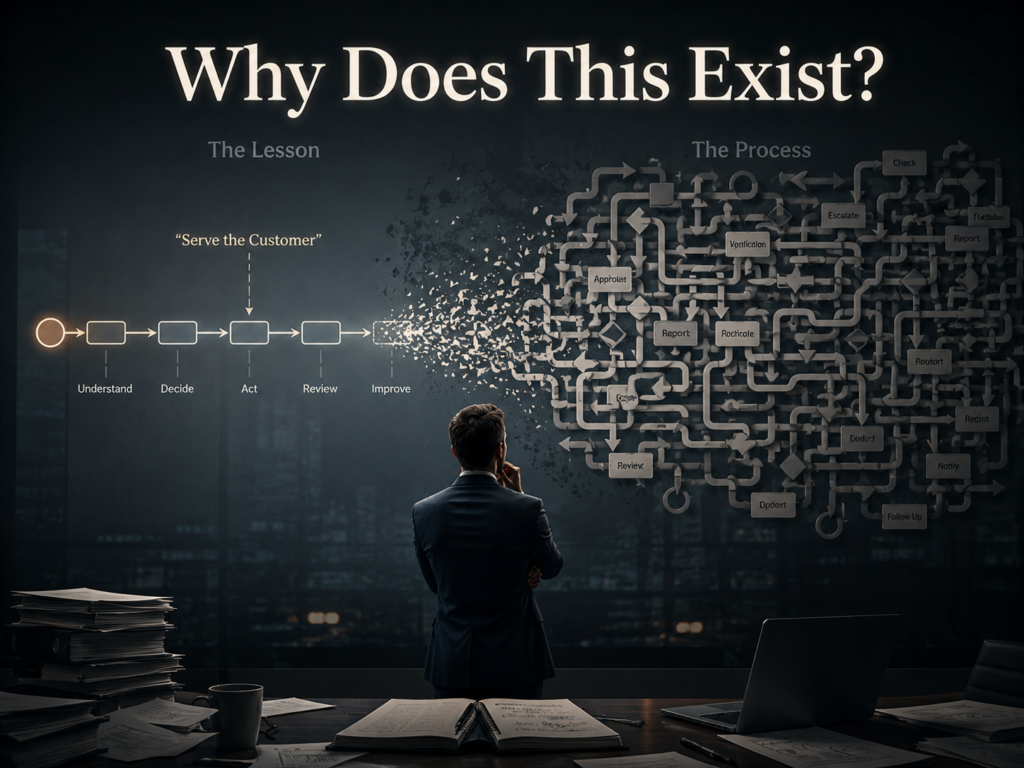
Process is simply memory that has been operationalised.
The challenge is that most businesses preserve the process while losing the lesson.
Over time, teams inherit procedures without understanding. New employees follow workflows without knowing why they exist. Leaders revisit decisions because the reasoning behind them has disappeared.
The business continues moving forward, but much of its hard-earned knowledge is constantly leaking away.
The result rarely shows up as a dramatic failure.
It shows up as a leadership team debating an issue they already solved eighteen months ago.
It shows up as a new manager rebuilding a process that already exists.
It shows up as a founder answering the same strategic question for the tenth time.
Nobody calls it knowledge loss.
They call it growth.
Most businesses respond by creating more documentation.
More folders.
More SOPs.
More systems for storing information.
But information was never the scarce resource.
Understanding is.
The businesses building durable advantages are not necessarily those with the most data.
They are the businesses that preserve and apply learning more effectively than competitors. They turn experience into organisational memory and organisational memory into better decisions.
This is where an AI knowledge management system becomes valuable.
Not because it stores more information.
Because it helps the business remember.
And in an economy where execution is becoming increasingly automated, the ability to retain and compound learning may become one of the few advantages that truly scales.
The Hidden Cost of Knowledge Loss in Growing Businesses
Most business owners think growth creates complexity.
More often, growth exposes memory problems that already existed.
When a business is small, knowledge moves through conversation. Founders remember customer feedback. Managers remember why decisions were made. Teams carry important lessons in their heads.
Human memory compensates for weak systems.
As the company grows, that compensation disappears.
A company with ten years of history does not necessarily possess ten years of learning.
It may possess one year of learning repeated ten times.
That idea is uncomfortable because it explains many problems that businesses incorrectly attribute to growth.
Think about how many times your team has solved the same customer issue.
Think about how many times someone has said:
“Didn’t we already discuss this?”
Most businesses assume these moments are normal.
They are actually evidence that organisational memory is failing.
Projects take longer because lessons from previous projects are not available. Strategic discussions revisit old debates because decision context has been lost.
New hires take months to become productive because expertise exists inside individuals rather than inside the organisation.
This is why your sales team keeps re-explaining the same thing on calls.
This is why operational issues return despite previous solutions.
This is why leadership meetings often feel familiar.
Knowledge loss is not simply an operational inefficiency.
It is a strategic tax.
It appears when a sales manager spends half their week answering questions that were answered months ago.
It appears when experienced staff become bottlenecks because critical knowledge only exists inside their heads.
It appears when teams recreate work that another department solved six months earlier.
Those costs rarely appear on a financial statement.
They still reduce growth.
Every forgotten lesson forces the organisation to pay again for knowledge it already earned. Every repeated mistake consumes resources that could have been invested elsewhere. Every departure increases risk because valuable judgment leaves with the employee.
A business owner spent months refining an onboarding process after a difficult client project.
Complaints dropped. Delivery improved. Twelve months later, the same problems returned. The documentation still existed, but nobody remembered why it had been created.
The lesson wasn’t lost because the files disappeared. It was lost because the reasoning disappeared.
He realised the business was storing information but not preserving understanding.
Because growth magnifies forgetting. The larger the organisation becomes, the more expensive lost knowledge becomes.
Pro Tip
Track recurring leadership conversations.
The questions that repeatedly return often reveal organisational learning that was never properly captured.
Why Traditional Documentation Fails
Most businesses attempt to solve knowledge loss with documentation.
The logic seems sound.
If knowledge is disappearing, document more of it.
The problem is that documentation preserves information. It rarely preserves judgment.
A standard operating procedure explains what to do. Sometimes it explains how to do it. Rarely does it explain why the process exists, what assumptions created it, or what conditions would require it to change.
The most valuable knowledge is often missing.
Documentation captures conclusions.
Business intelligence lives in reasoning.
This distinction explains why many organisations become increasingly documented yet struggle to become increasingly intelligent.
When leaders review a decision made years earlier, they can often find the outcome. What they cannot find is the thinking. The assumptions. The trade-offs. The risks considered.
Without context, decisions become difficult to evaluate, adapt, or improve.
This is where many knowledge management efforts fail.
They treat knowledge as a storage problem rather than a continuity problem.
Process is memory operationalised.
Every effective process begins as a lesson. A problem occurs, someone discovers a better way forward, and that learning becomes embedded into how work gets done. The process itself is not the asset. The lesson is.
When the lesson disappears but the process survives, useful systems slowly become bureaucracy. People continue following procedures without understanding the problem those procedures were designed to solve.
The business preserves activity while losing intelligence.
That is not organisational learning.
That is organisational drift.
Most businesses don’t lose knowledge because information disappears.
They lose knowledge because reasoning disappears.
Great businesses are not built by people who know everything. They are built by organisations that retain what they learn.
Because every year that reasoning disappears, decision quality becomes increasingly dependent on individual experience rather than organisational intelligence.
The business becomes harder to scale because knowledge remains tied to people instead of becoming part of the organisation itself.
Pro Tip
Start documenting decision rationale alongside decisions.
Future value comes from preserving thinking patterns, not just outcomes.

Capturing Decisions Instead of Information
The most valuable asset in a growing business is not information.
It is decision memory.
Most organisations capture what happened.
Very few capture why it happened.
Yet the ability to preserve reasoning is what allows knowledge to compound across time.
Imagine two companies facing the same strategic challenge.
The first finds an old report containing a previous decision.
The second finds the decision, the assumptions behind it, the alternatives considered, the risks discussed, and the outcomes that followed.
Which organisation possesses more intelligence?
The answer is obvious.
Now imagine inheriting a business where every major decision from the last five years is documented.
Then imagine inheriting one where every major decision includes the assumptions, debates, rejected alternatives, and outcomes.
The second company doesn’t simply possess more information.
It possesses accumulated judgment.
Decision memory transforms isolated experiences into organisational wisdom.
Future leaders gain access to accumulated thinking instead of isolated conclusions. Teams inherit frameworks for decision-making rather than instructions for repetition.
This becomes increasingly important as businesses grow.
Future situations rarely match previous situations exactly. What transfers successfully is not the decision itself but the reasoning process behind it.
Knowledge tells you what happened.
Decision memory helps explain why.
That difference determines whether learning survives growth.
Because businesses rarely fail due to a lack of information. They fail because they lose access to the judgment that once helped them navigate uncertainty.
Pro Tip
Record major decisions alongside assumptions and expected outcomes.
The ability to review decision quality later is how organisations improve judgment over time.
What AI Changes
Most conversations about AI focus on automation.
That misses the larger opportunity.
The real value of AI is not that it automates work.
It changes the economics of remembering.
Historically, preserving organisational memory was expensive. Capturing meeting insights required manual notes. Preserving decision rationale required discipline. Connecting lessons across departments required ongoing effort.
Most businesses simply could not do it consistently at scale.
Leaders had to remember to document.
Teams had to remember to update systems.
Employees had to remember where information lived.
As a result, preserving knowledge became a separate task rather than a natural outcome of work.
AI changes that constraint.
Meetings can be summarised automatically. Decisions can be captured as they happen. Customer patterns can be identified across thousands of interactions.
Lessons learned in one department can be connected to challenges emerging elsewhere in the organisation.
Memory becomes a byproduct of work rather than an administrative burden.
For the first time, preserving institutional knowledge can become a system capability rather than a management responsibility.
The important shift is not technological.
It is strategic.
Knowledge no longer needs to remain trapped inside conversations, inboxes, or individual employees.
It can become organisational.
AI does not replace institutional knowledge.
It preserves, structures, and distributes it.
This matters because knowledge transfer is no longer limited by who knows whom inside the organisation. Learning can move from system to person rather than person to person.
As businesses grow, that shift reduces onboarding time, lowers dependency on key individuals, and increases consistency across teams.
Great businesses are not built by people who know everything. They are built by organisations that retain what they learn.
When viewed through this lens, AI becomes less about productivity and more about continuity.
The question changes from:
“How can AI help us work faster?”
To:
“How can AI help us remember better?”
That is a much more powerful question.
How Learning Becomes a Competitive Advantage
Most assets depreciate.
Knowledge should not.
Yet many businesses allow learning to decay over time.
Projects end. Lessons disappear. Teams move on. Valuable experience becomes increasingly difficult to access. The organisation works hard to generate insight but struggles to preserve it.
The strongest organisations operate differently.
They treat learning as a compounding asset.
Every customer interaction contributes to future decisions. Every project strengthens future execution. Every challenge improves future judgment.
Over time, this creates a significant advantage.
Faster learning reduces the cost of mistakes, shortens decision cycles, improves onboarding, and decreases the amount of rework hidden inside operations. What begins as a knowledge initiative eventually becomes a margin initiative.
A faster-learning company reaches competence sooner.
New hires contribute earlier.
Customer feedback reaches decision-makers faster.
Sales objections become institutional knowledge rather than individual knowledge.
Small advantages accumulate quietly until they start looking like strategic superiority.
Organizations that retain learning do not simply become smarter.
They become more efficient.
More adaptive.
More predictable.
Competitors can copy products.
They can copy marketing campaigns.
They can even copy processes.
What becomes difficult to copy is years of accumulated organisational intelligence.
A growing services firm completed hundreds of projects each year.
Every team generated valuable insights, yet every new project felt like a fresh start. Once they began capturing assumptions, decisions, and outcomes—not just deliverables—something changed. T
eams stopped inheriting files and started inheriting experience. The business became smarter without getting bigger.
This is where learning becomes leverage.
The organisation begins improving not because it works harder, but because it remembers more.
Businesses often focus on scaling resources.
The stronger strategy is scaling judgment.
Why should you care now?
Because every lesson that is not preserved is future advantage that can never compound. Every lesson that is preserved increases the quality of future decisions.
Pro Tip
Measure learning as an asset.
The value of knowledge lies in how much it improves future decisions.
Building a Business That Learns Faster
Competitive advantage is increasingly becoming a learning race.
Markets change quickly. Technology evolves quickly. Customer expectations shift quickly.
The organisation that adapts fastest gains disproportionate benefits.
Many leaders believe they have an execution problem.
In reality, they often have a learning distribution problem.
The answer already exists somewhere inside the company.
It simply never reaches the people who need it.
Learning speed is not determined by intelligence alone.
It is determined by access.
Can teams access previous lessons?
Can leaders understand historical decisions?
Can new employees benefit from existing expertise?
If the answer is no, learning remains trapped.
If the answer is yes, learning compounds.
This is why your pipeline looks strong but doesn’t convert consistently.
The information required to improve performance often already exists somewhere inside the business.
The problem is that it remains disconnected.
Organisations that connect knowledge create alignment.
Organisations that create alignment improve decision quality.
Organisations that improve decision quality learn faster.
The consequence is not academic.
Faster learning means customer insights spread more quickly, sales objections are resolved sooner, operational improvements are adopted faster, and strategic decisions are made with greater confidence.
Learning speed eventually shows up in revenue, margin, and execution quality.
And learning faster eventually becomes a competitive moat.
Pro Tip
Treat every project as a learning asset. The outcome matters.
The lessons it creates may matter even more.
From Knowledge Management to a Knowledge OS
The phrase “knowledge management” feels too passive.
Management implies storage.
A Knowledge OS implies action.
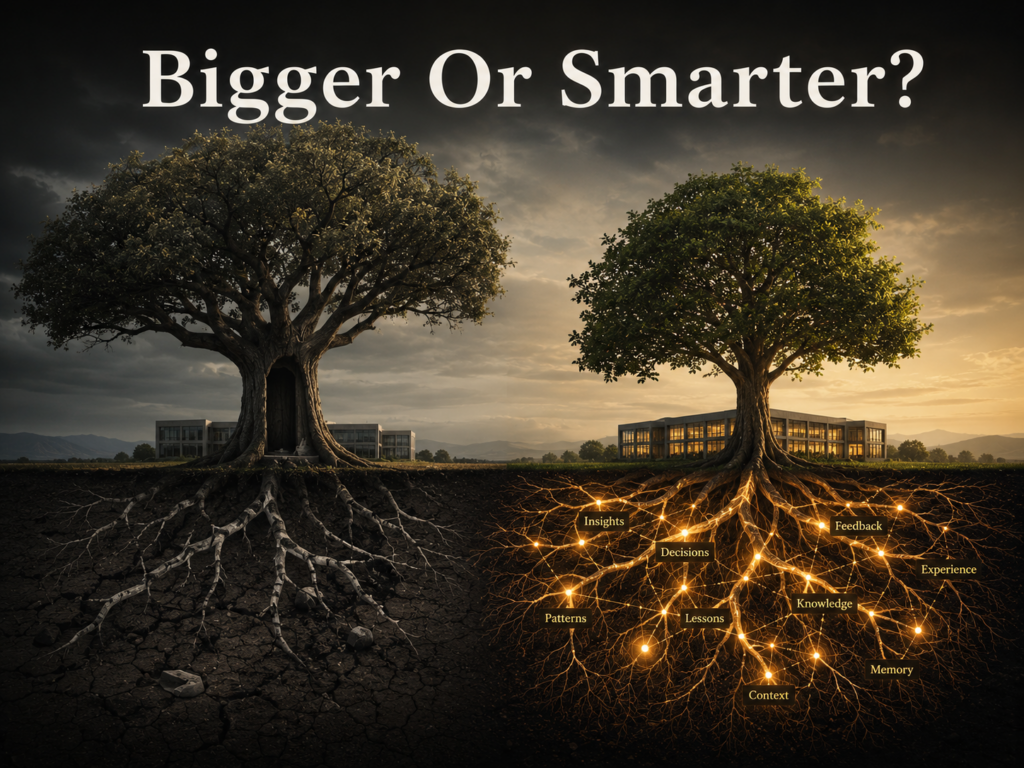
An operating system powers activity. It influences decisions. It connects information to execution. It ensures learning becomes part of how the organisation operates rather than something that sits in a repository waiting to be discovered.
That is the future.
A true Knowledge OS allows organisational learning to flow continuously through the business. Customer insights influence strategy. Operational lessons improve execution. Historical decisions inform future decisions.
Knowledge becomes active.
Not archived.
The goal is not simply to manage information.
The goal is to build a business that becomes smarter every time it operates.
Information storage is becoming a commodity.
Search is becoming a commodity.
Documentation is becoming a commodity.
The emerging advantage is organisational learning.
Two companies can have access to the same tools, the same information, and the same market data. The company that compounds learning more effectively will almost always outperform the company that repeatedly relearns old lessons.
Many businesses mistake complexity for sophistication.
They assume the growing number of systems, meetings, and processes signals maturity. Often the opposite is true. Complexity frequently appears when learning fails to compound.
What looks like growth can sometimes be organisational forgetting in disguise.
That observation changes how leaders think about scale.
Perhaps complexity is not the inevitable cost of growth.
Perhaps it is often the consequence of knowledge that failed to compound.
A Knowledge OS is ultimately not a repository.
It is organisational memory at scale.
And businesses that become smarter every time they operate will eventually outperform businesses that repeatedly start from experience instead of wisdom.
Conclusion
Every business gains experience.
Very few gain wisdom.
Experience accumulates naturally. Wisdom only accumulates when learning survives the people, projects, and decisions that created it.
Most organisations believe they scale through process.
The reality is that they scale through memory.
Process is simply a record of previous learning. Every workflow, playbook, and operating procedure originated as a lesson earned through experience.
When that lesson remains connected to the process, the organisation becomes more intelligent over time. When the lesson is forgotten, the process remains but its value gradually declines.
That is why memory—not process—is the true foundation of scale.
If your three most experienced employees left tomorrow, how much of your company’s judgment would leave with them?
Most leaders have never measured that risk.
When organisational memory weakens, growth becomes harder. Teams repeat work. Decisions lose context. Complexity increases.
When organisational memory strengthens, learning compounds. Decisions improve. Knowledge survives change.
An AI knowledge management system is ultimately not about storing information.
It is about preserving the intelligence your business has already paid to create.
AI is accelerating this shift. As access to information becomes universal, the advantage moves elsewhere. The differentiator is no longer who can gather knowledge. It is who can preserve, connect, and apply it most effectively across the organisation.
The businesses that win over the next decade will not be those that know the most.
They will be those that forget the least.
You can continue building a company that repeatedly relearns old lessons.
Or you can build one that remembers.
That choice becomes more expensive every year.
Action Steps
Audit Where Critical Knowledge Currently Lives
Map where decisions, customer insights, operational lessons, and strategic discussions are currently stored across the business. This reveals how dependent growth is on individual memory rather than organisational intelligence. The consequence is clear: if knowledge only exists inside people, scaling increases risk rather than capability.
Start Capturing Decision Context, Not Just Outcomes
For significant decisions, document the reasoning, assumptions, alternatives considered, and expected outcomes. This preserves judgment instead of merely preserving conclusions. The decision consequence is that future leaders can evaluate and improve decisions rather than blindly repeating them.
Identify Repeated Conversations Across Teams
Track questions that managers, sales teams, and operational leaders repeatedly answer. Recurring explanations often signal knowledge that has never been systematically captured. The consequence is that every repeated explanation represents organisational learning that is failing to compound.
Connect Knowledge to Workflows
Ensure insights, lessons, and historical decisions appear where work happens rather than remaining trapped in repositories. Knowledge creates value only when it influences decisions and actions. The consequence is that accessible intelligence improves execution while inaccessible intelligence becomes forgotten potential.
Build Systems That Preserve Learning From Every Project
Create a structured process for capturing lessons, assumptions, outcomes, and recommendations after key initiatives. This transforms projects from one-time activities into learning assets. The consequence is that every project strengthens future decision-making instead of ending as an isolated event.
Measure Organisational Learning as a Strategic Asset
Track how quickly knowledge moves across teams, how often decisions reuse previous learning, and how effectively expertise survives employee turnover. Learning speed increasingly determines competitive advantage. The consequence is that businesses that measure organisational intelligence are better positioned to improve it.
FAQs
An AI knowledge management system captures, organises, and surfaces business knowledge so it can be reused across the organisation. Its primary value is not storing information but preserving and applying organisational learning.
Why do growing businesses lose knowledge?
Knowledge often remains trapped inside employees, conversations, and disconnected systems. As teams grow, information fragments and critical reasoning becomes harder to access, slowing decision-making and execution.
How is organisational memory different from documentation?
Documentation records information. Organisational memory preserves context, reasoning, assumptions, and lessons learned. The difference determines whether future teams inherit information or intelligence.
Why is decision memory more valuable than stored documents?
Documents explain what happened. Decision memory explains why it happened. Preserving reasoning helps future leaders make better decisions when circumstances change.
Can AI replace institutional knowledge?
No. AI does not replace institutional knowledge; it helps preserve, connect, and distribute it. The goal is to make existing expertise more accessible and usable across the business.
What competitive advantage does an AI knowledge management system create?
It helps organisations learn faster than competitors by turning everyday experience into reusable intelligence. Over time, this creates a compounding advantage that improves decision quality and adaptability.
How do I know if my business has a knowledge retention problem?
Repeated mistakes, recurring leadership discussions, long onboarding cycles, and heavy reliance on key employees are common indicators. These signals often reveal that learning is not being retained at an organisational level.