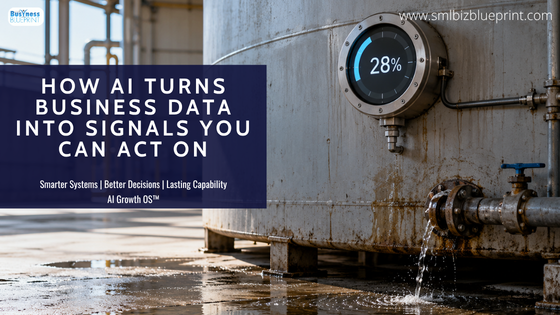

Discover what AI can now economically detect—and how to connect those signals to decisions, actions and measurable value.
AI can turn business data into actionable insights by detecting commercially meaningful signals across information that was previously too expensive or fragmented to analyse continuously.
The opportunity is not simply to generate more insights, but to identify changes early enough to improve a specific decision, trigger a different action and affect an economic outcome.
The strongest AI opportunities therefore follow a clear chain: Data → Signal → Decision → Action → Outcome → Value, with success measured by what changed in the business rather than how much information the AI produced.
Established businesses rarely suffer from a lack of information. They suffer from an inability to distinguish what deserves attention from everything they can already see.
The business appears well informed. Financial reports arrive. Sales pipelines are reviewed. Marketing performance is measured. Customer interactions are recorded. Operational systems capture jobs, exceptions, delays and outcomes.
Yet commercially important changes can remain invisible until they appear in a lagging result.
Margin erosion becomes obvious in the monthly accounts. Customer dissatisfaction becomes visible when retention falls. A competitive change becomes undeniable when conversion declines. Operational friction becomes a management issue after delivery performance deteriorates.
The data often existed before the result appeared.
What was missing was a sufficiently useful signal.
That distinction matters because most business intelligence systems were built around an economic constraint that is now changing.
Businesses historically measured what could be economically captured, structured, aggregated and reviewed.
Quantitative information naturally dominated because counting transactions, revenue, margin, conversion or delivery time was cheaper than continuously interpreting thousands of conversations, emails, quote notes, complaints, service records and operational exceptions.
AI changes that boundary.
Information that was technically available but economically impractical to interpret can increasingly be analysed across hundreds or thousands of cases. That changes what an established business can reasonably observe.
But cheaper observation creates another problem.
It can produce more things demanding attention.
This is the hidden operational tension. As the cost of detecting patterns falls, the number of possible signals rises. Management attention does not expand at the same rate. Neither does decision capacity.
A business can therefore become better at detecting change without becoming better at responding to it.
Most teams misdiagnose this as an analytics problem. They improve reporting, add alerts, generate summaries or ask for more insights. The assumption is that better information naturally produces better decisions.
It does not.
Information becomes commercially useful when it enters a decision system.
A customer-risk signal matters because somebody can decide to intervene. A change in discounting behaviour matters because pricing authority or commercial policy can change.
An emerging supplier issue matters because purchasing, inventory or scheduling decisions can change before the disruption becomes expensive.
Without that connection, the business has improved observation rather than performance.
The architectural principle is simple:
Work backwards from the outcome, not forwards from the data.
Identify the outcome worth changing. Determine which action could influence it. Identify the decision governing that action. Then determine what signal would allow that decision to be made earlier, differently or with greater confidence. Only then identify the information required to produce it.
The architecture becomes:
Data → Signal → Decision → Action → Outcome → Value
Every transition matters.
A reliable signal with no decision owner creates awareness without action. A decision without sufficient authority creates another approval queue. An action without downstream capacity moves the constraint elsewhere. An operational improvement without an economic consequence creates capability without captured value.
This is why successful AI analysis can still produce disappointing financial results.
The solution is not greater analytical effort. It is structural redesign around what the business needs to detect, which decisions those signals should change, what action follows and which outcome proves the system was worth building.
AI can make more of the business visible.
The management challenge is deciding what deserves to become visible—and designing the business so something valuable happens when it does.

More Data Isn’t the Same as Better Intelligence
Business intelligence is not determined by how much information a business possesses. It is determined by whether the right information reaches a consequential decision while there is still time to act.
Most management systems were not designed from that principle.
They were built from available data forwards.
The accounting system contains financial data, so financial reports are produced.
The CRM contains sales data, so sales dashboards are created. Marketing platforms provide campaign metrics, so those metrics are reported.
Operations systems contain job data, so operational KPIs appear on another dashboard.
Eventually someone asks: what insights can we get from all this?
The hidden assumption is that intelligence emerges from aggregation.
Sometimes it does. But aggregation can also produce an increasingly accurate description of something that has already happened.
Imagine gross margin declining from 32% to 28%.
The monthly report reveals the decline perfectly. But suppose it began six weeks earlier because estimators were increasingly discounting particular job types in response to competitor pressure.
The commercially useful intelligence wasn’t the eventual 28% margin.
It was the earlier change in quoting behaviour.
Data describes states. Signals identify changes that may require a response.
That distinction explains why another dashboard can leave management simultaneously better informed and no more in control.
The practical test is simple. Look at the reports your management team reviews most often and identify how many primarily explain results after they have occurred.
If management meetings spend more time explaining why last month’s numbers moved than identifying the conditions shaping next month’s numbers, the business has reporting. It may not have early intelligence.
The report still arrives every month. The same numbers are discussed. Everyone leaves understanding what happened a little better—but no earlier than they did last month.
You know more.
You are still late.
And lateness has a cost. Margin has already leaked. The customer has already reduced orders. Capacity has already tightened. The sales objection has already become common enough to affect conversion.
Better intelligence begins before the result becomes obvious.
If your information system primarily explains outcomes after they occur, making that system more detailed will not necessarily make the business more responsive.
It is easy to mistake a better report for a better understanding of the business.
You add another measure, refine the dashboard, and the Monday meeting feels more informed—but three months later you realise the same problems are still being discovered after the numbers move.
The shift comes when you stop asking what else should be measured and ask which decision should have changed before the result appeared.
You stop managing the report and start looking for the signal that would have let you act sooner.
AI Changes Which Business Signals Are Economically Visible
The important AI shift is not that businesses can analyse more data. It is that some things that were previously too expensive to observe can now become economically observable.
Traditional business measurement naturally favoured structured information.
Counting orders is cheap. Calculating average order value is cheap. Measuring gross margin is cheap.
Reading 4,000 customer emails to identify a gradual change in how customers talk about delivery reliability is expensive.
Comparing hundreds of lost-quote notes to detect an emerging competitive pattern is expensive.
Continuously examining service tickets, sales notes, call transcripts and customer correspondence for weak signals that only become meaningful in combination is expensive.
A person could theoretically do all of this.
The constraint was economics.
That reveals something important about conventional business intelligence:
Businesses have traditionally measured not only what matters, but what was economically measurable.
Those are not the same thing.
It also means some existing management systems are not necessarily organised around the best information. They are organised around the information that was historically affordable to collect, structure and interpret.
When AI changes the economics of observation, it can change the assumptions on which the management system itself was built.
Consider the information your business already creates every week but rarely interprets across cases: lost-quote reasons, customer emails, sales calls, project notes, complaints, supplier correspondence and operational exceptions.
Most of it is used transactionally. Someone opens the customer email to answer that customer. Someone reads the job note to understand that job.
The individual case gets handled.
The pattern across 500 cases may never become visible.
AI changes the economics of that comparison. It can make continuous classification and pattern detection across fragmented information practical at a scale that many established businesses could not previously justify.
That creates a different question from “What data do we have?”
What commercially important change could we now afford to detect that we could not economically detect before?
This is where AI becomes strategically interesting.
A well-run business does not use AI because it can analyse everything. It uses AI where previously unaffordable observation becomes commercially useful.
Look for information that is already being created but only interpreted one case at a time. That is where potentially valuable signals may be hiding in plain sight.
AI reduces the cost of seeing. The advantage is not seeing everything. It is discovering which previously invisible changes are worth seeing early enough to matter.
Start With the Decision, Not the Data
A signal has no independent business value. Its value comes from the decision it can change.
This is where the conventional approach should be reversed.
Businesses commonly start with questions such as:
What data do we have?
What can AI find in it?
What insights could we generate?
Those questions encourage analysis before establishing whether anything discovered will matter.
Start with a decision instead.
Suppose the business wants to improve customer retention. Don’t begin by asking AI to analyse customer data for insights.
Ask what decision would change if the business knew a valuable customer was becoming vulnerable 30 days earlier.
Perhaps the decision is whether an account manager intervenes.
Now ask what would justify that intervention.
Reduced order frequency? Different language in emails? More service complaints? Increased price sensitivity? Engagement from unfamiliar contacts?
Now you are defining the signal.
Only then ask which information is required to detect it.
The conventional chain runs:
Data → Analysis → Insight → hopefully a decision
The more useful approach works backwards:
Outcome ← Action ← Decision ← Signal ← Data
That reversal eliminates analytical waste because information must justify its place in the decision chain.
It also exposes an uncomfortable reality: some insights have no meaningful decision attached to them.
Management may find them interesting. Teams may discuss them. Someone may put them into a presentation.
Nothing changes.
Take the three reports your management team reviews most frequently. For each one, ask:
What decision is this supposed to change?
If nobody can answer precisely, you may have reporting without decision architecture.
The same test applies to AI-generated insights. If AI detects increasing discounting in a customer segment, what happens next?
Does pricing authority change? Does a sales manager investigate? Does the segment require a different commercial response?
Or does the finding simply become another line in Monday’s report?
The longer analysis remains disconnected from decisions, the easier it becomes to mistake AI activity for AI value. Start with the decision and much of the unnecessary analysis disappears.

Separate Valuable Signals From Metrics, Noise and Interesting Information
A business signal is a meaningful change in information that could justify a different decision or action.
Not every pattern deserves attention.
AI makes finding patterns easier. That also makes finding irrelevant patterns easier.
Suppose analysis shows that customers mentioning a particular product category ask 17% more questions before purchasing.
Interesting.
Should anybody do anything differently?
Perhaps not.
Contrast that with a pattern showing that customers who raise two particular implementation concerns are substantially more likely to delay or abandon a purchase unless those concerns are resolved quickly.
Now there may be a signal.
The difference is not novelty.
It is decision relevance.
Data records what happened. A metric tells you what you chose to measure. Noise is variation that does not warrant a response. An insight improves understanding.
A signal indicates that something may have changed enough to justify a decision.
A commercially useful signal sits at the intersection of three conditions: the outcome matters, the signal arrives while intervention is still possible, and the business has a decision capable of changing what happens next.
Remove any one of those conditions and the commercial value falls quickly.
An important signal detected too late becomes explanation. An early signal with no available intervention becomes knowledge. A detectable change attached to an immaterial outcome becomes distraction.
This distinction becomes more important as AI lowers the cost of analysis.
Without it, businesses risk replacing data overload with insight overload.
Every alert, anomaly, summary and recommendation consumes attention. Eventually managers start filtering informally. The alerts still arrive. The dashboards are still updated.
The Monday summary is still produced. But people have quietly learned which ones they no longer bother opening.
The business has automated the production of things for management to pay attention to.
That is not intelligence.
When detection becomes abundant, attention becomes scarce.
This is why asking AI to “find insights” without defining what would make an insight consequential is poor operating design. You have delegated curiosity, not improved management.
Look at the alerts, reports and summaries people in your business routinely ignore. They reveal where information supply has already exceeded decision value.
Unless you deliberately decide what deserves attention, AI can make the business better at noticing things without making it better at knowing what matters.
Connect Every Signal to a Decision and Action
A signal creates value only when it enters a decision system capable of producing a different action.
This is the point where analytics becomes operating design.
Imagine AI identifies an emerging pattern in lost sales: a competitor has begun offering substantially shorter delivery commitments in one product category.
The detection is accurate.
What happens next?
If the information enters a monthly report, the business has improved its knowledge.
If it triggers a review of affected quotes, capacity, supplier lead times and delivery promises, it may improve performance.
Same signal. Different system.
Better information does not naturally produce appropriate action.
Someone must own the signal. A threshold must warrant intervention. Someone must have authority to make the resulting decision. Ambiguous cases need somewhere to go.
These are not implementation details. They determine whether intelligence becomes operational.
Human judgment does not necessarily disappear either.
In many situations, AI’s highest-value role may be deciding where scarce human judgment should be concentrated.
It can examine thousands of ordinary cases and surface the handful that deserve attention.
That changes the owner’s role.
The goal isn’t to deliver more AI-generated intelligence to the owner. It is to build a business in which intelligence reaches the person or system with the appropriate authority to act.
And this is where competitive advantage begins to move.
As AI analysis becomes widely available, detecting a pattern becomes less distinctive.
Advantage moves downstream: which signals the business trusts, how quickly decisions are made, where authority sits and how effectively the organisation responds.
Two competitors may have access to similar analytical capability and similar information.
One produces an insight. The other has already designed what happens when that insight appears.
You can often see the difference already. A salesperson spots something unusual, a manager isn’t sure they have authority to respond, and the issue moves upward.
Eventually another “exception” lands with the owner—not because the owner has unique judgment, but because nobody has defined where the decision belongs.
Look for signals in your business that eventually travel upwards because nobody below the owner has clearly defined authority to respond.
That is a decision architecture problem.
And AI can make it worse. Faster detection can simply deliver more decisions to the existing bottleneck.
If every better signal ultimately creates another decision for the owner, AI hasn’t removed the constraint. It has delivered information to the constraint faster.
The owner of a growing distribution business had customer information everywhere—sales notes, service emails, order histories and account-manager updates—but important accounts still seemed to become “at risk” suddenly.
Instead of analysing everything, the business defined the conditions that should trigger an account decision and routed only those cases to the person with authority to respond.
The improvement was not simply earlier detection; fewer customer problems had to become obvious before somebody acted.
The owner stopped being the person who discovered problems and became the person who designed how the business recognised them.
Define the Changed State Before You Implement AI
An AI initiative should begin with a defined change in business behaviour or performance, not a technical capability.
“Use AI to analyse customer feedback” is an activity.
“Create better sales insights” is an aspiration.
Neither defines what will be different when the initiative works.
Suppose the current state is:
Customer retention problems become visible only after order frequency has fallen materially or the customer indicates they are leaving.
The desired changed state could be:
Accounts showing a defined combination of behavioural and conversational risk signals are identified 30 days earlier, routed to the appropriate account manager and reviewed within two working days.
Now there is something to design.
You know what must be detected. You know when. You know where the signal goes. You know what response is expected.
The state change is the project. AI is one component of the mechanism.
This also tells you when AI should not be used.
If a simple CRM rule reliably identifies the condition, use the rule. If the information is already structured and a threshold solves the problem, sophisticated interpretation may add little value.
And if nobody can explain what action follows detection, don’t automate detection yet.
Take one AI initiative currently being considered inside the business. Remove the word “AI” from its description.
Can you still state precisely what will happen differently when it succeeds?
If not, the initiative has a technology objective, not a defined changed state.
That matters in an established business because new signals enter existing roles, approval structures, workloads and customer processes. Better detection can create additional work somewhere else.
Implementation therefore means designing the changed operating state, not merely making the technology function.
Before spending money making AI work, define what the business should be able to do afterwards that it cannot reliably do today. If that sentence is unclear, implementation is premature.

Measure Whether Better Signals Actually Created Value
The economic value of a signal is not the value of detecting it. It is the value of the outcome changed because the business detected it.
This distinction prevents a great deal of imaginary ROI.
Suppose AI reduces customer-feedback analysis from 20 hours per month to two.
That is measurable.
It isn’t necessarily financial value.
Suppose the system also identifies at-risk accounts 30 days earlier.
Better.
Still not necessarily value.
Suppose account managers intervene and customer retention improves.
Now the chain reaches an economic outcome.
Measurement should therefore follow the operating architecture:
Detection → Decision → Action → Outcome → Economic effect
Each stage can fail independently.
The AI might detect the right signal but managers ignore it. Managers might act but choose the wrong intervention. The intervention might work operationally but produce too little financial benefit to justify the system.
This is why accuracy, usage, number of insights and time saved are insufficient as final measures.
They tell you whether parts of the mechanism worked.
They do not tell you whether the business became economically better.
For sales, value might appear through conversion, response time, reduced discounting or retention. In operations, it might appear through throughput, rework, delays or avoided capacity costs.
In purchasing, earlier supplier-risk detection might reduce stockouts or emergency sourcing.
Establish the baseline before implementation. Otherwise, success becomes whatever improved afterwards.
There is one further complication.
Better signals can move the constraint rather than remove it.
Detect customer problems twice as quickly while leaving the service team without capacity to resolve them and the business has improved detection while creating a larger queue.
Find more qualified opportunities while sales capacity is already constrained and the problem moves downstream.
That is why local improvement is not enough.
Look for AI initiatives currently described as successful because they are faster, more accurate or save time. Then inspect what happened next.
This is where some AI projects become uncomfortable to examine.
The team can show the hours saved, the accuracy improvement and the number of cases processed. But ask what happened to margin, throughput, customer retention or capacity afterwards and the room becomes quieter.
Did revenue, margin, throughput, capacity or customer performance change?
Measurement protects you from both failed AI projects and successful AI projects that improve the wrong part of the system.
The question isn’t whether the AI worked. It is whether the business became economically better because it worked.
There is an uncomfortable moment when an AI system starts finding more problems than the business can respond to.
The instinct is to celebrate the visibility: more anomalies found, more customers flagged, more opportunities identified.
Then the queue grows, managers become selective and genuinely important signals begin competing with everything else.
That is when the real shift becomes visible: intelligence was never the final constraint—what the business could decide and act on was.
Conclusion
Most established businesses do not need another reason to collect data.
They need a better reason to pay attention to something.
That is the deeper shift AI creates.
Information that was previously too fragmented or expensive to interpret continuously can increasingly become visible.
Customer conversations, quote notes, service records, exceptions and operational activity can reveal changes before those changes become obvious in conventional metrics.
But greater visibility does not automatically create greater value.
When detection becomes cheaper, businesses can generate more signals than they can use. When every pattern becomes an insight, management attention gets consumed.
When signals have no defined decisions attached to them, intelligence becomes another reporting layer.
And when an AI system works perfectly but nothing economically important changes, there is no meaningful return.
The better approach begins with the outcome.
What needs to improve?
Then identify the action that could influence it, the decision governing that action and the signal that would allow the decision to be made earlier or better.
Only then work backwards to the information and ask whether AI changes the economics of detecting that signal.
That sequence puts technology back where it belongs: inside the business system rather than at the centre of it.
It also changes the standard for a worthwhile AI initiative.
The question is no longer whether AI can analyse the information.
It is whether the business can now economically know something it could not economically know before—and whether knowing it changes what happens next.
You can continue building a business that discovers problems when they become visible in last month’s numbers.
Or you can build one that recognises meaningful change while there is still time to influence the outcome.
AI can make more of your business visible. That doesn’t mean more of it deserves your attention.
The businesses that use that capability well won’t necessarily know more.
They will know what matters sooner—and have already decided what to do when they see it.
Action Steps
Start with an economic outcome, not available data
Choose a result that materially affects revenue, margin, throughput, cost or customer performance. This prevents analysis from becoming an open-ended search for interesting patterns; the decision consequence is that only signals capable of influencing a valuable outcome deserve further investment.
Identify the decision that could change that outcome
Locate the recurring decision through which the business can actually intervene. If earlier knowledge cannot alter a decision, additional detection has limited strategic value; either define the decision that should change or stop treating the information as an AI opportunity.
Find information that is currently expensive to interpret
Look for customer conversations, quote notes, exceptions, complaints, job records or other information captured repeatedly but rarely interpreted across cases. AI becomes strategically relevant where reducing the cost of interpretation makes a previously impractical signal economically viable.
Define what deserves management attention
Specify the change, threshold or combination of evidence that warrants intervention. Cheaper detection can create more alerts than the business can absorb; the decision consequence is explicit separation between routine variation, useful intelligence and conditions requiring action.
Design the response before automating detection
Assign ownership, authority and the expected action when the signal appears. A signal without a response architecture merely creates another management input; decide who acts, what they can decide and which exceptions genuinely require escalation.
Define and measure the changed state
Document the current condition, intended operating change and economic outcome before implementation. Measure the complete chain from detection through decision and action to business result; continue investing only where the changed outcome justifies the cost of creating and operating the signal.
FAQs
AI can analyse large volumes of structured and unstructured information to identify patterns or changes that were previously expensive to detect continuously. The insight becomes actionable only when it changes a defined decision and leads to an action capable of improving a business outcome.
What is the difference between business data, an insight and a signal?
Data records what happened, while an insight improves understanding of what that information may mean. A signal is more specific: it indicates a change significant enough to potentially justify a different decision or action, so businesses should prioritise signals according to decision relevance rather than analytical interest.
What makes a business signal valuable?
A valuable signal relates to an economically important outcome, arrives while the business can still intervene and is reliable enough to justify attention. If detecting it earlier would not change a decision or action, its commercial value is limited regardless of how interesting the information is.
How does AI change business intelligence?
AI changes the economics of interpreting information that has historically been difficult or expensive to analyse continuously, including conversations, emails, notes, complaints and operational exceptions. The strategic opportunity is to identify commercially useful signals within that information rather than simply producing more analysis from existing dashboards.
Should a business start an AI project with its available data?
Usually, the stronger starting point is the business outcome and decision that need to improve. Work backwards from Outcome → Action → Decision → Signal → Data so the information being analysed has a defined purpose before investing in AI capability.
How do you prevent AI from creating information overload?
Define in advance which changes warrant attention, which can be handled routinely and which require human judgment. As detection becomes cheaper, management attention becomes comparatively scarce, so the system should filter information rather than continually add more alerts and summaries.
How do you measure whether an AI insight actually created value?
Measure beyond detection accuracy, usage or time saved and follow the chain through the decision, action and resulting business outcome. If revenue, margin, throughput, cost, capacity or customer performance does not improve, determine whether the signal was wrong, the decision failed to change, the action was ineffective or the constraint simply moved elsewhere.
Bonus Section — Three Ideas Worth Thinking About
AI makes it tempting to believe that seeing more of the business must make the business easier to manage.
That assumption deserves challenging. Increasing visibility changes the management problem; it does not automatically solve it.
The deeper opportunity may therefore come from being more selective, not more analytical.
You may be using AI to create work for management
This is what many businesses are doing wrong: every new alert, summary and insight becomes another item somebody must interpret.
AI reduces the cost of detection while quietly increasing demand for management attention. When observation becomes abundant, attention becomes scarce.
If this does not change, management becomes the processing layer for an increasingly intelligent information system.
Some of your most valuable data may be information you stopped noticing
Businesses naturally value information stored neatly in systems. Yet repeated exceptions, abandoned quotes, unusual customer requests and small operational workarounds can reveal where the formal picture no longer matches reality.
What looks like messy information can be evidence that the system itself is changing.
If this remains invisible, the business continues responding to outcomes after the underlying conditions have already shifted.
The best signal may tell you to stop looking
More monitoring is not always better. Once a condition is understood well enough to become a reliable rule, continuing to demand management interpretation can waste the very judgment AI was supposed to protect.
The mature intelligence system does not merely discover signals. It learns which signals no longer deserve human attention.
If that transition never happens, AI keeps producing intelligence while management keeps consuming it.
The aspiration is therefore not a business that sees everything.
It is a business that becomes increasingly precise about what deserves to be seen, what deserves a decision and what can safely disappear from management attention.
Other Articles
How to Turn AI Time Savings Into Real Business Value