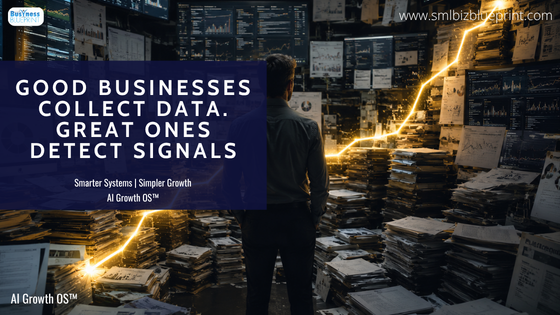

The advantage is not having more information—it is noticing what should change a decision before everyone else does.
Most small businesses do not suffer from a lack of data—they suffer from a lack of signal detection.
While dashboards, reports, and metrics can provide useful information, better decisions come from recognising the patterns, warnings, and opportunities hidden within everyday business activity.
The businesses that consistently make stronger decisions are not collecting more information than everyone else; they have systems that surface meaningful signals earlier, preserve organisational learning, and help leaders focus on what actually requires action.
A business owner sits down on Friday afternoon to review the week.
There are reports from the accounting system. Website analytics. Customer feedback emails. Social media numbers. Sales figures. Staff updates. A CRM full of notes. A dozen conversations still sitting in their inbox.
The business has never had more information.
And yet a familiar feeling remains.
Something feels off.
Sales are still reasonable. Customers are not actively complaining. The team seems busy. Nothing appears broken.
But experience says something is changing.
The uncomfortable part is that you cannot point to a single report that proves it. You just know something feels harder than it did three months ago.
Most business owners know this feeling.
It is the uncomfortable gap between having data and having clarity.

Data Is Not the Same Thing as a Signal
The hidden problem is that businesses often assume information automatically creates awareness.
It doesn’t.
Collecting data and detecting signals are two very different things.
Data tells you what happened.
Signals suggest what is about to happen.
A drop in sales is data.
Three long-term customers asking unusual questions before sales decline is a signal.
An increase in staff turnover is data.
Repeated comments about unclear responsibilities before people leave is a signal.
A customer cancellation is data.
A pattern of hesitation during sales conversations is a signal.
Signals are often subtle. They appear before outcomes become visible.
By the time a problem appears on a dashboard, somebody in the business has often noticed it already. The signal was present. It simply never became visible to the people making decisions.
Three customers mentioning slower response times. A staff member raising workload concerns in a meeting. A project deadline slipping for the second time.
None of these events seem significant on their own. Together, they may be revealing a capacity problem long before the numbers expose it.
The difficulty is that signals rarely arrive in a neat dashboard.
They emerge across conversations, decisions, customer interactions, support requests, meeting notes, and observations that seem insignificant on their own.
Most businesses already possess the information they need.
What they lack is a reliable way to notice what matters.

The Real Problem Isn’t Lack of Information
The usual response is predictable.
When clarity decreases, businesses collect more data.
They add another dashboard.
Track more metrics.
Create more reports.
Schedule more meetings.
Request more updates.
At first, this feels productive.
More information creates the impression of control.
But information has a hidden cost.
Every additional report competes for attention.
Every new metric demands interpretation.
Every dashboard asks the business owner to decide what matters.
Eventually the business becomes rich in information and poor in awareness.
Owners often assume they need more visibility when what they actually need is more discrimination.
The challenge is no longer finding information. It is deciding what deserves attention.
The signal becomes harder to see because it is buried beneath noise.
This is why some businesses become overwhelmed despite being highly measured.
The problem is not the absence of information.
The problem is the absence of filtering.
Without filtering, everything appears important.
When everything appears important, nothing stands out.
Great Businesses Make Patterns Easier to See
Instead of asking:
“How do we collect more information?”
The better question becomes:
“How do we make important patterns easier to notice?”
Systems create visibility.
Not visibility into everything.
Visibility into what matters.
A good system reduces the effort required to recognise recurring patterns.
It connects observations that would otherwise remain isolated.
It creates continuity between past decisions and current situations.
It preserves learning instead of forcing the business to rediscover it repeatedly.
Many business owners underestimate how much knowledge already exists inside their organisation.
A customer concern discussed six months ago.
A lesson learned from a failed project.
An operational issue raised during a team meeting.
A sales objection that appeared repeatedly over several quarters.
Individually, these seem small.
Together, they often reveal a pattern.
The challenge is that most businesses store information but fail to connect it.
Knowledge becomes scattered across emails, documents, chats, spreadsheets, and people’s memories.
Many business problems are not new problems at all.
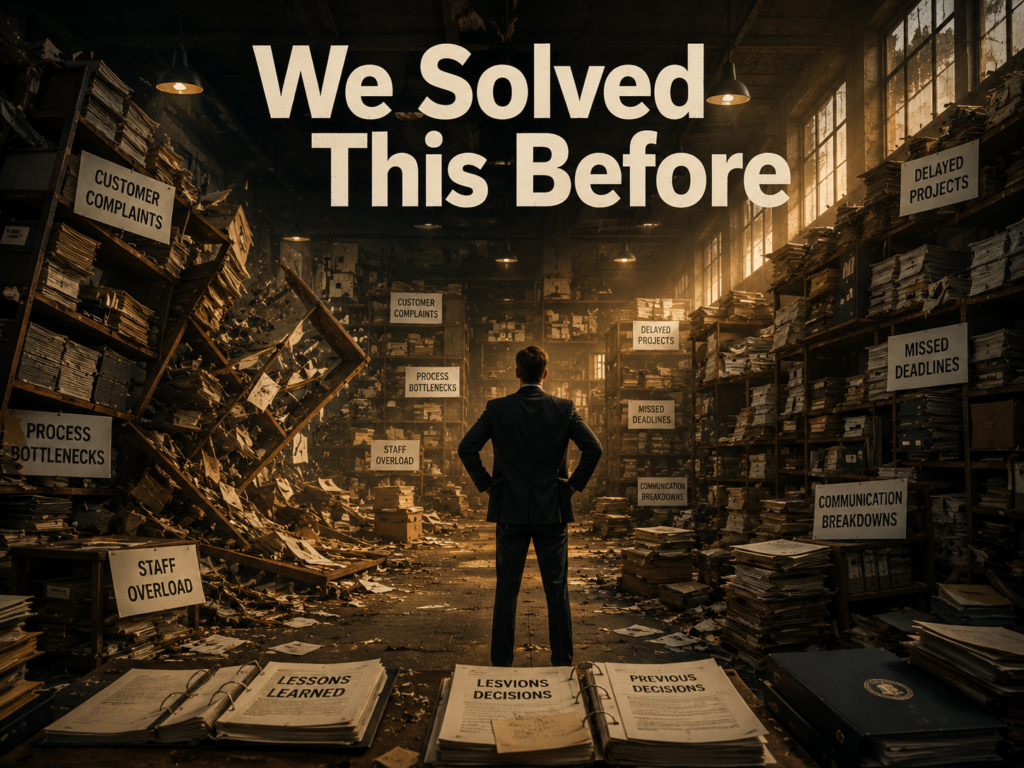
They are old problems returning to a business that has forgotten it solved them before.
The frustrating part is that the answer is often somewhere in the business already. Buried in an email thread. Hidden in meeting notes. Sitting inside the experience of someone who has since left the team.
A decision made eighteen months ago. A lesson learned from a difficult customer. A process improvement documented once and never revisited.
Eventually the business loses context.
And when context disappears, signals become difficult to detect.
The business already knows more than it can access.
That gap between knowledge and accessibility is where expensive decisions are often made.
AI Helps Find Signals. Systems Help Keep Them
This is where AI can be genuinely useful.
Not because it makes decisions.
Not because it replaces judgment.
And certainly not because it turns a struggling business into a successful one overnight.
Its value is much simpler.
AI can help systems recognise patterns across information that humans struggle to revisit consistently.
It can surface recurring customer concerns.
Highlight emerging themes in team discussions.
Connect current situations to previous decisions.
Identify anomalies that deserve attention.
Most importantly, it can reduce the time required to find signals hidden inside ordinary business activity.
The hero is not AI.
The hero is the system.
AI simply increases the system’s ability to observe.
It can notice patterns humans would eventually find themselves, but much later and with far more effort.
A business owner still decides what matters.
A business owner still applies experience, context, and judgment.
The difference is that important information becomes easier to see before it becomes expensive to ignore.
The Business Starts Remembering
When this starts working, something interesting happens.
The business feels different.
Not dramatically different.
Calmer.
Problems are noticed earlier.
Decisions require less guesswork.
Meetings become shorter because context is easier to access.
Fewer issues come as complete surprises.
The team spends less time searching for answers they have already discovered before.
Patterns become visible.
Learning accumulates.
The business starts building something many owners don’t realise they are missing.
Organisational memory.
Not memory trapped inside one person’s head.
Memory embedded inside systems.
This creates a subtle but powerful advantage.
The business becomes better at recognising reality.
Not because it knows everything.
Because it notices what matters sooner.
And in business, timing often matters more than certainty.
The earlier a signal is detected, the more options exist.
The later it is detected, the more expensive the response becomes.
Better Decisions Begin Long Before the Decision
Perhaps the most important shift is psychological.
Many business owners carry a quiet belief that they should already know what is happening.
When uncertainty appears, they assume they need more effort, more oversight, or more attention.
But running a business today does not suffer from a lack of information.
It suffers from an excess of it.
The goal is not to see everything.
The goal is to see enough.
Enough to make a good decision.
Enough to notice meaningful change.
Enough to respond before small issues become large ones.
The businesses that appear intuitive are rarely guessing.
They have simply created environments where important information becomes difficult to ignore.
Information rarely disappears.
It becomes disconnected.
And when information becomes disconnected, signals disappear with it. The pattern is still there. The business simply cannot see it.
And the longer those connections remain hidden, the more likely a business is to mistake a familiar problem for a new one.
Good businesses collect data.
Great businesses learn how to detect signals.
Because the quality of a business is often determined less by what it knows and more by what it notices.
And over time, the businesses that grow most sustainably are not the ones with the most information.
They are the ones that remember, connect, and act on what matters before everyone else does.
FAQs
Data records what has happened. A business signal suggests what may happen next or where attention is needed. If you are overwhelmed by metrics, start by identifying which recurring patterns have historically led to meaningful business outcomes.
Why do businesses with lots of data still make poor decisions?
More information does not automatically create clarity. When reporting grows faster than understanding, important signals become buried beneath noise. The immediate decision is whether a new report adds insight or simply adds another layer of information to review.
How can a small business identify important signals?
Look for recurring patterns that appear across customer conversations, team discussions, operational issues, and business results. Signals often emerge before measurable outcomes appear. Focus on patterns that influence future decisions rather than metrics that merely describe the past.
What does signal versus noise mean in a business context?
Signals help improve decisions. Noise consumes attention without changing actions. A useful test is simple: if a piece of information would not alter a decision, it may be noise rather than a meaningful signal.
Why is organisational memory important for decision intelligence?
Businesses frequently encounter similar challenges over time, but lessons are often lost across emails, documents, and conversations. Organisational memory allows past learning to inform current decisions. The practical step is ensuring key decisions, observations, and outcomes are captured in a system rather than relying on individual memory.
Where does AI fit into business signal detection?
AI can help identify patterns, themes, anomalies, and recurring issues across large volumes of information. Its role is to support observation, not replace judgment. The decision remains with the business owner; AI simply helps surface information that deserves attention.
What changes when a business becomes better at detecting signals?
Problems are recognised earlier, decisions become less reactive, and teams spend less time searching for context. The business gains confidence because important information becomes easier to find and act upon. The next step is not collecting more data, but improving how existing knowledge flows through the organisation.
Other Articles
Decision Intelligence in Business: From Data to Action