
How visibility, organisational learning, and automated feedback loops create a business that scales with greater control.
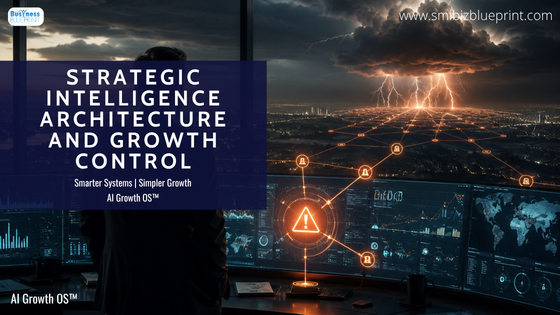
Strategic intelligence architecture is the system that helps businesses detect important changes early, reduce feedback delays, and maintain control as complexity increases.
Most growing organisations do not struggle because they lack information; they struggle because critical signals fail to reach the right people before outcomes deteriorate.
By connecting visibility, feedback loops, escalation pathways, and automation into a single operating architecture, businesses can learn faster, reduce organisational drift, and create a more predictable path to sustainable growth.
The Visibility Problem Most Growing Businesses Misdiagnose
Growth rarely breaks a business all at once.
It creates distance.
Distance between leaders and customers.
Distance between marketing activity and business outcomes.
Distance between operational decisions and their downstream consequences.
At first, these gaps are difficult to see. Revenue may still be growing. Teams remain busy. Reports continue to arrive. The business appears informed.
Yet beneath the surface, something more dangerous is happening.
The organization is gradually losing awareness of its own behavior.
Most leadership teams interpret this as a reporting problem. They assume they need better dashboards, more metrics, or more frequent updates.
The real issue is architectural.
Information exists.
Signals exist.
What is missing is a system capable of consistently detecting, interpreting, and responding to those signals.
This is the structural failure strategic intelligence architecture is designed to solve.
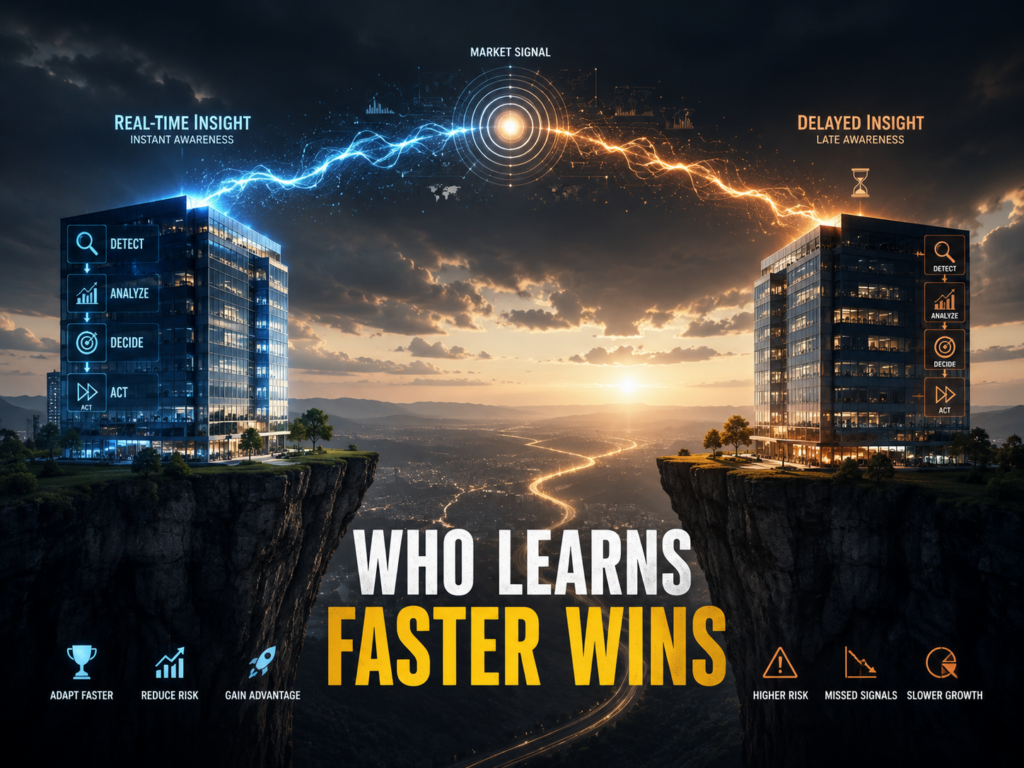
The Hidden Cost of Delayed Awareness
Every business operates through feedback loops.
Customers respond to offers.
Sales teams respond to market conditions.
Operations respond to demand.
Leaders respond to performance changes.
The effectiveness of the business depends on how quickly those loops function.
As organisations grow, feedback slows.
Customer complaints accumulate quietly because no individual complaint appears significant enough to escalate.
Sales teams adapt their messaging to overcome new objections, but leadership never sees the pattern because each conversation remains isolated.
Marketing performance weakens gradually, often disguised by activity metrics that create the illusion of progress.
Operational bottlenecks are usually visible to frontline teams weeks before they appear in management reporting.
The issue is not a lack of information.
The issue is feedback latency—the delay between an event occurring and the organization responding to it.
This cost rarely appears directly on a financial statement.
Instead, it accumulates as missed opportunities, repeated mistakes, slower decisions, and increasing complexity.
Two businesses can possess similar products, talent, and resources. The one that learns faster gains the advantage.
Most leaders assume competitive advantage comes from making better decisions. In practice, it often comes from discovering reality sooner.
The business that recognises a problem in March competes differently from the business that recognises the same problem in September.
Eventually, leadership finds itself managing symptoms rather than governing systems.
What began as a visibility problem becomes a growth constraint.
The consequence is rarely sudden failure.
It is a gradual loss of control.
The Architecture Behind Growth Control
Strategic intelligence architecture exists to reduce the distance between signal and response.
Its purpose is not to generate more information.
Its purpose is to create organisational awareness that can influence decisions before outcomes deteriorate.
Most businesses already possess more data than they can effectively use. The challenge is determining which signals matter, how those signals should move through the organisation, and what response should occur when conditions change.
At its core, strategic intelligence architecture is an exercise in entropy reduction.
Growth naturally increases complexity.
More customers create more interactions.
More employees create more communication pathways.
More products create more variables.
Without deliberate control mechanisms, complexity compounds faster than understanding.
The result is predictable. Important information becomes fragmented across departments, meetings, systems, and individuals.
The fragmentation is rarely intentional. It emerges because every department optimises for its own responsibilities, while no system exists to preserve organisational awareness across the whole business.
Strategic intelligence architecture introduces structure into that complexity.
It establishes continuity between observation and action.
Rather than relying on memory, informal communication, or periodic reporting cycles, the business develops a continuous awareness mechanism capable of identifying meaningful change.
The result is not greater activity.
It is greater control.

Signal Logic: What the System Is Actually Watching
The effectiveness of any intelligence architecture depends on signal design.
Not every metric deserves attention.
Not every fluctuation requires intervention.
The objective is to identify indicators that reveal meaningful changes in system performance before results begin to suffer.
In practice, those signals typically emerge from four areas:
Customer behaviour.
Marketing effectiveness.
Sales execution.
Operational performance.
A decline in lead quality.
A reduction in proposal acceptance rates.
An increase in onboarding delays.
A rise in unresolved customer issues.
These events are not isolated incidents.
They are indicators of system health.
The architecture’s role is to determine when those indicators become significant.
This is where thresholds matter.
A single delayed customer response may be irrelevant.
A sustained increase over several weeks may indicate a developing operational constraint.
A temporary conversion decline may be normal variation.
A persistent deviation from expected performance may signal structural deterioration.
Thresholds transform data into intelligence.
Without them, organizations drown in noise.
With them, attention is directed toward conditions that actually require intervention.
Decisions, Escalation, and Control Layers
Many organizations stop at visibility.
They build dashboards, distribute reports, and assume action will follow.
Often it does not.
Information alone does not create control.
Control emerges when predefined responses exist.
Every meaningful signal should be connected to a decision pathway.
Who needs to know?
What level of risk exists?
What action should occur?
At what point should leadership become involved?
These escalation layers ensure that important signals receive an appropriate response rather than depending on individual vigilance.
Low-risk deviations may trigger review.
Moderate-risk conditions may require management intervention.
High-risk signals may escalate directly to executive oversight.
The objective is not to automate decision-making.
It is to ensure that known risks cannot remain invisible.
The Automation Layer
Only after signal logic and escalation pathways are established does automation become valuable.
Automation is not the architecture.
Automation enforces the architecture.
Many businesses approach implementation in reverse. They begin with software, workflows, and integrations before defining the operating logic those systems are meant to support.
As a result, they automate activity rather than intelligence.
A more effective approach begins with control objectives.
Consider a business experiencing a sustained decline in lead-to-opportunity conversion rates.
The concern is not the metric itself.
The concern is what the metric may be revealing about market conditions, lead quality, positioning, or sales execution.
The system establishes acceptable performance ranges.
When results move beyond those ranges for a defined period, a response sequence begins.
Relevant information is gathered automatically.
Patterns are surfaced.
Responsible stakeholders are notified.
Escalation occurs if deterioration continues.
Leadership gains visibility while corrective action remains possible.
No one is required to manually inspect reports in the hope of noticing a problem.
The architecture performs continuous observation.
Automation enforces the response protocol.
Most growth-stage businesses do not suffer from a lack of information. They suffer from inconsistent response.
One manager notices a problem and acts immediately. Another notices the same problem and waits. A third never sees it at all.
Automation creates consistency by ensuring critical signals receive the same response regardless of who encounters them.
More importantly, automation functions as a governance layer. It preserves organizational discipline as complexity increases and ensures that learning becomes operational behavior rather than isolated awareness.

What This Means in Practice
For founders and operators, this means building businesses that identify instability before people experience its consequences.
Most organizations discover problems through outcomes because outcomes are impossible to ignore. The underlying signals are easier to dismiss, especially when revenue is still growing.
Revenue slows.
Customers complain.
Projects fail.
Teams become overwhelmed.
By the time those symptoms appear, the underlying issue has often been developing for months.
Consider a business where lead quality gradually declines over a quarter. Marketing continues generating volume. Sales activity remains high. Leadership sees no immediate reason for concern.
Six months later, revenue growth slows, forecasts become unreliable, and customer acquisition costs rise. The problem appears sudden, but the signal existed long before the outcome.
Strategic intelligence architecture changes the timing.
The organisation no longer waits for consequences to reveal problems.
It monitors the conditions that create those consequences.
That shift creates a different operating environment.
Leadership spends less time investigating surprises.
Managers spend less time collecting information.
Teams spend less time reacting to emergencies.
Leadership spends less time conducting post-mortems on problems that were visible long before they became urgent.
Predictability rarely comes from better forecasting. It comes from reducing the number of surprises the business allows to accumulate unnoticed.
The business becomes more predictable because awareness arrives earlier.
The Stability Advantage
Growth introduces complexity.
Complexity introduces uncertainty.
Without visibility, uncertainty becomes risk.
Without feedback loops, risk becomes drift.
Strategic intelligence architecture prevents that progression by creating continuity between signals, decisions, and corrective action.
Marketing becomes easier to optimize because performance changes are detected earlier.
Sales becomes easier to manage because emerging patterns become visible before they affect revenue.
Operational issues become easier to correct because escalation occurs before disruption spreads.
Across the business, feedback loops shorten.
Learning accelerates.
Decision quality improves.
Most businesses do not lose control because a single decision fails.
They lose control because dozens of small deviations go unnoticed until they begin reinforcing one another.
Stability comes from detecting those deviations while they are still inexpensive to correct.
Over time, this creates a compounding effect. Faster learning leads to faster correction. Faster correction reduces drift. Reduced drift preserves alignment between strategy, execution, and market reality.
This is how compounding advantage is created.
Not through more dashboards.
Not through more reports.
Not through more meetings.
Through an architecture that continuously converts signals into awareness, awareness into decisions, and decisions into corrective action.
The outcome is a business that learns faster than its environment changes.
A business that reduces drift before it becomes damage.
A business that scales without surrendering control.
That is the purpose of strategic intelligence architecture.
Not visibility alone.
Growth stability.
FAQs
Strategic intelligence architecture is the structure that connects signals, decisions, and corrective actions across a business. Its purpose is not to generate more data but to ensure meaningful information reaches decision-makers before performance problems become visible in financial results or operational outcomes.
Why do growing businesses lose visibility as they scale?
Growth increases complexity faster than most organisations increase awareness. Information becomes fragmented across teams, systems, and processes, creating delays between what is happening and what leadership understands. The solution is not more reporting but stronger signal routing and feedback continuity.
What is feedback latency and why does it matter?
Feedback latency is the time between an event occurring and the organisation responding to it. Businesses that reduce feedback latency identify risks, opportunities, and market changes earlier, allowing them to make adjustments before problems become expensive or difficult to reverse.
How is strategic intelligence architecture different from business reporting?
Reporting shows what has already happened. Strategic intelligence architecture is designed to detect meaningful changes while they are still developing. It creates awareness earlier in the decision cycle, allowing leadership to intervene before outcomes become visible in standard reports.
What role does automation play in strategic intelligence architecture?
Automation enforces consistency. Rather than simply reducing manual work, it ensures important signals are detected, escalated, and addressed according to predefined response rules. This reduces dependence on individual vigilance and improves organisational reliability.
How do feedback loops improve growth control?
Feedback loops create continuity between observation and action. When important signals are consistently identified and acted upon, businesses reduce drift, improve decision quality, and adapt more effectively to changing market conditions. Shorter feedback loops lead to faster organisational learning.
What is the biggest benefit of strategic intelligence architecture?
The greatest benefit is predictability. Businesses become less dependent on hindsight and more capable of identifying change while corrective action is still possible. This strengthens strategic alignment, reduces operational surprises, and helps growth occur without sacrificing control.
Other Articles
AI-Powered Operational Stability for Scaling Businesses
Meeting Intelligence Architecture for Operational Continuity