

When the reasoning disappears, strategy weakens even if processes remain.
Businesses do not lose momentum because they lack information—they lose momentum because they lose institutional knowledge.
When the reasoning behind decisions disappears, teams continue executing processes without understanding the lessons those processes were designed to preserve, leading to repeated mistakes, slower decision-making, and strategic drift.
Capturing institutional knowledge is not about documentation; it is about preserving organizational judgment so experience compounds into future advantage rather than being relearned at increasing cost.

Organizations rarely suffer from a shortage of information. They suffer from a shortage of retained understanding.
The structural failure is subtle because operational activity masks it. Revenue continues to move. Teams remain busy. Reports are generated. Processes are followed. From the outside, the business appears functional. Yet beneath the surface, something essential is degrading: the organization’s ability to carry learning forward.
Most leadership teams diagnose this as a communication problem, a training problem, a talent problem, or a process problem.
It is none of those.
It is a memory architecture problem.
Businesses naturally create information as they operate. Customer conversations, project outcomes, sales wins, implementation failures, pricing decisions, hiring choices, operational improvements, and strategic pivots all generate learning. The challenge is not creating learning. The challenge is ensuring that learning survives beyond the people and circumstances that created it.
This is where institutional knowledge becomes strategically important.
Institutional knowledge is not accumulated information. It is accumulated judgment. It represents the reasoning behind decisions, the assumptions that shaped actions, the lessons extracted from outcomes, and the contextual understanding that allows future decisions to improve.
Most organizations preserve outputs while losing reasoning.
They keep the process but lose the lesson.
They retain the decision but lose the thinking.
They archive the result but forget the assumptions.
This creates a hidden operational tension. Teams inherit procedures without understanding why they exist. New managers follow established workflows without knowing which conditions originally justified them. Departments execute historical decisions without realizing that the market realities supporting those decisions may no longer exist.
Over time, organizational activity becomes disconnected from organizational learning.
The consequences are significant.
Decision quality becomes inconsistent. Similar problems reappear across different functions. Teams debate issues that were already resolved years earlier. New employees recreate solutions that already existed. Experienced employees become bottlenecks because critical reasoning remains trapped inside individual memory.
The financial cost is rarely visible as a line item.
Instead, it appears as slower execution, duplicated effort, avoidable mistakes, delayed adaptation, longer onboarding cycles, reduced management leverage, and increasing organizational complexity.
This is why many growing businesses feel harder to operate despite having more resources than ever before.
The common assumption is that growth naturally creates capability.
In reality, growth often creates learning distance.
As organizations expand, the people making decisions become increasingly separated from the people who originally learned the lessons. Information scales more easily than understanding. Documentation scales more easily than judgment. Activity scales more easily than learning.
Without deliberate design, organizational intelligence fragments.
This leads to a critical reframe.
The objective is not knowledge management.
The objective is knowledge continuity.
Those are not the same thing.
Knowledge management focuses on storing information. Knowledge continuity focuses on preserving decision-making capability across time, teams, and growth stages.
This architectural principle changes how the problem is approached.
The goal is no longer to create more documentation. The goal is to ensure that experience becomes reusable. Every important lesson should increase the quality of future decisions. Every major decision should strengthen organizational judgment. Every operational improvement should remain accessible long after the individuals involved have moved on.
When viewed through this lens, institutional knowledge becomes a compounding asset rather than an administrative concern.
Organizations that preserve learning become progressively smarter. Organizations that lose learning become progressively dependent on rediscovering what they already knew.
The difference between those two paths is not effort.
It is architecture.

Strategy Rarely Fails Overnight
Strategy almost never breaks in a dramatic moment.
It decays.
Leaders often search for the event that caused performance to decline. A competitor entered the market. A key employee left. A campaign underperformed. A product launch missed expectations.
Sometimes those events matter.
More often they reveal weaknesses that have been accumulating quietly for years.
System Definition: Strategy is accumulated organizational learning expressed through decisions.
This is where most businesses misunderstand strategy. They treat it as a plan. In reality, strategy is a learning system.
Every time an organization captures a lesson and applies it to future decisions, strategy strengthens.
Every time that lesson disappears, strategy weakens.
The danger is that operational momentum can hide strategic decay for surprisingly long periods. Teams continue executing familiar routines. Reports continue arriving. Meetings continue filling calendars.
Progress creates the illusion of effectiveness.
But movement is not adaptation.
A company can remain busy while becoming less intelligent.
A company rarely notices learning loss when it happens.
It notices months later when a familiar problem returns and nobody remembers solving it the first time.
What looks like a new issue is often an old lesson that failed to survive.
This is why leadership teams are often surprised when performance suddenly stalls. The decline appears sudden only because the learning loss was invisible.
Most people don’t realize that strategy is less like a blueprint and more like a living memory system.
The moment that memory begins disappearing, decisions become less connected to reality.
This is why your sales team keeps re-explaining the same thing on calls.
This is why managers give different answers to identical operational questions.
This is why decisions feel slower despite having more information than ever before.
Real-World Consequence: Resources begin getting allocated based on assumptions nobody has tested recently.
The longer this continues, the more effort is spent maintaining activity rather than improving judgment.
Pro Tip
Document decision logic, not just decisions.
Future value comes from understanding the thinking, not preserving the outcome.
Three years into growth, a founder became frustrated that managers kept asking the same operational questions.
He responded by creating more documentation. Six months later, the questions were still coming.
The problem wasn’t missing information—it was missing reasoning.
He stopped documenting answers and started documenting decisions.
The business became less dependent on him and more capable without him.
The Difference Between Information and Institutional Knowledge
Most knowledge management efforts fail because they confuse information with understanding.
Information tells you what happened.
Institutional knowledge tells you why it happened.
A dashboard can show that conversion rates increased. A report can show that revenue improved. A process document can explain the steps required to complete a task.
None of those assets explain the reasoning that produced the result.
And reasoning is where future value lives.
System Definition: Institutional knowledge is stored reasoning that survives the people who originally created it.
That distinction changes everything.
Most businesses focus on preserving outputs.
Very few focus on preserving thinking.
When experienced employees leave, organizations often believe they are protected because procedures were documented.
But procedures capture behavior.
They rarely capture judgment.
As a result, successors inherit actions without context.
They know what to do.
They do not know why.
This is why new leaders often change things that were working.
Not because they are wrong.
Because the reasoning behind the original decision never survived the handover.
When conditions change—and they always do—the organization struggles to adapt. Teams either follow outdated rules or rebuild understanding from scratch.
Both options are expensive.
An overlooked reality follows from this.
The greatest knowledge risk in a business is often not employee turnover.
It is employee dependency.
Many organizations rely on long-tenured individuals to remember critical reasoning. Leadership assumes the risk is under control because the person is still employed.
It isn’t.
The knowledge remains trapped.
The business has simply delayed the problem.
This is the strategic shift most leaders miss.
Expertise used to live primarily inside people.
The highest-performing organizations increasingly move expertise into systems that preserve, refine, and distribute judgment.
Real-World Consequence: Growth becomes increasingly dependent on specific individuals rather than organizational capability. Revenue, execution quality, and decision-making become constrained by who remembers, not what the organization knows.
What that means for your business is simple: if understanding exists only inside people’s heads, scale eventually collides with memory.
Pro Tip
For every significant decision, capture three things: what was decided, why it was decided, and what assumptions were believed to be true at the time.
When Processes Survive but Learning Disappears
Businesses rarely become inefficient because they lack processes.
They become inefficient because they preserve processes after forgetting the lessons that created them.
Every process begins as a response to a problem. A customer complaint. A quality issue. A missed opportunity. A compliance requirement.
The process captures a lesson.
Then something strange happens.
The lesson fades.
The process remains.
System Definition: Organizations accumulate actions faster than they accumulate understanding.
That single dynamic explains much of the unnecessary complexity inside growing companies.
Every year more approvals are added.
More meetings.
More reports.
More rules.
The original reason behind many of them gradually disappears.
Eventually nobody remembers why they exist.
The warning sign is usually a phrase every leadership team has heard:
“That’s just how we do it here.”
The moment that becomes the explanation, the original lesson is often already gone.
Yet nobody feels comfortable removing the process.
So complexity compounds.
This creates a form of strategic debt.
Historical decisions accumulate inside the organization long after the conditions that justified them have changed.
From the outside, these systems appear mature.
In reality, they may be preserving obsolete assumptions.
This is why deals feel close but stall.
This is why customer experiences become inconsistent across departments.
This is why your pipeline looks strong but doesn’t convert consistently.
The business is executing inherited logic that no longer matches reality.
Many leaders respond by adding more structure.
That often makes the problem worse.
Because the issue is not insufficient process.
The issue is disconnected learning.
The better question is not whether a process exists.
The better question is whether anyone still understands the problem it was designed to solve.
Real-World Consequence: Organizations consume increasing resources defending yesterday’s assumptions.
Pro Tip
Every quarter, ask of one major process: “If we designed this from scratch today, would we build it this way?”
Why Growing Companies Repeat the Same Problems
Growth creates a challenge most leaders never anticipate.
It increases organizational forgetting.
As businesses expand, the people who learned the lessons become increasingly separated from the people making decisions.
Departments specialize.
Management layers emerge.
Information flows.
Context weakens.
System Definition: Every stage of growth creates new opportunities for organizational forgetting.
This explains why some companies become smarter as they scale while others become more dependent on heroic effort.
A problem gets solved.
Months later, the same issue appears somewhere else.
A sales challenge returns under a different label.
A customer complaint resurfaces in another department.
An operational bottleneck reappears despite previous efforts to eliminate it.
Leaders become frustrated because they believe the business already learned the lesson.
The business did.
The organization didn’t.
Learning happened locally.
It never became institutional.
Most leaders assume repeated problems signal poor execution.
Often they signal poor memory.
The organization is paying again for lessons it already purchased.
That distinction matters.
Organizations that scale effectively do not simply transfer information. They transfer understanding.
Without that capability, growth creates repeated learning costs.
The company pays multiple times for the same lesson.
Real-World Consequence: Recurring problems consume resources twice—once when they first appear and again when the organization fails to retain the lesson.
The most resilient businesses are not knowledge-rich. They are learning-rich.
Pro Tip
Track recurring problems with the same discipline used to track recurring revenue.
Repetition often reveals where organizational learning is breaking down.
How High-Performing Businesses Capture Institutional Knowledge
The strongest organizations do not collect more information.
They preserve reasoning.
Most knowledge initiatives focus on storage.
High-performing organizations focus on continuity.
System Definition: Institutional knowledge becomes valuable only when future decisions can access past learning.
That means capturing assumptions, decisions, outcomes, and lessons together.
Notice what is missing.
Documentation is not the goal.
Reusable judgment is the goal.
The highest-performing businesses treat major decisions as organizational assets.
They preserve not only what happened but how leadership thought at the time.
What assumptions were accepted?
What alternatives were considered?
What signals indicated the decision was working?
What conditions would invalidate it?
Over time, patterns emerge.
The organization begins recognizing familiar situations faster.
Decision quality improves.
Adaptation accelerates.
Experience becomes reusable.
This is where compounding advantage begins.
Real-World Consequence: Businesses that can retrieve past learning adapt faster than those forced to rediscover it.
Pro Tip
Build a decision archive, not a document archive.
Store reasoning, assumptions, and outcomes together.
An operations director inherited a business with hundreds of documented processes and constant execution problems.
Every department followed procedures, yet the same mistakes kept returning. Once the company began capturing assumptions and lessons alongside decisions, recurring issues started disappearing.
The organization stopped preserving activity and started preserving judgment. They became a business that learned once instead of repeatedly.
Building a Compounding Advantage Through Organizational Learning
Most competitive advantages decay.
Learning-based advantages compound.
Products can be copied.
Features can be replicated.
Pricing can be matched.
Talent can be poached.
Accumulated organizational judgment is much harder to duplicate.
System Definition:Compounding advantage occurs when every decision improves the quality of future decisions.
This creates a powerful feedback loop.
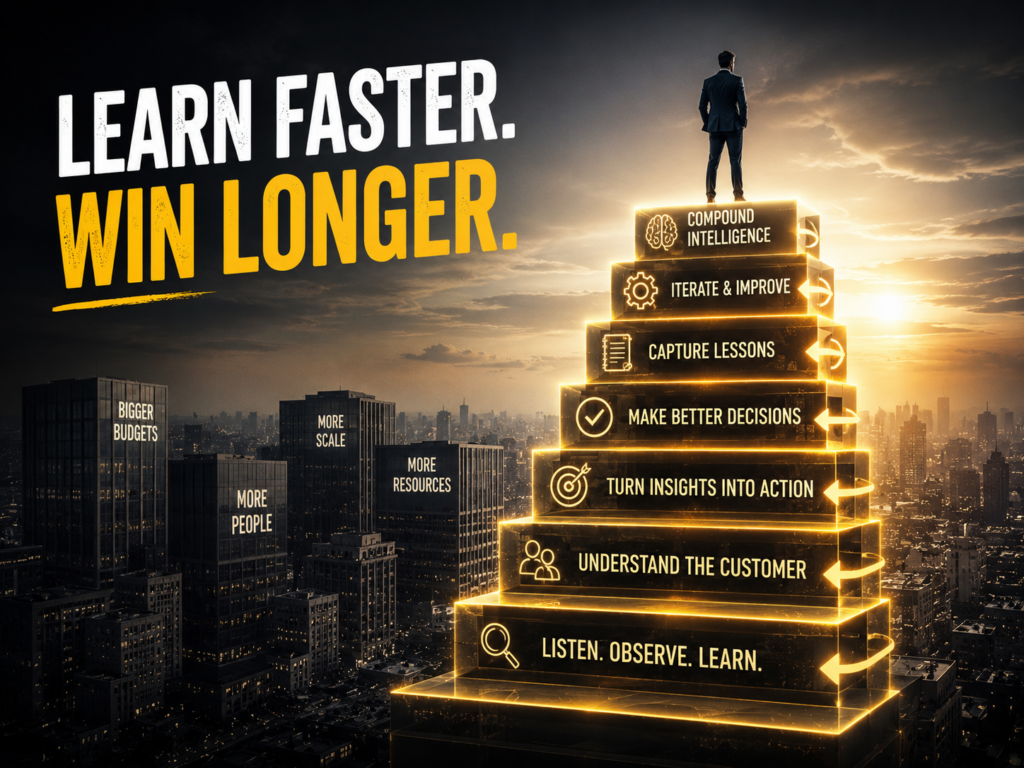
Experience improves judgment.
Judgment improves decisions.
Better decisions create better outcomes.
Better outcomes generate better learning.
The cycle strengthens itself.
Most businesses experience growth.
Few experience compounding intelligence.
One becomes larger.
The other becomes smarter.
Over time, smarter usually wins.
Not because it works harder.
Because it wastes less effort relearning what it already paid to discover.
This is where competitive advantage quietly changes form.
The strongest companies are not necessarily those with the best products today. They are often the companies with the fastest learning velocity tomorrow.
Competitors can copy what you sell.
They struggle to copy how your organization thinks.
Most leaders believe competitive advantage lives in products, talent, or market position.
Increasingly, advantage lives in learning velocity.
The organization that learns once and remembers will eventually outperform the organization that learns repeatedly and forgets.
As markets become more transparent and products become easier to replicate, organizational intelligence becomes increasingly difficult to commoditize.
Real-World Consequence: Organizations that fail to preserve learning continually spend resources recreating understanding instead of building upon it. Sales cycles stay longer, execution remains inconsistent, and growth becomes more dependent on effort than leverage.
Every company gains experience. Very few turn experience into an appreciating asset.
Pro Tip
Measure learning velocity alongside operational performance.
Growth follows when learning compounds faster than complexity.
The Question Every Process Should Answer
Every process should be able to answer one question.
Why does this exist?
If the answer depends on finding the longest-serving employee in the room, the process is already carrying risk.
Not because the process is ineffective.
Because the reasoning behind it may already be gone.
System Definition: Processes are frozen decisions whose value depends on whether the underlying reasoning remains valid.
Many organizations audit compliance.
They audit performance.
They rarely audit assumptions.
Yet assumptions are where strategy lives.
The strongest leaders challenge inherited logic.
Not because they dislike structure.
Because they understand that preserving outdated thinking is often more dangerous than having no process at all.
A process without remembered reasoning becomes organizational superstition.
People follow it because it exists.
Not because it creates value.
That is where strategic drift begins.
Real-World Consequence: Execution becomes increasingly disconnected from reality while complexity continues growing.
Pro Tip
Require every major process owner to explain the problem the process solves.
If the answer is unclear, the process deserves scrutiny.
Walk into most growing companies and ask why five critical processes exist.
Someone can usually explain what they do. Far fewer can explain why they exist. That gap looks harmless until conditions change.
The organizations that adapt fastest are often not the smartest—they are simply the ones that remember their own lessons.
Conclusion
Most businesses do not lose momentum because they stop working hard.
They lose momentum because they stop learning effectively.
That distinction changes how growth should be viewed.
The danger is subtle. Processes remain. Reports continue. Meetings happen. Activity fills the calendar.
Everything appears functional.
Yet beneath the surface, the reasoning that once guided decisions slowly disappears.
Organizations preserve behavior longer than they preserve understanding.
That single dynamic explains much of the hidden drag inside growing businesses.
When understanding disappears, organizations begin repeating lessons they have already paid to learn.
The most expensive lessons in business are rarely the ones you never learn.
They are the ones you learn, forget, and pay to learn again.
The cost shows up everywhere: slower decisions, inconsistent execution, duplicated effort, operational complexity, stalled sales momentum, and missed opportunities.
But there is another path.
Businesses that capture institutional knowledge transform experience into an asset that compounds. They preserve judgment, not just information. They build systems that remember. They turn individual learning into organizational intelligence.
Over time, that changes the trajectory of the business.
Not because they know more.
Because they forget less.
That is the opportunity.
Every company gains experience. Every company encounters setbacks, customer insights, operational failures, strategic pivots, and hard-earned lessons.
The question is whether those lessons disappear with time or become fuel for future growth.
Your current state is not fixed.
The repeated problems, the slow decisions, the constant need to re-explain what the business already knows—none of that is inevitable.
You can continue operating on fragmented memory and inherited assumptions.
Or you can build a business that learns faster than complexity grows.
One path creates more activity.
The other creates more intelligence.
The choice is not between working harder and working smarter.
The choice is between forgetting and compounding.
Action Steps
Audit Decision Memory, Not Documentation
Identify the 10 most important decisions made in the last 24 months and determine whether the reasoning behind them is still accessible. Strategic advantage comes from retained judgment, not retained files. If reasoning cannot be recovered, future decisions will be built on incomplete context.
Capture Assumptions Alongside Decisions
For every major decision, document the assumptions that were considered true at the time. Markets change faster than processes. When assumptions are visible, teams can update decisions intelligently rather than blindly following outdated logic.
Review Recurring Problems Quarterly
Track repeated operational issues, customer complaints, and internal bottlenecks. Repeated problems often indicate failed learning transfer rather than execution failure. If the same issue appears twice, institutional knowledge has not been successfully embedded.
Identify Knowledge Bottlenecks
Map where critical business understanding lives inside specific individuals. Organizational risk increases when reasoning is concentrated rather than distributed. The consequence is slower scaling and greater vulnerability during leadership transitions.
Challenge Legacy Processes
Require every major process owner to explain why a process exists and what problem it solves. Processes without remembered reasoning often become operational drag. The decision consequence is accumulating complexity without increasing capability.
Build a Decision Archive
Store decisions, assumptions, outcomes, and lessons together in a searchable format. The objective is not historical recordkeeping but future decision enhancement. Organizations that can retrieve past learning adapt faster than those forced to relearn it.
FAQS
Institutional knowledge is the accumulated reasoning, judgment, and lessons behind decisions made within a business. Unlike information, it explains why actions were taken. If your team cannot explain the reasoning behind important processes, institutional knowledge has already started to erode.
Why do businesses lose institutional knowledge?
Businesses often preserve procedures while failing to preserve the thinking behind them. As teams grow and employees move roles, context disappears. The result is an organization that remembers what to do but forgets why.
How does losing institutional knowledge affect business performance?
The impact appears as repeated mistakes, slower decision-making, duplicated effort, inconsistent execution, and increased complexity. These costs rarely appear directly on financial reports but steadily reduce operational effectiveness and strategic adaptability.
Is documentation enough to preserve institutional knowledge?
No. Documentation typically captures activities and outcomes. Institutional knowledge requires capturing assumptions, reasoning, alternatives considered, and lessons learned. Without context, documentation becomes information storage rather than organizational learning.
Why do growing companies repeat the same problems?
Growth increases organizational distance between those who learned a lesson and those who must apply it later. If learning is not transferred structurally, the business repeatedly pays to solve problems it has already encountered.
What is the difference between knowledge management and knowledge continuity?
Knowledge management focuses on storing information. Knowledge continuity focuses on preserving decision-making capability across time. The second creates compounding advantage because learning remains available for future decisions.
How can institutional knowledge create competitive advantage?
When learning survives, each decision improves future decision quality. Competitors can copy products, services, and pricing models. Accumulated organizational judgment is significantly harder to replicate because it compounds through experience.
Beyond Knowledge Management: Three Strategic Reframes
Most leaders believe institutional knowledge is something a business accumulates.
The uncomfortable reality is that most businesses are actively destroying institutional knowledge every day while believing they are preserving it.
They document processes. They store files. They build repositories. Yet they continue losing the reasoning that made those assets valuable in the first place.
The deeper opportunity is not better documentation.
It is better organizational memory design.
Your Best Employees May Be Your Biggest Knowledge Risk
This is what you are doing wrong.
You assume long-tenured employees reduce organizational risk.
In many cases they increase it.
When critical judgment remains trapped inside trusted individuals, the business appears stable while becoming increasingly dependent on memory concentration. The knowledge exists, but the organization cannot access it independently.
If this does not change, growth will continue increasing dependence instead of capability.
Complexity Is Often Unprocessed Learning
Most leaders treat complexity as evidence of business maturity.
Often it is evidence that lessons were never fully integrated.
Every unnecessary approval, duplicate report, or redundant meeting may represent a lesson that was solved operationally but never solved structurally.
If this does not change, complexity will keep growing faster than intelligence.
Competitive Advantage Is Often Memory Advantage
Markets reward organizations that learn faster than competitors.
Not because they gather more information.
Because they retain more understanding.
The future may belong less to businesses that know the most and more to businesses that forget the least.
If this does not change, competitors will continue benefiting from lessons you already paid to learn.
Other Articles
Scaling Without Losing Organizational Knowledge
Converting Meeting Notes Into Business Intelligence
Meeting Intelligence Architecture for Operational Continuity