
How growing businesses turn judgment into enforceable automation rules.
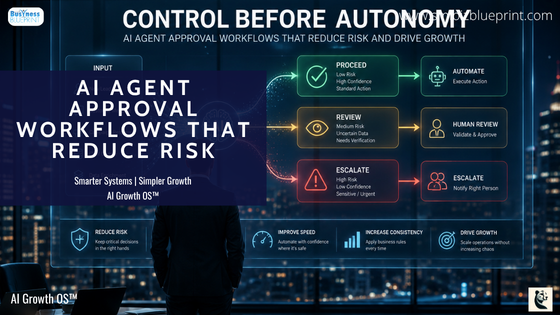
AI agent approval workflows reduce risk by defining what AI can do automatically, when it must pause, and when human judgment is required.
They turn business rules, risk thresholds, and operating standards into control layers that protect marketing, sales, and operations from drift.
Strategically, this matters because growth-stage businesses need automation that increases speed without weakening reliability, accountability, or system-wide alignment.
Uncontrolled Autonomy
The problem is not automation. The problem is automation without a control layer.
Most growing businesses do not fail with AI because the tools are weak. They fail because the business has no reliable structure between intention and execution.
An AI agent can draft, classify, route, recommend, enrich, score, respond, and trigger next actions. That creates leverage. It also creates exposure.
The moment AI starts influencing customer communication, sales prioritisation, marketing output, operational handoffs, or management reporting, it stops being a productivity tool. It becomes part of the operating system.
That is where the weakness appears.
Most teams introduce AI at the task level. They automate a repetitive action, connect a few systems, and reduce manual effort. On the surface, this looks efficient.
But underneath, the business has not answered the more important question:
What is allowed to happen automatically, under what conditions, with what level of confidence, and who is accountable when the system is uncertain?
Without that answer, automation does not create stability. It accelerates inconsistency.
Decision Leakage
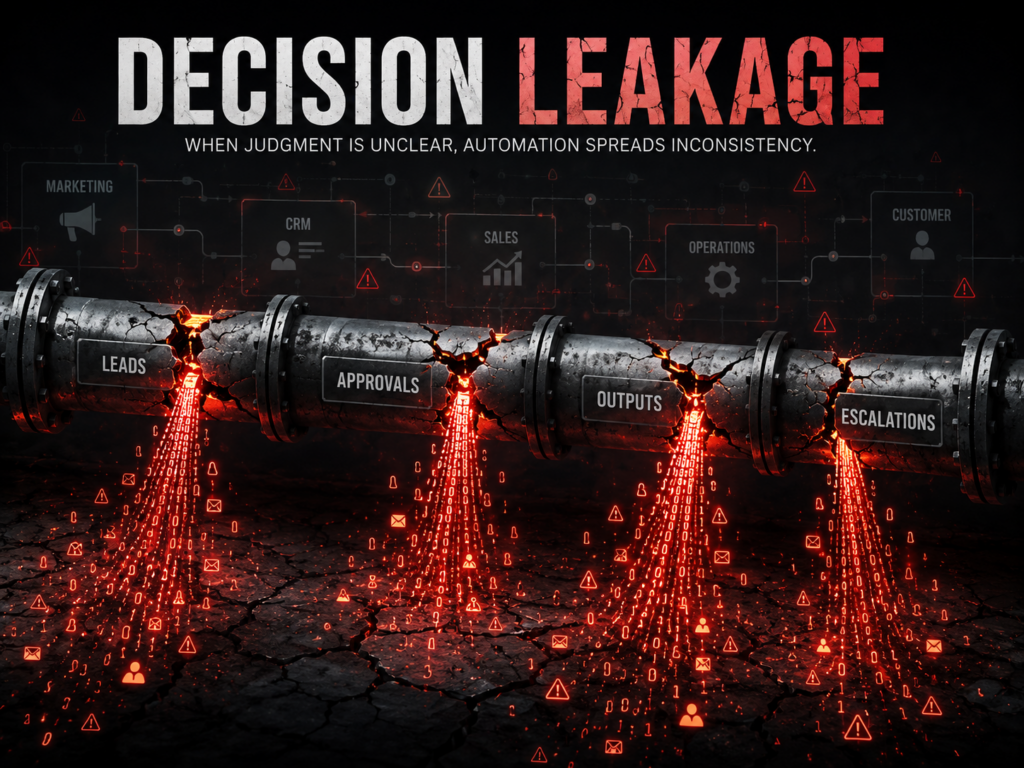
Decision leakage happens when judgment that should be governed by the business is left to individual interpretation, tool behaviour, or inconsistent human review.
A salesperson decides which leads deserve attention based on instinct.
A marketer approves AI-generated content because it “looks fine.”
An operations manager manually catches exceptions because no escalation rule exists.
A customer enquiry is routed based on keywords, but no one has defined what risk, value, urgency, or ambiguity should trigger human review.
These are not isolated workflow issues. They are architectural gaps.
The business has growth activity moving through the system, but the control logic is informal. It lives in people’s heads, messages, meetings, habits, and exceptions.
That works while the company is small enough for the founder or senior operator to absorb the ambiguity personally. It breaks when volume increases.
At $5M–$20M turnover, the business is usually past the point where founder judgment can remain the invisible control layer. There are more leads, more campaigns, more customer segments, more staff decisions, more operational dependencies, and more pressure to move faster.
AI then magnifies the existing structure.
If the structure is clear, AI reinforces it. If the structure is vague, AI spreads the vagueness faster.

Management Blindness
Most teams misdiagnose this as an AI accuracy problem.
They think the issue is a better prompt, a better tool, a better integration, or more training data.
Sometimes that is true. Usually it is incomplete.
The deeper issue is that the business has not defined the approval architecture around the work. The AI is not just producing outputs. It is entering a decision environment that may already be unstable.
When approval rules are unclear, the system creates hidden costs.
Senior people become silent quality-control bottlenecks.
Teams lose trust in automation because outputs vary.
Marketing velocity increases, but message consistency declines.
Sales follow-up becomes faster, but prioritisation becomes less reliable.
Customer communication scales, but risk becomes harder to see.
Operations become more automated, but exceptions become more dangerous.
This is the tension: the business wants speed, but speed without control creates drift.
And drift is expensive because it rarely announces itself immediately.
It appears as small inconsistencies. A lead is misclassified. A proposal uses the wrong positioning. A customer issue is routed too late. A campaign goes live with weak strategic alignment. A sales team starts trusting scores no one can explain.
None of these failures may be catastrophic alone. Together, they weaken the operating rhythm of the business.
The consequence of inaction is not simply bad AI output. It is management blindness.
The company becomes faster at producing activity, but less certain that the activity reflects the strategy.
Conditional Autonomy
AI agent approval workflows are not administrative checkpoints. They are control layers.
Their purpose is to convert business judgment into enforceable operating rules.
This is an entropy reduction problem.
Every growing business accumulates entropy: more people, more tools, more campaigns, more customer pathways, more exceptions, more handoffs. Without control layers, the system becomes noisier over time.
AI can either reduce that entropy or multiply it.
The difference is whether the business defines the logic of control before it scales the logic of execution.
An approval workflow should not exist because leaders are nervous about AI. It should exist because certain decisions carry different levels of risk, value, ambiguity, or strategic importance.
The architecture must separate low-risk repeatable work from high-impact judgment work. That requires escalation layering.
Not every AI action needs human review. That defeats the purpose of automation.
Not every AI action should proceed autonomously either. That creates unmanaged risk.
The system needs conditional autonomy.
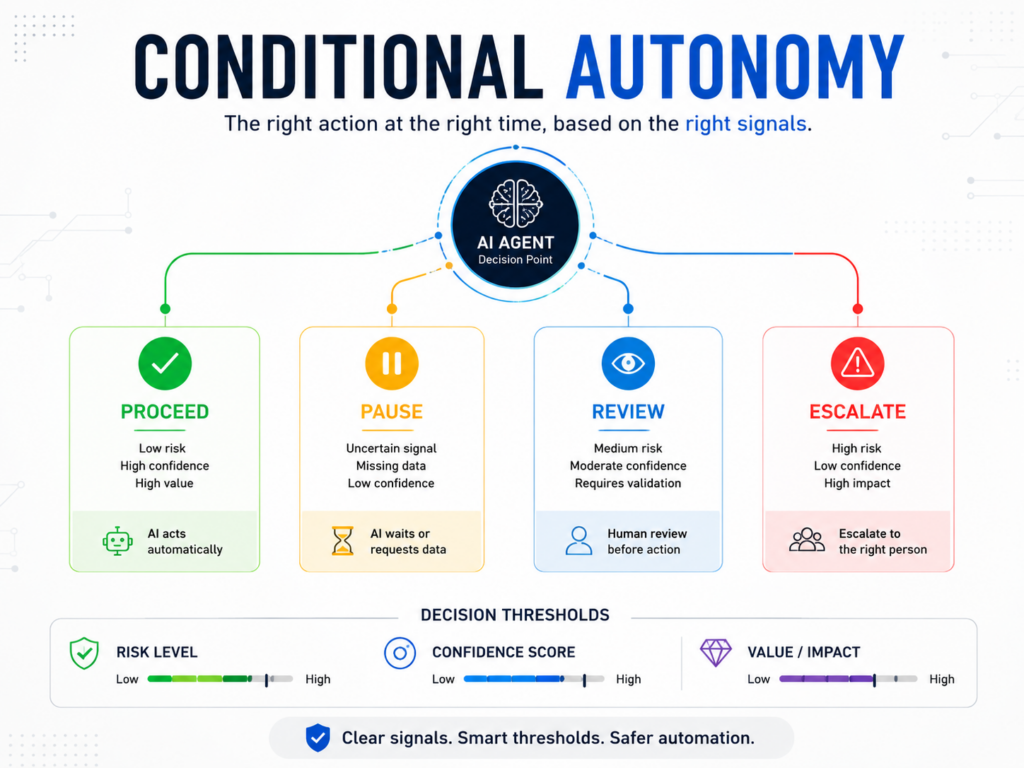
Conditional autonomy means AI can act freely inside defined boundaries, pause when thresholds are crossed, and escalate when confidence, risk, or value requires human judgment.
This is how automation becomes an enforcement layer. It does not replace leadership judgment. It operationalises it.
What the System Must Detect
A reliable AI approval workflow starts with signals.
Signals are the conditions the system detects before deciding what should happen next.
In a marketing and sales environment, the relevant signals usually include lead value, buying intent, source quality, customer segment, deal stage, message sensitivity, brand risk, compliance exposure, confidence score, data completeness, urgency, exception status, and strategic importance.
These signals matter because they determine whether an action should be automated, reviewed, escalated, delayed, enriched, or blocked.
Thresholds then define the control points.
A low-value enquiry with complete data, clear source attribution, and standard service language may be routed automatically.
A high-value account enquiry with urgent buying language and missing context should not disappear into a generic sequence. It should trigger immediate sales escalation.
An AI-generated nurture email may be approved automatically if it matches tone, offer, and segment rules.
A proposal summary for a strategic account should require human review before it reaches the client.
A customer message containing cancellation language, legal sensitivity, or reputational risk should bypass normal routing and escalate to a senior operator.
The point is not the tool. The point is the decision architecture.
The business defines what matters. The system detects whether those conditions are present. The automation enforces the next action.
That is the difference between AI as a task assistant and AI as an operating layer.
Routing, Not Blind Approval
In a mature approval workflow, the automated decision is rarely “approve everything” or “send everything to a human.”
The automated decision is routing.
Should this proceed?
Should this be reviewed?
Should this be escalated?
Should this be enriched with more data?
Should this be held until a missing input is resolved?
Should this be rejected because it violates a rule?
Should this be logged for pattern analysis?
These are control decisions.
They protect the system from two common failures: over-automation and over-review.
Over-automation creates risk because too much moves without judgment. Over-review creates bottlenecks because too much waits for approval.
A well-designed approval workflow creates the middle path. It allows the system to move quickly where conditions are stable and slow down where judgment matters.
This is probability management.
The business does not need perfect certainty before every action. It needs defined rules for what level of uncertainty is acceptable in each context.
Low-risk, reversible actions can tolerate more autonomy.
High-risk, visible, expensive, or relationship-sensitive actions require stronger control.
Prevent Drift From Becoming Damage
An approval workflow is incomplete until it includes correction.
Correction is what happens when the system detects drift.
Output drift occurs when AI starts producing language, recommendations, or classifications that no longer match the business standard.
Process drift appears when teams begin bypassing the workflow because the rules are unclear, too slow, or not trusted.
Strategic drift happens when activity increases, but the work no longer reflects the company’s positioning, priorities, or commercial model.
Data drift emerges when the inputs feeding the automation become incomplete, stale, or inconsistent.
The correction layer defines how the system responds.
It may trigger human review, route exceptions to a manager, require additional data, block an output, flag recurring failures, or update approval rules when patterns become clear.
This is where many businesses underbuild.
They create automation that moves work forward, but not automation that protects the integrity of the system.
Turn Logic Into Control
Only after the architecture is clear should implementation begin.
Take inbound lead handling.
An AI agent reviews new enquiries, extracts key information, classifies intent, identifies segment fit, checks data completeness, and recommends the next action.
But the agent does not decide in isolation. It operates inside an approval workflow.
If the enquiry is low-value, complete, and matches a standard service category, the system routes it to the appropriate sales sequence.
If the enquiry shows high buying intent or high account value, the system alerts a senior salesperson.
If the enquiry is ambiguous, the system requests clarification or sends it to manual review.
If the enquiry includes complaint language, legal sensitivity, cancellation risk, or reputational risk, the system escalates immediately.
If the AI confidence score falls below the defined threshold, the action is paused.
If required fields are missing, the system does not guess. It enriches, requests, or routes for completion.
The automation layer includes triggers, conditions, routing, and escalation rules.
The trigger might be a new enquiry, form submission, CRM update, campaign response, or sales-stage change.
The conditions might include deal size, source, segment, urgency, sentiment, confidence, and completeness.
The routing might send the item to sales, marketing, operations, leadership, or a review queue.
The escalation rule defines when the system must stop acting autonomously and bring in human judgment.
This is not a tool configuration exercise. It is a structural design choice.
The business is deciding where judgment must remain human, where execution can be automated, and where AI can enforce consistency between the two.
What This Means in Practice
The founder no longer has to be the invisible approval layer for every important decision.
Founder judgment is translated into operating rules.
The system knows which leads matter, which messages require review, which exceptions cannot be buried, which outputs are safe to send, and which ones need escalation.
It also knows when speed is useful and when speed is dangerous.
That is the practical shift.
The company stops relying on memory, instinct, and informal supervision to maintain quality. It starts embedding judgment into the workflow itself.
The Stability Outcome
The purpose of AI agent approval workflows is not to slow the business down.
It is to make speed safer.
When approval workflows are designed correctly, they reduce drift by making standards visible and enforceable.
They increase predictability by ensuring similar conditions produce similar actions.
They reinforce structural integrity by connecting marketing, sales, and operations through shared decision logic.
Marketing becomes more consistent because outputs are checked against positioning, audience, offer, and risk rules.
Sales becomes more focused because lead routing reflects value, intent, and urgency rather than noise.
Operations becomes more stable because exceptions are surfaced before they become failures.
Leadership gains visibility because the system records where uncertainty, risk, and escalation are occurring.
This is where AI becomes more than automation. It becomes an enforcement layer for the growth system.
Not enforcement in the rigid sense. Enforcement in the architectural sense.
The business defines what good judgment looks like. The system detects when judgment is required. Automation applies the rule, routes the work, escalates the exception, and preserves the operating standard.
That is how AI supports growth stability.
Not by doing more tasks.
By reducing the gap between strategy and execution.
A business at $5M–$20M does not need more disconnected automation. It needs systems that can absorb complexity without losing coherence.
AI agent approval workflows provide that control layer.
They allow the company to scale activity without scaling ambiguity at the same rate.
They protect the business from the false efficiency of unmanaged autonomy.
And they create the foundation for a more reliable growth architecture: faster where the system is stable, slower where judgment matters, and clearer everywhere.
FAQs
What are AI agent approval workflows?
AI agent approval workflows are control systems that define when AI can act, when it must escalate, and when a human must review the decision. Use them when AI outputs affect customers, sales prioritisation, marketing quality, or operational risk.
Why do AI agents need approval workflows?
AI agents need approval workflows because automation without control can accelerate inconsistency across the business. If the action is high-value, customer-facing, sensitive, or uncertain, the system should pause, route, or escalate before execution.
How do approval workflows reduce AI risk?
Approval workflows reduce AI risk by turning uncertainty into decision rules. When confidence is low, data is incomplete, or risk signals appear, the workflow prevents unmanaged action and moves the item into the correct review path.
What should an AI approval workflow control?
An AI approval workflow should control inputs, outputs, decisions, routing, escalation, and exception handling. The immediate decision is whether the AI action can proceed, needs enrichment, requires review, or must be blocked.
When should AI be allowed to act autonomously?
AI should act autonomously only when the task is low-risk, repeatable, reversible, and governed by clear rules. If the decision affects revenue, reputation, customer trust, or strategic accounts, conditional approval should be installed.
How do approval workflows improve output reliability?
Approval workflows improve output reliability by enforcing consistent standards before AI-generated work moves through the business. They reduce variation by checking signals such as intent, value, completeness, confidence, and brand risk.
What is the strategic value of AI agent approval workflows?
The strategic value is that they convert founder or leadership judgment into repeatable operating logic. This reduces dependency on individual oversight and creates a more stable growth system across marketing, sales, and operations.
Other Articles
Missed Opportunity Detection in AI CRM Systems