
How business owners spot early warnings before KPIs reveal the damage
Most businesses make slower decisions because they rely on metrics that confirm outcomes after they’ve already hardened.
The real advantage comes from reading signals—behavioural shifts that appear before revenue, churn, margin, or conversion KPIs visibly move.
Owners who reduce decision latency by tracking weak signals across sales, marketing, and operations preserve more options, intervene earlier, and steer outcomes instead of explaining them later.

Your dashboard says the business is healthy. Revenue is on pace. Pipeline volume looks full. CAC has not spiked. Nothing in the board pack gives leadership permission to worry.
Yet something feels off.
Deals that used to close in 21 days now stretch past 30. Teams are working just as hard, but momentum feels uneven. Customer replies are slower. Projects drift into clarification loops. No single KPI looks broken, but the room feels heavier every Monday.
This is the operating tension most businesses between $5M and $20M live with: the business changes before the dashboard admits it.
The default approach fails because it confuses accuracy with usefulness. A metric can be perfectly correct and still arrive too late to improve the decision. The real issue is decision latency—the gap between reality shifting and leadership recognising it.
That gap is expensive.
By the time conversion rate declines, buyer hesitation has already formed upstream. By the time churn appears in the monthly report, onboarding friction and usage inconsistency have already done the damage.
The hidden cost is not bad data. It is slow awareness that forces expensive, reactive decisions.
A better lens starts with one first-principles distinction:
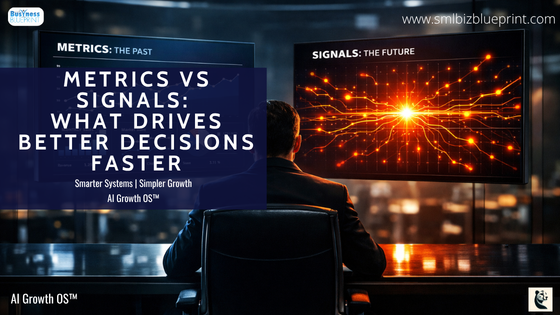
Metrics describe what has become true.
Signals reveal what is becoming true.
That single shift changes how leaders operate. Instead of waiting for proof, they learn to detect directional movement early enough to intervene.
The overlooked angle most teams miss is signal half-life: information can remain accurate while its decision value expires. A KPI may still be true on Friday, but the useful window to act may have closed on Wednesday.
That is why this matters now. The longer you rely on stable summaries alone, the more your business teaches you lessons only after they become expensive.
Why Most Dashboards Arrive Too Late to Be Useful
Most dashboards are built for explanation, not intervention.
They compress messy operating reality into stable summaries: monthly trends, performance deltas, executive rollups. That makes the business easier to discuss, but harder to steer. The very process that creates clarity also removes the early behavioural shifts that matter most.
This is why dashboards often feel calm while the business underneath them is already changing shape.
A strong pipeline chart can still hide slowing buyer response times. Stable conversion numbers can mask repeated pricing objections. Delivery margin may still look intact while internal clarification loops quietly expand.
This is why your pipeline looks strong but doesn’t convert consistently.
The failure is structural: dashboards average away weak signals in the name of confidence. But weak signals are often the first evidence of directional drift.
The better question is not what happened?
It is:
What changed in behaviour before the KPI changed in outcome?
That shift moves leadership attention upstream:
slower stakeholder replies
proposal revision loops
more deals needing executive intervention
rising handoff friction between sales and delivery
repeated internal escalations
None of these are “official” KPIs. That is exactly why they are strategically valuable.
Serious operators do not wait for numbers to become emotionally undeniable; they act when the pattern begins to form.
Because the longer leadership spends its time explaining historical stability, the less time it spends steering emerging risk.
Late on a Thursday afternoon, the founder refreshed the revenue dashboard again.
Everything still looked stable, yet the sales floor had gone strangely quiet—fewer spontaneous Slack wins, longer pauses after proposal sends, more “let me think about it” replies.
Two weeks later, the miss finally showed up in the KPI layer, but by then the quarter was already harder to recover.
He stopped trusting clean dashboards alone and started paying attention to behavioural drift—the business became something he could steer, not just explain.
The Core Difference Between Metrics and Signals
The difference is not semantic. It is functional.
A metric is a state description. It tells you the outcome of a completed sequence: win rate, churn, CAC, margin, close rate.
A signal is a directional clue. It captures the behavioural shift inside the sequence while the outcome is still fluid.
Take win rate. Useful, but retrospective.
Now compare it to:
increase in second pricing calls
slower champion follow-up
more legal reviews earlier in the cycle
repeated objections clustering around one offer point
Those are signals. They expose hesitation while leadership still has room to change the path.
This is why deals feel close but stall.
The standard mistake is treating all measurable data as equally useful. It isn’t. The value of data depends on whether it arrives before optionality disappears.
Metrics help you calibrate.
Signals help you intervene.
That distinction changes management behaviour:
metrics support reviews
signals support live decisions
metrics explain variance
signals expose drift
metrics improve accountability
signals improve timing
Most businesses over-invest in accountability systems and under-invest in timing systems.
That is the deeper failure.
If your team only acts when KPIs visibly move, slow response becomes embedded into the operating model itself.
Pro Tip
Ask one question every KPI review: what moved before this moved?
The strategic advantage is not better reporting accuracy. It is earlier causal visibility.

How Signals Reveal Business Risk Before KPIs Move
Risk almost never appears first in financial language.
It starts as hesitation, delay, repetition, and exceptions teams explain away as isolated incidents. By the time it becomes visible in revenue, margin, or churn, the response window is already narrower.
The real early warning system is flow irregularity.
Healthy businesses move cleanly:
demand → decision → handoff → delivery → retention.
When risk forms, flow becomes uneven before totals decline.
Examples:
top reps pulling leadership into routine calls
legal review cycles expanding
project kickoffs slipping despite stable bookings
customer success touches increasing before renewal windows
repeated confusion around the same value proposition
This is why your sales team keeps re-explaining the same thing on calls.
The non-obvious angle here is signal stacking. One weak signal is noise. Three weak signals across adjacent systems point to structural drift.
For example:
marketing message mismatch → lower sales conviction → onboarding expectation gaps → support escalation
That chain reveals system stress before any single department KPI fully reflects it.
Because weak signals compound silently. By the time finance captures the cost, the operational damage is already harder to reverse.
Examples of Signals Across Sales, Marketing, and Operations
Signals are easiest to use when attached to real business motion.
Sales
Watch for:
longer silence after proposal send
more procurement involvement earlier
repeated “next quarter” deferrals
champions losing urgency
higher proof-asset dependency
These shifts often precede falling win rates.
Marketing
Track:
rising traffic with weaker progression behaviour
more low-fit demo requests
stronger content engagement but slower lead-to-opportunity speed
repeat visits without decision movement
The mistake is celebrating volume while intent quality quietly decays.
Operations
Signals often surface here first:
approval drag
repeated clarification requests
more exception handling
project restarts becoming normal
delivery teams requesting missing sales context
This is where growth creates invisible fragility.
The deeper lens is to read cross-functional signal chains, not isolated departmental metrics. Drift usually moves across teams before it consolidates into one visible KPI.
When signals remain siloed, leaders optimise locally and miss system-level risk.

How to Build a Signal-Based Decision System
A signal system is not more reporting. It is a faster response architecture.
Start by reverse-mapping your most expensive lagging KPIs into the behaviours that precede them.
Examples:
revenue → proposal ageing, pricing escalation, stakeholder silence
churn → delayed onboarding, inconsistent adoption, rising support touches
margin → rework, scope ambiguity, approval latency
Then define response thresholds before proof is complete.
For example:
proposal delay > 5 days
same objection appears in 3+ calls
approval latency exceeds 48 hours
support escalations rise week-over-week
Each threshold must map to an action:
investigate, escalate, intervene, redesign.
This is where most businesses fail. They detect the signal but have no decision path attached to it.
Next, install a weekly weak-signal review using four prompts:
What changed?
What repeated?
What crossed teams?
What still hasn’t hit the KPI layer?
This is why your pipeline looks strong but doesn’t convert consistently.
Because scale amplifies hidden delay loops. Without signal infrastructure, growth increases blindness faster than it increases control.
Pro Tip
Start with three signals tied to your most expensive lagging KPI.
Completeness is not the edge—faster organisational learning is.
The operations lead of a $12M services firm noticed project kickoff delays creeping from two days to five, even though bookings remained strong.
Instead of waiting for churn or margin pressure, she traced the friction upstream to unclear sales handoff notes and leadership approval bottlenecks. Within three weeks, response thresholds and weekly signal reviews cut delays in half.
She stopped managing outcomes and started shaping flow—the identity shift from reactive manager to systems operator.
Where AI Improves Signal Detection and Response Speed
AI creates leverage at the pattern-recognition layer.
Humans can spot obvious anomalies. They struggle to detect weak, distributed changes across sales conversations, support channels, delivery workflows, and internal meetings at the same time.
This is where AI becomes strategically useful.
Use AI to surface:
objection clustering in sales calls
sentiment drift in customer conversations
repeated escalation themes
response-time anomalies
exception patterns across teams
uncertainty language in project updates
The real gain is not faster reporting. It is decision freshness.
Signals often have a short action window. AI compresses the time between weak-signal emergence and leadership awareness, preserving optionality while outcomes are still changeable.
This is why your sales team keeps re-explaining the same thing on calls.
As complexity grows, leadership pattern bandwidth does not scale linearly. AI extends awareness where human review starts missing convergence.
Pro Tip
Feed AI behavioural texture, not just KPI exports.
Call transcripts, escalations, and exception logs reveal movement long before dashboards do.
From Reporting Performance to Steering Outcomes
The strategic shift is simple:
Stop treating the business like a scorecard. Start treating it like a flow system.
Reporting asks what happened.
Steering asks what is changing.
That changes how leadership meetings work.
Less time on:
defending last month’s numbers
post-hoc explanations
static departmental rollups
More time on:
directional shifts
signal convergence
threshold breaches
intervention experiments
response speed
The strongest operators do not confuse measurement with control.
Steering preserves strategic freedom. Reporting alone only tells you which freedoms have already been lost.
The uncomfortable truth is that most leadership teams are not under-informed—they are over-comforted by stable numbers.
The spreadsheet becomes emotional protection, a way to delay acting until the problem feels socially undeniable. But by then the business has already changed shape beneath the surface.
The leaders who grow faster are the ones willing to trust directional tension before consensus arrives.
Conclusion
The friction you are living with is not a lack of data. It is the false comfort of data that arrives after the business has already changed.
That is why strong dashboards can coexist with weak decisions.
Metrics make reality visible once it stabilises. Signals make reality actionable while it is still moving.
The difference is not analytical sophistication. It is whether leadership still has room to alter the outcome.
Relief starts when you stop asking the dashboard for certainty and start asking the system for movement.
What changed before the KPI changed?
What repeated across teams?
What is getting slower, noisier, or harder to explain? These questions restore control because they move your attention upstream—where decisions are still cheap.
The strongest operators are not better at reading reports; they are better at sensing drift early enough to change the future.
Your current state is optional.
You can keep managing by historical proof and continue paying the hidden tax of slow awareness—stalled deals, false confidence, invisible margin loss, and teams reacting too late.
Or you can build a business that reads behavioural change in real time, intervenes sooner, and compounds strategic clarity.
That is the emotional contrast and the operational truth: stay stuck in retrospective comfort, or step into earlier control.
The business is already sending signals. The real decision is whether you are still waiting for permission from the metrics.
Action Steps
1) Map one lagging KPI to precursor behaviours
Take your most expensive lagging KPI and identify the 3 behaviours that shift before it moves. This creates an earlier intervention layer so leadership can act before the outcome hardens.
2) Set one response threshold
Choose the point where the signal must trigger action, such as proposal ageing beyond five days. The strategic value comes from shortening response time, not collecting more observations.
3) Run a weekly signal review
Spend 20 minutes reviewing what changed, repeated, or crossed teams. This keeps leadership focused on directional drift instead of historical explanation.
4) Track one cross-functional signal chain
Follow how one upstream behaviour creates downstream friction across marketing, sales, delivery, or support. This reveals system risk before silo KPIs deteriorate.
5) Use AI to surface weak-signal convergence
Feed AI transcripts, escalation logs, and meeting notes to identify repeated hesitation patterns or timing anomalies. This expands leadership awareness where manual review starts missing signal overlap.
FAQs
What is the difference between metrics and signals?
Metrics confirm completed outcomes. Signals reveal behavioural movement early enough to improve the decision.
Why are signals better for faster decisions?
Because they preserve timing and optionality. Metrics often validate the problem after the cost of response has increased.
What are the most useful early signals?
Proposal ageing, slower replies, approval drag, repeated objections, and rising exception handling. These often show drift before financial KPIs visibly change.
How often should leadership review signals?
At least weekly. The review cadence should match how quickly the decision window expires, not the reporting calendar.
Where does AI create the most leverage?
AI is strongest at identifying weak-signal convergence across multiple systems, especially where leadership complexity exceeds human pattern-recognition bandwidth.
Other Articles
Decision Intelligence in Business: From Data to Action