

A practical framework for turning scattered KPI reporting into an early-warning decision system for founders and leadership teams.
An AI signal layer for weekly executive visibility reduces growth drift by detecting leading indicators before revenue, margin, and pipeline issues surface in lagging dashboards.
Instead of producing more reports, it installs a control layer that monitors threshold convergence across marketing, sales, and delivery, then routes deviations into escalation logic before instability compounds.
For $5M–$20M businesses, this shortens the gap between signal emergence and executive action, increasing predictability and reinforcing structural integrity.

The Structural Failure: Visibility Arrives After the Decision Window
Most leadership teams do not suffer from a reporting problem. They suffer from expired decision value.
The structural weakness sits in the delay between signal emergence and executive awareness.
By the time pipeline softness, margin compression, delivery slippage, or conversion decay appears on a polished monthly dashboard, the highest-leverage intervention window has already narrowed.
The numbers may still be accurate, but their strategic usefulness has already decayed.
This is where system drift begins.
The business can still look healthy on the surface. Revenue remains on plan. Pipeline volume appears stable. CAC still looks efficient. Yet beneath those lagging indicators, the leading structure is already weakening.
Lead-to-opportunity velocity slows, proposal ageing extends, handoff friction rises, and response-time variance starts compounding across teams.
Most operators misdiagnose this as a dashboard design issue.
It is rarely a dashboard issue. It is a failure in decision infrastructure: the absence of a weekly AI signal layer that converts operational movement into executive-grade intervention windows.
The Hidden Cost: Delayed Correction Creates Structural Fragility
The hidden cost is not poor reporting accuracy. It is delayed correction.
When the operating system waits for end-of-month summaries, risk compounds in three ways.
Revenue softness accumulates invisibly. Small weekly declines in stage progression, response-time velocity, or proposal movement rarely appear severe enough to trigger intervention on their own.
In aggregate, they materially change quarter-end outcomes.
Teams then compensate locally. Sales increases activity pressure. Marketing pushes lead volume. Operations adds controls downstream.
Each function responds rationally to the visible symptom while unintentionally amplifying the structural mismatch upstream.
At the executive layer, cognitive load rises. Leadership meetings become forensic exercises spent reconstructing what happened rather than choosing the next intervention.
This is the moment hindsight governance takes hold: the system is no longer steering outcomes, only explaining them after decision leverage has already weakened.
The consequence is subtle but severe: growth appears manageable until volatility exposes how much of the business is operating on stale visibility.

The Architectural Principle: Signal Visibility as Entropy Reduction
The core architectural principle is entropy reduction through signal visibility.
As businesses scale beyond $5M, complexity no longer increases linearly.
Cross-functional dependencies multiply. Marketing quality affects sales velocity. Sales qualification affects onboarding throughput. Delivery performance influences renewals. Finance visibility changes risk posture.
Without a signal layer, every function optimises against its local truth.
The executive layer must therefore act as a coherence system.
Its role is not to generate more metrics. Its role is to compress cross-functional movement into decision-ready variance signals that preserve intervention timing and reduce executive interpretation load.
This is continuity enforcement.
The purpose is to keep acquisition, conversion, fulfilment, and retention structurally aligned before local deviations harden into system-wide instability.
Most teams default to KPI abundance: too many metrics, reviewed too late, with no threshold logic tied to action.
A real decision architecture asks sharper questions.
Which deviations reliably precede downstream instability?
Which patterns represent noise versus structural drift?
Which threshold breaches justify escalation?
That is the difference between reporting and control.
The Signal Logic: Thresholds, Convergence, and Decision Routing
At the signal layer, the system monitors movement, not static totals.
The objective is to detect directional integrity shifts before they become financial outcomes.
High-value signals include CRM stage progression decay, lead-response latency variance, proposal ageing, sales-to-delivery handoff delays, MQL-to-SQL confidence deterioration, margin erosion by acquisition source, and segment-specific deal slippage.
The thresholds that matter are relative and relational.
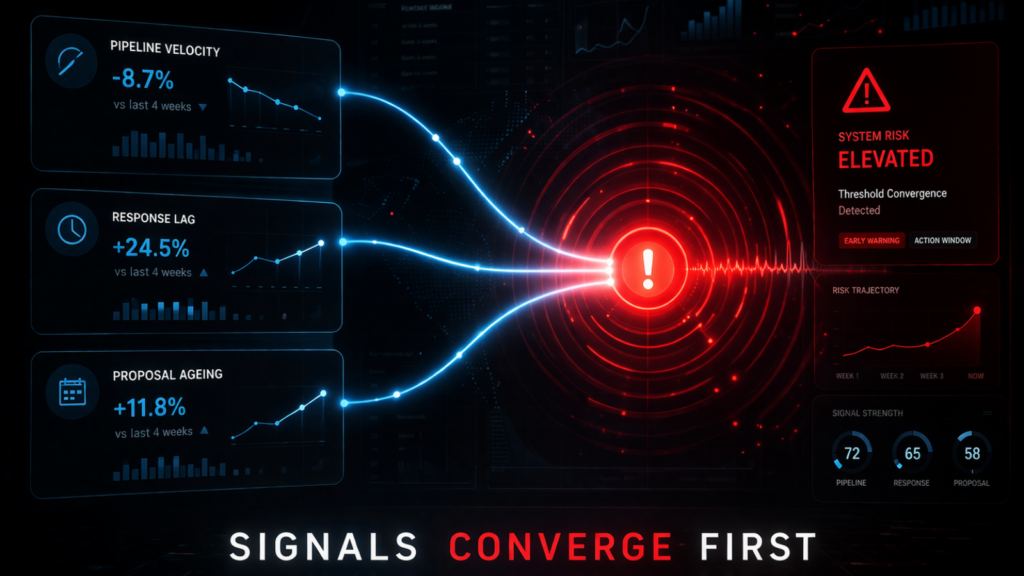
A 7% drop in stage progression may not justify attention in isolation. Combined with a rise in proposal ageing and slower inbound response times, it materially increases the probability of quarter-end softness.
In practice, this often reveals velocity risk rather than a top-of-funnel weakness—an important distinction because it changes whether leadership corrects conversion mechanics or acquisition strategy.
This is where the AI layer creates leverage.
It detects threshold convergence.
Rather than automating on isolated KPI movement, it automates on correlated deviations across adjacent systems.
The decision being automated is not the corrective action itself. The decision being automated is classification.
Does this variance self-correct?
Does it require team-level intervention?
Does it require executive escalation?
That logic preserves leadership bandwidth while ensuring the decision window remains open.
The correction layer is an escalation framework that routes deviations based on predicted downstream impact.
The Automation Layer: Control Logic That Preserves Integrity
Once the architecture is defined, automation becomes a control surface for continuity.
Its purpose is to reduce the time between deviation detection and structured correction.
A practical implementation might monitor weekly CRM velocity, campaign quality movement, and response-time dispersion.
When qualified pipeline volume remains flat while proposal ageing breaches a defined band for two consecutive cycles, the system triggers a control response.
The first layer routes a variance summary to the sales leader with contextual intelligence: affected segment, acquisition source, rep clusters, and historical baseline movement.
If marketing-side quality remains stable, the issue is classified as sales-side velocity friction.
If marketing quality has also deteriorated, the signal escalates into a shared revenue correction layer.
The second layer enforces continuity.
If the variance persists into the following cycle, the system automatically inserts the issue into the executive weekly review cadence with forecast exposure, conversion-risk probability, and pipeline contamination scenarios attached.
This is not workflow automation for convenience.
It is escalation layering for structural resilience.
The automation layer does not replace judgment. It protects judgment from noise, delay, and local optimisation bias.
What This Means in Practice
What this means in practice is that your leadership team stops discovering instability after it has already spread.
Instead of waiting for month-end reporting to explain softness, the system surfaces the earliest weekly signals most correlated with downstream drift and forces visibility at the right level.
A useful executive test is simple: if your weekly leadership meeting spends more time reconstructing causes than choosing interventions, your signal layer is lagging behind the business.
Sales no longer compensates blindly for marketing noise.
Marketing no longer mistakes volume for velocity.
Operations no longer absorbs preventable variance created upstream.
The organisation gains a shared decision language built on thresholds, confidence bands, and escalation rules.
That materially reduces the cognitive cost of executive oversight and shifts leadership time from forensic reconstruction to controlled intervention.
The Stability Outcome: Predictability Through Drift Suppression
The long-term outcome is not faster reporting. It is lower drift.
By compressing the time between signal emergence and executive awareness, the business reduces the probability that local inefficiencies evolve into quarter-level surprises.
This increases predictability in three ways.
Revenue pathways stabilise because early-stage friction is surfaced before it compounds into conversion loss.
Cross-functional alignment improves because correction logic is based on shared thresholds instead of departmental interpretation.
Growth systems become more resilient over time because every deviation strengthens threshold models, escalation rules, and signal confidence.
This is the real value of the implementation layer inside AI growth system architecture.
Automation is not there to save time. It exists to enforce continuity, reduce entropy, and preserve executive decision quality under scale pressure.
Across marketing and sales, this reinforces structural integrity because both functions now operate against the same leading indicators, timing assumptions, and correction pathways.
The result is a business that no longer relies on heroic management attention to stay aligned.
It stays aligned because the architecture itself is designed to detect drift early, route correction deliberately, and preserve growth stability before instability appears in financial outcomes.
FAQs
What is an AI signal layer for executive visibility?
An AI signal layer is a decision infrastructure layer that detects leading operational signals across marketing, sales, and delivery, then converts them into executive-grade alerts before lagging KPIs reveal the issue.
Why is weekly decision infrastructure better than monthly dashboards?
Because it preserves intervention timing. Monthly dashboards often surface accurate data after the highest-leverage decision window has already passed.
What signals matter most each week?
Stage progression, response-time variance, proposal ageing, handoff delays, pipeline velocity, acquisition-source margin patterns, and churn-risk movement.
How does automation improve structural integrity?
It reduces delay between threshold breach and correction by applying routing, escalation, and continuity logic before local deviations spread.
What thresholds matter most?
Relative threshold convergence across adjacent systems matters more than isolated KPI drops.
How does this reduce drift across marketing and sales?
It creates shared escalation rules and leading indicators so both teams optimise against the same control logic.
What does this mean for founders?
Earlier visibility, lower cognitive load, and more predictable intervention pathways.
Other Articles
Decision Continuity in Marketing Systems: A Control Layer