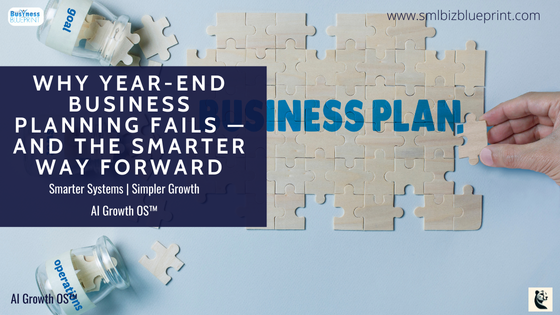

Year-end planning fails when businesses focus on setting goals instead of resolving the decisions that slow execution.
Real clarity comes from closing open decisions, building systems that hold them permanently, and creating feedback loops that sustain momentum without constant leadership intervention.
When decision debt is reduced, businesses become easier to run, scale with less friction, and enter the new year with confidence instead of pressure.
A calmer, clearer operating model that scales without burning you out.
You’re doing everything you’re supposed to do.
You reviewed the year. You hit the numbers. You sat through the planning sessions. You set priorities for next year. And yet—beneath the surface—something still feels off.
The business is busy, but not lighter. Decisions take longer than they should. Execution depends on a few people holding everything together.
Momentum shows up in bursts, then leaks away.
That tension is the real year-end problem most leaders are living with.
Not failure—but friction. The quiet frustration of knowing the business is performing, yet feeling harder to run.
The pressure comes from a simple question you can’t quite shake: If we’re doing well, why does it still feel like this much work?
What’s at risk isn’t just next year’s growth—it’s clarity, confidence, and the ability to scale without burning attention and energy as the hidden cost.
Here’s the overlooked truth: year-end business planning fails not because goals are wrong, but because the business is carrying too many unresolved decisions.
That decision debt creates complexity, slows execution, and kills momentum—no matter how good the plan looks on paper.
Clarity doesn’t come from sharper goals. Systems don’t come from more tools. Momentum doesn’t come from motivation.
They come from designing the business so fewer things need to be re-decided every day.
This article reframes year-end planning from first principles.
We’ll break down why the default approach collapses, how clarity actually works, why systems reduce—not add—complexity, and what really sustains momentum past February.
If you’ve outgrown surface-level planning and want the business to feel calmer, more deliberate, and easier to run, this is the shift.
This is the moment where you stop pushing harder—and start operating like the kind of leader who builds leverage instead of carrying everything alone.

Why the Default Year-End Review Fails (Even When the Numbers Look Good)
The core problem: most year-end reviews create the feeling of clarity without changing how the business actually runs.
You close the year with charts, summaries, and confident language—but once January arrives, the same bottlenecks resurface.
Decisions still funnel upward. Work still depends on a few people. Execution still slows the moment something unexpected appears.
That friction isn’t a motivation issue. It’s structural.
What’s frustrating: the review tells you what happened, not why it keeps happening.
Most year-end planning relies on memory, narrative, and lagging indicators like revenue or growth rate. Those inputs feel authoritative, but they’re incomplete.
Memory smooths over friction. Narratives reward hindsight. Financials hide operational drag.
The business looks coherent on paper while remaining chaotic in motion.
The logic most people miss: performance metrics don’t explain performance mechanics.
Revenue tells you what the business produced, not how reliably it did so. Two businesses can hit the same numbers—one through repeatable systems, the other through constant intervention.
The review treats them as equal. The next year exposes the difference.
What that means for your business is this: if you don’t examine how decisions moved through the organisation, you plan the future on top of the same constraints.
When reviews ignore where work stalled, where authority was unclear, or where effort compensated for structure, the next plan simply rebrands old problems as new priorities.
The better lens: clarity comes from resolving decisions, not recounting outcomes.
A useful year-end review asks different questions:
- Where did work slow because no one knew who could decide?
- What required repeated discussion because the answer wasn’t documented?
- Which problems escalated that should have been contained?
Those answers reveal friction the numbers never will.
You stop acting like a reporter of results and start thinking like a designer of systems.
Leaders who scale well don’t just ask, “How did we perform?” They ask, “Where did the business make thinking expensive?”
That mindset turns reviews into leverage instead of ritual.
Why this matters right now: the longer this stays the same, the more next year’s growth depends on heroics instead of structure.
Every unresolved decision quietly taxes time, attention, and confidence. Left unaddressed, it compounds—until the business feels heavy no matter how well it performs.
Pro tip:
After your financial review, run a “decision replay.” List the top 10 issues that consumed leadership time this year and ask: Was the decision unclear, undocumented, or repeatedly revisited?
You surface where execution actually broke down.
Because speed isn’t the edge—decision finality is. The fewer questions your business needs answered twice, the faster it moves without you pushing.
I once ended a year feeling proud of how much we’d achieved—and quietly frustrated by how heavy everything still felt.
The plan looked clean, the goals were clear, yet every decision kept looping back through the same conversations. The shift came when I realised the review had explained the year, but it hadn’t removed a single point of friction.
That was the moment I stopped planning for performance and started planning for relief. I didn’t become more driven—I became more deliberate.
Clarity: Why “Focus” Is the Wrong Goal
The real frustration: you’re being told to “focus,” but everything already feels important.
You enter year-end with a long list of priorities, each one defensible, each one tied to growth, clients, or risk.
The advice to “just focus” sounds right—but it doesn’t reduce the load. It quietly adds pressure. If everything matters, then nothing can be safely dropped.
The relief most people don’t realise is available: clarity doesn’t come from choosing better priorities—it comes from choosing fewer active decisions.
Focus is a downstream effect. The upstream cause is decision resolution. When decisions remain open, work keeps branching. Meetings multiply. Exceptions pile up. People hedge instead of commit.
The business feels mentally noisy because it is.
The logic behind this: ambiguity is more expensive than difficulty.
A hard decision made once is cheaper than an easy decision revisited weekly. Most businesses carry hidden cost not because work is complex, but because choices were postponed, softened, or never formally closed.
That unresolved state forces teams to keep thinking about the same issues again and again.
Most people don’t realise that revenue is a poor proxy for clarity.
A business can grow while becoming less clear. In fact, growth often masks the problem.
Sales increase, so friction gets tolerated. Headcount expands, so ambiguity spreads.
What looks like momentum is often just compensation—more effort filling the gaps left by undecided direction.
What that means for your business is this: clarity should be measured by how often people don’t need to ask.
Better indicators than revenue include:
- How often decisions are escalated unnecessarily
- How frequently work is re-done due to “misalignment”
- How many priorities survive purely because no one officially stopped them
These signals reveal whether clarity exists at an operational level, not just a strategic one.
You move from being a “vision holder” to a “decision closer.”
Leaders who create real clarity don’t inspire harder—they decide faster and cleaner. They understand that every unresolved question becomes cognitive tax paid daily by the organisation.
Your role isn’t to carry the vision louder. It’s to retire decisions so others can move without you.
Why this matters right now: the longer this stays the same, the more next year’s execution relies on individual judgment instead of shared direction.
Every month you delay closing decisions, you spend time re-explaining priorities that should already be settled. That’s not just inefficient—it erodes confidence.
Pro tip:
Run a “stop-doing” review before you set any new goals. Identify initiatives that still exist only because they haven’t been formally ended.
You immediately reduce noise and workload.
Because growth isn’t created by adding more direction—it’s created by removing ambiguity. The fewer open loops your business carries, the more leverage every decision has.
Ready to level up your business?
Sign up for our newsletter and get expert tips delivered weekly.
Systems: Where Complexity Actually Comes From (and How to Reduce It)
The frustration most leaders feel: the business is growing, but everything feels heavier.
More people. More tools. More meetings. More follow-ups. Instead of ease, growth brings drag.
You expected scale to simplify things. Instead, it introduced friction you can’t quite trace to any single cause.
The relief comes from a counterintuitive truth: complexity doesn’t come from growth—it comes from decisions that never found a permanent home.
As volume increases, any decision that lives in a person’s head instead of a system starts leaking. Teams hesitate. Work stalls. Exceptions become normal.
What feels like “process overhead” is usually just ambiguity multiplying under pressure.
The logic behind this is simple: systems don’t exist to organise work—they exist to prevent unnecessary thinking.
A real system is not software.
It’s a settled agreement that answers three questions without debate:
- Who decides?
- What happens by default?
- How do we know it worked?
If any of those are unclear, people compensate with effort. Meetings replace rules. Experience replaces documentation. Leaders become the system by default.
Most people don’t realise that tools often make this worse.
Adding software before decisions are clear accelerates noise.
A CRM without defined lead ownership creates more confusion than email. A project tool without decision rights generates updates, not progress.
Tools amplify whatever structure already exists—clarity or chaos.
What that means for your business is this: bottlenecks form where authority and criteria are vague, not where people are slow.
Operational friction usually shows up in the same places:
- Work waiting for approval because no one knows who can decide
- Tasks bouncing between teams due to unclear standards
- Leaders being pulled into routine issues that should be contained
These are not people problems. They’re system gaps.
You stop being the safety net and start being the architect.
Leaders who scale well don’t solve problems repeatedly—they design conditions where problems resolve themselves.
They understand that every time they step in to clarify something informally, they delay the creation of a system that could have handled it permanently.
Systems reduce effort by making good decisions boring and automatic.
When decisions are documented, ownership is explicit, and feedback is visible, work moves without constant supervision. That’s when growth starts to feel lighter instead of louder.
The longer this stays the same, the more growth increases dependence on a few people instead of the business itself.
Every month you rely on memory instead of structure, you increase operational risk—and limit how far the business can scale without burning out its leaders.
Pro tip:
Audit where you are acting as the system. For one week, note every decision or clarification that only you can provide. Then ask: What rule, owner, or default outcome would eliminate this next time?
You identify the highest-leverage system gaps.
Because scale isn’t achieved by working harder—it’s achieved by relocating decisions out of people and into the business. That’s how leaders create leverage without losing control.
By mid-year, the business was growing—but every decision still waited for approval. Nothing broke, but nothing flowed either.
The shift came when priorities were closed instead of discussed, and decisions were placed into systems instead of people. Within months, meetings shortened, execution sped up, and leaders stopped being the safety net.
The business didn’t just move faster—it started moving without asking.
Momentum: Why Plans Collapse by February
The frustration is familiar: January starts strong, then reality creeps in.
The plan looked solid. The offsite felt aligned. The priorities were clear—at least for a moment. Then exceptions appeared. Decisions slowed. Teams started asking for clarification again.
By February, momentum didn’t disappear—it leaked, quietly, through a dozen small cracks.
The relief comes from understanding this: momentum isn’t lost because people stop caring—it’s lost because the plan can’t survive contact with real work.
Most execution breakdowns are blamed on motivation, discipline, or accountability. That diagnosis feels neat, but it’s wrong.
People don’t disengage because they’re lazy. They disengage when effort doesn’t reliably turn into progress.
The logic most plans ignore: momentum is structural, not emotional.
Execution decays when three things are missing:
- Singular ownership (everyone is responsible means no one decides)
- Fast feedback (progress is reviewed too slowly to correct drift)
- Clear defaults (exceptions require debate instead of following a rule)
Without these, even good plans turn brittle. The moment something unexpected happens—and it always does—work pauses while people renegotiate direction.
Most people don’t realise that shared ownership kills momentum faster than no plan at all.
When priorities are collective, decisions become political. When progress reviews are monthly, drift compounds. When success criteria are vague, teams hedge instead of commit.
What looks like “loss of focus” is actually unresolved authority playing out in slow motion.
What that means for your business is this: the plan didn’t fail—its operating conditions did.
If execution requires constant alignment conversations, the plan is doing too much conceptual work and not enough operational work.
Strategy lives or dies in the space between decisions and feedback.
You stop trying to “keep people motivated” and start designing execution that sustains itself.
Leaders who maintain momentum don’t chase energy. They remove ambiguity. They know that when ownership is clear, and progress is visible, motivation becomes a byproduct—not a requirement.
The release: momentum stabilises when the business can correct itself weekly, not quarterly.
Short review cycles, explicit decision rights, and visible signals turn execution into a rhythm instead of a push. That’s when plans stop collapsing under pressure and start adapting without drama.
The longer this stays the same, the more each year repeats the last with different labels.
Every quarter without structural momentum costs you compounding progress—and quietly teaches the team that plans are temporary suggestions, not operating truth.
Pro tip:
Replace monthly strategy reviews with a weekly “decision and signal” check. Ask only two questions: What decision did we lock this week? and What signal tells us execution is drifting?
Momentum stays visible and correctable.
Because consistency isn’t built on pressure—it’s built on fast feedback. Leaders who win don’t push harder; they shorten the distance between action and learning.
The Overlooked Constraint: Decision Debt Is What’s Really Slowing You Down
The frustration most leaders can feel but can’t name: the same issues keep resurfacing.
You answer the same questions. You revisit the same trade-offs. You re-explain decisions you were sure were already made.
Nothing is “on fire,” yet progress feels sticky—like the business is wading through invisible resistance.
The relief comes from naming the real problem: this isn’t inefficiency—it’s decision debt.
Decision debt accumulates when choices are postponed, softened, undocumented, or inconsistently applied. Just like technical debt, it compounds quietly.
Each unresolved decision adds friction to future work, slowing execution without ever appearing on a report.
The logic behind decision debt is straightforward: undecided businesses pay interest in time, attention, and trust.
When a decision isn’t closed:
- Teams hedge instead of committing
- Work pauses for clarification
- Leaders become bottlenecks by default
The cost isn’t dramatic—it’s constant. Small delays stack. Minor confusion spreads. What should be routine becomes effortful.
Most people don’t realise that decision debt increases faster as the business succeeds.
Growth adds volume. Volume exposes ambiguity. What worked informally at a smaller scale breaks when more people need the same answer.
Decisions that once lived safely in someone’s head now leak across teams, creating inconsistency and rework.
What that means for your business is this: every time a decision depends on who’s present, the organisation slows.
Decision debt shows up as:
- Meetings that exist only to “align”
- Exceptions that override rules
- Leaders being pulled into everyday choices
None of this feels catastrophic—but together, it caps how far the business can scale without exhausting its leaders.
You move from being the resolver of issues to the eliminator of recurring questions.
Leaders who create leverage don’t pride themselves on being needed. They design the business so fewer decisions require human intervention.
They know that clarity isn’t inspirational—it’s operational.
The release: paying down decision debt restores flow.
When decisions are explicit, documented, and owned, execution speeds up without urgency. Work moves because it knows how to move.
That’s when momentum becomes reliable instead of fragile.
Why this matters right now: the longer this stays the same, the more next year’s growth increases cognitive load instead of capability.
Every unresolved decision quietly taxes your best people and trains the organisation to wait instead of act.
Pro tip:
Run a quarterly “decision debt audit.” Ask: Which decisions did we make repeatedly this quarter—and why? Then formalise just the top three.
Fewer repeat conversations and faster execution.
Because scale isn’t achieved by answering questions faster—it’s achieved by ensuring the same questions never need to be asked again.

From Insight to a 12-Month Roadmap That Actually Holds
The frustration at this stage: you finally see the real issues—yet roadmaps still feel fragile.
You’ve identified the friction. You’ve named the decision debt. But when it’s time to translate insight into a plan, the old habits creep back in. Long lists. Overstuffed priorities.
A roadmap that looks decisive but collapses the moment reality intervenes.
The relief comes from a reframing: a roadmap isn’t a list of initiatives—it’s a sequence of decisions the business no longer has to rethink.
Most roadmaps fail because they describe what you want to do, not what must now be true for execution to flow. They confuse activity with readiness.
The result is a plan that requires constant interpretation instead of enabling action.
The logic that holds: durable roadmaps are built around constraint removal, not ambition stacking.
A roadmap that survives contact with reality answers three questions:
- Which decisions must be locked in for the next 12 months?
- Which systems must absorb volume without escalation?
- Which signals tell us early when execution is drifting?
This shifts planning from prediction to preparation.
Most people don’t realise that planning too far ahead in detail actually weakens execution.
Twelve months is for direction, not precision. Precision belongs in 90-day windows, where feedback is fast, and correction is cheap.
When businesses over-specify the future, they create false certainty—and brittle plans that can’t adapt.
What that means for your business is this: a strong roadmap reduces thinking load before it increases output.
When decisions are clear, systems are owned, and review rhythms are set, teams don’t wait for permission—they move.
The roadmap becomes a stabiliser, not a source of pressure.
You stop being a planner of outcomes and become a builder of operating conditions.
Leaders who get this right don’t obsess over whether the plan will be “right.” They focus on whether the business can correct itself without drama.
That’s the mark of a mature organisation.
When the roadmap is decision-led, momentum becomes predictable.
Execution stops depending on enthusiasm and starts depending on structure. The business moves forward even when conditions change—because the rules of movement are clear.
The longer this stays the same, the more each new year adds pressure instead of progress.
Every roadmap built on unresolved decisions guarantees rework, renegotiation, and wasted leadership time by Q2.
Pro tip:
Design your roadmap backwards from decision finality. Before listing initiatives, write down the 5–7 decisions that, once made, would make next year easier to run.
Fewer stalled projects and faster starts.
Because execution isn’t powered by ambition—it’s powered by readiness. The clearer the decisions, the lighter the roadmap feels.
The most telling moment isn’t when a business struggles—it’s when it succeeds and still feels exhausting.
That’s when leaders mistake commitment for control and confuse involvement with impact. The shift happens when they realise exhaustion isn’t a badge—it’s a signal.
They stop trying to hold everything together and start designing a business that can.
Conclusion
The frustration to name honestly: if you’re tired, it’s not because you’re doing it wrong—it’s because the system is asking too much of you.
You’ve planned. You’ve pushed. You’ve carried decisions that should have been settled long ago.
The business is performing, yet it still leans on you for clarity, judgment, and momentum. That tension isn’t a personal failing. It’s the predictable result of unresolved decisions, fragile systems, and plans built on hope instead of structure.
The relief comes from seeing the pattern clearly: nothing here requires more effort—only better design.
Clarity comes from closing decisions, not revisiting them.
Systems reduce complexity when they hold decisions permanently, instead of leaking them back to people. Momentum lasts when execution is designed to self-correct, not when leaders work harder to keep it alive.
When you pay down decision debt, the business starts moving with less friction and more confidence.
This is the identity shift that matters: you stop being the engine and start being the architect.
Leaders who scale well don’t measure success by how much they carry. They measure it by how little the business needs them to keep moving.
They build organisations that think clearly, decide cleanly, and execute without constant intervention.
Here’s the real choice in front of you:
You can keep planning harder—accepting that next year will feel much like this one, just with new labels and familiar friction.
Or you can redesign how decisions live in your business, reclaiming time, focus, and momentum that compound instead of drain.
Your current state isn’t permanent. It’s optional.
The cost of doing nothing is subtle but real: more meetings, more escalation, more dependence on you to hold everything together.
The alternative is equally real: a business that feels calmer, clearer, and easier to run—because it was built that way.
The next step isn’t another plan.
It’s choosing to stop carrying what the business itself should hold.
Transform your business with insights that matter.
Subscribe to Pulse for exclusive strategies designed to drive your success.
Action Steps
Run a Decision Audit (Not a Performance Review)
Start by listing the top 10 decisions that consumed leadership time this year.
Circle the ones that were revisited multiple times or escalated repeatedly.
What you’re looking for: decisions that were never fully closed, documented, or owned.
Unresolved decisions are the fastest way to kill momentum without noticing.
Replace “Focus” With Subtraction
Before setting any new goals, identify what should stop next year:
Initiatives still running without a clear owner
Projects justified by history, not impact
Work that exists because no one formally ended it
What that means for your business: fewer priorities create more clarity than sharper ones.
Identify Where You Are the System
For one week, track every issue that only you can resolve.
Ask for each: Why does this require a person instead of a rule?
Outcome: a short list of system gaps where decisions live in people instead of processes.
Risk of inaction: growth increases dependency on you instead of capability in the business.
Lock Decision Rights Before Tools or Plans
For your core workflows (sales, delivery, hiring, pricing), clarify:
Who decides?
What happens by default?
How success is measured?
Only then evaluate tools, systems, or automation.
Why this matters now: tools amplify structure—good or bad. Decide first, automate second.
Shorten the Feedback Loop That Sustains Momentum
Move from monthly or quarterly reviews to a weekly execution check:
What decision was locked this week?
What signal tells us execution is drifting?
Result: momentum becomes structural, not motivational.
Cost of delay: drift compounds quietly until plans lose credibility.
Design the Roadmap Around Decision Finality
Build your 12-month roadmap around:
Decisions that must be permanently settled
Systems that must absorb volume
Signals that trigger correction early
Avoid initiative-heavy plans that look impressive but collapse under reality.
Identity shift: you stop planning outcomes and start designing operating conditions.
The takeaway
If you do nothing else, do this:
Reduce the number of decisions your business has to make twice.
That single move creates clarity, simplifies systems, and stabilises momentum—without asking anyone to work harder.
The longer you delay this reset, the more next year’s growth will cost in attention, energy, and confidence.
FAQs
Q1: Why does year-end business planning fail so often?
A1: Year-end planning fails because it focuses on goals and summaries instead of decisions and constraints. Most plans describe what leaders want to achieve but ignore unresolved decisions, unclear ownership, and fragile systems. When those issues remain, execution slows no matter how good the plan looks.
Q2: What should business owners review at the end of the year besides revenue?
A2: Beyond revenue, business owners should review:
Where decisions were delayed or revisited
Which problems escalated repeatedly
Where work relied on specific individuals instead of systems
How often priorities changed due to ambiguity
These reveal operational friction that financial metrics hide.
Q3: What is “decision debt” in a business?
A3: Decision debt is the accumulated cost of unmade, unclear, or undocumented decisions. It shows up as repeated conversations, slow execution, excessive meetings, and leadership bottlenecks. Like technical debt, it compounds quietly and becomes more expensive as the business grows.
Q4: How do systems actually reduce complexity in a growing business?
A4: Systems reduce complexity by removing the need to think repeatedly. A true system defines who decides, what happens by default, and how success is measured. When decisions live in systems instead of people, work moves faster with less supervision.
Q5: Why do most business plans lose momentum by February?
A5: Momentum collapses when plans lack:
Clear decision rights
Fast feedback loops
Explicit ownership
Most execution failures are not motivation problems—they are structural problems. Without weekly signals and correction, drift compounds quickly.
Q6: What should be included in a 12-month business roadmap?
A6: A durable roadmap should focus on:
Decisions that must be permanently locked
Systems that must absorb growth
Signals that indicate execution is drifting
Initiatives matter less than operating conditions that make execution easier.
Q7: How can leaders maintain clarity as the business scales?
A7: Clarity at scale comes from subtraction and decision finality, not sharper vision statements. Leaders maintain clarity by closing decisions, formally stopping low-value work, and ensuring fewer questions require escalation. The goal is not more alignment—it’s fewer open loops.
Bonus Section: Three Uncomfortable Truths That Quietly Change How You See Your Business
Most leaders believe clarity comes from better communication, momentum comes from motivation, and control comes from staying close to decisions.
Those assumptions feel sensible—until the business grows large enough that effort stops scaling and attention becomes the bottleneck.
At that point, the old instincts don’t just stop working; they actively get in the way.
The deeper issue isn’t that leaders are doing the wrong things. It’s that they’re solving the visible problems instead of the structural ones.
The following ideas don’t fix a specific pain point. They widen the lens. They change what you notice.
And once you see them, it’s hard to go back to managing the business the same way.
Confusion Is Not a Feeling — It’s a Cost
The surprising truth: confusion isn’t an emotional issue, it’s an operational one.
Most businesses treat confusion as background noise—something to smooth over with meetings, updates, or better communication.
But confusion is rarely random. It’s a signal that a decision doesn’t live anywhere permanent.
When the same questions keep resurfacing, when people “double-check” before acting, when work pauses waiting for clarity, the business is paying an invisible tax.
Time is lost. Confidence erodes. Momentum slows—not dramatically, but persistently.
The reflective shift here is subtle: instead of asking whether people feel clear, start noticing where clarity fails to hold under pressure.
Those moments reveal exactly where the business is asking humans to compensate for missing structure.
A business where clarity is designed, not reinforced. Where fewer questions need to be answered at all—not because people are smarter, but because the answers already exist.
Alignment Is Fragile — Design for Misalignment Instead
The counterintuitive insight: alignment is not a stable state. It decays the moment reality interferes.
Most planning assumes alignment will persist if it’s communicated clearly enough. But disagreement isn’t a flaw—it’s a certainty.
Different incentives, perspectives, and pressures guarantee it.
What separates resilient businesses from brittle ones isn’t stronger alignment—it’s better defaults when alignment breaks.
When priorities collide, who decides? When trade-offs surface, what wins? When opinions differ, what happens next without escalation?
This reframes planning entirely. Instead of trying to preserve agreement, you design the business to keep moving despite disagreement.
An organisation that doesn’t slow down when people see things differently. One that treats misalignment as expected—and already accounted for in how decisions flow.
Leadership Load Is the Real Scaling Limit
The quietest constraint in most growing businesses is not revenue, headcount, or demand—it’s leadership attention.
When leaders are pulled into routine decisions, constant clarification, or repeated problem-solving, the business may be growing—but it isn’t scaling.
It’s leaning harder on a shrinking resource.
What’s often missed is that leadership load is measurable. Escalations, approvals, and “quick checks” all point to the same issue: the business still depends on individual judgment where systems should exist.
The reflective moment comes when leaders realise their exhaustion isn’t personal—it’s diagnostic. It’s evidence of decisions that never found a permanent home.
Leadership that feels lighter over time, not heavier. Not because leaders care less, but because the business carries more of its own weight.
Other Articles
The 3 Systems Every Business Should Start 2026 With (and How to Set Them Up Fast)
How To Identify Low-Value Work With AI Before Planning
How to Leave Inefficiency Behind: The Simple System to Start 2026 Fresh