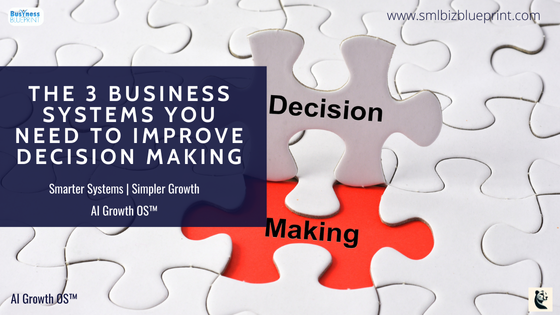

The three systems every business should start 2026 with are a business visibility system, a decision quality system, and an execution system—built in that order to prevent scaling the wrong priorities.
These systems work together to surface problems early, clarify who decides what, and ensure work moves forward without constant leadership involvement.
When designed correctly, they replace guesswork and overwork with clarity, control, and confidence going into the new year.
Because faster execution won’t save you if the decisions are wrong.
You’re doing a lot right—and yet something still feels off.
The team is busy. The numbers aren’t bad. The tools are in place.
But as the year closes, you’re carrying a low-grade tension you can’t quite ignore: the business is moving, but you’re not fully in control of where it’s heading.
Decisions take longer than they should. Small issues keep resurfacing in new forms. You’re involved in more than makes sense—yet when you step back, things wobble.
Planning for 2026 feels heavier than it should, not because you lack ideas, but because you don’t fully trust the system underneath them.
That’s the quiet risk most businesses live with at year-end. Not failure—but drift. Scaling effort, tools, and activity without being sure you’re scaling the right logic.
Here’s the relief most leaders don’t realise is available: you don’t need more systems. You need fewer—designed in the right order, for the right job.
This article breaks down the three essential business systems every company should start 2026 with—not to grow faster, but to regain clarity, tighten decisions, and make execution lighter.
When these systems are in place, planning stops feeling speculative and starts feeling grounded.
This is the shift from managing noise to designing control.
From reacting inside the business to leading it with intent.

The 2026 Systems Checklist — What to Build First (and What to Stop Building)
The real problem isn’t that your business lacks systems—it’s that you’re building them in the wrong order.
Most leaders end the year with a familiar frustration: more tools, more processes, more meetings… and still less clarity than they expected.
The business looks “systemised” on the surface, yet decision-making feels slower, execution heavier, and planning for 2026 oddly fragile.
What that means for your business is simple but uncomfortable: you’re likely scaling structure before certainty.
Most system checklists start with operations—document processes, standardise workflows, add dashboards, automate where possible. It feels responsible. It feels mature.
But this approach quietly fails because processes don’t create alignment—decisions do.
Most people don’t realize that when you systemise without clarity:
You hard-code assumptions you haven’t questioned in years
You lock teams into “efficient” execution of outdated priorities
You increase activity while reducing adaptability
The longer this stays the same, the more effort it takes to correct course—because the system itself starts resisting change.
A business is not a collection of tasks. It’s a decision engine. From that lens, systems exist for one reason only: to reduce uncertainty at scale.
That means there are only three systems that matter—and they must be built in this order:
A Visibility System – so you can see reality early, not after damage is done
A Decision Quality System – so the right choices happen without escalation
An Execution System – so outcomes repeat without constant intervention
Anything else is decoration.
When visibility comes last, you optimise blind.
When decision rules are implicit, alignment collapses under pressure.
When execution is built first, you scale behaviour before intent.
The relief comes when you stop trying to systemise everything and instead design systems to answer three questions, every week:
What’s actually happening?
What decisions does that force?
Who owns acting on them?
This is where complexity drops away. Planning for 2026 stops feeling like guesswork because your systems are finally anchored to reality, not reporting cycles or org charts.
This is the shift most leaders are really craving—even if they don’t name it this way.
You move from:
Managing activity → designing control
Fixing symptoms → shaping decision flow
Being needed everywhere → being effective where it counts
That’s the identity of a leader whose business can grow without demanding more of them each quarter.
Every planning cycle you spend layering systems on top of unclear decisions increases drag you’ll feel all through 2026. The cost isn’t just wasted tools or time—it’s slower reactions, heavier leadership load, and mistakes that compound quietly before they surface.
Pro tip
Before adding or upgrading any system, write down the single decision it’s meant to improve.
Because systems don’t fail due to poor execution—they fail when they’re built to support motion instead of judgment.
Clarity first is how control compounds.
I once automated a weekly dashboard that tracked everything except decisions.
By Thursday, it was full of red alerts—utilisation, response times, backlog—but no one knew what to do with them. The data was accurate, yet every issue still escalated to leadership.
The mistake wasn’t the metrics. It was assuming visibility alone would create movement. I’d automated activity, not judgment.
Once we redesigned the system to flag decision points—where trade-offs were required—meeting time dropped and escalation volume fell within two cycles.
System #1 — The Business Visibility System (So You Stop Leading by Vibes)
The frustration most leaders won’t say out loud: you’re making high-stakes decisions with low-confidence information.
You have reports. Dashboards. Weekly updates.
And still, when you’re asked, “Are we actually on track?” the honest answer is often, “I think so.”
That gap—between data and certainty—is where stress, over-involvement, and second-guessing live.
The relief comes when visibility stops being about reporting and starts being about truth.
Not more numbers. Better ones. Delivered at the moment decisions are still cheap to change.
The identity shift: you move from reacting to signals too late to leading with early awareness.
Most visibility systems are built for explanation, not decision-making.
They’re designed to justify what already happened, not to surface what’s about to break.
Most people don’t realize that:
Monthly reports arrive after the cost is locked in
Dashboards mix lagging outcomes with leading noise
Teams optimise what’s measured—even if it doesn’t matter
What that means for your business is subtle but damaging: you feel informed, but you’re still surprised.
The longer this stays the same, the more your role drifts toward firefighting—because problems don’t announce themselves early anymore.
True visibility answers one question, repeatedly: “What decision does this force?”
If a metric doesn’t change behaviour, it isn’t visibility—it’s decoration.
A strong business visibility system has three defining traits:
It runs weekly, not monthly
Weekly cadence is where decisions are still reversible. Monthly is post-mortem territory.
It prioritises leading indicators over outcomes
Outcomes tell you if you won. Leading indicators tell you whether you’re about to lose.
It is deliberately incomplete
The goal is not to capture everything—it’s to spotlight pressure points.
Think of visibility as a spotlight, not a floodlight. You don’t need to see the whole room. You need to see where the floor is cracking.
Relief shows up when you can answer three questions every week without debate:
Where is momentum building—or stalling?
What assumption no longer looks safe?
What must change this week to avoid downstream cost?
This is why high-functioning businesses often track surprisingly few numbers:
1–2 demand signals (pipeline quality, lead velocity, utilisation pressure)
1 constraint metric (capacity, cycle time, decision latency)
1 economic anchor (cash, margin, or contribution)
Anything beyond that is context, not control.
When visibility is right-sized, meetings get shorter. Decisions speed up. And leadership presence becomes lighter—not heavier.
This system marks a quiet but important identity shift.
You stop being the leader who:
Waits for confirmation
Digs through reports
Gets involved because something “feels off”
And become the one who:
Sees drift early
Names the real issue
Acts before cost compounds
That’s not intuition. That’s engineered clarity.
Every week you rely on lagging visibility, you pay for problems at their most expensive point—when options are limited and pressure is high.
The cost isn’t just financial; it’s the erosion of confidence that comes from always reacting late.
Pro tip
Strip your current dashboard down to five metrics and ask, “Which one would force a decision if it moved unexpectedly?”
Because visibility isn’t about knowing more—it’s about knowing sooner. The earlier you see pressure, the more power you have to shape outcomes instead of absorbing consequences.
Want more insights like this?
Join our newsletter for exclusive tips, strategies, and updates straight to your inbox!
System #2 — The Execution System (So Work Happens Without You)
The frustration is familiar: the business can’t seem to move unless you’re involved.
Decisions stack up. Work slows at handoffs. Small issues escalate unnecessarily.
You’ve hired capable people—but execution still leans on you far more than it should.
The relief doesn’t come from more documentation or tighter control.
It comes from designing execution so the business absorbs variability without pulling you back in.
The identity shift: you stop being the glue holding everything together and become the architect of flow.
Most execution systems fail because they try to remove judgment instead of containing it.
They aim for predictability by documenting everything—every step, every exception, every rule.
Most people don’t realize that:
Over-documented processes become brittle the moment reality shifts
Teams follow steps instead of outcomes
When edge cases appear, everything escalates upward
What that means for your business is paradoxical: the more “systemised” it looks, the more dependent it becomes on you to resolve ambiguity.
The longer this stays the same, the more execution drag you feel—because every exception becomes a leadership problem.
Execution breaks down at constraints, not at tasks.
If work slows, stalls, or rework piles up, it’s rarely because people don’t know what to do.
It’s because the system doesn’t define:
What “done right” actually means
Where judgment is allowed
When escalation is required
A strong execution system does three things well:
Defines outcomes, not instructions
Identifies failure signals early
Specifies who decides when reality deviates
This is why systemising everything is a trap. The leverage is always at the bottleneck—the point where small errors cascade into delays, cost, or customer pain.
Relief shows up when execution becomes lighter, not tighter.
Instead of controlling every move, you design guardrails that keep work moving without constant oversight.
A Minimum Viable SOP answers just three questions:
What outcome are we aiming for?
How do we know it’s failing?
When does a human intervene?
That’s it.
When teams understand outcomes and escalation rules, they stop waiting for permission. Work flows forward.
And exceptions no longer pile up silently.
This is where leadership pressure changes shape.
You move from:
Being pulled into execution
Solving the same problems repeatedly
Feeling responsible for momentum
To:
Designing flow once
Letting teams handle variation
Trusting the system under stress
That’s the difference between running the business inside the work and leading it above the work.
Every quarter execution depends on you, your capacity becomes the business’s hidden ceiling.
The cost isn’t just slower growth—it’s missed opportunities that never even surface because the system can’t absorb more load.
Pro tip
Identify the one step in your operation where delays or rework show up most often, and systemise only that.
Because execution doesn’t fail everywhere—it fails at pressure points. Fixing the constraint compounds impact, while over-systemising everything else just adds weight.
Picture a services firm growing fast enough that every project review felt urgent.
Decisions piled up in Slack threads, priorities shifted mid-week, and senior leaders stayed involved “just to keep things moving.” Momentum existed—but it was fragile.
The shift came when they realised execution wasn’t the problem. Decision ownership was. Too many choices had no clear owner or deadline.
By introducing a simple decision ladder—who decides, with what inputs, by when—cycle time shortened and leaders stepped out of day-to-day calls within a month.
System #3 — The Decision Quality System (The One Almost No One Builds)
The quiet frustration: decisions slow down as the business grows—even though you hired smart people to speed things up.
Questions bounce upward. Meetings multiply. Alignment sounds good in theory but collapses under pressure.
You’re still the final stop for choices you shouldn’t be making anymore.
The relief doesn’t come from more alignment—it comes from clearer decision rules.
And the identity shift is subtle but powerful: you stop being the arbiter of everything and become the designer of how decisions happen.
Most businesses don’t struggle with execution—they struggle with ambiguous decision ownership.
As complexity increases, decisions quietly default upward because no one is sure who owns the call when trade-offs appear.
Most people don’t realize that:
“Alignment” meetings discuss outcomes, not decision rights
Consensus feels safe but slows action
Smart teams hesitate when the cost of being wrong isn’t defined
What that means for your business is compounding drag: decisions take longer, confidence erodes, and speed becomes personality-dependent instead of system-supported.
The longer this stays the same, the more your business trains people to wait instead of decide.
Good decisions at scale don’t come from better people—they come from better structure.
Decision quality improves when three things are explicit:
Who decides
With what inputs
By when
Without this, every decision becomes a mini-negotiation. Energy shifts from progress to politics.
A Decision Quality System does not remove judgment. It locates it.
This is where most businesses go wrong with AI and automation: they automate execution before clarifying decision logic, amplifying confusion faster than before.
Relief shows up when decisions stop being personal and start being procedural.
A simple decision ladder defines:
Decision type (strategic, operational, reversible)
Single owner (not a committee)
Required data (not “all the context”)
Review trigger (when to revisit, not re-argue)
Paired with lightweight feedback loops—Did the signal arrive on time? Was the assumption right?—decisions become learning assets, not blame events.
Speed increases. Confidence returns. And escalation becomes the exception, not the rule.
This system completes the leadership transition most founders stall in.
You move from:
Being the final decision-maker
Carrying invisible cognitive load
Holding context others never get
To:
Designing decision flow
Trusting the system under pressure
Seeing weak signals before they become losses
That’s not delegation. That’s leverage.
Every unclear decision right delays execution and trains hesitation into the organisation.
The cost isn’t just time—it’s missed opportunities that never get acted on because no one is sure they’re allowed to move.
Pro tip
List the last ten decisions that escalated to you and identify which ones shouldn’t have.
Because decision quality isn’t about being right—it’s about being clear. When decisions have owners and rules, speed becomes structural, not heroic.
The Overlooked Truth — Your Systems Need Strategic Friction, Not Just Speed
The frustration most leaders feel but rarely name: everything is moving faster, yet the business feels more fragile.
Decisions are made quickly. Work ships faster. Automation is everywhere.
And still, mistakes feel more expensive than they used to—because when things go wrong now, they go wrong at scale.
The relief comes from a counterintuitive shift: not removing friction, but placing it deliberately.
And the identity shift is decisive—you stop chasing speed for its own sake and start designing resilience into how the business thinks.
Most systems are designed to eliminate friction everywhere. That’s the mistake.
Speed feels like progress, especially after years of inefficiency. But when friction disappears at the wrong points, weak assumptions slip through unnoticed.
Most people don’t realize that:
Faster execution amplifies flawed decisions
Automation hides uncertainty instead of surfacing it
Teams optimise throughput even when direction is wrong
What that means for your business is uncomfortable: you don’t just move faster—you lock in errors faster.
The longer this stays the same, the more your systems reward motion over judgment—and that’s how “successful” businesses drift into expensive reversals.
High-performing systems are not frictionless; they are selectively resistant.
They move quickly where outcomes are reversible and slow down where mistakes compound.
Strategic friction belongs in three places:
Before irreversible decisions (pricing, hiring, major commitments)
When signals diverge (leading indicators vs outcomes)
Where incentives conflict (speed vs quality, growth vs margin)
This is why blanket automation fails. It removes the pauses where thinking should occur.
The goal isn’t to slow the business—it’s to slow the right moments so everything else can move with confidence.
Relief appears when friction becomes a safeguard, not a bottleneck.
Instead of more approvals, you introduce:
Pre-mortems before big bets
Thresholds that trigger review, not panic
Simple challenge mechanisms that test assumptions early
These moments don’t kill speed. They prevent rework, reversals, and reputational damage later.
When friction is intentional, teams trust the system more—and paradoxically, they move faster because they’re not second-guessing.
This is a leadership evolution few make consciously.
You move from:
Celebrating velocity
Reacting to consequences
Fixing problems after they scale
To:
Designing decision checkpoints
Catching errors while they’re still cheap
Building a business that can move fast and stay upright
That’s not caution. That’s maturity.
Every automated decision without a friction point increases the cost of being wrong in 2026.
The loss isn’t always visible—it shows up as churn, margin erosion, or strategic backtracking that could have been avoided with one deliberate pause.
Pro tip
Identify one recurring decision that never gets challenged—and add a simple “pause question” before it executes.
Because speed isn’t the edge—direction is. Strategic friction is how you protect direction while the rest of the system accelerates.

How to Set These Systems Up Fast (Without Disrupting Operations)
The frustration is real: you know the systems matter—but you don’t have the time, appetite, or margin for a long transformation project.
The business is running. People are stretched.
Any change that feels heavy risks slowing momentum or creating resistance.
The relief is this: speed doesn’t come from doing more at once—it comes from doing things in the right sequence.
And the identity shift is decisive: you stop “rolling out systems” and start installing leverage.
Most “fast” system implementations fail because they try to change behaviour before changing clarity.
New tools are introduced. New dashboards appear. New processes are announced. And underneath it all, the same confusion persists.
Most people don’t realize that:
Systems fail when they ask teams to adapt without context
Automation amplifies whatever logic already exists—good or bad
Speed without sequence creates churn, not progress
What that means for your business is wasted effort: time spent configuring systems that never quite stick, while trust in “another initiative” quietly erodes.
The longer this stays the same, the harder future changes become—because the organisation learns to wait it out.
The fastest way to build durable systems is to follow how the business actually works.
That means installing systems in the same order decisions are made.
A practical 30-day sequence looks like this:
Week 1: Lock weekly visibility
Establish a small set of metrics reviewed every week that force conversation and decisions. No tooling overhaul—just consistency and relevance.
Week 2: Define decision rules
Clarify which decisions matter most, who owns them, and what inputs are required. This immediately reduces noise and escalation.
Week 3: Systemise the primary bottleneck
Identify where work slows or escalates most often and design a Minimum Viable SOP around outcomes and escalation—not steps.
Week 4: Introduce automation selectively
Only now do tools and AI add value—because they’re reinforcing clarity, not compensating for its absence.
This sequence feels slower on paper. In practice, it’s dramatically faster because resistance drops and adoption rises.
Relief shows up when the business feels lighter within weeks—not months.
Meetings shorten. Fewer things escalate. People move with more confidence because expectations are clearer.
Instead of “system fatigue,” you get visible wins:
Fewer re-decisions
Faster follow-through
Less leadership drag
This is what fast actually looks like: not speed of rollout, but speed of benefit.
This approach changes how leadership shows up.
You move from:
Pushing adoption
Managing resistance
Explaining the “why” repeatedly
To:
Designing conditions
Letting behaviour follow clarity
Trusting the system to do the work
That’s not implementation. That’s stewardship.
Every month you delay system clarity, you pay compounding interest in rework, escalation, and decision fatigue.
The cost isn’t visible on a P&L—but it shows up as slower execution and heavier leadership load throughout 2026.
Pro tip
Before introducing any new tool or automation, ask, “What decision will this make easier or faster?”
Because tools don’t create leverage—decisions do. When systems reinforce clear decision flow, speed becomes a byproduct, not a goal.
Year-End Questions That Lock the 2026 Roadmap
The frustration at year-end isn’t a lack of plans—it’s the uneasy sense that you’re reviewing activity, not direction.
You look back at what shipped, what grew, what broke. The numbers are there. The summaries are neat.
And still, something important feels unresolved.
The relief comes when reflection stops being descriptive and starts being corrective.
And the identity shift is subtle but defining: you move from reviewing the past to rewiring the future.
Most year-end reviews fail because they reward memory, not learning.
They catalogue events instead of interrogating decisions. They explain outcomes without challenging the logic that produced them.
Most people don’t realize that:
Looking back without changing rules guarantees repetition
“What happened” is less useful than “why we chose it”
Success often hides fragile assumptions
What that means for your business is quiet risk: you carry the same decision patterns into a new year, just with higher stakes.
The longer this stays the same, the more each year feels busy—but strategically familiar.
The quality of your 2026 roadmap is directly tied to the questions you ask at the end of 2025.
Not more questions. Sharper ones.
High-leverage year-end questions do three things:
They expose decision patterns, not events
They surface weak signals, not surprises
They force trade-offs into the open
Examples that matter:
Which decisions created the most downstream cost?
Where did speed override clarity?
What signals arrived too late to act on?
Which assumptions quietly expired this year?
These questions don’t feel comfortable—but they create alignment faster than any planning deck.
Relief shows up when answers point directly to system changes—not just insights.
You stop debating priorities and start adjusting rules, thresholds, and ownership.
This is where roadmaps stop being aspirational and become operational:
Visibility gaps become metrics
Decision failures become rules
Execution pain becomes constraints to fix
When reflection leads to system design, next year doesn’t rely on better discipline—it relies on better structure.
This final shift completes the arc of the article—and the year.
You move from:
Reviewing outcomes
Explaining results
Hoping next year “runs smoother”
To:
Redesigning decision flow
Installing guardrails
Entering the new year with confidence, not caution
That’s not optimism. That’s earned readiness.
Every year you review outcomes without changing systems, you lock in invisible costs—repeated mistakes, delayed decisions, and leadership fatigue that compounds quietly into 2026.
Pro tip
After your year-end review, write down the three decisions you would make differently with hindsight.
Because insight only matters if it changes behaviour. Turning hindsight into system changes is how leaders stop reliving the same year with a new calendar.
Most leadership teams believe speed comes from removing friction.
So they automate faster, approve quicker, and compress timelines—until mistakes start compounding and reversals become expensive.
The uncomfortable truth is that friction isn’t the enemy. Misplaced friction is. Removing pauses at the wrong moments scales errors, not progress.
Teams that slow down before irreversible decisions spend less time correcting them later—because clarity costs less than rework.
Conclusion
The frustration you’re feeling right now isn’t a lack of effort—it’s the weight of carrying a business that depends on you too much.
Too many decisions funnel upward. Too many issues surface late.
Too much of your time is spent compensating for systems that look functional but don’t actually protect you from drift.
You could keep going this way. Many do. They add another tool, tighten another process, hope the next planning cycle brings clarity.
And slowly, year after year, the business becomes harder to steer—not because it’s failing, but because it’s scaling uncertainty alongside success.
The relief is real when you see the problem clearly.
You don’t need more systems. You need the right ones, built in the right order.
Visibility that tells the truth early.
Decision rules that prevent hesitation and escalation.
Execution that flows without pulling you back into the weeds.
Strategic friction that protects direction instead of killing speed.
When these are in place, planning for the future stops feeling speculative. The business becomes lighter to run.
And control stops being something you chase—it becomes something the system enforces.
This is the identity shift that changes everything.
From operator to architect.
From reactive to deliberate.
From carrying the business to designing how it carries itself.
Here’s the real choice in front of you:
You can stay in a system that depends on your constant involvement—and accept the quiet cost of delayed decisions, repeated mistakes, and growing fatigue.
Or you can decide that your current state is optional—and take the next step toward a business that sees clearly, decides well, and moves without friction.
Control isn’t a personality trait. It’s designed.
The question is whether you keep living inside the problem—or start building the system that solves it.
Don’t miss a beat in your business growth journey!
Join Pulse and stay ahead with expert tips and actionable advice every month.
Subscribe to Pulse Today
Action Steps
Strip your business back to the decisions that matter most
Start by listing the 10–15 decisions that most affect results (pricing, hiring, capacity, priorities, customer selection).
If a decision keeps escalating, repeating, or stalling, it’s a system problem—not a people problem.
👉 If you can’t name the decisions, you can’t design the system.
Design a weekly visibility view—not a dashboard
Choose 3–5 metrics you will review every week, without exception.
They should answer: Are we building pressure, losing momentum, or drifting off course?
Remove anything that explains the past but doesn’t force a decision.
👉 Visibility exists to change behaviour, not to look impressive.
Identify the single execution bottleneck worth fixing first
Find the one place where work slows, escalates, or gets reworked most.
Document only that step—define the outcome, failure signal, and escalation rule.
Ignore everything else for now.
👉 Fixing the constraint creates more leverage than systemising the whole business.
Make decision ownership explicit (and uncomfortable)
For your most common decisions, define:
Who decides
What inputs are required
When the decision must be made
If ownership feels awkward, that’s the point—you’re exposing hidden friction.
👉 Speed doesn’t come from alignment; it comes from clarity.
Add strategic friction where mistakes are expensive
Introduce a pause before irreversible decisions (big hires, pricing changes, major investments).
Use one simple question: “What would have to be true for this to fail?”
This slows the right moments so everything else can move faster.
👉 Friction is protection when placed deliberately.
End your year-end review by changing one rule, not setting more goals
Ask: Which decision or assumption caused the most downstream cost this year?
Then change the system that allowed it—not the behaviour you hope improves.
👉 If nothing changes structurally, next year will feel familiar—just heavier.
You don’t need to rebuild your business to regain control.
You need to see earlier, decide clearer, and design execution that doesn’t depend on you.
The work isn’t more effort.
It’s better structure.
FAQs
Q1: What are the most important business systems to have in place for 2026?
A1: The most important systems are not tools or processes—they are control systems.
Specifically:
A business visibility system to surface problems early
A decision quality system to prevent hesitation and escalation
An execution system that allows work to move without constant leadership involvement
Together, these systems ensure you scale clarity and judgment, not just activity.
Q2: Why do traditional business systems fail as companies grow?
A2: Traditional systems fail because they prioritise efficiency before certainty.
They automate processes without questioning assumptions, which causes businesses to:
Execute outdated priorities faster
Hide weak signals behind reports
Increase dependency on leadership instead of reducing it
Growth exposes these flaws by amplifying them.
Q3: How do I know if my business has a visibility problem?
A3: You likely have a visibility problem if:
Decisions feel reactive instead of deliberate
Problems surprise you late
Metrics explain the past but don’t change behaviour
True visibility forces decisions early, when they’re still cheap to change.
Q4: What’s the difference between execution systems and decision systems?
A4: Execution systems define how work gets done.
Decision systems define who decides what, with which information, and by when.
Most businesses over-invest in execution and under-invest in decision quality—creating speed without direction. Decision systems prevent that drift.
Q5: Can AI replace business systems or decision-making?
A5: No. AI can support systems, but it cannot replace them.
AI amplifies existing logic—good or bad. Without clear decision rules and visibility:
AI accelerates confusion
Automation locks in flawed assumptions
AI works best after clarity is designed into the system.
Q6: How quickly can these systems be implemented without disrupting operations?
A6: When sequenced correctly, core systems can be installed in 30 days or less:
Week 1: Lock weekly visibility
Week 2: Define decision ownership
Week 3: Fix the primary execution bottleneck
Week 4: Introduce selective automation
Speed comes from sequence, not intensity.
Q7: What’s the biggest risk of not fixing systems before 2026?
A7: The biggest risk is silent drift.
If systems don’t change, the business will:
Repeat the same mistakes at higher cost
Depend more on leadership time
Feel busier without feeling better
Inaction doesn’t keep things stable—it compounds friction.
Bonus: Three Uncomfortable Ideas That Quietly Change How You Lead
Most leaders think about systems as infrastructure—something you install once the business is “big enough,” or something you clean up after growth creates mess.
The assumption is simple: better systems make the business more efficient.
What’s usually missed is this: systems don’t just organise work—they shape how leaders think, decide, and show up. They influence what gets noticed, what gets delayed, and what quietly becomes acceptable.
Over time, they define the ceiling of clarity a business can operate under.
This bonus section isn’t about fixing a problem you’re already aware of.
It’s about noticing the invisible forces at play—and expanding how you think about systems before they harden into habit.
Decision Latency Is the Bottleneck You’re Not Measuring
Most businesses track performance, activity, and outcomes—but almost none track how long decisions sit unresolved.
Decision latency—the gap between when a decision becomes necessary and when it’s actually made—quietly taxes every system. While teams wait, work slows, context decays, and momentum dissipates. What looks like an execution issue is often hesitation embedded in the structure.
Long decision cycles don’t always signal caution. They usually signal unclear ownership, weak inputs, or fear of consequence. And because no one measures it, the cost remains invisible.
Imagine a business where decisions move at a deliberate, predictable pace—not rushed, not stalled. Where clarity replaces escalation, and momentum doesn’t depend on personalities. Measuring decision latency isn’t about pressure. It’s about designing flow.
Every Roadmap Needs a Kill List
Most strategy documents are additive. They list priorities, initiatives, and goals—but rarely name what must stop.
Strategic drift often comes from survivorship, not ambition. Old assumptions, processes, and metrics linger long past their usefulness, quietly consuming attention and energy.
Systems calcify not because leaders add too much—but because they remove too little.
A roadmap without subtraction isn’t strategy. It’s accumulation.
A mature system doesn’t just support growth—it enables release. When leaders explicitly retire outdated rules and rituals, space opens for better decisions to take root.
Progress feels lighter because the system isn’t carrying unnecessary weight forward.
The Best Systems Protect Energy, Not Just Efficiency
Efficiency is measurable. Energy is not—yet energy depletion predicts failure earlier than almost any metric.
Leaders rarely burn out from volume alone. They burn out from cognitive residue: unresolved decisions, constant context-switching, unclear ownership, and systems that demand attention instead of providing relief.
A system that saves time but increases mental load isn’t helping—it’s extracting quietly.
The most powerful systems make the business feel lighter to run. They reduce noise, narrow focus, and preserve leadership energy for judgment—not recovery.
Over time, this becomes a competitive advantage that no tool can replicate.
These ideas don’t ask you to rebuild your systems. They invite you to see them differently.
Because once you notice what your systems are really shaping—how decisions move, what lingers, where energy drains—you stop treating structure as a technical problem.
You start treating it as leadership design.
Other Articles
Strategic Alignment in Action: The 5-Step System to Plan 2026 With Confidence
How to Leave Inefficiency Behind: The Simple System to Start 2026 Fresh
The 2026 AI-Driven Planning Framework to Build a Business That Runs Itself