

How to Prove Marketing Claims When AI Can Make Any Claim
AI has made sophisticated marketing claims easier to produce, but that does not make them easier to believe. Discover how to prove marketing claims with evidence drawn from real customer outcomes, operating experience and business capability—and why the businesses that can prove what they say will become harder to imitate.
How to Build Brand Authority When AI Can Create Content
AI is making professional content easier to create—but that changes what businesses need to build brand authority with content. Discover why experience, judgment, evidence and proof are becoming more valuable as AI makes expert-looking outputs easier for competitors to reproduce.
When AI Has the Answers, What Should Your Content Do?
AI hasn’t changed the fundamentals of trust, but it is changing what business content needs to accomplish. When customers can get generic answers directly from AI, learn how to build trust with content by moving beyond information towards the experience, judgment and proof that make your business worth believing.
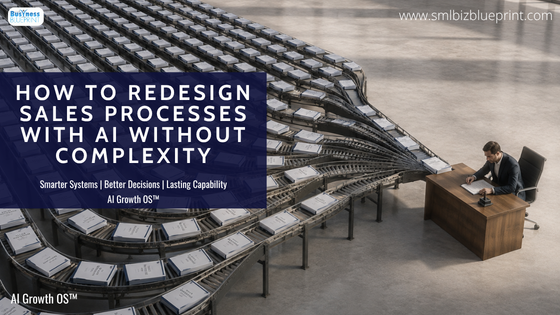
How to Redesign Sales Processes With AI Without Complexity
AI can make sales research, qualification and follow-up dramatically faster—but adding more capacity to an unchanged sales process can create complexity instead of growth. Learn how to redesign sales processes with AI by focusing on the decisions, boundaries and feedback loops that actually move opportunities forward.

How to Redesign Sales and Marketing Workflows With AI
AI can make sales and marketing work dramatically faster without making the business itself faster. Discover why effective AI workflow redesign for sales and marketing means rethinking how customer intelligence, decisions and work move through the growth system—not simply automating more tasks.
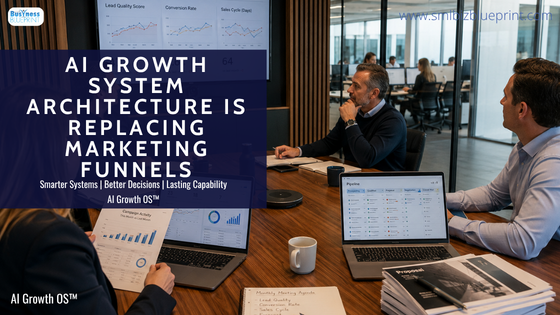
AI Growth System Architecture Is Replacing Marketing Funnels
AI is making marketing and sales faster, but faster activity alone does not create a stronger Growth System. Discover why AI Growth System Architecture connects Marketing, Sales, Operations and decision-making so every market interaction can strengthen future growth.
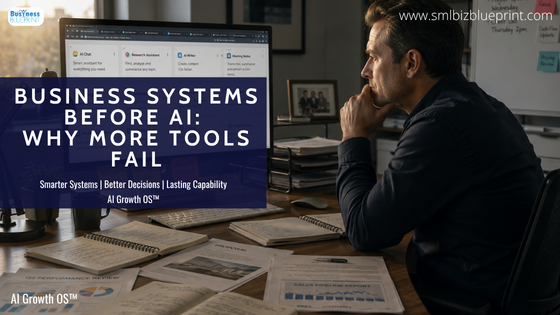
Business Systems Before AI: Why More Tools Fail
Buying more AI tools won’t fix a business built on inconsistent decisions. Discover why business systems before AI is the real competitive advantage—and how stronger decision architecture turns AI from another expense into a force multiplier for sustainable growth.
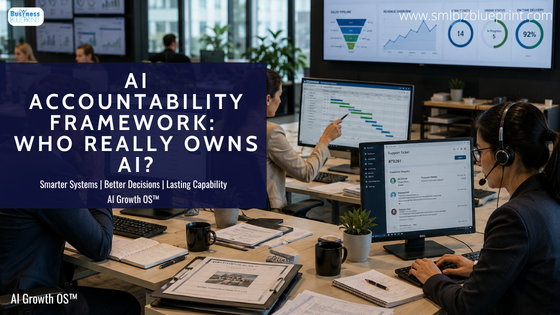
AI Accountability Framework: Who Really Owns AI?
An AI accountability framework isn’t about owning the technology—it’s about owning the decisions AI influences. Discover how clear accountability, governance, and organisational learning transform AI from disconnected productivity gains into a strategic business capability that scales with consistency.