

Turn business claims, customer results and operating evidence into proof buyers can evaluate.
To prove business credibility, connect every important claim you make to evidence a buyer can independently evaluate.
Testimonials can provide reassurance, but stronger proof comes from customer outcomes, operating records, documented decisions and measurable performance that reveal the capability behind the claim.
The goal is not to give customers more reasons to believe you—it is to make your business easier to verify.
Your business probably has more credibility signals than it did five years ago.
More customer reviews. More testimonials. More content. Better case studies. A stronger website. Perhaps industry awards, certifications and years of experience displayed prominently.
Yet a prospective customer can still reach the end of your website and think: But how do I know you can actually do what you say?
That is the credibility problem many established businesses are living with.
The default response is to add another layer of persuasion.
Strengthen the copy. Publish another testimonial. Explain the methodology. Add more logos. Produce more content demonstrating expertise.
It feels sensible because we have treated credibility as a belief problem: customers are uncertain; therefore, give them more reasons to believe.
But perhaps customers don’t need more reasons to believe you.
They need better ways to evaluate you.
Consider the claims appearing on almost every established business website: responsive, experienced, reliable, customer-focused, consistent, results-driven.
They may be completely true. The problem is that competitors can make exactly the same claims—and increasingly produce equally sophisticated material supporting them.
The cost isn’t simply weaker marketing.
It shows up as longer sales conversations. Buyers asking questions your website supposedly answered. Proposals carrying too much explanatory weight. Price becoming disproportionately important because customers struggle to distinguish capability.
There is a different way to think about proving business credibility.
Start with the claim. Find what happens inside the business that makes it true. Capture the evidence. Then turn that evidence into proof a prospective customer can evaluate.
That moves credibility away from persuasion alone and towards verifiability.
For an established business, that should be encouraging.
You may not need to become more convincing.
You may need to make more of what is already true visible.

Your Customers Have More Reasons to Believe You Than Ever
Businesses have spent years building credibility signals, yet each additional signal is worth less.
A prospect can visit your website, read ten articles, examine customer reviews, browse employee profiles, inspect your LinkedIn presence and read several case studies before speaking to you.
So can they with five competitors.
Credibility used to benefit from scarcity.
A polished website meant something when many competitors had poor ones. Publishing useful articles distinguished a business when few companies published anything. Professional video and sophisticated presentations implied investment and capability.
Those signals haven’t become worthless.
They have become easier to reproduce.
Capability hasn’t become abundant. The appearance of capability has.
That distinction matters because buyers have historically used visible signals—professionalism, content, confidence, presentation—as shortcuts for judging what might exist underneath.
As the cost of producing those signals falls, their ability to distinguish one business from another weakens.
And that changes the buyer’s problem.
Imagine three companies competing for the same $150,000 contract. Each has a professional website. Each claims twenty years of experience. Each describes itself as responsive. Each has positive testimonials. Each publishes knowledgeable content.
The buyer isn’t suffering from a shortage of reasons to believe.
They are facing an excess of apparently credible choices.
You can see this yourself. Open your website beside three competitors and temporarily ignore the logos, colours and names. Read the claims alone. “Experienced.” “Customer-focused.” “Quality.” “Tailored.” “Reliable.”
In many industries, entire paragraphs could move between websites without looking obviously out of place.
That is the problem in plain sight.
That is why sales teams keep re-explaining what marketing has already covered. The information exists. What the customer still lacks is the confidence to distinguish asserted capability from demonstrated capability.
For an established business, that should change the question you ask about authority.
Not: How can we produce more credibility signals?
Ask: What can a buyer learn about us that would be difficult for a less capable competitor to demonstrate?
That question leads somewhere different: accumulated experience, specific decisions, operating records, measured outcomes, known limitations and patterns learned across real customer work.
Things a buyer can inspect.
When the appearance of expertise becomes cheap, evidence of expertise becomes more valuable.
Pro tip
Audit your strongest credibility assets for replicability.
If a capable marketer could create something similar without possessing your operating experience, treat it as a signal—not yet as proof.
The mistake was thinking more proof meant more testimonials.
So another customer quote went onto the website, another logo into the proposal, another success story into the sales deck—and prospects kept asking essentially the same questions.
The shift came when we stopped counting credibility assets and started asking what those assets actually allowed a sceptical buyer to verify.
That is when credibility stopped being something we added to the marketing and became something we looked for inside the business.
Credibility Breaks Down When Claims Become Easy to Make
The problem with many business claims isn’t that they’re false. It’s that making them costs almost nothing.
“We deliver exceptional quality.”
“We’re responsive.”
“We have an experienced team.”
“We provide tailored solutions.”
An unreliable business can call itself reliable. An inexperienced company can describe itself as expert. A slow organisation can promise responsiveness.
That creates a peculiar asymmetry:
Making the claim is cheap. Discovering whether it is true is expensive.
The buyer pays that cost.
They investigate. Ask questions. Request references. Compare proposals. Hold additional meetings. Search for reviews. Involve colleagues. Negotiate protections.
What looks like customer indecision may actually be rational risk reduction.
And that verification burden has a commercial consequence.
When buyers cannot confidently distinguish capability, they need other ways to decide. Price, familiarity, personal chemistry, references and contractual protection can begin carrying more weight than they should.
Weak evidence doesn’t just weaken your marketing. It changes how customers compare you.
That creates an uncomfortable possibility: a better business can lose to a better-presented business because the buyer has no reliable way to see the difference.
The buyer isn’t making an irrational decision. They are making the best decision available from the evidence they can access.
That should bother established businesses with genuinely strong capability.
Businesses often make the situation worse.
They respond to uncertainty with stronger adjectives.
Stop doing that.
If a buyer doesn’t have enough evidence that your business is responsive, changing “responsive service” to “unrivalled responsiveness” hasn’t reduced uncertainty.
You have increased the size of the claim while leaving the evidence unchanged.
This is why deals can feel close but stall. The buyer may understand the offer perfectly well.
What remains unresolved is whether the expected outcome is sufficiently believable to justify the decision.
Established businesses face an identity shift here.
A confident business doesn’t need to insist that it is good. It can show customers what good looks like inside the business.
That is a higher standard for marketing because marketing can no longer operate only at the level of messaging. It needs access to the capability beneath the message.
If competitors can copy your positioning language faster than they can copy the capability beneath it, capability is where defensible authority begins.
But invisible capability has little commercial advantage.
Buyers have to be able to see the difference.

The Difference Between Claims, Evidence and Proof
A claim, evidence and proof perform different jobs.
A claim tells customers what you want them to believe.
We respond quickly to customer issues.
Evidence is what exists because the business actually behaves that way.
Perhaps your records show that 91% of priority enquiries receive a response within 45 minutes.
Proof is that evidence presented with enough context for someone outside the business to evaluate the original claim.
That might mean showing response-time performance across 1,240 priority enquiries over twelve months, alongside a clear definition of “priority” and how response time was measured.
The progression is:
Claim → Evidence → Proof
But publishing evidence doesn’t automatically turn it into proof.
“We helped a client increase sales by 40%” sounds impressive.
But compared with what? Over what period? What changed? What else happened? What did your business contribute?
Without context, a result can remain another claim wearing a number.
This is where conventional social proof often stops too early.
A testimonial saying, “They were fantastic to work with and really understood our business” provides reassurance. It tells us another person had a positive experience.
It reveals considerably less about why the supplier was effective or whether the underlying capability matters to the next buyer.
The deeper principle is traceability.
Can the customer move backwards from the proof to the evidence and from the evidence to the capability that produced it?
A project outcome might trace to a particular decision process. Reliability might trace to operating standards. Expertise might trace to patterns recognised across hundreds of engagements.
That traceability makes credibility harder to manufacture.
Once you understand the distinction, you stop asking marketing to create credibility from finished customer quotes. You start looking upstream at where credibility originates.
Pro tip
For every proof asset, ask: What underlying business behaviour produced this?
Strong proof reveals capability, not merely satisfaction.
What Evidence Do B2B Buyers Actually Need?
Buyers don’t need maximum evidence. They need evidence against the uncertainty stopping the decision.
Most businesses organise proof around what is easiest to collect.
A customer says something complimentary, so it becomes a testimonial. A recognisable company becomes a logo. A successful project becomes a case study.
The better question is: What uncertainty does this evidence remove?
Imagine a manufacturer selecting a technology partner. The supplier presents fifteen glowing testimonials, but the buyer’s real concern is whether implementation can happen without disrupting production.
The testimonials may be genuine.
They still don’t answer the question.
Evidence becomes valuable when it corresponds to risk.
If the concern is capability, show comparable problems solved and the decisions that mattered.
If it is implementation, show the process, dependencies and what happens when conditions change.
If it is reliability, show consistency across outcomes rather than one spectacular result.
If it is commercial impact, establish the baseline and show what measurably changed.
And if it is fit, show where the solution works—and where it doesn’t.
This matters commercially because unresolved uncertainty doesn’t disappear simply because the buyer likes your business. It moves further into the sales process.
Another meeting is requested. Another person becomes involved. A reference is needed. The proposal carries more explanatory weight. Price becomes easier to compare than capability.
Proof should reduce the amount of credibility-building that sales has to perform manually.
That last category—fit—is frequently overlooked.
Businesses assume credibility requires eliminating doubt, so they avoid discussing limitations. But clearly defined boundaries can provide unusually strong evidence of expertise.
“This approach works best under these conditions; outside them, we recommend something different” reveals something important.
Judgment.
Knowing when not to recommend something is evidence too.
The business owner who understands this stops trying to appear suitable for everyone and starts helping the right customer make a better decision.
Irrelevant proof creates volume without reducing risk. A customer can see plenty of evidence and remain unable to decide.
Pro tip
Build proof backwards from buyer uncertainty.
Identify the questions a serious prospect must resolve before saying yes, then determine what evidence would actually resolve each one.
Match Every Important Business Claim to Evidence
Every significant business claim creates an evidence obligation.
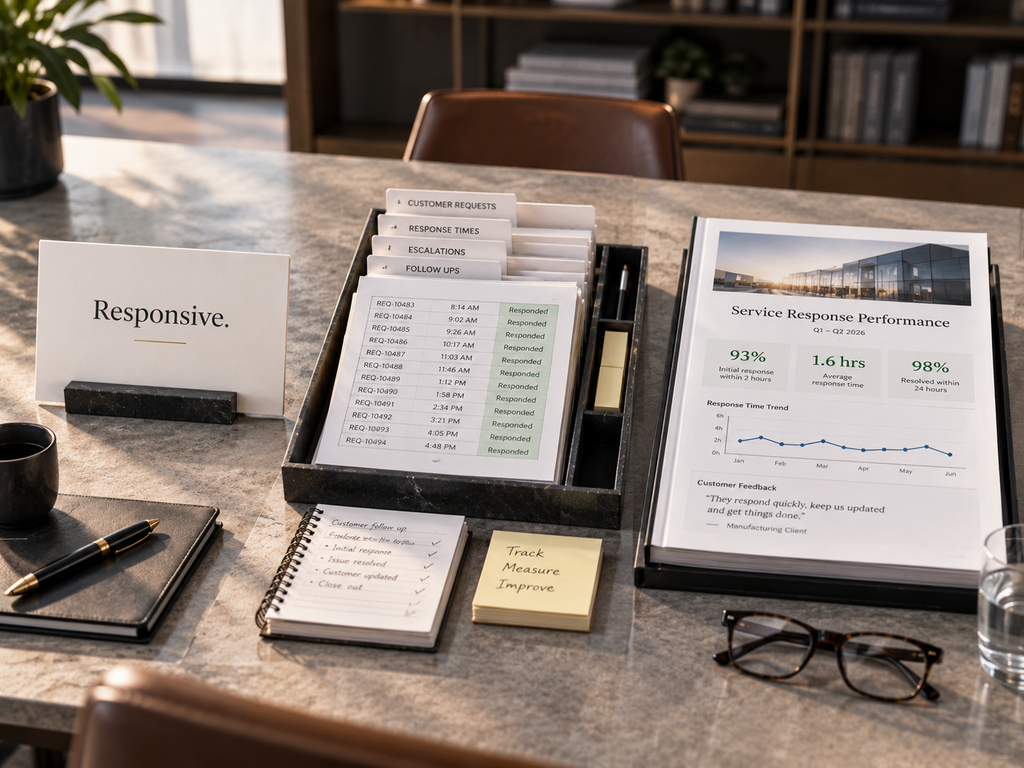
If you promise responsiveness, define what responsiveness looks like operationally.
If you promise consistency, know how consistent performance actually is.
If you sell expertise, expose the judgment behind it.
Responsive might connect to response times, decision authority and resolution times.
Reliable might connect to on-time delivery, error rates or commitments met.
Consistent might connect to variation across projects, locations or customer cohorts.
Expert might connect to decisions made, patterns recognised and unusual problems solved.
Results-driven might connect to baselines, measurable changes and repeated outcomes.
Now compare that with the normal process.
Marketing writes: “We pride ourselves on exceptional customer service.”
Then someone searches for a testimonial containing the word “service.”
The sequence is backwards.
Start inside the operation. Find what is actually happening. Decide which claims those behaviours justify. Then communicate them.
This does more than improve marketing.
It exposes claims the business hasn’t earned.
Suppose you promise fast turnaround but discover approval bottlenecks make delivery times unpredictable. That isn’t primarily a copywriting problem.
Changing the website won’t fix it.
Changing the business might.
And sometimes the discovery is more uncomfortable than missing evidence.
An evidence audit can reveal a management belief that isn’t consistently true.
Leadership may believe the business is highly responsive because important issues reach them quickly, while routine customer requests regularly wait.
The company may believe delivery is consistent because management hears about major successes and serious failures, but has little visibility into the variation between them.
The claim may not have been dishonest.
The business simply never tested its own belief.
That is why evidence matters internally as much as externally. It forces positioning to meet operating reality.
Your brand promise can become an operating standard, not merely an external message.
If you say it, can the business demonstrate it?
Sometimes the answer will expose a content opportunity.
Sometimes it will expose work the business needs to do.
Pro tip
Create a claim ledger: Claim | What makes it true? | Evidence available | Evidence missing.
Don’t assume every gap belongs to marketing. The important ones may be telling management something about the business.
Imagine an established services business that describes itself as responsive but has never defined what responsive actually means.
Its owner maps the claim to enquiry times, escalation decisions and issue resolution, only to discover the business performs far better than its marketing can demonstrate.
Once those records are captured consistently, sales no longer has to keep insisting the company is responsive—the team can show what responsiveness looks like.
The owner stops marketing an aspiration and starts exposing a capability.
Turn Customer Results and Operating Evidence Into Proof
Most businesses collect proof too late.
The project finishes on Friday. Everyone moves onto the next job on Monday.
Three months later, marketing asks what changed for the customer.
Everyone remembers that it went well. They remember the customer was happy. Someone remembers there was a difficult point halfway through.
But nobody can quite reconstruct the baseline.
The important decision has disappeared into an email thread. The metric everyone noticed at the time wasn’t recorded. The person who understood exactly why the outcome improved is now working on six other things.
So the customer is asked for a testimonial.
“Great team. Very professional. Highly recommended.”
A positive result has survived.
Most of the evidence that could explain it hasn’t.
The solution isn’t getting better at requesting testimonials.
Capture evidence while the business is producing it.
Record the relevant baseline before work begins.
During delivery, capture significant decisions, changes and constraints.
At completion, record outcomes.
Later, determine whether those outcomes persisted.
Now a case study can reveal more than success. It can show what happened and why—or, where causality cannot reasonably be established, honestly describe the contribution.
That distinction strengthens credibility.
Business outcomes rarely have one cause. Claiming full credit for every improvement can make evidence less believable.
Explaining what changed, what you contributed and what you cannot attribute to your work is less dramatic.
It is also more useful.
And structured evidence has value beyond marketing.
Sales can retrieve it against objections. Leadership can see recurring patterns. Delivery teams can learn which interventions produce results.
AI can classify evidence, connect claims with supporting records, identify gaps and retrieve relevant examples for specific buyer questions.
The asset isn’t the case study.
The asset is the structured evidence underneath it.
If you start capturing evidence after success, you’re relying on memory to reconstruct what happened. Valuable business knowledge doesn’t disappear because the work failed.
Sometimes it disappears because everyone was too busy moving on to the next successful job.
Pro tip
Add evidence capture to the work itself.
The deeper objective isn’t producing more case studies. It is preventing commercially valuable experience from evaporating after delivery.
Build a Business That Continuously Produces Evidence
The strongest credibility system isn’t a better testimonials page.
It is a business whose normal operation leaves its capability observable.
A customer enquiry creates response data.
A proposal records the problem diagnosed and assumptions made.
A project creates decisions, milestones and outcomes.
A service issue creates evidence about resolution and judgment.
A renewal creates retention evidence.
Even a lost customer creates evidence.
Most businesses already generate these traces. They simply don’t connect them.
Operations has one set. Sales another. Customer service another. Marketing receives occasional fragments and turns them into content.
Meanwhile, some of the company’s strongest experience remains trapped inside the business.
You can see the problem with one simple test.
Pick an important claim your sales team makes every week and ask where the evidence supporting it lives. If finding the answer requires three people, two systems and someone’s memory, the business may possess the evidence—but it does not yet possess it as a usable commercial asset.
A better system starts with the claims that matter commercially and identifies where evidence for those claims naturally appears. Capture then becomes part of normal work rather than an occasional marketing request.
AI can make this easier.
It can extract recurring themes from feedback, surface comparable outcomes, connect claims with operating records, identify where evidence is weak and retrieve the right examples for a particular sales situation.
But it should not invent missing evidence.
That boundary becomes more important as generating convincing language becomes easier.
The opportunity isn’t that AI lets every company produce proof faster. It is that AI can help a well-run company see, organise and use the evidence its operations already produce.
That creates a compounding effect.
Work produces evidence. Evidence reveals patterns. Patterns improve judgment. Better judgment improves the work.
And then something important changes.
Marketing no longer has to manufacture an impression of capability from the outside. It can expose capability being produced inside the business every day.
That is a fundamentally stronger source of authority.
An experienced company should become easier to trust as it accumulates experience—not merely because it can say it has been operating for twenty years, but because twenty years of work has left behind something a buyer can evaluate.
Authority becomes an output of capability rather than a layer marketing applies afterwards.
Businesses that recognise this won’t need to get louder as credible-looking communication becomes more abundant.
They will become easier to verify.
There is something strange about an experienced business trying to manufacture credibility in its marketing department.
Twenty years of decisions, customer outcomes, mistakes, improvements and accumulated judgment already sit throughout the organisation—while marketing starts with a blank page and asks what it should say.
The opportunity isn’t to invent a more convincing story; it is to stop allowing the real one to disappear into inboxes, systems and people’s heads.
The businesses that become easiest to trust may simply become the best at making their accumulated reality visible.
Conclusion
For years, businesses have approached credibility as though customers needed convincing.
So they added more.
More testimonials. More thought leadership. More case studies. More polished explanations of why the company is different.
But when every credible-looking business can do the same, volume stops solving the problem.
The customer still has to decide what is true.
That is the shift.
To prove business credibility, don’t begin with what you want to say. Begin with what the customer needs to evaluate.
Separate claims from evidence.
Find where that evidence is created inside the business. Capture outcomes while they are measurable. Expose the decisions and operating behaviours behind them. Acknowledge the conditions and limitations that make the evidence meaningful.
Then make that proof easy for the buyer to use.
This doesn’t make marketing less important.
It gives marketing something stronger to work with.
An established business has spent years accumulating experience, solving difficult problems, making judgments and learning what works. Much of that value already exists.
It is simply invisible.
And invisible capability competes badly with visible confidence.
You can keep adding reasons customers should believe you while competitors learn to make equally persuasive claims.
Or you can make your business easier to evaluate.
Show what happened. Show what changed. Show how you know. Show where your approach works and where it doesn’t.
Let the evidence carry some of the weight your marketing has been carrying alone.
You don’t have to become louder to become more believable.
You have to make what is true easier to see.
Action Steps
Identify the claims carrying the most commercial weight
List the 5–10 claims customers must believe to choose your business: responsiveness, expertise, consistency, reliability, results or others specific to your offer. Strategically, these claims create your evidence obligations; the decision is whether each claim deserves to remain in your positioning if you cannot substantiate it.
Define what would make each claim objectively true
Translate each claim into observable behaviour, performance or judgment rather than marketing language. This creates an operational definition of credibility; the decision becomes whether the business currently performs strongly enough to support the promise it makes externally.
Map where the evidence is already being created
Trace relevant evidence to sales, operations, service, project delivery, customer outcomes and management decisions. This shifts evidence collection from an occasional marketing activity to an operating-system question; the decision is what should be systematically captured rather than left scattered across systems and people’s memories.
Match evidence to the uncertainty it needs to remove
Organise proof around buyer questions such as capability, implementation, reliability, results and fit—not around whatever testimonials happen to be available. Proof becomes commercially useful when it reduces a specific decision risk; the decision is which evidence belongs at each point in the buying journey.
Capture evidence while the work is happening
Record baselines, important decisions, constraints, outcomes and relevant performance measures during delivery rather than reconstructing them afterward. This preserves the context that turns results into credible proof; the decision is which evidence-capture points should become part of normal workflows.
Build an evidence layer the business can continuously use
Connect claims with supporting customer outcomes, operating records and documented judgment so relevant proof can be retrieved when needed. This turns accumulated experience into a reusable business asset; the decision is whether credibility remains a collection of marketing assets or becomes a capability that compounds with every customer served.
FAQs
Start by identifying the important claims your business makes and connecting each one to observable evidence such as customer outcomes, performance data or documented decisions. If a claim cannot be substantiated, decide whether to strengthen the underlying capability or stop making the claim.
Are customer testimonials enough to establish credibility?
Testimonials provide reassurance, but they rarely demonstrate the capability that produced the customer’s experience. Use them alongside evidence that helps buyers evaluate specific concerns about results, reliability, implementation, expertise or fit.
What is the difference between a business claim, evidence and proof?
A claim is what your business says; evidence is what actually happens that supports it; proof is that evidence presented with enough context for a buyer to evaluate it. Use this distinction to determine whether your marketing is demonstrating capability or merely describing it.
What evidence do B2B buyers need before choosing a business?
The useful evidence depends on the uncertainty preventing the decision: capability, implementation, reliability, commercial impact or fit. Identify the unresolved risk first, then provide evidence specifically capable of reducing it.
How can a business demonstrate expertise without simply claiming it?
Make judgment visible through decisions, recognised patterns, solved problems, documented outcomes and the boundaries of where your approach does and does not work. Expertise becomes more credible when buyers can inspect how the business thinks rather than being told that it is expert.
How do you turn customer results into credible proof?
Capture the starting position, intervention, important decisions, constraints and measurable outcome while the work is occurring. Then present enough context for buyers to understand what changed and what contribution your business can reasonably claim.
How can AI help businesses build stronger customer evidence?
AI can organise customer feedback, retrieve comparable outcomes, connect claims with supporting records and identify evidence gaps. Use it to make genuine evidence easier to find and apply—not to generate proof that the underlying business has never produced.
Other Articles
When AI Has the Answers, What Should Your Content Do?