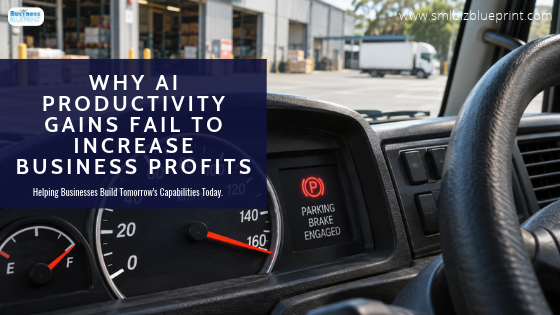

AI pilots can save time without improving profitability. The missing link is often how work, decisions and resources combine to produce business results.
AI productivity gains often fail to increase business profits because faster tasks do not automatically improve revenue, margins, operating costs or business capacity.
Many established businesses still organise work and decisions around the historical cost of human interpretation and specialist judgement, even though AI can now reduce some of those constraints and make different operating arrangements economically practical.
To turn successful AI pilots into measurable business value, owners must identify which constraints AI materially changes, redesign the workflows and decision authority surrounding them, and measure improvements in the performance and economics of the entire business system—not simply hours saved or tasks automated.
The Business Hasn’t Changed as Much as the Technology
Your AI pilot worked. Employees are completing tasks faster. Reports take minutes instead of hours. Customer enquiries are processed more efficiently. The improvements are measurable.
Yet profitability hasn’t noticeably changed.
Operating costs remain stable. Managers are still overloaded. Important decisions still accumulate in the same places. The business may be producing more activity without generating more valuable outcomes.
For an established business, this creates a difficult management problem. Investment has produced genuine operational improvements, but their commercial contribution remains uncertain.
The usual explanation is that AI hasn’t been implemented deeply enough. More employees need to adopt it. More workflows need automating. More systems need connecting.
Sometimes that’s correct.
But there is a more fundamental possibility.
AI has changed the economics of performing certain activities, while the business continues operating through arrangements designed around their previous cost and difficulty.
Established businesses develop around constraints. Information needs interpreting. Customers present unusual requirements. Commercial decisions require judgement. Exceptions must be resolved before work can proceed.
Historically, experienced employees were often the most economical way to handle this complexity. Businesses organised specialist roles, approval structures and management responsibilities accordingly.
Those arrangements were not necessarily inefficient. They reflected what was practical at the time.
AI can now reduce the cost of some information-intensive work. It can interpret variable requests, retrieve relevant knowledge, prepare recommendations and support decisions that previously required substantial human effort.
A sales team may prepare quotations faster while pricing approvals remain slow. Finance may produce reports earlier while management decisions remain delayed. Customer service may process enquiries more quickly while technical specialists become overwhelmed by escalations.
The technology changes the performance of an activity, but the surrounding operating arrangements continue to determine what the business can achieve.
The hidden cost of improving the wrong thing
Businesses typically measure AI success where the technology is introduced.
They track time saved, tasks completed, employee adoption and processing speed. These measures establish whether AI improves local productivity, but not whether that improvement changes the economics of the complete business process.
A business produces results through connected activities: demand, information, decisions, resources, execution and delivery. Its performance depends on how those elements interact.
If employees complete work faster but downstream capacity remains fixed, additional work accumulates. If management approval remains mandatory, faster preparation creates longer decision queues. If customer demand is insufficient, additional capacity may have limited immediate commercial value.
The business can become more productive without becoming more profitable.
The hidden cost extends beyond unrealised savings. Management attention and investment capital remain committed to improvements that may not address the business’s most consequential constraints.
Over time, the organisation can accumulate successful automation initiatives while preserving the same dependencies that limit growth, profitability and management capacity.
The architectural shift
The alternative requires reconsidering how the business should organise work and decisions now that some historical constraints have changed.
This means distinguishing between arrangements that remain necessary and those that exist because information interpretation, coordination or specialist judgement was previously expensive.
Some decisions still require experienced people. Some processes are better handled by conventional software. Some constraints have little to do with AI.
But where AI materially changes the cost of handling information or supporting decisions, the existing operating arrangement may no longer be the most economical.
The commercial opportunity is not to automate the business as it exists. It is to reconsider how the business should operate given what AI has made possible.
That does not mean every technically possible redesign is commercially justified. The expected improvement must outweigh the investment, disruption, ongoing oversight and risks involved in changing how the business operates.
The objective is a business that can handle greater complexity, make appropriate decisions and produce valuable outcomes without proportionately increasing cost or management intervention.
That is the difference between deploying AI and using AI to improve business performance.

The AI Pilot Worked. So Why Didn’t Profit Improve?
A successful AI pilot proves that an activity can be performed differently. It does not prove that the difference improves the business.
Consider a hypothetical distributor generating $10 million in annual revenue.
Its sales team uses AI to interpret customer enquiries, retrieve product information and prepare draft quotations. Preparation time falls substantially, and employees can respond to more requests.
The pilot meets its productivity targets.
Three months later, however, sales revenue and gross margin remain largely unchanged.
Management initially assumes the team needs more training or wider adoption.
But closer examination reveals that quotations still wait for pricing approval, stock availability remains uncertain, and many enquiries were never likely to convert.
The pilot improved preparation speed. It did not change the factors limiting profitable sales.
The value of an AI improvement depends on what it enables the business to achieve, not simply what it makes faster.
This distinction changes how pilots should be evaluated.
If quotation preparation is genuinely limiting the number of qualified opportunities the business can pursue, AI may create valuable capacity.
If slow responses are causing customers to buy elsewhere, faster quotations may improve conversion.
But if pricing, demand or fulfilment is the actual constraint, accelerating preparation may produce little additional profit.
The relevant system is the complete path from customer enquiry to a profitable fulfilled order.
A pilot that measures only preparation time cannot establish whether that system has improved.
For an owner, the warning sign is familiar: the AI performance report looks impressive, but the monthly management meeting still discusses the same missed opportunities, approval delays and margin pressures.
The problem is not necessarily that the pilot failed.
It may have succeeded at something the business was never meaningfully constrained by.
A managing director reviewed an AI pilot report showing that quotation preparation time had fallen dramatically.
He approved the next phase, confident the sales team could now handle more opportunities. Three months later, the quotation backlog had moved into pricing approvals, and sales performance was largely unchanged.
The uncomfortable lesson was that he had funded faster preparation without establishing what actually limited sales.
He began judging improvements by completed commercial outcomes rather than impressive activity reports.
Why Faster Tasks Don’t Necessarily Produce Better Business Results
Time saved has potential value. Financial value requires something more.
Suppose ten employees each save five hours per week using AI.
At an employment cost of $50 per hour, those 50 hours represent $2,500 of labour capacity.
But unless the business reduces expenditure, avoids a future cost or converts that capacity into additional valuable output, it has not realised $2,500 in financial savings.
Productivity creates capacity. The business system determines whether that capacity becomes profit.
Consider a finance team that uses AI to prepare management reports in half the time.
The reports arrive earlier. Yet department managers still review them at the same monthly meeting. Variances remain unexplained until someone requests clarification. Corrective action is delayed.
The reporting activity has improved, but the management decision cycle has not.
The potential financial value lies in what earlier information enables: faster corrective decisions, better cash management, reduced losses or more effective resource allocation.
Without those changes, faster reporting may simply give the business information earlier than it is prepared to use.
The same logic applies to sales, operations and customer service.
Additional capacity becomes valuable when it changes an economically meaningful outcome. That might mean serving more profitable customers, reducing rework, avoiding recruitment or improving retention.
It does not always require reducing headcount.
An established business may benefit substantially from increasing output without proportionately increasing payroll.
But management must establish whether sufficient profitable demand exists to use that capacity and whether the surrounding operation can support it.
Capacity that cannot be economically deployed is not the same as capacity that creates value.
Owners should therefore separate three measures: capacity released, capacity redeployed and financial value realised.
When those measures are confused, businesses can count benefits that exist operationally but have not yet appeared economically.

Why Businesses Were Organised Around Human Work and Judgement
Many existing workflows were designed around the cost of handling uncertainty.
A customer describes an unusual requirement. A supplier provides inconsistent documentation. An order contains an exception that does not fit established rules.
Someone must interpret the information and decide what happens next.
Historically, people were often the most economical solution.
Conventional software could capture records, apply defined rules and move information between systems.
But variable language, incomplete requests and unfamiliar situations frequently required human interpretation.
Businesses therefore concentrated expertise in particular roles.
Experienced salespeople interpreted customer requirements. Technical specialists handled exceptions. Managers approved unusual commercial decisions. Owners became the final escalation point.
These arrangements provided flexibility and control.
They also avoided the substantial cost of attempting to document, standardise and automate every possible variation. For many businesses, maintaining experienced judgement was more economical than building software capable of handling the exceptions.
Many management bottlenecks are the legacy of decisions that were once economically sensible.
Consider an owner who insists on approving discounts above a certain threshold.
That authority may have remained centralised because a previous attempt to delegate pricing resulted in inconsistent margins or unprofitable transactions.
The approval process is not simply a management habit. It is a control introduced in response to a commercial problem.
Removing it without addressing the underlying risk would be poor management.
AI does not make that experience irrelevant. It may, however, change how the business can provide reliable pricing information, prepare recommendations and enforce decision boundaries without requiring the owner to review every routine transaction.
The distinction matters because conventional process improvement advice can mistake a deliberate control for unnecessary bureaucracy.
Similarly, specialist involvement may look inefficient until management understands the judgement being applied.
The objective is to distinguish between necessary judgement and arrangements created to compensate for historical information limitations.
For a business owner, this distinction is visible in recurring management behaviour.
Experienced employees are repeatedly interrupted to interpret familiar situations. Decisions wait for a small number of people. Knowledge remains concentrated because documenting every possible variation was impractical.
These dependencies may have been rational.
But their original justification deserves reconsideration when technology changes what information can be interpreted and prepared economically.
A process can remain operationally effective while becoming economically outdated.
The question is whether the business still needs the same allocation of expertise and authority to achieve an acceptable result.
What AI Changes About the Economics of Work and Decisions
AI changes what some businesses can afford to understand, process and decide.
That may be more consequential than making existing tasks faster.
Traditional automation works well when inputs are structured, and rules are explicit. A system can calculate prices, check inventory thresholds or route transactions according to predefined conditions.
AI extends what can be economically handled before those rules are applied.
It can interpret customer descriptions, extract requirements from documents, classify variable requests and assemble relevant information for decisions.
These capabilities are imperfect and require validation. But where they are sufficiently reliable, they can reduce the cost of work that previously depended heavily on experienced employees.
AI can make certain operating arrangements economically practical that were previously too expensive to sustain.
Consider the distributor again.
Historically, every complex enquiry might require a salesperson to interpret requirements, consult product information and prepare a recommendation.
The business may have avoided smaller or more complicated enquiries because the labour involved made them commercially unattractive.
AI-assisted interpretation could reduce that preparation cost.
Conventional systems could then validate stock, pricing and approved commercial conditions. Employees could focus on unusual requirements, commercial negotiation and decisions involving material risk.
The opportunity is not merely processing existing enquiries faster.
It may be handling additional categories of enquiries profitably, serving customers previously considered too expensive or expanding capacity without proportionately increasing specialist labour.
When the cost of handling variation falls, the minimum economically viable transaction can change.
That has implications beyond operational efficiency. A business may be able to serve different customer segments, offer greater customisation or expand services without carrying the same specialist labour cost per transaction.
These possibilities require commercial testing.
AI interpretation errors, unreliable information, integration costs and human oversight can eliminate the apparent advantage.
Nor should AI replace deterministic software where established rules already provide reliable outcomes.
The stronger operating arrangement combines AI where interpretation is valuable, conventional technology where rules are sufficient, and human judgement where uncertainty or risk justifies it.
But reducing the cost of serving a customer does not establish who captures the resulting value.
If competitors achieve similar improvements, customers may begin expecting faster service, greater customisation or lower prices. The business could become more efficient without enjoying a lasting margin advantage.
For owners, this introduces a harder commercial distinction.
AI may allow the business to deliver something competitors cannot easily match. Or it may simply reduce the cost of meeting what becomes a standard market expectation.
Both outcomes can justify investment, but they have different implications for pricing, growth and competitive advantage.
The business still has to determine whether the new capability creates value it can retain.
Why AI Can Move Bottlenecks Rather Than Remove Them
Faster work can make a constrained business more difficult to operate.
Imagine a sales team increasing quotation preparation capacity from 20 to 40 quotations per day.
The pricing manager can still approve only 20 exceptions.
Additional quotations accumulate. Salespeople chase decisions. Customers wait. Management faces more interruptions.
The business has doubled preparation capacity without increasing completed commercial throughput.
AI can increase the speed at which work reaches a constraint without increasing the capacity of the system.
This is why local productivity improvements can create unexpected operational pressure.
Marketing may generate more leads while sales qualification remains limited.
Customer service may process enquiries faster while technical escalations accumulate.
Operations may automate order entry while warehouse capacity remains unchanged.
In each case, the relevant measure is not how quickly one department works. It is how effectively the business converts work into completed, valuable outcomes.
This reveals a weakness in departmental performance reporting.
Marketing celebrates lead volume. Sales celebrates quotation output. Operations celebrates orders processed.
All three can improve while profitability remains unchanged.
The business needs visibility across the complete flow of work.
Approval queues, exception volumes, overdue follow-ups and customer waiting times can reveal where the constraint has moved.
Moving a constraint is not automatically failure. It may expose the next limitation and clarify where investment should be directed.
But management must recognise the change.
Otherwise, additional automation can increase operational complexity while leaving the underlying economic result untouched.
For an owner already carrying too many decisions, this is particularly significant.
AI that increases the number of issues requiring management attention may improve employee productivity while reducing management capacity.
The business becomes busier, not necessarily better.

Redesigning Workflows and Decision Authority to Capture AI’s Value
The next opportunity is not always another automation.
Sometimes it is removing the reason a task or approval exists.
Consider a business where salespeople routinely request management approval for familiar discounts.
AI could help employees prepare those requests faster.
But the underlying decision structure would remain unchanged.
A more useful examination asks why management must approve the same types of decisions repeatedly.
Perhaps employees lack current margin information. Perhaps commercial authority has never been clearly delegated. Perhaps routine transactions and material exceptions follow the same approval pathway.
AI can help assemble relevant customer and transaction information.
Conventional software can enforce explicit pricing rules and approval limits.
Employees can act within defined authority, while unusual or high-risk decisions remain with experienced managers.
The objective is not to eliminate human judgement. It is to stop consuming it where it adds little additional value.
This is where AI-enabled redesign differs from simply accelerating an existing process.
The business changes how information is prepared, how decisions are routed and where specialist attention is required.
Routine work can proceed through established pathways. Exceptions arrive with relevant information already assembled. Management intervention becomes more selective.
But changing decision authority is rarely as straightforward as redesigning the workflow.
An owner who has spent years protecting margins will not necessarily delegate pricing authority because AI can prepare a recommendation.
They may still carry responsibility when a transaction goes wrong.
That concern is legitimate.
Before authority can be redistributed, management needs confidence that pricing information is accurate, commercial boundaries are enforceable and exceptions will be visible before they become material losses.
The redesign succeeds when the control remains effective without requiring the same person to perform every check.
Decision authority can become more distributed while accountability remains clear.
For owner-led businesses, the potential benefit extends beyond immediate labour productivity.
Growth frequently increases the volume of decisions requiring senior attention. Revenue expands, but the owner’s available time does not.
Eventually, management capacity becomes a constraint on further growth.
AI-assisted interpretation and better decision architecture may reduce that dependency.
But only if the organisation changes responsibilities and authority alongside the technology.
The redesign must also justify its own economics.
A workflow that reduces specialist involvement may still be commercially unattractive if transaction volumes are low, implementation is disruptive or ongoing validation consumes much of the capacity released.
The existing arrangement may remain the better choice until the expected benefit is sufficiently large and reliable to outweigh the full cost and risk of change.
Automated recommendations still require validation. Decision boundaries must be explicit. Employees need to understand when to escalate. Management must monitor errors and unintended consequences.
The practical sign of progress is not that managers receive AI-generated recommendations faster.
It is that fewer routine decisions require their intervention, while important exceptions receive better information and attention.
That is a meaningful change in how the business operates.
Consider an owner of a $12 million distribution business whose experienced sales manager was interrupted throughout the day to resolve familiar quotation exceptions.
Rather than simply accelerating quotation preparation, the business introduced AI-assisted information interpretation, clear pricing rules and a defined pathway for unusual decisions.
Routine cases no longer needed the same level of specialist attention, while genuinely complex decisions still received human review.
The potential improvement was not merely faster quotations, but greater commercial capacity without every transaction depending on the same manager.
The owner could begin managing the system rather than personally absorbing its exceptions.
Measuring Business Performance, Not Just AI Productivity
The final test is whether the redesigned system produces a better economic result.
For a distributor, the outcome might be contribution profit from completed orders.
For a professional services business, it might be profitable client capacity.
For a manufacturer, it might be throughput, rework or delivery performance.
The appropriate measure depends on the business constraint being addressed.
AI return on investment should reflect economic changes attributable to the improvement, not the theoretical value of activity completed faster.
That requires measuring beyond the automated task.
If AI improves quotation preparation, management should examine qualified quotation volume, approval delays, conversion, margins and fulfilment.
If AI improves reporting, it should examine whether decisions occur earlier and whether those decisions improve financial or operational outcomes.
If AI reduces specialist involvement, it should measure the amount of expert attention required per completed transaction alongside quality and risk.
Implementation and ongoing operating costs also matter.
An arrangement that saves labour but creates expensive validation, integration or error-handling requirements may deliver little net benefit.
Sometimes the correct decision is to leave the existing workflow alone.
A process handling a small number of high-value exceptions may be better managed by an experienced employee. If the cost of integration, validation and ongoing oversight exceeds the labour or capacity benefit, automation creates complexity without improving the business.
The objective is to establish whether changing how the work is performed produces a better commercial result, not simply whether AI can perform it.
The assessment should distinguish between benefits already realised and capacity that might generate future value.
It should also recognise that business performance changes for reasons unrelated to AI.
Demand, pricing, staffing and market conditions can influence results. A credible evaluation needs an appropriate baseline and, where practical, a comparison that helps isolate the improvement’s contribution.
But measuring the immediate financial return is only part of the assessment.
A business can capture an initial productivity advantage without retaining it as a lasting competitive advantage.
As AI capabilities become more widely available, competitors may achieve similar cost reductions. Customers may expect some of those benefits through lower prices, faster service or greater flexibility.
Management therefore needs to distinguish between operational improvement, financial value captured and the durability of that value.
The strongest evidence is not widespread AI adoption.
It is a demonstrated change in how economically the business produces an important outcome—and whether that improvement remains commercially valuable as market conditions change.
For an owner, the decisive question is whether management can connect the initiative to the operating and financial measures already used to run the business.
If it cannot, the improvement may still be promising.
But its commercial value remains unproven.
Imagine two competing businesses introducing the same AI capabilities.
One uses them to help employees complete existing tasks faster; the other reconsiders which tasks require employees, which decisions require approval and which services have become economical to deliver.
Both may report productivity improvements, but only the second has deliberately changed how its business produces results.
The uncomfortable possibility is that the technology was never the main difference between them.
The difference was what management was prepared to redesign.
Conclusion
A business can adopt AI successfully and still remain constrained by the same operating arrangements.
Employees work faster. Information arrives earlier. More activity moves through the organisation.
Yet the owner remains involved in routine decisions, management capacity stays stretched and profitability barely changes.
The problem may not be insufficient AI adoption.
It may be that the business is using new capabilities inside a system organised around old limitations.
Many established workflows developed because human interpretation, specialist expertise and coordination were expensive or difficult to scale. AI can now reduce some of those costs, creating opportunities to organise work and decisions differently.
In some cases, that means greater capacity without proportionately increasing specialist labour. In others, it may make previously uneconomical customers, transactions or services commercially viable.
But the opportunity is not unlimited.
Some constraints remain unchanged. Some processes are better improved through conventional software or clearer management authority. And some AI-enabled improvements may become standard market expectations rather than lasting sources of additional profit.
The task is to recognise where AI changes the economics of the business—and where those changes can produce value worth capturing.
Start with one decision that repeatedly reaches your desk.
Identify why it requires your involvement. Is it because your judgement genuinely changes the outcome, or because the information needed to make the decision has never been available reliably elsewhere?
If AI can change the cost of preparing that information, the decision may no longer need to be organised in the same way.
You don’t need to redesign the entire business to begin. You need to identify one operating constraint whose original justification may no longer hold.
For an established business owner, this is ultimately a question of control.
You can continue investing in faster tasks while the same operational dependencies determine how much the business can achieve.
Or you can use the changing economics of AI to reconsider which dependencies remain necessary.
You’re using AI to make work faster inside a business that may still be designed around limitations AI has already changed.
That arrangement is no longer automatically the best available option.
The choice is whether to keep accelerating the existing business—or redesign the parts that determine its performance.
Action Steps
Establish the commercial outcome before assessing AI performance
Identify one business result that matters: contribution profit, profitable sales capacity, cost-to-serve, delivery throughput or another measurable outcome. This prevents task efficiency from becoming a substitute for commercial performance. Decision consequence: Continue an AI initiative only when there is a credible connection between the improvement and an economically meaningful result.
Identify the constraint governing that outcome
Examine where work waits, decisions stall, exceptions accumulate or resources limit output. Distinguish the activity consuming the most time from the constraint actually limiting performance. Decision consequence: Direct investment towards the limiting factor rather than the most visible or easily automated task.
Reassess why the existing operating arrangement developed
Identify which responsibilities, approval structures and specialist dependencies exist because information was historically expensive or difficult to interpret. Determine whether those limitations remain valid. Decision consequence: Retain arrangements that protect necessary judgement while reconsidering those built around constraints AI can now materially weaken.
Test what AI changes economically
Assess whether AI can reliably reduce the cost of interpreting information, preparing decisions or handling variable work. Include validation, oversight, integration and exception costs. Decision consequence: Use AI where it changes the economics of an important activity; use conventional automation, clearer rules or human judgement where they remain more appropriate.
Redesign the complete workflow and decision structure
Define how information moves, which decisions follow approved rules, where human authority remains necessary and how exceptions are handled. Assess downstream capacity before increasing upstream output. Decision consequence: Implement an operating arrangement that can convert increased capability into completed, valuable business outcomes rather than additional queues.
Measure realised value and emerging constraints
Track the original business outcome alongside operating costs, quality, exception rates and the location of new bottlenecks. Separate capacity released from capacity redeployed and financial value actually captured. Decision consequence: Expand, modify or discontinue the initiative according to demonstrated business performance, not AI usage or estimated hours saved.
FAQs
AI productivity gains fail to increase profits when faster work does not reduce actual costs, generate additional profitable output or improve another financially meaningful result. Identify the commercial outcome the improved task influences, then determine whether the complete workflow converts the productivity gain into measurable value.
Why do successful AI pilots fail to deliver business value?
AI pilots often measure whether a specific activity becomes faster, cheaper or easier, rather than whether the business performs better. Evaluate the pilot against the constraint it was intended to change and the downstream outcomes affected before deciding whether to scale it.
How can a business measure the ROI of AI automation?
Measure AI return on investment using attributable financial benefits, including realised cost reductions, avoided expenditure, additional contribution profit and measurable reductions in losses, against implementation and ongoing operating costs. Establish a baseline and distinguish theoretical labour savings from financial value actually captured before approving expansion.
What is the difference between AI productivity and business performance?
AI productivity measures improvements in activities such as processing time, employee output or information preparation, while business performance measures results such as profitability, throughput, margins and customer outcomes. Track both, but make investment decisions using the business result rather than the activity metric alone.
Should businesses redesign workflows before implementing AI?
Businesses should understand the existing workflow and its constraints before committing to a permanent AI-enabled design, but they do not need to complete every redesign before testing AI. Use controlled experiments to establish what AI can reliably and economically change, then redesign the surrounding decisions, responsibilities and information flows accordingly.
How does AI change the economics of business operations?
AI can reduce the cost of interpreting unstructured information, preparing recommendations and supporting decisions that previously required extensive specialist involvement. Assess where this makes existing workflows less expensive or previously uneconomical work viable, then compare the full operating costs and risks of the proposed arrangement against the current system.
Why can AI automation create new business bottlenecks?
AI automation can increase the volume or speed of work entering downstream activities whose capacity remains unchanged, creating longer queues, additional exceptions or greater management pressure. Examine the complete workflow before increasing automation and determine whether the next constraint can absorb the additional output.
When should a business use AI instead of conventional automation?
Use AI when interpreting variable information or preparing context-dependent recommendations materially improves an important business process and the outputs can be validated at an acceptable cost. Prefer conventional automation for stable, explicit rules and retain human authority where commercial risk, uncertainty or accountability requires judgement.
Can AI increase business capacity without reducing headcount?
Yes, AI can release capacity that allows existing employees to handle more profitable work, improve service or avoid future hiring without reducing current headcount. The owner should establish where that capacity will be redeployed and measure the resulting output or avoided expenditure rather than assuming saved hours equal cash savings.
Bonus Section: Three Uncomfortable Truths About AI and Business Performance
You’re probably measuring the wrong success.
Not because your AI productivity figures are inaccurate, but because they describe what happens inside an activity rather than what changes for the business.
The deeper opportunity is to reconsider assumptions about capacity, expertise and growth that made sense before AI changed the cost of certain kinds of work. Three shifts deserve attention.
Your Most Productive Employees May Be Protecting an Inefficient System
When experienced employees become faster with AI, management often treats that as evidence of progress. But if those employees remain responsible for interpreting every exception, resolving routine uncertainty and approving familiar decisions, the business has preserved its dependence on them.
Measure how much specialist intervention the business requires per completed outcome, not simply how much each specialist produces.
If nothing changes: Growth continues consuming the same scarce management attention, only at a faster pace.
The Most Valuable AI Opportunity May Be Work You Currently Refuse
Businesses often avoid low-volume customers, complex enquiries or customised services because the cost of understanding and handling them exceeds their commercial value.
AI may reduce that cost enough to make selected opportunities viable.
Examine which commercially attractive activities were previously uneconomical, rather than limiting AI investment to work already being performed.
If nothing changes: The business may become more efficient within its existing market while overlooking opportunities its new capabilities could support.
A Smaller Bottleneck Can Reveal a Bigger Business Problem
Removing an operational constraint can expose a more consequential limitation: insufficient demand, weak conversion, poor pricing or inadequate fulfilment capacity.
That can feel disappointing after a successful AI implementation. But the new constraint may reveal where the next commercially meaningful decision belongs.
Treat changing bottlenecks as evidence about the business system, not automatically as evidence that the AI initiative failed.
If nothing changes: Management continues optimising activities without discovering what actually governs profitability.
The deeper advantage of AI is not necessarily doing more of the same work. It is gaining the freedom to question which work, decisions and operating arrangements are still necessary.
Other Articles
AI Saved You 20 Hours. Why Isn’t Your Business Better?