
AI can make work faster without making the business more valuable.
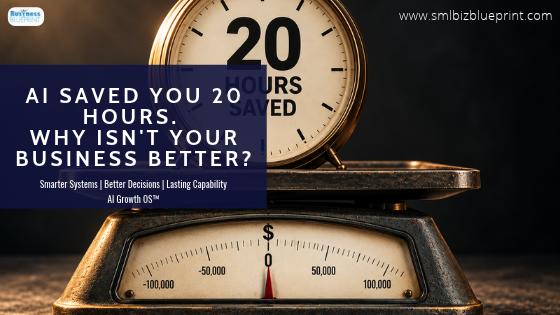
AI can save a business 20 hours without improving profitability because faster execution does not automatically increase throughput, reduce operating costs or change the decisions that determine commercial performance.
Many established businesses still operate through workflows, approval structures and management arrangements designed when human interpretation, coordination and execution were more expensive, allowing AI productivity gains to accumulate behind unchanged constraints.
Turning AI time savings into profit requires identifying where capacity becomes stranded, determining which operating structures AI has made possible to redesign, and measuring whether those changes improve margins, customer outcomes, throughput or management capacity.
AI Is Changing the Economics of Business Design
AI is increasing the productive capacity of established businesses without necessarily increasing their ability to convert that capacity into commercial results.
Employees complete activities faster. Departments produce more output. Information becomes easier to analyse. Yet customer response times, operating margins, management workload and overall throughput may remain largely unchanged.
The difficulty often becomes visible in management meetings. Departmental productivity has improved, but the financial results haven’t moved enough to explain the reported gains.
Everyone can identify where AI saved time. Few can identify where the business captured the value.
The underlying problem is a mismatch between newly available capabilities and an operating structure designed around older economic constraints.
Businesses have historically organised work according to the scarcity of human expertise, information processing and coordination.
Specialist departments concentrate knowledge. Management hierarchies distribute authority. Approval processes compensate for differences in experience and protect against inconsistent decisions.
These arrangements were often economically rational.
When information was expensive to gather, centralising expertise reduced duplication. When employees could not reliably assess commercial conditions, management review provided control. When coordination depended on human communication, departmental responsibilities maintained accountability.
AI changes some of these underlying costs without automatically changing the structures they created.
A business may reduce quotation preparation from four hours to 45 minutes while retaining the same approval hierarchy. Marketing may produce more campaigns while budget decisions remain slow. Operations may generate continuous insights while managers still rely on monthly reviews to determine action.
The consequence is not simply unused employee time.
It is an increasingly uneven operating system.
Execution capacity expands where AI can assist effectively. Decision capacity, verification processes, coordination mechanisms and management authority may remain relatively fixed.
Completed work accumulates at these boundaries. Additional output creates more requests for review. Managers receive more information without a corresponding improvement in their ability to prioritise or act.
The organisation becomes faster at producing work than at converting that work into outcomes.
The economic constraint has moved, but the management architecture has not moved with it.
Most teams misdiagnose this problem because they measure improvement where AI was introduced rather than where business value is realised.
A reduction in preparation time becomes a reported labour saving, even when payroll remains unchanged. Increased document production becomes evidence of productivity, even when those documents wait for approval.
More analysis becomes improved intelligence, even when it does not influence decisions.
These measurements are not necessarily incorrect. They are incomplete.
They describe the performance of an activity without establishing whether the organisation has increased its ability to deliver commercially valuable outcomes.
The distinction matters particularly for established businesses because many operating costs are committed.
Saving portions of employee time does not automatically release expenditure. Nor does faster execution create additional revenue when another part of the system determines how much work can be sold or delivered.
The architectural principle is straightforward:
The value of an AI capability depends on how it changes the capacity and constraints of the complete operating system.
This reframes AI investment from a question of task efficiency to one of business design.
The critical issue is whether existing responsibilities, information flows and decision boundaries remain appropriate when the cost of performing work changes.
The objective is not to remove human involvement indiscriminately. It is to distinguish work that requires human judgment from work that can proceed reliably within defined conditions.
This changes the economic role of management.
Management capacity can become less dependent on repeatedly processing routine cases and more concentrated on exceptions, uncertainty, commercial decisions and improvements to the operating system itself.
Ignoring this distinction has financial consequences.
Businesses continue paying for AI capabilities while retaining avoidable coordination costs.
Employees produce more work that waits. Management attention becomes increasingly fragmented. Customers experience delays that internal productivity measures do not explain.
Additional technology investment may increase these pressures rather than resolve them.
The alternative is not simply better time management or more disciplined implementation.
It is to examine whether the business’s operating arrangements remain economically appropriate for the capabilities now available.
Some will remain necessary. Others may require different decision rights, verification boundaries, information flows or responsibilities.
AI’s structural significance lies in changing what a business can economically organise, not merely what its employees can accomplish faster.
The commercial opportunity emerges when that change in capability becomes a change in how the business operates.

Why Saving 20 Hours With AI Doesn’t Automatically Improve Business Performance
Time saved measures work avoided. It does not measure business value created.
Consider an estimating team that uses AI to reduce the time required to prepare customer quotations.
Across the week, the business saves 20 hours.
Management calculates the saving using employee hourly costs and reports a substantial productivity improvement.
But payroll remains unchanged. The same employees work the same hours. The business doesn’t necessarily win more customers, process more orders or improve margins.
The saving is real. The financial benefit has not yet been established.
This happens because businesses often treat employee time as though it were a variable cost. In established companies, much of that expenditure is committed.
Saving three hours of an employee’s week doesn’t automatically reduce the cost of employing them.
Nor does it guarantee those hours can be used productively. Savings scattered across multiple activities may reduce pressure without creating usable capacity.
Three outcomes must therefore be distinguished:
- Time saved: An activity requires less effort.
- Capacity released: The business can reliably redirect that effort.
- Value realised: The change improves costs, throughput, revenue, risk or customer outcomes.
Each transition requires a business decision.
The estimating team could use its capacity to handle additional enquiries, improve technical accuracy, reduce overtime or avoid a planned hire.
Each produces a different economic result.
An hour saved has no fixed financial value independent of what the business can do with it.
Productivity reports may show increasing hours saved while financial reviews reveal little corresponding improvement. Management can continue investing in faster work without knowing whether the investment is making the business better.
The question is not how many additional hours AI could save. It is what those hours now make possible.
A business owner reviews the latest productivity report and feels satisfied: AI has saved the team 20 hours in a single week.
At the next financial meeting, however, the numbers look much the same, and the owner realises the saving was recorded without anyone deciding how to use the capacity.
The mistake wasn’t investing in AI; it was treating a faster activity as a completed business improvement.
The owner begins asking what must change downstream before counting the benefit.
The Business Was Designed Around Constraints AI Is Now Changing
Business structures reflect the economics of the work they were designed to perform.
Departments, specialist roles and approval processes developed because information was difficult to obtain, expertise was expensive to distribute, and coordination required human effort.
Consider a business preparing 45 customer quotations each week.
An estimator gathers supplier prices, checks specifications and calculates costs. A sales manager reviews the quotation before it reaches the customer.
The manager protects margins, identifies unusual conditions and compensates for differences in estimator experience.
But not every approval exists for the same reason. Some require specialist judgment because the commercial or technical risk is genuinely unusual. Others persist because nobody has clearly established what the estimator is authorised to decide.
AI may improve the information available to the estimator without resolving that uncertainty about authority.
Reviewing every quotation may appear inefficient. Historically, however, it could be less expensive than allowing inconsistent decisions to create commercial losses.
The approval process was not necessarily poor management. It was a rational response to limited information and distributed expertise.
AI changes some of those conditions.
It can assist with interpreting specifications, retrieving historical information, comparing supplier prices and identifying departures from established commercial rules.
Checks that previously depended on several people can become less expensive and more consistently available.
But if every quotation still follows the same approval sequence, the business retains a structure designed partly around capabilities that were previously scarce.
The manager may still need to approve unusual pricing, contractual risks or technical exceptions.
What deserves examination is whether every routine case requires identical intervention.
This is the architectural consequence of AI.
When the economics of performing work change, the economics of organising that work change too.
The opportunity is not necessarily to remove departments or management positions. It is to reconsider which responsibilities require specialist involvement, which decisions can follow established rules and where human judgment creates the greatest value.
Routine quotations may continue passing through multiple employees and approvals even after AI makes preparation and verification substantially easier.
The business then pays for new capabilities while retaining coordination costs created by its previous way of working.
The existing process may still function. That does not establish that its original economic justification remains intact.

Where AI Productivity Gains Disappear Inside Existing Workflows
AI can increase the capacity to complete work without increasing the capacity to move that work through the business.
Most organisations measure productivity within departments.
Sales generates enquiries. Estimating prepares quotations. Management approves commercial commitments. Operations fulfils orders.
Each function can become more efficient while the overall customer outcome remains unchanged.
The reason lies in the boundaries between activities.
Every handoff can introduce information transfer, verification, prioritisation or a decision.
Consider the quotation business.
An estimator gathers supplier information, interprets customer requirements and prepares a commercially acceptable quotation. The completed document then moves to management for review before sales communicates the result to the customer.
At each transition, information may need to be explained, checked or reconstructed.
The estimator documents assumptions. The manager requests clarification. Sales interprets the approval conditions before communicating with the customer.
The underlying information already exists, but the business repeatedly spends time transferring and validating its meaning.
AI can reduce the cost of preparing and interpreting that information. It may also help preserve context across the workflow.
But those improvements are limited if each department continues operating as an isolated unit, requiring the next person to reconstruct the work before taking responsibility.
The business is not simply transferring work between departments. It is repeatedly transferring the responsibility to understand and act on that work.
That distinction matters.
Some handoffs are necessary because they establish accountability, separate conflicting responsibilities or provide independent verification.
Others exist primarily because the next person historically lacked access to the information or capability required to proceed.
AI can change the economics of the second category without removing the need for the first.
The opportunity is therefore to reconsider how information, work and decisions move together.
Instead of measuring only how quickly each department completes its activities, management must examine the coordination required to produce the final customer outcome.
The cost of coordination becomes more visible when the cost of execution falls.
That changes how productivity should be evaluated.
Employees may repeatedly explain completed work, managers may request information already collected, and customers may wait while responsibility moves between functions.
The business pays for faster execution while retaining the coordination costs and delays embedded in its departmental structure.
It has improved individual activities. It has not necessarily improved the architecture connecting those activities to the result.
When Faster Work Simply Moves the Business Bottleneck
When AI reduces one operating constraint, another can become the factor determining business performance.
Before AI, the quotation business may have been constrained by estimating capacity.
Two estimators could prepare approximately 45 quotations each week. Management could review that volume.
The system was reasonably balanced.
AI changes one part of the equation.
Estimators can now prepare 70 quotations, but management can still review only 45.
The original constraint has been reduced. Approval capacity is now the limit.
Adding more estimating automation will not solve it.
It may create larger queues, more urgent requests and greater uncertainty about priorities.
This is constraint relocation.
The important distinction is the nature of the new constraint.
It might involve execution, coordination, verification, judgment or decision authority. Each requires a different response.
If employees lack processing capacity, automation may help. If information is fragmented, the workflow may need better integration. If routine decisions repeatedly return to management, authority may need to be reconsidered.
Suppose most quotations meet familiar commercial conditions.
Margin thresholds, supplier pricing requirements and technical checks are applied repeatedly. Only a minority involve unusual exclusions or commercial risks.
With dependable verification, standard cases might proceed within delegated authority while exceptions receive management review.
That is not simply faster approval.
It changes management’s responsibility from authorising every routine case to governing the conditions under which work can proceed.
The scarce resource may no longer be the ability to do the work. It may be the authority and judgment required to let the work move forward.
The owner may agree that routine quotations should proceed without approval and still insist on reviewing them.
The issue is no longer simply whether AI can prepare the quotation accurately. It is whether the owner is willing to transfer authority within agreed commercial boundaries.
This creates new design responsibilities.
Owners must establish acceptable risk, verification requirements, escalation conditions and accountability.
AI does not remove those responsibilities. It makes their boundaries more important.
The strategic mistake is to keep increasing capacity at the stage that AI has already improved, while leaving the new limiting factor untouched.
Managers receive more completed work. Employees wait for decisions on cases that repeatedly meet the same commercial conditions.
The business has increased execution capacity without increasing its ability to deliver quotations to customers.
The next improvement must address the constraint that now exists, not the one AI has already reduced.
The estimating manager at a mid-sized supplier arrives on Monday to find another queue of completed quotations waiting for approval, despite AI having made preparation dramatically faster.
In this illustrative scenario, the business reviews its approval requirements and establishes controlled authority for standard quotations, reserving management review for genuine exceptions.
Routine work can now move forward without waiting for the same manager, while unusual commercial decisions still receive experienced attention.
The manager’s role shifts from processing every quotation to governing the conditions under which quotations can proceed.
What AI Makes Possible Beyond Doing the Same Work Faster
AI’s deeper economic contribution is making some operating arrangements affordable that were previously too expensive or difficult to maintain.
Three possibilities follow from its ability to assist with interpretation, coordination and routine verification.
Connected workflows rather than disconnected departmental activities
Traditional workflows divide responsibility into activities performed by different functions.
The estimator prepares the quotation. The manager reviews it. Sales sends it.
Each stage may require information to be transferred and interpreted again.
You can see this in work that has been completed by one department but must be explained again before another department can act. The information exists, yet progress depends on someone reconstructing its meaning.
AI-enabled systems can help maintain relevant context and coordinate defined actions across these boundaries.
The organising unit can become the required business outcome rather than the individual departmental task.
For the quotation business, that outcome might be an accurate, commercially acceptable quotation delivered within two working days.
The shift is from managing completed activities to managing a defined change in business state.
Functional expertise remains necessary. Repeated coordination may not.
The economic consequence is significant: transaction volume may increase without requiring a proportional increase in the people and management effort needed to coordinate every stage.
The business gains more than faster execution. It gains the possibility of reducing coordination cost per completed transaction.
Management by exception rather than universal review
Historically, managers reviewed routine work because consistent verification was expensive and employee experience varied.
AI can help assess cases against established commercial conditions.
Consider how often a manager approves a decision without changing the recommendation or applying materially different judgment. The approval may provide reassurance, but does every case require the same intervention?
Routine cases may proceed within delegated authority. Unusual cases receive experienced judgment.
But exception-based management only works when the business can reliably distinguish ordinary cases from unusual ones. If commercial rules are ambiguous or underlying information is unreliable, the system may create more exceptions than management can handle.
Dependable information, verification, auditability and clear escalation rules are therefore essential.
Where those conditions exist, throughput may increase without a proportional increase in management workload.
The advantage comes from applying human judgment where it is valuable, rather than requiring it everywhere.
The economic relationship between transaction volume and management capacity can change.
A business may be able to process more standard transactions without requiring equivalent growth in approval capacity.
Management attention becomes available for commercial decisions, unusual risks and improvements that cannot be reduced to established rules.
Continuous intelligence rather than periodic discovery
Established businesses often identify problems through scheduled reporting.
Margins are reviewed monthly. Sales conversion is analysed periodically. Operational problems become visible after delays accumulate.
Consider a margin problem that only becomes apparent in the monthly accounts, or a decline in customer conversion that management recognises after several weeks.
The underlying changes may have been occurring throughout that period. The business simply wasn’t interpreting the information early enough to respond.
Continuous interpretation was historically expensive.
AI can help examine information as conditions change and identify commercially relevant exceptions.
In the quotation business, that might reveal supplier price changes, declining conversion or increasing approval delays before they become obvious in monthly results.
The value is not a faster report.
It is the opportunity to make a different decision earlier.
More frequent analysis, across more transactions and operational conditions, can become economically feasible without requiring an equivalent expansion of analytical staff.
This may allow the business to protect margins, respond to customer changes or correct operating problems before their financial consequences accumulate.
These arrangements are not automatic consequences of AI adoption. They require reliable information, appropriate controls and deliberate operating design.
AI becomes strategically significant when it changes what the business can economically manage, not merely how quickly employees complete existing work.
A business that continues relying on disconnected reports, universal approvals and delayed management intervention retains costs that a different operating structure may reduce.
Two businesses may possess similar AI capabilities but achieve different commercial results because one has redesigned the operating conditions through which those capabilities create value.

How to Redesign Work to Turn Released Capacity Into Value
Business redesign should begin with the outcome that needs to change, not the AI capability available to implement it.
Businesses often identify a task AI can accelerate, introduce a tool, measure the saving and then search for a use for the released capacity.
The sequence is backwards.
Return to the quotation business.
The owner wants faster customer responses, greater quotation throughput and protected gross margins without additional management overhead.
The existing process takes almost six days from enquiry to quotation.
AI has reduced preparation time, but the overall cycle has barely changed.
The owner now needs to examine the operating structure.
First, define the required changed state:
Standard quotations meeting agreed commercial and technical conditions are delivered within two working days, while exceptions receive appropriate management review.
This establishes what the business must become capable of doing.
It does not prescribe a particular technology.
The design must then address the complete process.
Customer information must be sufficiently complete. Supplier prices must be current. Technical assumptions require verification. Commercial conditions must be assessed.
Some activities may benefit from AI. Others may be handled more reliably through conventional software or established rules.
The critical decisions concern how these capabilities fit together.
Which cases are routine? What conditions allow them to proceed? Which exceptions require escalation? Who holds authority for the commercial commitment?
These decisions establish the operating architecture.
But not every AI productivity improvement justifies changing that architecture.
Redesign is justified when AI changes the cost or availability of a capability enough that the existing way of organising work is no longer the most effective way to achieve the required outcome.
If the existing workflow delivers the required result and AI simply reduces effort, improving the activity may be sufficient.
If faster execution exposes a downstream capacity limit, the business must address that constraint.
If AI changes the economic justification for existing handoffs, verification arrangements or approval requirements, structural redesign becomes a legitimate option.
The distinction prevents businesses from treating every efficiency improvement as a transformation opportunity.
AI can assist with interpreting enquiries, identifying missing information and preparing quotations. Rules can enforce delegated approval limits. Experienced managers can review unusual risks.
Each component has a defined responsibility.
But a new approval rule changes little if estimators continue sending every quotation to the manager for reassurance.
The operating model changes only when people understand the boundaries, trust the controls and consistently act within their authority.
The business must also decide how to use the released capacity.
Additional enquiries, better customer follow-up, reduced overtime and avoided hiring represent different economic opportunities.
They should not be counted as interchangeable benefits.
Implementation should begin with controlled standard cases, comparing cycle time, accuracy, margins and exception rates against the previous process.
Failures should improve the design.
A correction should improve the process for future cases, not merely resolve the case that exposed the problem.
And not every constraint requires AI.
If supplier availability limits fulfilment, faster quotation preparation may contribute little. If a straightforward software rule handles a decision reliably, AI may add unnecessary cost and complexity.
Teams can introduce AI independently while employees still rely on informal approvals and repeated clarification to move work forward. Individual activities improve, but the business remains unable to convert those gains into a dependable commercial result.
The objective is not maximum AI adoption. It is the simplest reliable architecture capable of producing the required business outcome.
Two competing businesses adopt similar AI capabilities and achieve similar reductions in task time.
One keeps its existing approvals, handoffs and reporting arrangements; the other examines which of those arrangements are still necessary.
The difference is not who adopted the more powerful technology, but who changed the operating conditions that determine how much value the technology can produce.
AI capability may become widely available, while the ability to organise a business around it remains a meaningful source of differentiation.
How to Measure Whether the Business Actually Improved
AI return on investment should reflect attributable business improvement, not the volume of work AI performs.
Hours saved establish whether an activity has become more efficient.
They do not establish whether the business has become more profitable.
For the quotation business, management should compare performance before and after the operating change.
Relevant measures include enquiry-to-quotation time, weekly quotation throughput, approval delays, conversion, gross margin and management review workload.
These measures reveal whether the business’s capacity to produce commercial outcomes has improved.
The financial assessment requires further discipline.
If 20 labour hours are saved but payroll remains unchanged, those hours are not automatically a cash saving.
If released capacity produces additional profitable sales, the relevant benefit is the attributable contribution margin.
If the business avoids overtime or a planned hire, the benefit is the expenditure genuinely avoided.
Implementation, integration, verification, training and ongoing supervision costs must also be included.
Attribution matters.
Revenue may rise because demand improves. Quotation speed may improve because enquiry volume declines. Margins may change because supplier prices move.
Results should therefore be assessed against a credible baseline, with controlled comparisons where practical.
Management capacity also deserves attention.
If managers spend less time approving routine quotations, the business gains an opportunity to apply their judgment elsewhere.
That opportunity becomes economic value when it produces an identifiable improvement. It should not be counted twice or assigned an invented financial value.
An AI initiative has not paid for itself merely because employees are busier with different work.
AI reports may emphasise automated tasks and saved hours while financial reviews struggle to connect the initiative to throughput, margins or customer performance. Without that connection, owners cannot distinguish successful structural improvements from attractive productivity demonstrations.
The final test is whether the business produces better outcomes, at an acceptable cost and risk, because of what changed.
Conclusion
AI can save a business 20 hours and leave its financial performance almost unchanged.
That doesn’t mean the technology failed. It may mean the business improved an activity without changing the conditions that determine its results.
But there is a deeper possibility.
The business may still be organised around economic constraints that AI is beginning to change.
Departments, approval processes, management responsibilities and information flows developed when human interpretation, coordination and execution were expensive.
Those structures often made sense.
Some still do.
Others may now limit the value of capabilities the business already possesses.
This is why the next stage of AI adoption cannot be measured only by how much work becomes faster.
Owners need to understand which constraints have changed, where new limitations are emerging and whether different operating arrangements have become economically viable.
Sometimes the answer will be straightforward automation.
Sometimes it will require redesigning how work moves, how decisions are authorised and where management judgment is applied.
And sometimes the correct decision will be to leave AI out entirely.
Start with one workflow where AI has already improved productivity. Follow the work to the customer or commercial outcome. Identify what still prevents that outcome from improving.
Then examine whether the existing operating structure remains justified.
The alternative is to keep adding AI capabilities while preserving the same delays, approvals and management pressures.
More output. More technology. The same operating limitations.
Your business does not have to remain organised around yesterday’s constraints.
The 20 hours have already been saved.
The next decision is whether to absorb them into the existing business or use what AI has changed to create a business that operates differently.
That’s where the greater opportunity begins.
Action Steps
Establish the commercial outcome before evaluating productivity
Define the business result that should improve: contribution margin, quotation conversion, customer response time, throughput or avoidable operating cost. Record its current performance and determine what limits it.
Decision consequence: AI opportunities are assessed according to their ability to change a commercial result, rather than the number of employee hours they might save.
Trace the work beyond the activity AI accelerates
Follow a representative transaction from initial request to completed business outcome. Identify active processing time, waiting time, repeated handoffs, verification requirements and approval queues.
Decision consequence: Management can distinguish activities that genuinely constrain performance from activities that are merely expensive or time-consuming.
Identify which original constraint AI has changed
Establish whether AI has reduced the cost of execution, information interpretation, coordination or routine verification. Examine which existing roles, processes and approval arrangements were designed to manage that constraint.
Decision consequence: The business can determine whether straightforward automation is sufficient or whether the economics now justify structural redesign.
Locate the new limiting factor
Determine whether faster execution has shifted the constraint to another activity, management judgment, verification, customer demand or operational capacity. Assess the capacity of that next stage before increasing upstream output.
Decision consequence: Further investment targets the factor restricting business performance instead of producing more work that cannot progress.
Redefine routine work, exceptions and decision authority
Specify which cases can proceed under established commercial conditions, which require additional verification and which must remain under human authority. Preserve accountability, traceability and appropriate controls.
Decision consequence: Management attention can shift from repeated routine approvals toward decisions that genuinely require experience and judgment.
Define the changed operating state and verify its economics
Describe the required future condition in measurable business terms, then test the redesigned workflow against its original baseline. Include implementation, verification, operating and supervision costs alongside attributable financial benefits.
Decision consequence: The business expands the change only when evidence supports improved performance at an acceptable cost and risk.
FAQs
Saving 20 hours reduces the effort required to perform work, but it does not automatically reduce payroll, increase revenue or improve throughput. Determine whether the released capacity can eliminate a genuine expense, support additional profitable output or improve another measurable outcome before recognising a financial return.
How can a business turn AI time savings into profit?
A business can convert AI time savings into profit by reducing avoidable costs, increasing profitable throughput, preventing additional expenditure or improving commercially important customer outcomes. Trace the released capacity to a specific financial result and identify any downstream constraints that must change before the benefit can be realised.
How does AI change the way a business should be structured?
AI can reduce the cost of interpreting information, coordinating routine activities and checking work against defined conditions, potentially changing the economic justification for existing handoffs and approval processes. Examine which arrangements remain necessary for expertise, control and accountability, then redesign only those whose purpose can now be achieved more effectively.
How do you know whether AI has moved a business bottleneck?
A bottleneck has moved when the previously constrained activity gains capacity but another stage now limits the flow of work toward the final outcome. Compare processing volumes, waiting times and queues before and after implementation, then direct attention toward the new limiting factor rather than continuing to accelerate the original activity.
When should a business redesign a workflow instead of simply automating it?
Redesign is justified when the existing sequence of activities, handoffs or decisions prevents an AI improvement from producing a commercially meaningful result. If the workflow already delivers the required outcome reliably, straightforward automation may be sufficient; if its structure creates the limiting constraint, changing the structure becomes part of the investment decision.
How should management measure the financial value of AI productivity improvements?
Measure the attributable change in contribution margin, operating costs, throughput, customer performance or expenditure avoided, rather than assigning a monetary value to every hour saved. Compare results with a credible baseline, account for other influences and subtract the full cost of implementation and ongoing operation before determining whether the initiative paid for itself.
What role should managers play when AI can perform more routine work?
Managers should retain accountability for commercial outcomes, risk boundaries, exceptions and decisions requiring experienced judgment. Identify routine cases that can safely proceed under defined authority, establish reliable verification and escalation rules, and redirect released management capacity toward work that can improve business performance rather than simply processing more approvals.
Bonus Insight: Three Assumptions AI Is Making Worth Questioning
Most businesses assume that improving productivity means making existing activities faster.
When AI reduces the effort required, management celebrates the saving and looks for the next activity to accelerate.
But the more consequential question is whether the business should continue organising work in the same way. Three assumptions deserve closer examination.
Your most efficient department may be making the business less efficient
You are optimising activities without establishing whether the business needs more output from them.
An estimating team can double its production while creating an approval backlog. A marketing team can generate more leads than sales can handle. Each department improves its results while the business absorbs additional coordination costs.
Consequence: Local efficiency continues increasing while end-to-end performance remains constrained.
The better measure is not how much each department produces, but how effectively the entire business converts work into outcomes.
An approval can be evidence of missing system capability
Management approval is often treated as a permanent requirement for maintaining control.
But some approvals exist because employees lack access to consistent information, established decision rules or reliable verification.
AI may make those capabilities more economically accessible.
The distinction is between decisions requiring experienced judgment and routine cases requiring confirmation that defined conditions have been met.
Consequence: Management continues spending scarce attention repeatedly authorising decisions that could operate within established boundaries.
The opportunity is not less accountability. It is more deliberate allocation of decision authority.
The most valuable AI saving may be work the business no longer needs to perform
Businesses typically calculate value by measuring how much faster an existing activity becomes.
But if AI can maintain context across a workflow, some information transfers, repeated checks and coordination activities may become unnecessary.
Their value is not the time saved performing them. It is the cost, delay and complexity avoided by eliminating their original purpose.
Consequence: The business continues optimising activities whose economic justification has weakened.
The larger possibility is a business designed around the capabilities now available, rather than the limitations that originally shaped its processes.
Other Articles
How AI Turns Business Data Into Signals You Can Act On