
Identify the claims your customers are being asked to believe—and where stronger evidence should become your next priority.
To prove marketing claims, start by identifying the few claims customers must believe for choosing your business to make sense, then examine what credible evidence exists behind each one.
As AI makes professional content and convincing claims easier to produce, polished communication becomes a weaker signal of genuine expertise, making customer outcomes, operational evidence, documented experience and measurable results more important.
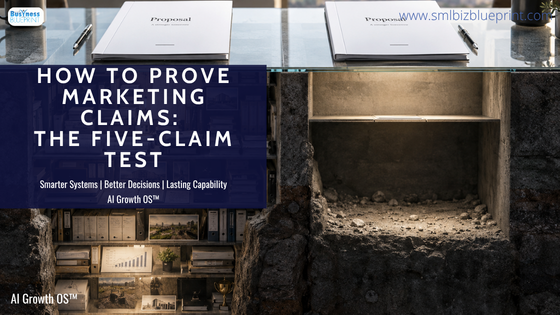
The Five-Claim Test helps business owners identify which commercially important claims are strongly supported, which are merely asserted, and which deserve stronger evidence next.
An uncomfortable question hides inside most good marketing.
What if the customer simply doesn’t believe you?
Not because the claim is false. Not because the marketing is poor. And not because the business lacks experience.
They just have no particularly good reason to believe it yet.
Look at the language used by established businesses:
Exceptional service. Decades of experience. Industry-leading expertise. Fast response. Proven results.
Often, these claims are perfectly reasonable. The business may have spent years earning the right to make them.
But earning a claim and proving a claim are different things.
That distinction matters more now because AI is weakening an old relationship. A professional website, thoughtful article or polished proposal once required meaningful effort and capability to produce. Increasingly, sophisticated expression can be created without equivalent depth behind it.
This doesn’t make the content worthless.
It changes what the content proves.
So the authority question is shifting from:
How do we sound more authoritative?
to:
What are the most important things we ask customers to believe about us—and what sits behind those claims?
That is where the Five-Claim Test begins.
Not with content.
With belief.

It Has Never Been Easier to Sound Credible
Most businesses approach authority as a communication problem.
If customers don’t understand our expertise, explain it better. If competitors are getting more attention, publish more. If our positioning isn’t strong enough, sharpen the message.
The assumption is that the constraint is expression.
Increasingly, it isn’t.
For years, the difficulty of producing sophisticated communication acted as an imperfect proxy for the capability behind it. A substantial article took expertise and effort. A polished proposal required people who understood the problem.
AI is breaking that proxy.
Businesses can now produce polished articles, proposals, presentations and sales material at a speed that previously required considerable resources.
That creates an important change:
The sophistication of the output no longer reliably signals the sophistication behind it.
Two companies can now look remarkably similar from the outside.
Both can explain the customer’s problem intelligently. Both can publish useful content. Both can present compelling proposals.
Yet one may have spent 15 years solving the problem across hundreds of situations. The other may simply be very good at expressing what solving the problem should look like.
This is usually treated as an AI-content problem.
It is really an authority signal problem.
Businesses have long relied on proxies for capability: polished communication, confident explanations and professional presentation.
Those proxies are becoming easier to reproduce.
The underlying capability isn’t.
So a more useful question emerges:
What can this business demonstrate that would be difficult for a less capable business to demonstrate?
Now we are looking somewhere different—at customer outcomes, decisions made, unusual situations handled, measurements, accumulated patterns and lessons learned.
Authority starts moving from what the business can say towards what it can show.
If professional expression is becoming abundant, producing more professional expression cannot remain the primary way you prove expertise.

Your Strongest Claims May Be Stronger Than Your Evidence
There is an obvious test for a marketing claim:
Is it true?
Necessary, but insufficient.
For an established business, the more interesting problem is often that a true claim is poorly connected to the evidence that supports it.
Consider a company that claims exceptional responsiveness.
Customers may regularly praise its service. Staff may solve problems quickly. The owner may recall dozens of examples where the company responded when competitors would not.
But where is that evidence?
Perhaps it is scattered through emails, customer conversations, support records and the memories of long-serving employees.
The business possesses the experience.
It just cannot readily produce it.
Ask a business owner for proof of an important claim, and you will often get a story. Ask where that story is documented and the answer changes.
That reveals something important:
A business can possess far more credibility than it can demonstrate.
And there is a deeper distinction underneath that.
Experience isn’t automatically an authority asset. Accessible experience is.
Businesses usually think of evidence as something marketing collects: testimonials, reviews, case studies, awards and customer logos.
But a much larger body of evidence is created inside the business every day.
A difficult customer issue resolved. A judgment call that prevented a mistake. A delivery promise consistently met. A pattern recognised after seeing the same problem repeatedly.
These aren’t marketing events.
They are operating events.
Marketing may eventually communicate the evidence. But much of the evidence itself is produced while the business serves customers, solves problems, makes decisions and delivers outcomes.
The authority system begins upstream of marketing.
That changes the problem. Authority isn’t created only by what a business publishes. It is created throughout the business and either captured or lost.
Start With the Five Claims Your Business Depends On
The natural response is to start collecting more evidence.
Don’t.
That simply creates another volume problem.
Established businesses make hundreds of explicit and implicit claims. Some concern outcomes. Others concern expertise, reliability, service, judgment or why the business is worth paying more for.
Trying to prove everything is unnecessary.
Instead, impose a constraint.
Imagine you could prove only five things about your business.
Not five things you want to say.
Five things a prospective customer would need to believe for choosing your business to make sense.
What would they be?
That is the Five-Claim Test.
The number matters because it forces commercial judgment. Which beliefs actually influence trust, preference or the buying decision?
One claim might concern an outcome:
We consistently reduce the time required to get this done.
Another might concern judgment:
We recognise problems less experienced providers tend to miss.
Another might concern reliability:
When we commit to a delivery date, we meet it.
Different businesses should arrive at different claims.
If every competitor can make the same five claims, you probably haven’t uncovered authority. You have uncovered category language.
“Quality.” “Service.” “Experience.” “Innovation.”
These aren’t necessarily weak claims.
They’re unfinished claims.
The useful question is:
What does this business know, do or consistently produce that makes the claim credible?
Or make the test harder:
If this claim disappeared from your website tomorrow, what evidence would allow a customer to reach the same conclusion anyway?
Now the claim is no longer carrying the evidence.
The evidence is carrying the claim.
Identifying the few beliefs that genuinely influence why customers choose you tells you where stronger evidence deserves attention.

Evidence Should Reduce Uncertainty
Suppose a business says:
Our customers stay with us because our service is exceptional.
It has 40 five-star reviews.
Evidence? Certainly.
Do those reviews establish that particular claim? Not necessarily.
They demonstrate satisfaction. They may not establish why customers stay or what “exceptional service” actually means.
This distinction is easily missed.
Twenty years in business demonstrates longevity, not automatically expertise. A major customer logo demonstrates a relationship existed, not what was achieved. A testimonial saying “great company” demonstrates satisfaction, not necessarily superior capability.
The issue is fit between claim and evidence.
The stronger the claim, the more the evidence needs to carry.
But customers aren’t conducting an academic proof exercise. They are making a decision under uncertainty.
So a better question is:
What would a reasonable customer need to see for this particular claim to become easier to believe?
That is the real job of evidence.
Not to remove every possible doubt, but to materially reduce uncertainty around something the customer needs to believe.
Sometimes that requires results. Sometimes measurement, examples, third-party validation or a detailed explanation of how the work actually happens.
And sometimes the strongest evidence is something businesses instinctively hide:
limitations.
A company that can explain where its approach works, where it doesn’t, what can go wrong and when it would recommend something else may demonstrate more expertise than one presenting unqualified certainty.
Limits are expensive to understand.
They are usually learned through experience.
AI can generate certainty cheaply. Knowing where certainty stops is harder.
You are not trying to look like the company with all the answers. You are becoming the company that can show why its answers deserve weight.
Experience Isn’t the Asset. Accessible Experience Is.
AI creates an interesting reversal.
As generic expression becomes less scarce, specific experience becomes more valuable.
AI can help a company structure an argument, draft a proposal, explain a concept or turn notes into a case study.
It cannot retroactively create the 300 projects already completed.
It cannot create the difficult decisions made under uncertainty, the pattern someone recognised after seeing the same failure repeatedly, or the exception that taught the company when to ignore its standard process.
That experience already exists.
But experience alone is not the advantage.
The advantage is being able to recover what the experience taught you when it matters.
Businesses routinely fail this test.
A project finishes. The customer receives the outcome. The invoice is paid. Everyone moves on.
On Tuesday, everyone remembers why the project was difficult. Six months later, perhaps the person who solved it still does. The business itself may remember almost nothing.
But something else was created.
The business learned.
The problem is that the learning didn’t necessarily become something the business could keep.
Imagine two companies completing 100 similar projects.
The first completes the work and moves on.
The second retains the important observations, decisions, exceptions, outcomes and lessons created along the way.
They haven’t simply completed the same amount of work.
They have become different businesses.
One has experience.
The other has accessible experience.
That distinction matters because accessible experience can be found, connected and reused in sales, proposals, customer conversations, decisions and marketing.
It also compounds.
Each completed project can either disappear into the history of the business or make the business slightly more capable of explaining what it knows, why it knows it and what evidence supports its judgment.
AI makes that difference more consequential.
The opportunity is not simply to use AI to create more content.
It is to make more of the business’s accumulated reality usable.
What Should You Look At Next?
Don’t start by rewriting the website.
Look at the claims.
Take the five things your business most needs customers to believe and treat them as business assertions rather than marketing statements.
If you claim superior expertise, where is the evidence?
If you claim reliability, where is it demonstrated?
If you claim better outcomes, which outcomes?
If you claim deep experience, what has that experience taught you that a less experienced competitor would be unlikely to know?
Then ask the uncomfortable version:
Could we prove this tomorrow?
Not: could someone write something convincing about it?
Could the business produce credible evidence without reconstructing its history from scratch?
Some claims will survive easily.
Others won’t.
Pay attention to those.
But don’t assume every failed claim needs more marketing evidence.
A weakly supported claim can reveal three very different problems.
Perhaps the reality itself is weak: the business doesn’t consistently deliver what it claims.
Perhaps the reality is strong, but the evidence isn’t being captured: outcomes happen, decisions are made, and customers benefit, but little survives.
Or perhaps the evidence already exists, but it is inaccessible: scattered across systems, projects, emails and people’s heads.
Don’t treat those as the same problem.
One points back to the business itself. The others point to what the business fails to retain or make usable.
An unsubstantiated claim may reveal a marketing weakness. Or it may reveal something about the business’s architecture.
Conclusion
AI will continue making businesses better at explaining themselves.
Everyone will sound increasingly capable.
Authority doesn’t disappear because of that. Some of the things we once mistook for authority simply lose their signalling power.
The advantage moves underneath them.
Towards what happened. What changed. What was learned. What can be measured. What customers experienced. What the business knows because it has actually done the work.
The Five-Claim Test isn’t about creating five better claims.
It is about discovering whether the claims your business depends on are connected to the reality that earned them.
Two very different paths lie ahead.
In one, AI helps the business produce increasingly sophisticated versions of the same assertions everyone else can make.
In the other, AI helps the business surface and use years of accumulated evidence that competitors cannot simply generate.
Both businesses may create better content.
Only one becomes harder to imitate.
Before you ask AI to help your business say more, ask which five things your business should be able to prove.
You may already have earned the authority.
The question is whether anyone can see it.
FAQs
Start with the claims that materially influence why a customer would choose your business, then identify evidence that directly supports each one. The immediate decision is not whether you need more content, but whether the evidence behind an important claim is strong enough for a reasonable customer to believe it.
What evidence should support marketing claims?
The evidence should match the specific claim: customer outcomes can support results, performance data can support reliability, documented decisions can demonstrate judgment, and examples or third-party validation can demonstrate experience. Ask what a reasonable customer would need to see to believe this particular claim, rather than collecting generic testimonials and assuming they prove everything.
How do you identify which marketing claims need proof?
Focus first on the claims carrying the most commercial weight—the beliefs customers rely on when deciding whether to choose, trust or pay more for your business. If removing a claim would materially weaken the case for choosing you, it deserves closer examination of the evidence behind it.
What is the Five-Claim Test?
The Five-Claim Test asks you to identify the five things customers most need to believe for choosing your business to make sense, then examine what evidence exists behind each one. The restriction to five prevents an indiscriminate evidence exercise and directs attention towards the claims most important to differentiation, trust and buying decisions.
Why does AI make evidence behind marketing claims more important?
AI makes sophisticated explanations, proposals, articles and other professional content easier for almost any business to produce, weakening polished communication as a standalone signal of capability. Businesses should therefore place greater weight on evidence competitors cannot simply generate: actual outcomes, accumulated experience, operational performance, documented judgment and lessons earned through doing the work.
What if a marketing claim is true but the business cannot easily prove it?
Treat that as an evidence gap rather than automatically assuming the claim or marketing is weak. Determine whether supporting evidence already exists in customer outcomes, project records, operational data or employee knowledge; if it does but cannot be readily accessed, the next priority may be capturing and retaining evidence rather than changing the claim.
How can a business turn its experience into stronger authority?
Look beyond published case studies and testimonials to the evidence created during everyday work: unusual problems solved, important decisions made, measurable outcomes achieved, exceptions encountered and lessons learned. The immediate question is whether that experience disappears when the work finishes or becomes accessible evidence the business can reuse when customers, sales teams or marketing need to substantiate an important claim.
Other Articles
When AI Has the Answers, What Should Your Content Do?