

Move beyond isolated automation by redesigning how customer intelligence, decisions and work flow across the growth system.
AI workflow redesign for sales and marketing starts with recognising that AI changes more than the speed of individual tasks—it changes the constraint around which the growth system was designed.
As intelligence becomes cheaper and more abundant, bottlenecks shift from producing work toward coordinating information, making decisions, managing exceptions and learning from outcomes.
Businesses create greater leverage when they redesign how customer intelligence, decisions and work move across Marketing and Sales, rather than simply adding AI automation to workflows built for scarce human intelligence.
AI is creating an uncomfortable operating reality for established businesses: teams can produce more work without the business becoming proportionately faster, simpler or easier to scale.
Marketing can analyse more customer data and produce more campaigns. Sales can research prospects, prepare conversations and develop proposals faster.
Customer information can be interpreted with a depth and frequency that would previously have required substantially more people.
Yet proposals still wait. Decisions still escalate. Customer knowledge remains fragmented between functions. Managers continue connecting information that should already be connected.
The owner remains involved in decisions that the organisation has made many times before.
The structural failure is not insufficient automation. It is a mismatch between the economics of intelligence and the architecture through which work moves.
Most established sales and marketing systems were designed when human intelligence was expensive. Research, analysis, interpretation, personalisation and judgement consumed significant human capacity.
Dividing work between specialist functions was therefore rational. Marketing generated demand. Sales converted it. Operations delivered it.
Customer Service managed what happened afterwards. Meetings, managers, reports and software helped information cross those boundaries.
AI changes one of the assumptions beneath that architecture.
Intelligence can now be applied repeatedly at much lower marginal cost. More enquiries can be analysed. More customer conversations can be interpreted. More proposals can be prepared. More signals can be identified. More variations can be evaluated.
But greater production does not remove the need for coordination and decisions. It exposes them.
That is the hidden operational tension.
A business can increase execution capacity while leaving decision capacity almost unchanged. The result is not necessarily visible failure.
It is accumulation: more completed work awaiting review, more recommendations requiring judgement, more exceptions reaching managers and more information competing for attention.
Teams often misdiagnose this as an adoption problem. The response is to improve prompts, add automation, introduce another system or encourage people to use AI more consistently.
Those interventions can increase output while making the underlying constraint worse.
The architectural principle is different: when the cost of intelligence falls, the growth system must be redesigned around the resources that remain scarce.
Those scarce resources increasingly include judgement, decision rights, coordination, trust and the organisation’s ability to turn what it learns into changed behaviour.
This changes the objective of AI workflow redesign for sales and marketing. The objective is not to automate the greatest possible number of tasks.
It is to determine how customer intelligence should move, which decisions can occur closer to the work, which exceptions genuinely require escalation and how outcomes should improve future decisions.
The financial consequences of ignoring this shift are easily underestimated because they rarely appear as a single line item.
They appear as management capacity consumed by routine approvals.
Sales opportunities waiting unnecessarily. Campaigns produced faster than the organisation can evaluate them. Customer knowledge repeatedly rediscovered. Senior people performing coordination work rather than improving the business.
AI expenditure increases while growth remains constrained by essentially the same dependencies.
There is also an opportunity cost. Every recurring decision that continues to depend unnecessarily on a senior person limits how much additional activity the organisation can absorb before that person becomes the constraint.
The issue therefore becomes architectural rather than technological.
A business designed around scarce intelligence optimises the production and transfer of information. A business designed around abundant intelligence must optimise the movement of decisions, exceptions and learning.
That requires structural redesign, not more effort.
The businesses that make this transition will not necessarily be those using the most AI. They will be those that redesign how work moves now that intelligence is no longer the constraint it once was.

Why Existing Sales and Marketing Workflows Were Designed This Way
Traditional sales and marketing workflows are not badly designed. They are designed around an old economic reality.
For decades, useful business intelligence was expensive because producing it required human time.
Consider a normal B2B sales process.
Marketing attracted prospects and collected enquiries. Someone reviewed them. Sales qualified them. A salesperson researched the prospect, held a conversation, recorded notes and decided what mattered. A proposal was prepared.
A manager might review pricing or terms. Follow-up occurred later. Customer feedback eventually found its way back to Marketing.
Every stage required human attention.
The logical response was specialisation.
Marketing generated demand. Sales converted it. Operations delivered what was sold. Customer Service dealt with what happened afterwards. CRM systems stored information between functions, while meetings, reports and managers helped coordinate them.
The system was designed to conserve scarce human intelligence by dividing work into manageable functional stages.
The familiar funnel and pipeline were logical consequences of that constraint.
Conventional advice about improving them—better handoffs, clearer CRM stages, tighter qualification criteria, disciplined follow-up—is therefore not wrong.
If people remain responsible for gathering, interpreting and transferring most information, those practices improve performance.
But there is a hidden assumption underneath the model:
Intelligence has to travel with the person performing the work.
A salesperson learns something in a customer conversation, so the knowledge largely remains with Sales until it is recorded, discussed or deliberately transferred elsewhere.
That creates latency.
A customer may explain why they rejected a proposal on Tuesday. Marketing might not learn from it until the next review. Another salesperson could encounter the same objection on Thursday without knowing the first conversation happened.
For years, that was an unavoidable cost of coordination.
Increasingly, it isn’t.
When AI changes the cost of capturing and interpreting what the business learns, the architecture created to ration human intelligence deserves to be reconsidered.
What that means for your business is simple: if Marketing, Sales and Customer Service each hold valuable customer knowledge but someone still has to manually connect it, the business is operating around a constraint that technology has already begun to remove.
The first instinct was to look at the slowest sales activities and ask which ones AI could accelerate.
Research became faster. Follow-ups became faster. Proposal preparation became faster. Then the uncomfortable pattern appeared: everything still arrived at the same decision points, only more frequently.
The mistake wasn’t choosing the wrong automation—it was assuming the surrounding workflow deserved to survive unchanged.
What Changes When Intelligence Becomes Abundant
AI does something more consequential than reducing the time required to complete tasks.
It reduces the cost of applying intelligence repeatedly.
A business could always research every prospect deeply before a sales call. It could analyse every customer conversation, personalise every follow-up, compare every lost deal for patterns and continuously adjust messaging around what buyers were actually saying.
The problem was economics.
Doing all of that required more people, more time and more management. So businesses rationed intelligence.
High-value prospects received more research. Important deals received more management attention. Customer feedback was sampled. Campaigns were reviewed periodically. Sales calls were coached selectively.
AI weakens that trade-off.
When intelligence becomes cheaper, activities that were economically sensible only for exceptional situations can become routine.
Every enquiry can potentially be interpreted. Every call can become structured customer intelligence. Every proposal can be assessed against agreed criteria. Every lost opportunity can contribute to understanding why customers hesitate.
This changes what a growth system can reasonably be expected to do.
It also creates a less obvious problem.
More intelligence creates more possible actions.
If AI identifies 30 buying signals instead of five, the business must determine which matter.
If Marketing can produce ten campaign variations instead of two, someone must decide what deserves attention. If Sales can prepare proposals three times faster but every non-standard proposal still requires the same manager, output simply reaches the constraint sooner.
Abundant intelligence does not remove constraints. It relocates them.
And that can produce a result that initially feels contradictory: the team becomes more productive while the business starts feeling more congested.
More gets finished. More waits.
The scarce resource increasingly becomes the capacity to decide and act. Coordination determines whether the right information reaches those decisions; trust and clear boundaries determine whether they can proceed without unnecessary intervention.
This is where businesses can misread AI progress. Increased output looks like successful adoption while queues quietly form around managers, approvals, exceptions and cross-functional decisions.
The business has increased execution capacity without increasing decision capacity at the same rate.
That mismatch changes where improvement should occur. Producing even more upstream of the bottleneck does not increase throughput. It increases pressure on the bottleneck.
When completed work is arriving faster but still waiting in the same places, the next AI investment should not automatically be more production.
The constraint is telling you where the architecture needs to change.

Why Adding AI to Existing Workflows Isn’t Enough
Automating an existing workflow usually preserves the logic of the existing workflow.
That is the weakness in the default approach to AI adoption.
Businesses understandably begin by asking what AI can perform: draft the email, summarise the meeting, research the prospect, create the campaign, update the CRM, prepare the proposal.
These can be useful improvements.
But consider what happens next.
AI researches the prospect and the salesperson reviews the research. It drafts the follow-up and the salesperson approves it. It prepares the proposal and the manager checks it. It analyses customer feedback, but someone still has to interpret what matters and decide what should change.
The individual activities take less time, yet the same people and decision points continue controlling whether the work moves.
Automation changes who performs a task. Redesign changes whether the task, handoff or approval should exist in its current form at all.
Take lead qualification.
The automation question is: Can AI qualify leads before Sales reviews them?
Workflow redesign asks something deeper.
What information determines whether an opportunity deserves attention? What confidence is sufficient? Which opportunities can progress within established rules? Which exceptions require judgement? What should the system learn when Sales overrides its recommendation?
The business is no longer simply automating qualification. It is redesigning how qualification works.
This is the behaviour worth challenging directly: stop measuring AI progress by how many tasks you have automated.
A business can automate dozens of activities and leave its most important dependencies untouched. Faster production can even intensify them.
A manager who previously reviewed five proposals might receive fifteen. Marketing can create more campaigns than the organisation can evaluate. Sales can generate more personalised outreach than the business can meaningfully learn from.
This explains why AI can produce genuine improvements in individual productivity without creating the expected leverage across the business. The productivity is real. So is the dependency it eventually encounters.
If AI completes the first 80% of more activities but the final decision repeatedly returns to the same people, you have reduced the cost of producing work while increasing demand on the people who release it.
Automating around a bottleneck does not remove it. It feeds it faster.
Where the New Growth Bottlenecks Appear
Once AI reduces the cost of producing intelligence and work, the immediate bottleneck moves toward decision capacity.
That distinction matters because several related problems often get grouped together.
Decision capacity is the organisation’s ability to turn reliable information into appropriate action. Coordination determines whether the right information reaches that decision. Trust determines whether the decision can proceed without unnecessary checking. Exception handling determines when human judgement genuinely needs to intervene.
These are not separate constraints competing for attention.
They are the conditions that determine whether decision capacity can expand as execution capacity increases.
Suppose Marketing identifies a change in customer behaviour within days rather than months. That intelligence could influence campaign messaging, qualification criteria, sales conversations and proposals.
But who can act on it?
If Marketing needs approval to change the campaign, Sales needs a meeting to adjust its approach, and the underlying evidence sits somewhere else, the business possesses the intelligence without possessing the ability to use it.
The value of intelligence is determined not by how much the business knows, but by how quickly reliable knowledge can change appropriate action.
This is where decision rights become critical. People need to know which decisions they own and which genuinely require escalation.
Trust matters for the same reason. If every AI-supported recommendation must be checked regardless of confidence, consequence or precedent, human review becomes a permanent validation layer.
Exceptions become more important too. As routine work moves with less intervention, scarce human judgement should concentrate on situations outside agreed boundaries rather than being spread across decisions the organisation already knows how to make.
Then there is coordination.
Historically, businesses coordinated through meetings, managers, reports, CRM updates and handoffs because information had to be collected and interpreted before another function could use it.
AI can reduce the cost of coordination itself.
When relevant customer signals can be interpreted continuously and made available at the point of action, some coordination can move from management activity into system design.
The manager does not disappear.
The manager stops being the courier.
You can often see the problem before anyone measures it. A manager starts Monday with several perfectly reasonable things waiting: a pricing exception, two proposals outside the usual terms, a campaign decision and a customer issue. Different functions. Different work. Same destination.
The system principle is simple: routine intelligence should travel to the point where it can change action; human judgement should concentrate where uncertainty, consequence or genuine exceptions justify it.
If managers spend increasing amounts of time reviewing completed work, transferring information and resolving recurring exceptions, leadership has quietly become the integration layer holding the growth system together.
There is a deeper cost. Every hour experienced people spend coordinating routine intelligence is an hour they cannot spend improving the rules by which the business operates.
The longer that remains unchanged, the more additional AI capacity amplifies leadership dependency rather than reducing it.
How to Redesign Sales and Marketing Workflows Around AI
AI workflow redesign should begin with decisions and information flow, not tools.
The simplest starting point is to stop drawing the workflow only as a sequence of tasks.
Instead, examine the customer journey and ask what must be known, decided and acted upon at each point.
Those three questions reveal the structure underneath the activity.
What must be known? identifies the information and signals required.
What must be decided? exposes the judgement, rule or authority controlling movement.
What action does that decision release? shows whether the workflow can actually continue or simply creates another handoff.
Consider an inbound sales opportunity.
The conventional workflow might be:
Lead arrives → Marketing qualifies → Sales contacts → discovery → proposal → approval → follow-up.
That describes activity. It does not describe the system underneath it.
A redesigned view asks different questions.
What must be known when the enquiry arrives?
Which signals determine priority?
What evidence changes that assessment?
Which decision moves the opportunity forward?
Who owns it?
Under what conditions can it happen without approval?
What action should follow immediately?
What should the business learn from the outcome?
Suddenly, the workflow changes.
A high-confidence enquiry might move directly to the appropriate salesperson with relevant context already assembled. A low-confidence enquiry may follow a different path.
Standard proposals inside agreed commercial boundaries may not require management approval. Exceptions do.
After the interaction, the intelligence should not simply disappear into a CRM record.
A pricing objection can inform future sales conversations. A repeated implementation concern can reach Operations. An emerging customer question can influence Marketing. A lost opportunity can change qualification logic.
A modern growth workflow is not merely a path along which work moves. It is a loop through which intelligence improves future work.
That is the redesign.
Map the customer journey. Identify recurring decisions. Define the information each requires. Establish ownership and boundaries. Determine where AI can analyse, recommend or act and where human judgement remains essential.
Then ensure outcomes feed back into the system.
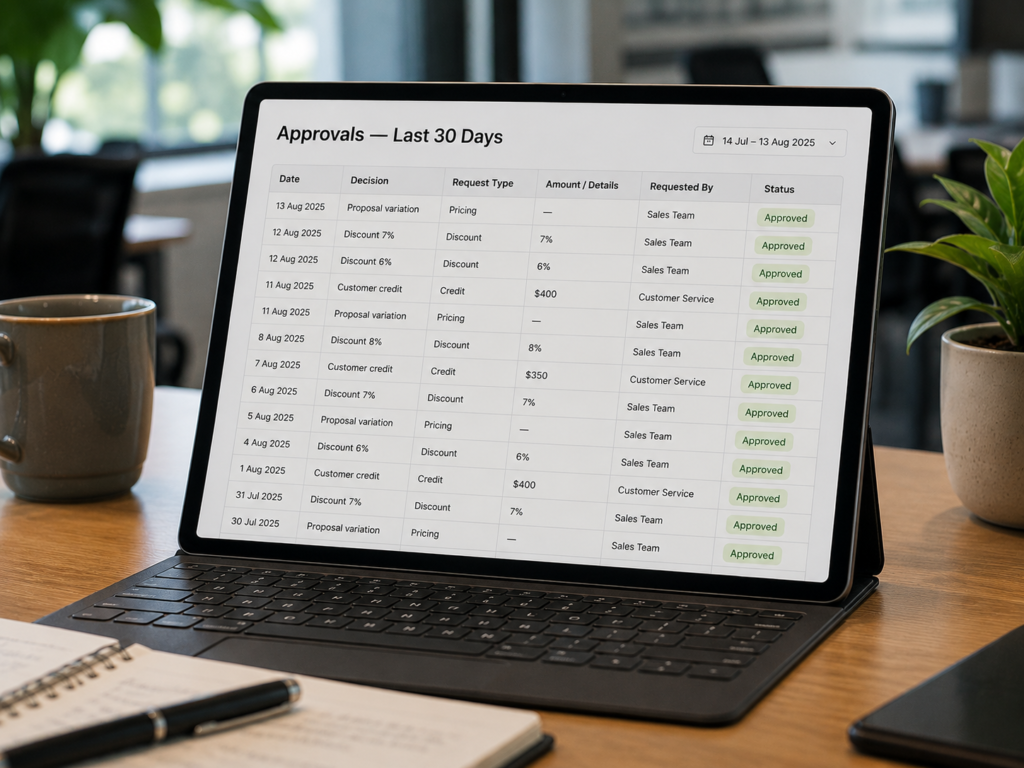
There is an awkward test here for an owner. Look at the decisions that reached you last week and ask how many were genuinely new.
If you have approved essentially the same discount, proposal variation or customer concession repeatedly, the business may no longer be benefiting from your judgement. It may simply be depending on your permission.
That distinction changes the leadership task.
The leader’s job is no longer to approve every good decision. It is to design the conditions under which good decisions can happen repeatedly.
If the same questions, approvals and exceptions continue reaching the same people despite AI being used throughout the workflow, the organisation has become faster at creating decisions without becoming better at distributing them.
Every recurring decision you fail to design becomes tomorrow’s bottleneck.
An established business owner had become the final stop for pricing exceptions, unusual proposals and sales decisions that didn’t quite fit the rules.
The breakthrough wasn’t automating his approvals; it was separating routine decisions from genuine exceptions and defining where authority belonged. Gradually, fewer decisions arrived at his desk while the important ones became easier to see.
He stopped being the person who released the work and became the person who improved how decisions were made.
What an AI-Enabled Growth System Looks Like in Practice
The clearest sign of a mature AI-enabled growth system is not more automation.
It is continuity.
Information discovered in one part of the customer journey changes the next appropriate action somewhere else without requiring people to repeatedly reconstruct the context.
That distinction matters.
A connected system does not simply share more information. It makes relevant intelligence usable at the point where it can affect what happens next.
Suppose a prospect tells Sales that their primary concern is not price but implementation disruption.
That conversation contains more than a sales note.
The concern can inform the salesperson’s next conversation. If the pattern appears repeatedly, Marketing can adjust messaging. Operations can examine whether onboarding evidence addresses the concern.
Future proposals can include the most relevant proof where appropriate.
No individual action is remarkable.
The architecture is.
The growth system becomes stronger when customer intelligence is captured once, interpreted continuously and made useful wherever it can improve the next decision.
This changes the role of the sales pipeline.
A conventional pipeline primarily tells the business where opportunities are.
A more intelligent growth system should also help explain why opportunities move, why they stall, which signals predict progression, what customers repeatedly need and which actions improve outcomes.
The pipeline becomes part of the operating context rather than merely a record of stages.
People remain central, but their work changes.
Salespeople spend less time reconstructing context. Marketers receive stronger signals from actual customer conversations. Managers intervene selectively rather than routinely.
Leaders can see where the system is breaking instead of repeatedly stitching it back together.
Not everything should move automatically.
High-consequence pricing decisions, unusual contractual terms, sensitive customer situations and ambiguous signals may still require human judgement.
That is not a failure of automation.
It is good system design.
The objective is not to remove people from the growth system. It is to stop spending scarce human judgement on situations the organisation already knows how to handle.
If Marketing, Sales and Service continually capture customer information but each function still reconstructs its own version of the customer, the organisation pays repeatedly to relearn what it already knows.
A connected growth system reduces that reconstruction. A learning system takes the next step and uses outcomes to improve future decisions.
That distinction matters because continuity comes first. The system must be able to carry intelligence across the business before it can compound what it learns from it.
A business that achieves that does not simply operate faster.
It operates with better context—and creates the foundation for the learning advantage that follows.
Where Competitive Advantage Moves Next
When everyone can access capable AI, access to intelligence becomes a weaker source of advantage.
For the last few years, businesses could gain ground simply by adopting AI earlier. A team using it for research, content, analysis or sales preparation could outperform one doing everything manually.
That advantage will narrow.
Similar models become widely available. Features spread between platforms. Competitors gain comparable production capabilities. Generating another campaign, analysis or personalised email becomes progressively less distinctive.
When a capability becomes abundant, advantage moves to what remains scarce.
What remains scarce is organisational clarity.
Can the business recognise the right customer signal?
Can it distinguish routine decisions from consequential ones?
Can intelligence cross functional boundaries?
Can people act without unnecessary escalation?
Can the system recognise when its assumptions are wrong?
And, increasingly, can it improve faster than competitors?
This leads to one of the more important consequences of AI-enabled growth systems:
The strongest AI advantage may eventually be learning speed rather than execution speed.
Two businesses could use similar AI models, CRM platforms and marketing technology. Both might automate comparable activities.
One captures what happens after decisions. It learns which signals matter. Outcomes improve its rules. Sales experience improves Marketing’s understanding. Customer issues change future qualification. Exceptions refine future decision boundaries.
The other completes tasks faster.
At first, the difference may look small.
Then it compounds.
This is why growth architecture becomes more important as AI capability becomes commonplace. Technology can increasingly be copied. A system shaped by thousands of your own customer interactions, decisions, exceptions and outcomes is considerably harder to reproduce.
That changes what leaders should ultimately be trying to build.
Not the business producing the most AI-generated work.
The business that becomes more capable because the work happened.
If competitors can access increasingly similar intelligence, productivity based purely on tools becomes temporary. The quality and speed of organisational learning become harder to copy.
The next competitive divide may not be between businesses that use AI and those that don’t. It may be between businesses that merely use intelligence and businesses that retain what it teaches them.
There will be a strange moment when two competing businesses have access to roughly the same intelligence.
Both can research quickly, personalise at scale and analyse almost anything. Yet one will keep getting better because every customer interaction changes what it knows and what it does next; the other will simply produce more.
At that point, the advantage won’t belong to the business with more AI—it will belong to the business that learns faster.
Conclusion
The frustrating part of AI adoption is that a business can become visibly more productive without becoming meaningfully easier to run.
More campaigns appear. Research arrives faster. Salespeople have better preparation. Proposals take less time.
Yet decisions still accumulate. Customer knowledge remains fragmented. Managers keep connecting functions manually. The owner continues to be pulled into situations the organisation should increasingly be capable of handling.
That is not simply an AI problem.
It is what happens when a new capability is inserted into an architecture designed around an old constraint.
Traditional sales and marketing workflows were built when human intelligence was expensive. Dividing work into functions, stages and handoffs was a sensible response.
AI changes that constraint.
Intelligence can now be applied more frequently, consistently and at far lower marginal cost. The opportunity is therefore larger than automating individual activities.
Businesses can redesign how customer intelligence moves, where decisions happen, what people own, when AI can act, where judgement belongs and how outcomes improve what happens next.
The relief comes from recognising that you do not need to automate everything.
You need to design deliberately.
Leave the existing architecture untouched and AI will continue making parts of the business faster. Eventually, those faster parts collide with decisions, handoffs and dependencies that have not changed.
Redesign the system and the experience is different.
Work moves without every routine decision travelling upward. People have the context they need. Customer intelligence crosses functional boundaries. Managers spend more time on exceptions and less time transferring information. Leaders improve the system instead of continually releasing the work trapped inside it.
And the business begins to retain what it learns.
That may prove more important than any individual productivity gain AI provides.
You can use AI to produce more work inside the business you already have.
Or you can use abundant intelligence as the reason to build a business that works differently.
The current architecture is not fixed. It was a response to constraints that once made sense.
Those constraints are changing.
The architecture can change with them.
Action Steps
Map decisions before automating tasks
Identify the recurring decisions inside the sales and marketing workflow, particularly those controlling qualification, pricing, proposals, follow-up and escalation. Why it matters: tasks reveal activity; decisions reveal where work actually stops. Decision consequence: determine which decisions require judgement, which can operate within defined boundaries and which should disappear entirely.
Find where completed work waits
Track where qualified leads, campaigns, proposals, recommendations and customer issues accumulate after the work itself is finished. Why it matters: AI can increase production without increasing throughput. Decision consequence: redesign the approval, ownership or information requirement causing the queue before increasing upstream capacity.
Define decision boundaries
Separate routine decisions from genuine exceptions and establish the commercial, operational and risk boundaries within which teams can act. Why it matters: unclear authority converts management into a permanent approval layer. Decision consequence: escalate exceptions rather than routinely escalating decisions.
Redesign how customer intelligence moves
Identify customer signals generated across Marketing, Sales and Service and determine where each signal could improve another decision. Why it matters: intelligence trapped inside functions forces the business to repeatedly relearn what it already knows. Decision consequence: route relevant intelligence to the point of action rather than simply storing it.
Build learning into the workflow
Capture what happened after important recommendations and decisions rather than recording only the activity itself. Why it matters: without outcomes, the system produces intelligence but cannot improve its judgement. Decision consequence: use results and overrides to refine future rules, signals and decision boundaries.
Measure flow, not AI activity
Track decision delays, exception rates, approval dependency and the time between signal and action alongside conventional productivity measures. Why it matters: more AI-generated output can disguise an unchanged constraint. Decision consequence: invest in the part of the system limiting throughput, not automatically in additional production capacity.
FAQs
AI workflow redesign changes how information, decisions and work move across Marketing and Sales rather than simply automating existing tasks. The immediate decision is whether AI is merely performing an existing activity faster or allowing the business to remove unnecessary handoffs, approvals and delays.
How is AI changing sales and marketing workflows?
AI reduces the cost of research, analysis, personalisation, interpretation and content production, allowing intelligence to be applied far more frequently. As production capacity increases, businesses need to decide how decision rights, customer signals and exceptions should move through the system without creating new management bottlenecks.
Why isn’t AI automation enough to improve business growth?
Automation can accelerate individual tasks while leaving the surrounding workflow unchanged. If faster work still reaches the same approval, handoff or decision bottleneck, the business should redesign that constraint before adding more automation upstream.
How do you redesign business workflows around AI?
Start by mapping recurring decisions and the information required to make them, rather than mapping tasks alone. Then determine which decisions require human judgement, which can happen within defined boundaries and which customer signals should automatically inform activity elsewhere in the growth system.
How can businesses scale AI beyond individual tools and use cases?
Scale comes from embedding intelligence into repeatable workflows and decision structures rather than accumulating isolated AI capabilities. The key decision is whether each implementation improves the movement of work, information or decisions across the business rather than merely making one employee more productive.
Where do bottlenecks move when AI increases productivity?
As AI reduces production constraints, bottlenecks increasingly appear around judgement, approvals, coordination, exceptions and trust. Businesses should look for completed work waiting for decisions because these queues often reveal the constraint that additional AI productivity will amplify.
How does AI improve the sales pipeline?
AI can make a sales pipeline more useful by continuously interpreting customer signals, identifying patterns and improving the information available at each decision point. The strategic shift is from treating the pipeline solely as a record of opportunity stages toward using it as part of a system that learns why opportunities progress, stall or disappear.
What creates competitive advantage when every business has access to AI?
Access to AI becomes less differentiating as similar capabilities become widely available. Advantage increasingly comes from how quickly a business converts customer signals and outcomes into better decisions, making organisational learning speed more defensible than raw AI production speed.
Bonus: Three Shifts Worth Thinking About
Most businesses are still judging AI by visible activity: faster output, fewer manual tasks, better research, more personalised communication. That feels sensible because productivity is easy to see.
But some of the most consequential changes are happening somewhere less obvious: in what the business no longer needs people to coordinate, approve or repeatedly rediscover.
You may be automating the wrong side of the bottleneck
This is what you are doing wrong: increasing production before examining what happens to the work afterwards.
Making proposals faster has limited value when every proposal still reaches the same manager. Generating more leads creates little leverage when qualification and follow-up cannot absorb them.
If this doesn’t change: AI keeps feeding the constraint rather than removing it.
The better question is not what can AI produce? It is what currently prevents produced work from moving?
Management may be performing hidden integration work
Managers often appear to be making decisions when they are actually connecting fragmented information: asking Sales what happened, checking with Operations, interpreting a report, then passing the answer somewhere else.
That coordination was once necessary.
With better information flow, some of it becomes architecture rather than management.
If this doesn’t change: senior capacity remains consumed by keeping functions connected manually.
The aspiration is not fewer managers. It is managers applying judgement where judgement genuinely matters.
Your most valuable AI asset may be what the business learns
AI capabilities will spread. Your accumulated learning will not spread with them.
Every customer interaction, exception, lost opportunity and decision outcome can improve how the next situation is handled.
If this doesn’t change: the business gets faster without becoming progressively smarter.
That may ultimately be the more interesting AI question: not how much intelligence the business can access, but how much intelligence it retains.
Other Articles
AI Growth System Architecture Is Replacing Marketing Funnels