
Turn AI into an enforcement layer that standardises actions and removes guesswork
AI cognitive load reduction systems work by removing decisions—not generating more options.
Most AI implementations fail because they increase thinking overhead instead of enforcing clear actions across workflows.
The real advantage comes when AI standardises decisions, reduces variability, and enables consistent execution without constant human input.
He added three AI tools to speed up marketing. Within weeks, the team was producing more—but publishing less.
Every piece required review, debate, and revision. The shift came when he realised the tools weren’t the problem—the decisions were. He stopped asking for options and started defining outcomes.
He stopped managing outputs and started controlling decisions.
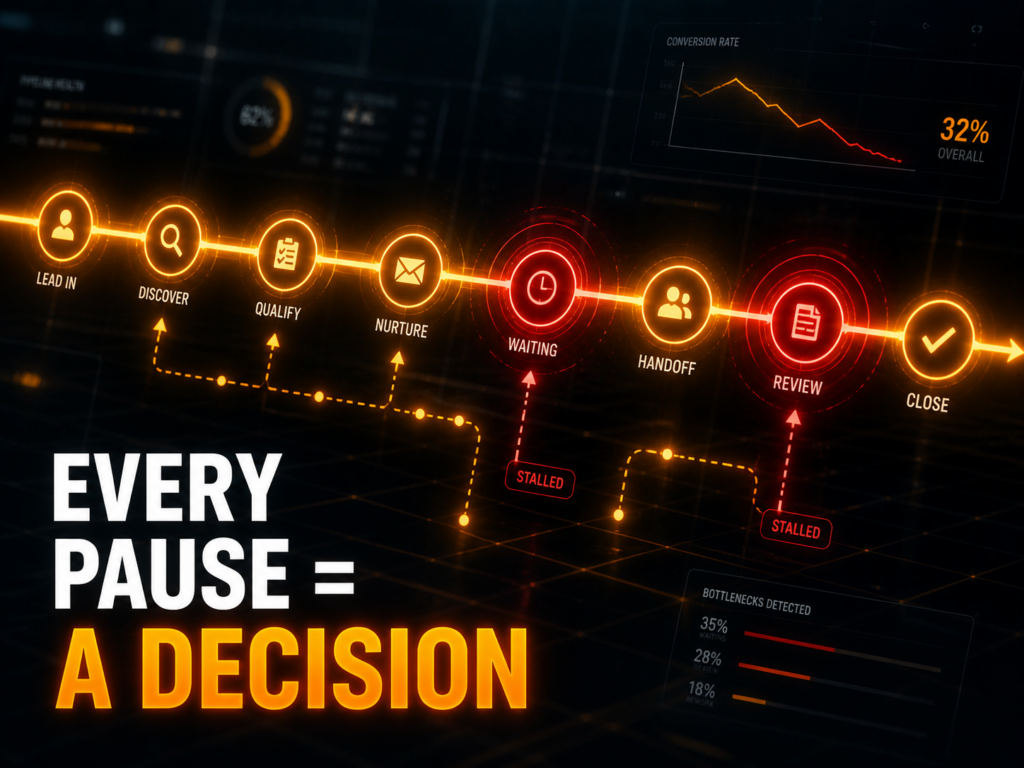
Most businesses believe they have an execution problem. What they actually have is a decision architecture failure.
Decision architecture is the set of rules that determines who decides, when they decide, and what happens next. Most businesses never define it—so decisions default to individuals instead of systems.
AI was introduced to increase speed and leverage. Instead, it has exposed a structural weakness: too many decisions exist inside the system, and none of them are owned. Every output creates another moment of interpretation. Every workflow pauses for judgment.
Execution slows—not because teams are incapable, but because the system requires them to think too often.
This is the hidden operational tension.
On the surface, activity increases. More content. More data. More interactions.
But underneath, decision density expands. The number of choices required to move work forward grows silently. Effort increases without proportional progress.
Most teams misdiagnose this as a tooling problem. They assume the issue is capability, adoption, or training. So they add more tools, refine prompts, or increase oversight.
This compounds the problem.
Each addition introduces new variables, new outputs, and new decisions. Complexity becomes embedded.
The core failure is structural: AI has been implemented as a generation layer, not a decision system.
Generation layers produce options. Decision systems remove them.
This distinction defines whether AI reduces or increases cognitive load.
When AI generates options, it expands the decision surface. Teams are forced to interpret what should already be defined. Execution becomes inconsistent. Outcomes depend on individual judgment instead of system logic.
Over time, this leads to operational drift.
Sales conversations vary. Marketing outputs lose coherence. Processes fragment.
The financial impact compounds quietly:
Slower deal cycles. Lower conversion consistency. Increased reliance on senior oversight. Reduced scalability.
This is not a performance issue. It is a design flaw.
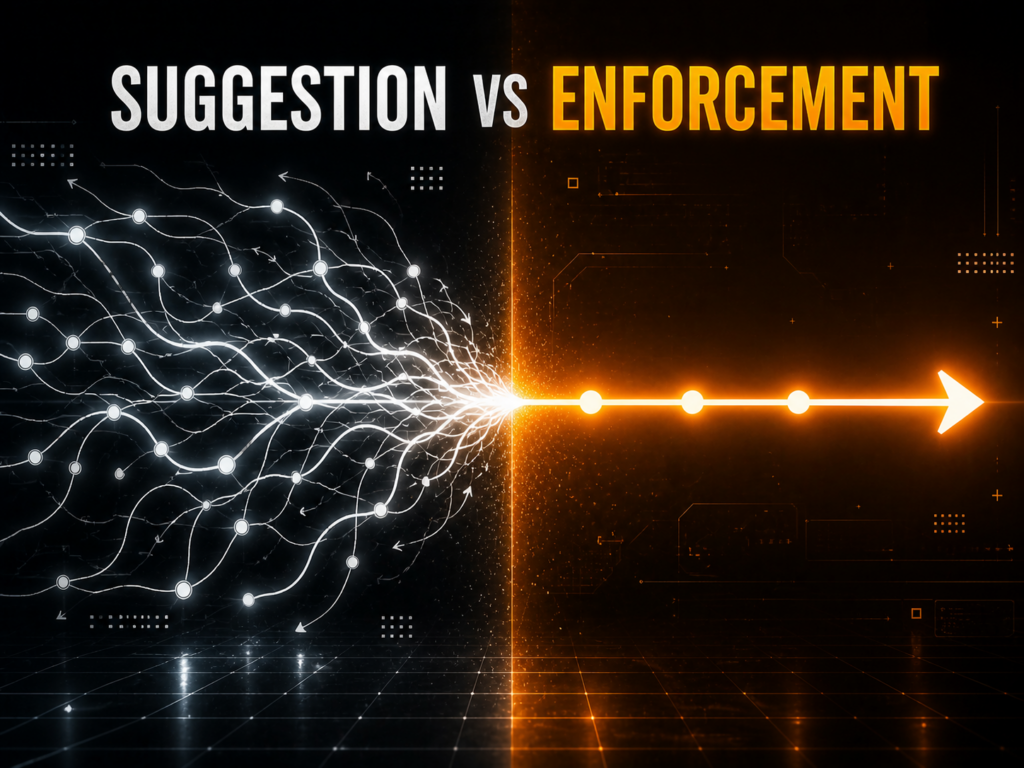
The alternative is to treat AI as an enforcement layer.
An enforcement layer converts conditions into predetermined actions. It removes repeated decisions by encoding them into the system. Instead of asking “what should we do?”, the system executes based on defined logic.
This reframes AI from assistance to control.
Control does not mean rigidity. It means consistency. It ensures repeatable scenarios are handled the same way every time. Cognitive load decreases at scale.
The architectural principle is simple: reduce the number of decisions required to produce an outcome.
When decision count decreases, speed increases. Variability decreases. Execution becomes predictable.
Ignoring this shift carries a clear consequence.
The business continues to scale activity without improving efficiency. Teams remain busy but constrained. Growth becomes dependent on human decision capacity.
The solution is not more effort. It is structural redesign.
AI must move from supporting thinking to removing unnecessary thinking.
The Hidden Cost of AI: Increased Cognitive Load
AI increases cognitive load when it expands decisions instead of collapsing them.
Most implementations are built around output generation—more ideas, more variations, more assistance. But every output creates a new decision point.
Accept it. Edit it. Ignore it.
So instead of removing work, AI redistributes it into thinking.
Your marketing team reviews multiple options instead of committing to direction.
Your sales team improvises instead of following structured steps.
Your operations team debates scenarios instead of executing defaults.
The result is subtle but compounding: slower decisions and inconsistent execution.
This is why your sales team keeps re-explaining the same thing on calls.
Because nothing is standardised.
The default belief is that more options create better outcomes.
In operating systems, more options delay commitment—and delay compounds across the system.
System definition: AI systems that generate options increase cognitive load by expanding the number of decisions required to act.
Consequence: When every action requires interpretation, execution slows and quality becomes inconsistent.
The longer this stays the same, the more your business drifts into variability—where outcomes depend on who is thinking, not what the system dictates.
Pro tip
Measure AI by decision reduction, not output volume.
Because the advantage isn’t what AI generates—it’s what it eliminates.
If your team is still thinking at every step, AI hasn’t reduced complexity—it’s hidden it.

Why Most AI Implementations Add Thinking Overhead
Most AI fails because it’s layered onto chaos, not designed to resolve it.
Businesses adopt tools without defining the decisions those tools should make. So AI generates outputs—but no clear path forward.
Teams are left asking: “What do we do with this?”
That question is the failure point.
Because every unanswered “what do we do?” introduces latency. Not just in time—but in confidence. Teams hesitate, escalate, or defer—and execution fragments.
AI without decision architecture relocates thinking downstream.
Marketing generates more but struggles to choose.
Sales gathers insights but still improvises.
Operations sees alerts but lacks defined responses.
This is why deals feel close but stall.
System definition: AI without predefined decision pathways increases cognitive overhead by forcing humans to interpret outputs before acting.
Consequence: Teams become slower and less confident, even while using advanced tools.
The deeper issue: businesses optimise for flexibility when they should optimise for constraint.
Flexibility feels intelligent. Constraint creates execution.
Without constraint, AI becomes a suggestion engine. Suggestion engines don’t scale.
The longer this continues, the more your business depends on individual judgment instead of system logic.
Pro tip
Before implementing AI, define the decision it will own—not assist.
Because clarity at the decision level removes ambiguity everywhere else.
If AI still requires interpretation, it hasn’t automated anything meaningful.
From Automation to Enforcement: Redefining AI’s Role
AI should not assist decisions. It should enforce them.
Automation speeds up tasks. Enforcement ensures the right action happens every time.
Automation expands choice. Enforcement removes it.
And the removal is not a limitation—it’s compression. It collapses variability into a single, repeatable path.
Decision fatigue is caused by variability—too many possible paths, too many exceptions, too many moments where someone must stop and think.
Enforcement eliminates that.
System definition: AI as an enforcement layer standardises decisions by converting conditions into predetermined actions.
Consequence: Without enforcement, execution becomes inconsistent and dependent on human judgment.
Most businesses hesitate here. They fear losing flexibility.
What they’re actually protecting is inconsistency.
Your best-performing actions are already predictable. You just haven’t formalised them.
So your team keeps re-deciding what should already be locked in.
You’re not building a smarter team. You’re building a system that makes smart decisions inevitable.
Pro tip
Identify repeat decisions with predictable outcomes—and encode them as rules.
Once predictable, a decision should no longer be manual.
Every decision you don’t standardise becomes friction your competitors can remove.
Designing AI Cognitive Load Reduction Systems
Cognitive load reduction is designed, not accidental.
Start with a different question:
Where is thinking currently required that shouldn’t be?
That exposes decision nodes—points where work pauses for judgment.
Most of them are unnecessary.
The principle is simple: convert decision nodes into rule-based actions.
If a lead meets criteria → route automatically.
If a deal reaches stage → trigger next step.
If a threshold is met → adjust without intervention.
No interpretation. No delay.
For example: if a lead visits pricing twice, matches ICP criteria, and downloads a guide—AI should not suggest follow-up options.
It should assign the lead, trigger the follow-up sequence, update CRM stage, and notify sales with the next action already defined.
System definition: Cognitive load reduction systems replace human decision points with predefined logic that executes automatically.
Consequence: Without this, teams become bottlenecks and speed depends on availability.
This is why your pipeline looks strong but doesn’t convert consistently.
Because movement depends on people deciding—not systems progressing.
The overlooked leverage is not at the task level—but at the sequence level.
When decision flow is structured end-to-end, individual decisions disappear.
The longer your system requires checkpoints, the more it accumulates delay.
A founder noticed their sales pipeline was active but inconsistent.
Leads entered, but conversion varied wildly. They mapped decisions instead of tasks—and removed half of them. Follow-ups became automatic. Qualification became fixed.
Within months, the pipeline didn’t just grow—it stabilised. The business stopped reacting and started executing.
Pro tip
Map decision flow end-to-end and remove every step that can be predetermined.
Speed comes from less thinking, not faster thinking.
If your business pauses between steps, growth is capped by decision speed—not demand.
Eliminating Decision Fatigue Through Standardisation
Decision fatigue disappears when variation is reduced.
Not completely—but strategically.
Standardisation defines default actions for recurring scenarios. This removes repeated decisions and concentrates thinking where it matters.
System definition: Standardisation reduces cognitive load by defining default actions for recurring scenarios.
Consequence: Without it, teams waste energy re-solving known problems, leading to burnout and inconsistency.
If your team is making the same decision more than twice, the system is broken.
That’s not a people issue. It’s design failure.
Every week this stays manual, you lose efficiency you never see—embedded in slower cycles and missed follow-ups.
This is why deals feel close but stall.
Standardisation doesn’t eliminate thinking. It concentrates it.
You decide once—correctly—and enforce it at scale.
Pro tip
Create default paths for common scenarios.
Once defined, deviation becomes intentional—not accidental.
Allowing variation in repeat decisions forces your business to depend on memory instead of systems.
Measuring Whether AI Is Actually Reducing Complexity
If you don’t measure cognitive load, you optimise the wrong thing.
Most businesses track output—tasks completed, content created.
None of these indicate whether thinking has been reduced.
The real metric: decisions required per outcome.
Fewer decisions = lower cognitive load = faster execution.
System definition: Complexity is measured by the number of decisions required per outcome.
Consequence: Tracking outputs instead of decisions scales activity while increasing internal friction.
Look at your workflows.
How often does work pause for input, approval, or interpretation?
Those pauses are friction.
If ignored, the business scales effort—not efficiency.
Pro tip
Track decisions per workflow.
Once visible, cognitive load can be systematically reduced.
If AI hasn’t reduced decisions, it hasn’t reduced complexity.
Most teams don’t lack intelligence—they suffer from excess choice.
The more options they have, the less they commit. The moment decisions are removed, execution sharpens.
The shift isn’t capability—it’s constraint.
Conclusion
You didn’t adopt AI to think more. But that’s what most systems create.
More outputs. More decisions. More friction.
The shift is simple—but structural.
AI should remove decisions where thinking no longer adds value.
It should enforce what already works.
It should standardise execution.
That’s where speed, consistency, and scale come from.
Most businesses won’t make this shift. They’ll keep adding tools, increasing activity, and wondering why complexity grows.
Identity line: You’re not here to manage more decisions. You’re here to eliminate the ones that shouldn’t exist.
So the choice is clear:
Continue operating in a system that requires constant thinking.
Or build one that removes it.
Because the longer you stay in the first, the more your growth is constrained by decision speed.
And that’s a cost you can choose to remove.
Action Steps
Audit decision density across workflows
Map how many decisions are required to move work from start to completion. This reveals hidden cognitive load.
Decision consequence: You identify where thinking is unnecessary and where enforcement should replace interpretation.
Define ownership at the decision level
Ensure every AI system owns a specific decision, not just generates outputs.
Decision consequence: You remove ambiguity and eliminate delays caused by interpretation.
Replace repeat decisions with rule-based triggers
Convert predictable scenarios into predefined actions.
Decision consequence: You standardise execution and reduce dependency on individual judgment.
Design default pathways for workflows
Create fixed sequences where most cases follow a standard path.
Decision consequence: You increase speed and consistency while reserving thinking for exceptions.
Track decisions per workflow
Use decision count as a proxy for complexity.
Decision consequence: You gain visibility into where cognitive load is limiting scale.
Eliminate outputs that require interpretation
Redesign AI outputs into direct execution triggers.
Decision consequence: You shift AI from suggestion engine to enforcement system.
FAQs
What is the main reason AI increases cognitive load?
Because it generates options instead of enforcing actions, forcing teams to interpret before acting.
How do I know if AI is reducing complexity?
Measure decisions per workflow. If they haven’t decreased, complexity remains.
What does AI as an enforcement layer mean?
It executes predefined actions based on conditions, removing variability and standardising outcomes.
Why do AI tools make teams feel slower?
They increase decision surfaces without reducing responsibility, shifting work into thinking.
What should be standardised?
Repeatable decisions with predictable outcomes. Leave edge cases flexible.
Can reducing decisions limit innovation?
No. It increases capacity for higher-value thinking by removing low-value decisions.
Bonus Section: What Most Leaders Get Wrong About AI and Thinking
Most leaders believe AI should make their teams smarter.
That assumption is quietly damaging the business.
Because the more you optimise for intelligence at the individual level, the more you ignore the system that forces them to think in the first place.
The tension is simple: you’re trying to improve thinking instead of eliminating unnecessary decisions.
You’re Optimising for Better Decisions Instead of Fewer Decisions
This is what you are doing wrong and why it matters.
You keep trying to improve decision quality instead of reducing decision quantity.
Better decisions feel like progress. But they don’t scale.
Fewer decisions do.
If this doesn’t change, your business remains dependent on human capacity—not system design.
You Treat Variability as Intelligence
Most operators believe flexibility signals sophistication.
In reality, it signals inconsistency.
The best systems are not the most adaptable—they are the most predictable under normal conditions.
If this continues, your outcomes will always depend on who is executing, not what is defined.
You Measure Output Instead of Friction
More content. More activity. More data.
All of it looks like progress.
But friction lives in the gaps between actions—the pauses, approvals, and decisions.
If you don’t measure friction, you will scale effort without reducing complexity.
If this continues, your business will grow heavier with every layer you add.
Other Articles
AI Decision Intelligence That Cuts Decision Latency