
How continuity gaps and automation failures quietly erode revenue
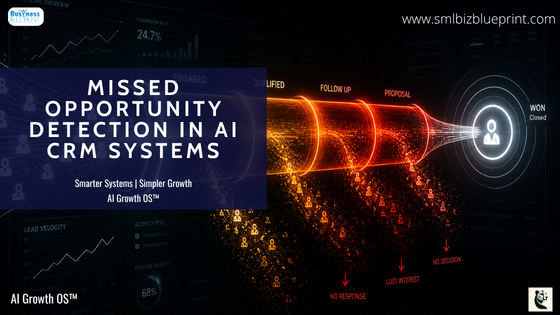
Missed opportunity detection in AI CRM systems ensures every lead and revenue interaction reaches a defined outcome instead of silently failing.
By enforcing signal thresholds, escalation rules, and resolution tracking, businesses detect breakdowns in real time and recover lost opportunities before they compound.
This creates a controlled revenue system where continuity is enforced, accountability is visible, and growth becomes predictable.
The Structural Failure
Most revenue systems are designed to initiate action, not to guarantee completion.
A lead enters. A workflow triggers. Activity begins. And then—nothing.
Not because the system breaks in a visible way, but because it was never designed to confirm whether the process reached an outcome.
AI and CRM layers are typically built as forward-moving pipelines. They trigger sequences, assign tasks, and generate activity. But they rarely enforce resolution.
This is the structural failure.
Missed opportunity detection is not about better reporting. It is about ensuring that every initiated process reaches a defined end state.
Most teams misdiagnose this as a tooling gap.
They look for more dashboards, more notifications, or faster automation.
But the issue is not visibility or speed. It is the absence of a control layer that enforces completion.
Without that layer, the system does not break—it drifts.
And drift is harder to detect than failure.

The Hidden Cost
At low volume, missed opportunities appear isolated.
A delayed response. A follow-up that never happens. A lead that quietly expires.
At scale, these are not isolated events. They are patterns.
Each missed interaction is not just a lost deal. It is a break in system integrity.
The tension is simple: revenue is being lost without a corresponding signal.
No alert. No escalation. No recovery.
The system continues to show activity, giving the appearance of performance. But underneath, it is leaking.
This creates three structural consequences.
Revenue decay. Opportunities that should convert never reach a decision point.
Accountability erosion. No one owns the failure because it is never surfaced.
False confidence. Metrics reflect movement, not outcomes.
The risk is not inefficiency.
It is operating without awareness of where and why revenue is being lost.
And that lack of awareness compounds.
The Architectural Principle
The solution is not more automation. It is controlled automation.
Specifically, continuity enforcement through signal visibility and resolution tracking.
Most systems operate on trigger logic. An action occurs, and the system moves forward.
But trigger-based systems assume completion.
A resolution-based system does not.
It tracks every initiated interaction until it reaches a defined outcome.
Converted. Lost. Disqualified. Deferred.
Anything else is treated as an unresolved state.
This shift reduces entropy.
Because entropy in business systems is the accumulation of incomplete processes.
Unresolved interactions create uncertainty. Over time, that uncertainty becomes systemic drift.
Missed opportunity detection exists to eliminate that drift by closing every loop.
The principle is simple: no revenue interaction is allowed to disappear without classification.
This is not additional complexity.
It is structural discipline.
The Signal Logic
Continuity cannot be enforced without detecting absence.
Most systems are built to track what happens.
Very few are designed to detect what does not.
Missed opportunity detection relies on four signal types.
Expected action signals define what should occur after a trigger. A lead should receive a response within a defined time window.
Time-based thresholds define when inaction becomes failure. Not every delay matters, but beyond a certain point it becomes revenue risk.
State progression signals track whether an opportunity is moving through defined stages. Stagnation is treated as a signal, not a neutral condition.
Completion signals confirm that an interaction has reached a terminal state.
Together, these signals shift the system from monitoring activity to monitoring deviation.
From these signals, three decision layers are applied.
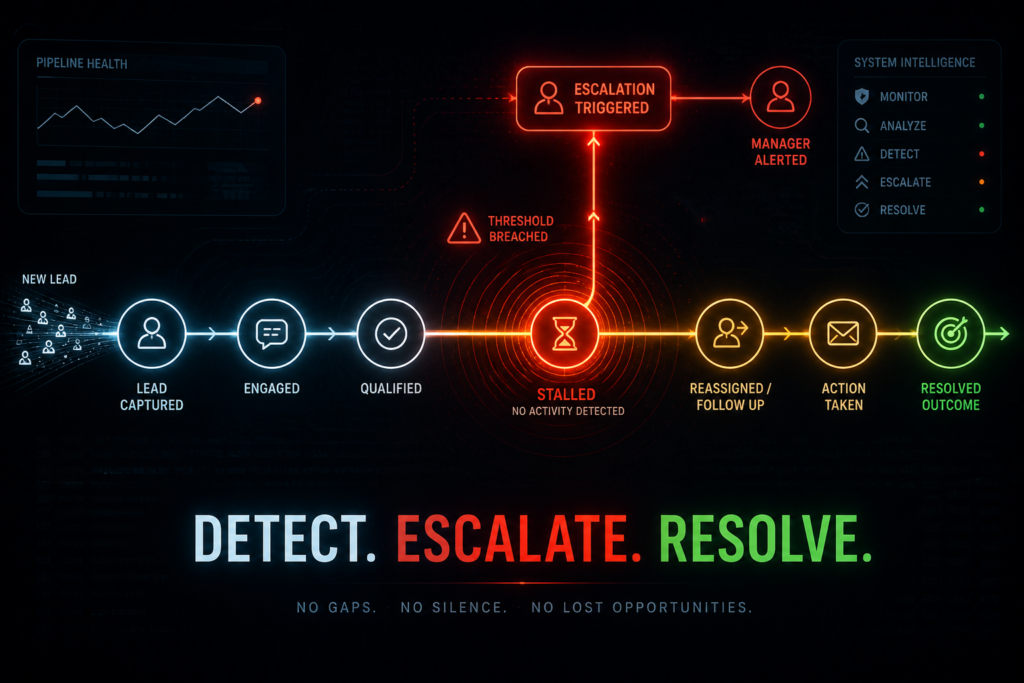
Detection identifies when expected actions fail within defined thresholds.
Classification determines whether the issue is a delay, breakdown, or disqualification.
Escalation assigns responsibility for recovery.
This is where most systems fail.
They detect issues but do not act on them.
Or they notify without enforcing resolution.
Signal logic without decision logic creates noise.
And noise does not restore continuity.

The Automation Layer
Once signal and decision logic are defined, automation becomes a control mechanism.
Not a way to increase speed—but a way to ensure nothing is lost.
The automation layer operates across three functions.
Detection continuously scans for threshold breaches. A lead without response. A deal that has not progressed. A sequence that ends without engagement.
These are not reports. They are active triggers.
Classification assigns context to each failure. A high-value lead without response is treated differently from a low-intent lead.
The system applies priority, not just flags.
Escalation enforces correction.
Opportunities are reassigned. Follow-ups are triggered. Recovery sequences are activated. Management is notified when thresholds are repeatedly breached.
No failure remains passive.
Every gap produces a defined response.
Not a notification.
A correction.
What this means in practice is direct.
If a qualified lead enters the system and is not contacted within the defined window, the system intervenes.
It reassigns, re-engages, or escalates.
The failure is resolved, not recorded.
There is no silent loss.
The Stability Outcome
When continuity is enforced, the system changes at a structural level.
Drift is reduced because incomplete processes are continuously identified and resolved.
Predictability increases because outcomes are no longer dependent on perfect execution.
The system compensates for inconsistency.
Marketing and sales alignment improves because handoffs are no longer assumed—they are validated.
Every transition is monitored.
Every gap is surfaced.
Every failure is actionable.
Over time, this builds structural integrity.
Revenue becomes less sensitive to individual performance.
Growth becomes less dependent on operational precision.
The system begins to behave as a controlled environment rather than a collection of activities.
This is the role of automation at scale.
Not acceleration.
Stability.
Because the constraint is not effort.
It is integrity.
And integrity determines whether growth compounds—or erodes under complexity.
Conclusion
Most systems are built to generate activity.
Very few are built to guarantee outcomes.
That distinction defines whether growth is controlled or exposed.
Missed opportunity detection closes the gap between intent and execution. It ensures that every initiated revenue process is accounted for, resolved, and classified.
Without it, automation amplifies drift. It scales inconsistency and hides failure behind activity.
With it, gaps are visible, failures are actionable, and revenue is no longer dependent on perfect execution.
Continuity becomes enforced.
Predictability follows.
Automation shifts from task execution to system control.
From speed to stability.
From activity to integrity.
And once integrity is established, growth becomes repeatable, compounding, and structurally reliable.
FAQs
How do I detect missed opportunities in my AI CRM system?
Define response-time thresholds for key actions and trigger alerts when they are breached. This exposes failures in real time instead of after revenue is lost. Start by enforcing a response window on qualified leads.
Why do most CRM systems fail to prevent revenue loss?
They track activity instead of enforcing outcomes, assuming processes complete without verification. This creates blind spots where opportunities disappear. Shift to requiring every interaction to reach a defined state—won, lost, or exited.
What is the fastest way to recover lost leads automatically?
Use escalation rules to reassign or re-engage leads when inactivity exceeds thresholds. This ensures no opportunity remains idle. Prioritise high-value leads first to maximise impact.
How do I know if my automation is degrading performance?
Monitor stagnation—leads or deals that stop progressing within expected timeframes. This indicates system drift, not isolated delay. Treat inactivity as a failure condition that requires action.
Where should accountability sit in an automated system?
Attach ownership to unresolved states so every stalled opportunity has a responsible party. This prevents invisible failures. Enforce escalation when thresholds are missed.
What signals matter most for continuity enforcement?
Response time, stage progression, and completion status define whether the system is functioning. These signals reveal breakdowns early. Standardise them across marketing and sales.
How does missed opportunity detection improve revenue predictability?
It eliminates silent failures by ensuring every opportunity is tracked and resolved. This reduces variability caused by inconsistent execution. Implement continuous detection and recovery loops.
Other Articles
AI Decision Systems for Mid-Sized Growth Companies