
The hidden decision gaps killing performance
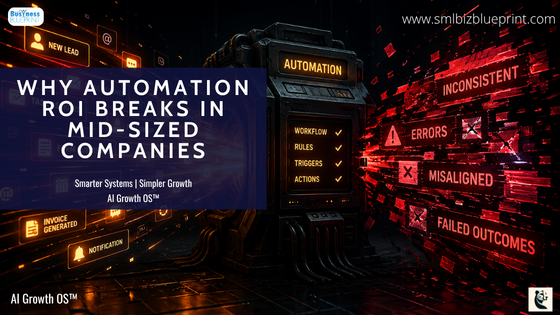
Automation ROI breaks in mid-sized companies because businesses scale execution before defining how decisions should be made.
Automation doesn’t fix inefficiencies—it enforces them, accelerating inconsistent logic across the system.
Real returns come from building decision architecture first, then using AI to enforce consistent, scalable decision-making.
You invested in automation to create leverage.
Instead, you created noise.
The systems are running. Workflows fire constantly. Activity is up across the board. But revenue hasn’t followed. Margins feel tighter. Teams are busier—and still chasing clarity.
No one can point to a single failure point. That’s the problem.
This is the tension most mid-sized companies live in: you did what you were told. You adopted tools, connected systems, automated tasks.
Yet the return feels diluted—spread across activity instead of concentrated into outcomes.
What’s at risk isn’t just wasted spend. It’s structural drift.
When automation scales without clarity, it compounds inconsistency. Small inefficiencies multiply. Misaligned processes become embedded.
Over time, your business moves faster… but with less control.
That’s how it shows up:
Teams doing more work, closing fewer deals
Pipelines that look strong but convert unevenly
Decisions varying depending on who touches the system
You don’t have a capacity problem. You have a coherence problem.
And most businesses don’t realise that until growth starts slowing—while activity keeps rising.
Here’s the shift most businesses miss: automation doesn’t create value. It enforces whatever logic already exists. If that logic is unclear or inconsistent, automation amplifies the problem.
There’s another path. One where automation becomes control, not activity. Where AI doesn’t just execute—it enforces how decisions are made.
See that difference, and you stop chasing tools. You start rebuilding the system.
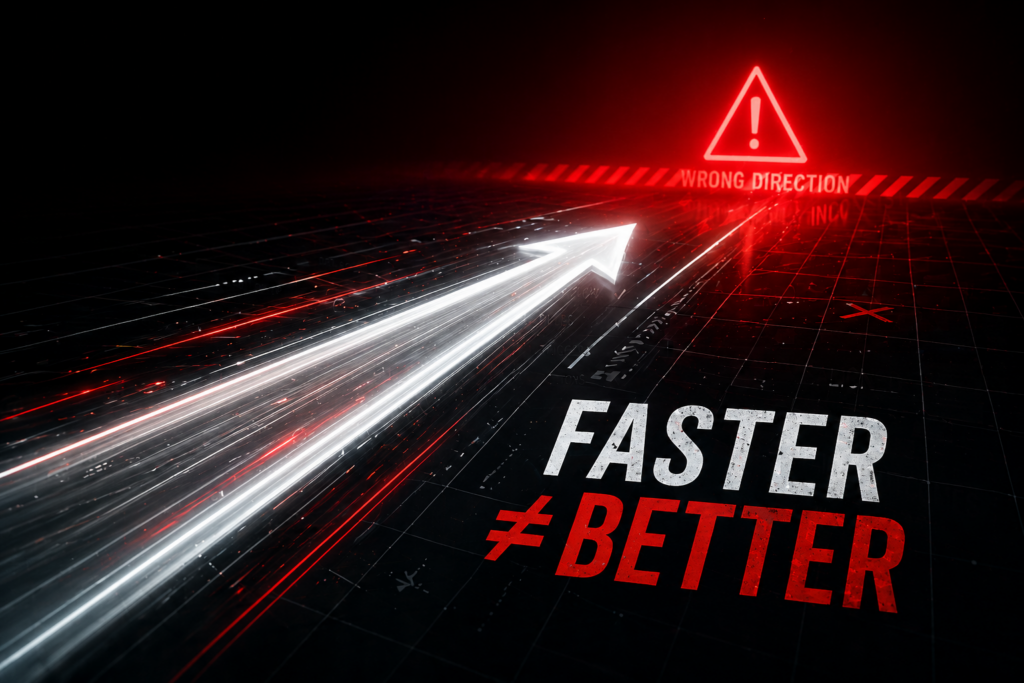
The Real Reason Automation ROI Fails in Mid-Sized Companies
Automation ROI fails because execution is scaled before decision-making is stabilised.
Most automation projects start with: What can we automate?
They ignore the harder question: How are decisions being made inside this process?
Without that clarity, automation replicates ambiguity.
In practice:
One rep qualifies leads by instinct
Another uses a checklist
A third prioritises urgency
Then you automate routing, follow-ups, and pipeline movement.
Now you’ve scaled three different decision models simultaneously.
At first, it looks like progress. Activity increases. Response times improve. But inconsistency compounds. Conversion fluctuates. Forecasts drift.
This is why your sales team keeps re-explaining the same thing on calls.
Because the system never defined what a “qualified lead” actually is.
Automation doesn’t standardise thinking—it exposes the absence of it.
Most teams aren’t aligned on how decisions should be made—they’ve just learned how to work around each other.
Mid-sized companies often grow through momentum, not formalisation. Decisions live in people, not systems. That works—until you scale.
The longer this stays the same, the more your automation layer becomes a liability.
Every automated action built on unclear logic multiplies downstream inefficiency.
Pro Tip:
Extract the decision criteria behind a process before automating it.
Execution can be automated. Judgment must be defined.
He automated his pipeline in a weekend—emails firing, leads moving automatically. It felt like control.
Two months later, conversions dropped while activity doubled. The shift came when he realised nothing defined what a “good lead” actually was.
He stopped automating movement and started defining decisions. He stopped chasing efficiency and started designing clarity.
The Illusion of Efficiency: When Automation Scales the Wrong Work
Automation increases output. It doesn’t guarantee value.
That’s where most businesses get trapped.
You see more emails sent, more leads touched, more tasks completed. The system looks efficient. But outcomes don’t move.
Because you didn’t remove bad work—you accelerated it.
Speed amplifies direction. You didn’t remove bad work—you accelerated it.
And most teams don’t actually know what direction they’re scaling.
If your qualification is weak, automation ensures more unqualified leads move faster.
If your messaging is unclear, automation distributes confusion at scale.
This is why your pipeline looks strong but doesn’t convert consistently.
Volume is compensating for precision.
The overlooked issue is deeper: automation reshapes feedback loops. When flawed processes are automated, problems take longer to surface—and become harder to trace.
You gain speed, but lose visibility.
The longer inefficient work is automated, the more cost expands without value creation.
And the harder it becomes to diagnose—because everything looks like it’s working.
Pro Tip:
Audit outcomes, not activity.
If automation increases output but not decision quality, it’s scaling waste.

Task Automation vs System-Level Automation: Where ROI Breaks
Most companies automate tasks. Very few automate systems.
Task automation speeds up isolated actions—emails, updates, reminders. It’s visible and easy to implement.
System-level automation governs how decisions flow across the entire process.
Task automation assumes the system works.
System-level automation questions whether it does.
When you automate tasks inside a broken system, you reinforce fragmentation. Each function optimises locally.
This is why deals feel close but stall.
Marketing drives volume. Sales drives speed. Operations drive efficiency.
Individually, each improves. Collectively, the system misaligns.
No one owns the decision flow end-to-end.
System-level automation starts with outcomes—conversion, retention, expansion—and works backwards to define decisions.
Then automation enforces those decisions consistently.
It’s harder. It exposes contradictions. That’s why most avoid it.
This is why your pipeline looks active but leadership still doesn’t trust the forecast.
Fragmented automation leads to fragmented growth.
Pro Tip:
Map decisions across the full lifecycle, not tasks within a function.
Systems break at the boundaries.
Most teams never look there.
Why Most Processes Aren’t Ready to Be Automated
Most processes aren’t designed—they’re accumulated.
Over time, businesses patch gaps, solve edge cases, and adapt under pressure. What emerges is a layered workaround, not a system.
Then automation is added as if the process is stable.
It isn’t.
Common signs:
Steps exist without clear purpose
Exceptions are handled inconsistently
Ownership is assumed, not defined
Automation requires clear inputs, rules, and outcomes. Most processes rely on interpretation.
That mismatch creates failure.
If decision criteria shift depending on context or person, there’s nothing stable to automate. Any automation will either oversimplify or misfire.
One deal gets marked “qualified” because the budget looks right.
Another because the conversation felt promising.
Both enter the same pipeline—and no one questions it.
Many businesses accept “good enough” logic to enable automation. That trade-off compounds.
The longer this continues, the more your system drifts from reality. Decisions become faster—but less accurate.
Automating unstable processes creates hidden errors that scale silently.
Quick Diagnostic:
Ask three people in your team: “What makes a lead qualified?”
If you get three different answers, your process isn’t ready for automation.
If no one can answer clearly, your system is already drifting.
Pro Tip:
Test decision consistency.
If two people wouldn’t make the same call with the same inputs, don’t automate yet.
The Missing Layer: Decision Architecture Before Automation
Every automation system runs on an invisible layer: decision architecture.
Most businesses don’t define it. They feel its absence.
Decision architecture determines how inputs are interpreted, prioritised, and acted on.
In practice, this means defining things like: what qualifies a lead, what triggers follow-up, what gets escalated—and why.
Without it, automation becomes guesswork at scale.
Instead of asking what happens next, define why it happens.
This means answering:
What qualifies a lead—precisely?
When should a deal be prioritised?
Which signals override others?
These are constraints, not preferences.
Once defined, they become enforceable.
And most businesses resist defining them—because it forces trade-offs they’ve been avoiding.
This is where AI becomes powerful—not as a tool, but as an enforcement layer.
AI applies rules consistently, validates inputs, and adapts decisions in real time.
Midway through growth, this becomes an identity shift:
You’re no longer relying on people to make good decisions.
You’re designing systems where good decisions are the default—not the exception.
This is where most automation systems stop—and where AI should begin.
Without decision architecture, every new automation increases variability.
Pro Tip:
Document decisions as rules, not guidelines.
Systems follow rules. People interpret guidelines.
She had three teams hitting targets, yet revenue stayed unpredictable.
Marketing blamed sales, sales blamed lead quality, operations blamed onboarding. The shift came when she mapped decision rules across the lifecycle. Fewer leads converted better, forecasts stabilised.
She didn’t fix the teams—she aligned the system. She became the operator who designs outcomes.
How AI Enforces Consistent, Scalable Decision-Making
AI’s real value isn’t automation. It’s enforcement.
Traditional automation executes steps. It assumes decisions are already correct.
AI evaluates inputs, applies logic, and determines the right action.
It closes the gap between data and execution.
This enables:
Consistent lead scoring
Adaptive prioritisation
Decision validation before action
You’re no longer automating outcomes—you’re automating judgment.
That’s where scale becomes controlled.
Most businesses use AI superficially—content, basic workflows, surface insights.
There’s a tension here.
The more you rely on AI to enforce decisions, the more exposed your underlying thinking becomes.
Most businesses aren’t ready for that level of visibility.
The deeper application is structural. AI enforces your decision architecture across every interaction.
No drift. No variation. No dependency on individual interpretation.
This is why deals become predictable.
This is why conversion stabilises.
There’s tension here: AI won’t fix vague thinking. It exposes it.
That’s the leverage.
Human-dependent decisions introduce variability as you scale. AI reduces it.
Pro Tip:
Use AI to validate decisions before execution.
Preventing bad decisions creates more value than speeding up good ones.
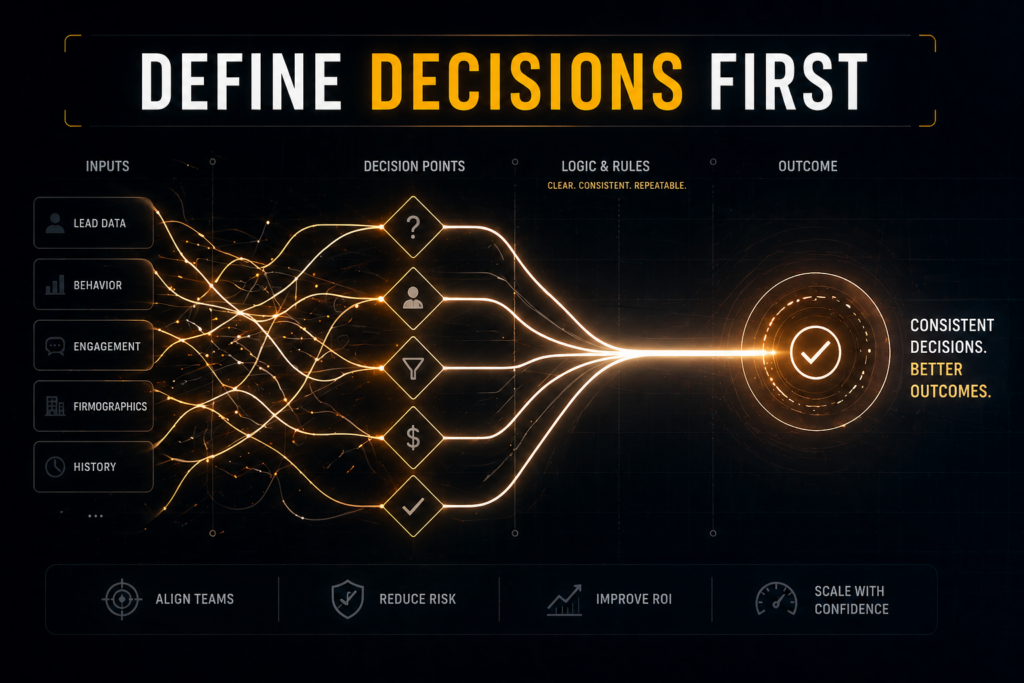
Rebuilding Automation for Measurable ROI Outcomes
Fixing automation ROI isn’t about better tools. It’s about rebuilding the system.
Most automation projects don’t fail because they’re poorly implemented.
They fail because they should never have been started.
Stop thinking in workflows. Start thinking in decision flows.
Workflows describe what happens.
Decision flows define why it happens.
That shift forces clarity.
Start by identifying where outcomes break—conversion gaps, delays, inconsistencies.
Then trace back to the decisions driving those points.
Not steps. Judgments.
You’ll find contradictions and missing criteria. That’s the real system.
Define clear decision rules. Then layer automation on top.
At this point, AI becomes the enforcement mechanism—applying rules consistently as conditions change.
ROI starts to look different:
Less wasted activity
Higher conversion from existing volume
Predictable outcomes
You’re not doing more. You’re doing the right things, consistently.
The overlooked truth:
Automation ROI is driven by decision precision—not cost reduction.
Most businesses optimise workflows. The ones that scale optimise decision systems.
Every month you delay this rebuild, you invest further into a system that can’t produce consistent returns.
Pro Tip:
Measure ROI at the decision level. Improved decisions drive outcomes.
Activity does not.
Most businesses don’t have an automation problem—they have a thinking problem disguised as a systems issue.
They try to install speed where clarity doesn’t exist. The shift is uncomfortable: the bottleneck isn’t the tool, it’s the logic.
But once that’s rebuilt, automation becomes control. That’s when the business stops reacting—and starts deciding.
Conclusion
You didn’t invest in automation to create more activity.
But that’s what most systems produce.
More workflows. More triggers. More output.
And still—uncertain outcomes.
That’s the friction.
The relief comes from a simple shift: automation didn’t fail—it enforced the system you already had.
The problem is, that system wasn’t designed for scale.
Once you see that, everything changes. You stop chasing tools. You rebuild the logic beneath them.
Results stabilise.
Teams align.
Growth becomes predictable.
This is the identity shift:
From reacting inside the system…
To designing how the system thinks.
Right now, you have a choice.
Keep scaling noise—and watch complexity compound.
Or rebuild decision architecture—and turn automation into leverage.
The cost of inaction isn’t just missed ROI.
It’s a system that becomes harder to fix with every new layer you add.
Your current state isn’t fixed. It’s optional.
You can keep scaling activity—and hope it eventually converts.
Or you can design a system that makes conversion predictable.
Action Steps
Use this sequence to rebuild automation into a controlled system—not just a faster one:
Step 1: Extract
Extract decision criteria from key processes
Identify how decisions are made—not just steps. Automation scales logic, not actions. If undefined, you scale inconsistency.
Step 2: Audit
Audit automation against outcomes
Compare output vs results. If activity rises but outcomes don’t, you’re scaling the wrong work.
Step 3: Map
Map decision flow end-to-end
Align decisions across marketing, sales, and operations. Fragmentation kills system performance.
Step 4: Convert
Convert judgment into rules
Make decisions explicit and repeatable. Consistency is required for effective automation.
Step 5: Apply
Use AI at the decision layer
Validate inputs and enforce rules before execution. This reduces variability and improves predictability.
Step 6: Measure
Measure decision quality, not activity
Track conversion consistency and accuracy. Outcomes follow better decisions.
FAQs
Why does automation fail to deliver ROI in mid-sized companies?
Because it scales execution before decision logic is defined. Automation enforces inconsistency at speed.
How do I know if a process is ready to be automated?
If decisions are consistent across people, it’s ready. If not, automation will amplify errors.
What’s the difference between task and system-level automation?
Task automation speeds actions. System-level automation aligns decisions across outcomes.
Why does automation increase complexity?
Because it accelerates unclear processes, adding activity without alignment.
How can AI improve automation outcomes?
By enforcing decision rules consistently and adapting to inputs in real time.
What should I measure for automation success?
Decision accuracy, conversion consistency, and outcome predictability.
Can automation work without AI?
Yes, but it remains static. AI enables adaptive, scalable decision enforcement.
Other Articles
AI Decision Intelligence That Cuts Decision Latency