
Identify signals faster and act before metrics catch up
AI decision intelligence reduces decision latency by identifying early signals before they appear in traditional metrics.
Instead of relying on delayed dashboards, it enables real-time pattern detection across sales, marketing, and operations.
This allows businesses to act earlier, preserve optionality, and shape outcomes before performance shifts become fixed.
Most businesses do not have a data problem. They have a timing failure embedded in how decisions are made.
The structure is consistent: data is collected, processed, aggregated, and then surfaced as insight. Each layer introduces delay. By the time leadership sees a number, the behaviour behind it has already stabilised.
Stability feels like clarity, but in operational terms, it means the moment for influence has already passed.
This creates a hidden tension. Teams believe they are operating with visibility, yet outcomes repeatedly lag expectation.
Sales pipelines appear strong until they compress without warning. Marketing shows early traction but fails to convert consistently. Operational issues arrive fully formed, forcing reaction instead of controlled adjustment.
The system appears to work. The numbers are accurate. But the decisions are late.
And it doesn’t show up as a clear failure. It shows up as hesitation—small, repeated, hard to isolate.
Most teams misdiagnose this as a performance problem. What looks like a performance issue is often structural.
At the time, the decision to optimise execution makes sense. The signal was already pointing elsewhere.
They adjust messaging, retrain teams, increase reporting cadence, or add tools. These actions improve clarity within the system—but they do not change the timing of insight. The latency remains.
Decision latency is not visible in dashboards. It is experienced as missed timing, hesitation, and reduced strategic options. It is the gap between what is happening and when leadership becomes aware of it.
That gap is where value is lost.
The financial impact compounds quietly. Early signals carry the highest leverage because they allow intervention while outcomes are still flexible.
As time passes, response options narrow. Decisions become corrective instead of directional. Margins compress, conversion drifts, and inefficiencies accumulate.
The business begins to rely on momentum instead of control.
The failure is structural. Insight is positioned too late in the system.
Insight isn’t missing—it’s mistimed. And timing is what determines whether a decision has leverage.
AI decision intelligence reframes this. It moves intelligence from retrospective validation to real-time inference. Instead of waiting for patterns to resolve into metrics, it detects directional movement while behaviour is still in motion.
This changes where decisions are anchored.
The system shifts from confirmation-based decisions to signal-based decisions. That reduces the time between awareness and action, allowing decisions to happen while outcomes can still be shaped.
Ignoring this shift does not create immediate failure. It creates gradual loss of responsiveness. Competitors acting on earlier signals adjust faster and capture opportunities sooner. The gap is subtle, but it compounds.
The response is not more effort. It is structural redesign.
Clarity without timing is informational.
Clarity with timing is strategic.

Why Traditional Analytics Fails to Support Real-Time Decisions
Traditional analytics doesn’t fail because it’s inaccurate. It fails because it’s late.
Most businesses trust dashboards because they feel objective. Numbers don’t lie. Charts give clarity.
But what those dashboards actually show is a cleaned, structured version of what has already happened. Not what is happening now. And definitely not what’s about to happen.
System definition: Traditional analytics systems are retrospective compression layers—they summarise past activity into simplified metrics.
That sounds useful. It is. But only for understanding—not for timing.
Here’s where it breaks: every layer of reporting introduces delay. Data must be collected, cleaned, aggregated, and visualised. By the time it appears as a KPI, it’s already stable.
And stability in data usually means the underlying behaviour has already moved on.
So you end up managing yesterday’s business with today’s effort.
This is why your sales team keeps re-explaining the same thing on calls. The objection pattern shifted weeks ago, but your data hasn’t surfaced it yet.
This is why deals feel close but stall. The signal was there—response delays, engagement drops—but it never made it into a dashboard in time.
Sometimes you can feel it before you can prove it. The numbers don’t justify a change yet—so the decision gets delayed. At the time, that decision makes sense. The signal was already there.
You make correct decisions at the wrong time—and in business, timing often matters more than correctness.
Most people don’t realise the real issue isn’t visibility—it’s latency embedded in the system itself.
The longer this stays the same, the more your business optimises for reporting clarity instead of decision speed. And that’s a losing trade.
Pro tip
Stop asking “What do the numbers say?” and start asking “How long did it take for this to become visible?”
Because the delay is the strategy leak—not the data itself.
Every decision you delay—even by days—reduces the range of outcomes available to you. You’re not just slower. You’re operating with fewer options.
What AI Decision Intelligence Actually Does Differently
AI decision intelligence doesn’t replace analytics. It changes where intelligence sits in the system.
Instead of waiting for data to stabilise, it works on data while it’s still unstable—messy, incomplete, and in motion.
That’s the shift most people miss.
System definition: AI decision intelligence is a forward-looking inference layer that detects emerging patterns before they resolve into metrics.
It doesn’t wait for confirmation. It looks for directional movement.
Where traditional systems ask, “What happened?” AI systems ask, “What is changing right now, and where is it likely to lead?”
This is not about prediction in the abstract. It’s about reducing the gap between signal emergence and decision action.
For example: instead of reporting a drop in conversion rate after the fact, AI detects micro-patterns—longer response times, reduced interaction depth, subtle behavioural shifts across segments—and flags a likely decline before it becomes visible in your KPI.
That’s a different category of awareness.
Most businesses think AI is about automation. It isn’t. It’s about timing.
You move from reactive decision-making to pre-emptive adjustment—changing direction while outcomes are still fluid.
This is why your pipeline looks strong but doesn’t convert consistently. The system shows volume, but misses the quality shift happening underneath. AI surfaces that shift early.
You’re not here to manage reports. You’re here to shape outcomes before they settle.
The longer you rely on confirmation-based systems, the more your business becomes dependent on hindsight. And hindsight does not compound—it only explains loss.
Pro tip:
Use AI not to automate outputs, but to interrogate inputs in real time.
Because the earliest signal always lives before the metric—and that’s where advantage sits.
Every early signal you miss forces you into reactive mode later. And reactive businesses don’t scale cleanly—they drift.
From Data Noise to Signals: How AI Identifies What Matters
Most businesses think they have a data problem. They don’t. They have a filtering problem.
There is no shortage of information. There is a shortage of interpretation at the right level of speed and precision.
Noise is not random. It’s just unstructured signal.
System definition: Noise becomes signal when patterns are identified, weighted, and contextualised against expected behaviour.
AI does this by continuously scanning for deviations—not just trends. It compares current behaviour against baselines, expected sequences, and cross-variable relationships.
Humans struggle here because we look for obvious patterns. AI looks for subtle divergence.
For example: a slight delay in email responses, combined with fewer page interactions and longer decision cycles across a segment. Individually, each is insignificant. Together, they form an early warning system.
Traditional systems ignore this because it’s too fragmented. AI connects it.
Most people don’t realise that the earliest signals are always the weakest—and therefore the easiest to dismiss.
That’s the trap.
Without signal detection, your business responds only when patterns become undeniable—and by then, they’re expensive to fix.
This is why your sales team keeps re-explaining positioning. The market signal shifted subtly, but your system didn’t register it early enough to adapt messaging.
There’s an uncomfortable truth here: the businesses that win aren’t the ones with the best data. They’re the ones that recognise weak signals faster.
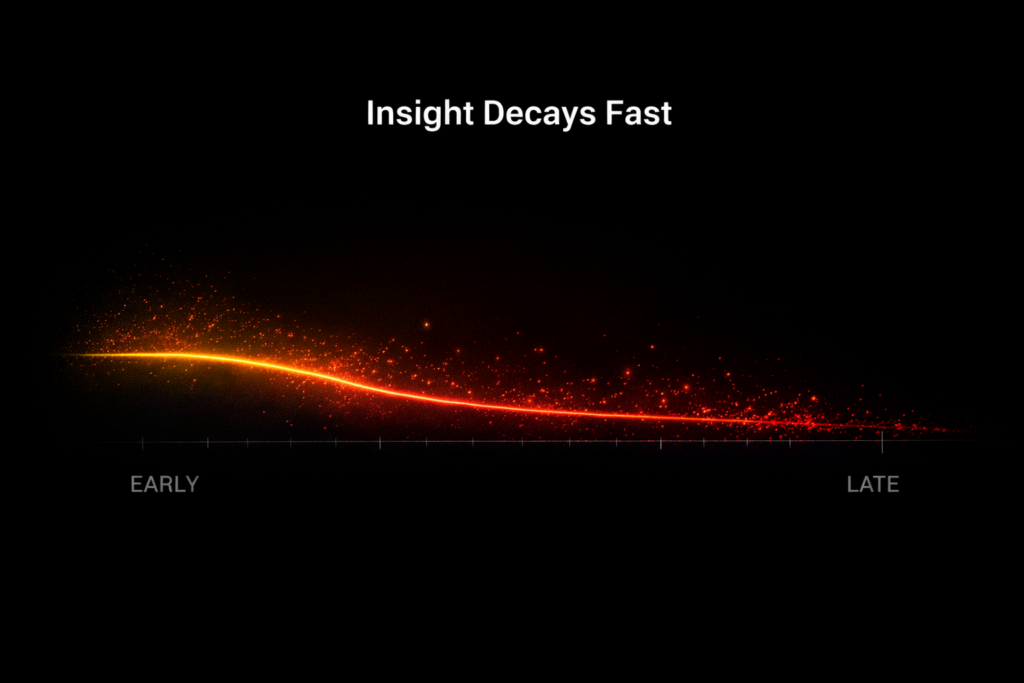
Uncommon angle: Insight has a half-life. The value of a signal decays over time. The later you act, the less leverage it carries—even if the insight is correct.
The longer this stays the same, the more your team confuses activity with awareness.
Pro tip
Don’t ask “Is this signal strong enough?” Ask “What happens if we’re early versus late?”
Because early action compounds. Late action stabilises loss.
Every weak signal ignored today becomes a strong problem tomorrow—just with fewer options to solve it.
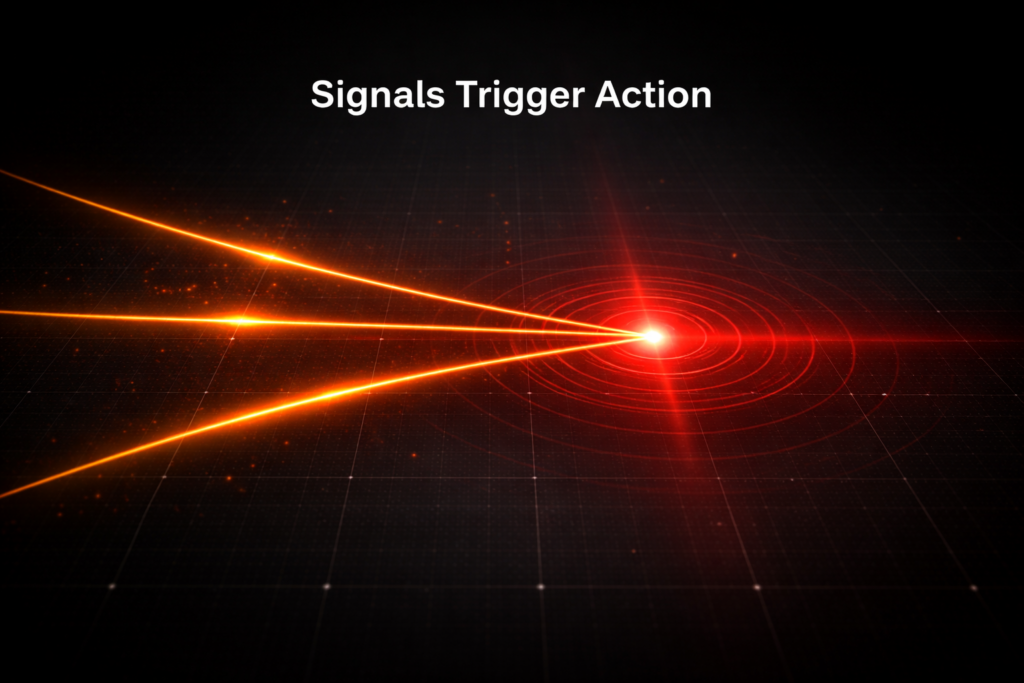
Where Decision Intelligence Impacts Business Performance Most
Not all decisions carry equal timing sensitivity. Some tolerate delay. Others collapse under it.
The mistake is treating all decisions as if they operate on the same clock.
System definition: Decision intelligence allocates attention based on timing sensitivity—prioritising decisions where latency directly impacts outcomes.
In a $5M–$20M business, three areas consistently carry the highest timing sensitivity: sales velocity, marketing response loops, and operational flow.
Sales first. Deals don’t usually die suddenly—they decay. Slower replies, weaker engagement, longer gaps. AI surfaces this decay early.
Marketing next. Campaigns don’t fail overnight—they drift off-course. Signal detection allows mid-flight correction instead of post-campaign analysis.
Operations last. Bottlenecks rarely announce themselves. They build quietly through small inefficiencies until they hit capacity limits.
Without decision intelligence, these areas degrade silently—performance drops without a clear trigger.
This is why deals feel close but stall. The signal was there. It just wasn’t surfaced in time.
Most people focus on improving outcomes. Fewer focus on improving decision timing. But timing is upstream of outcome.
You’re not optimising tasks—you’re optimising when decisions happen.
The longer this stays the same, the more your business relies on momentum instead of control. And momentum without awareness eventually breaks.
Pro tip
Map your business decisions by timing sensitivity.
Then apply AI where delay has the highest cost—not where data is easiest to access.
Improving timing in just one of these areas can outperform marginal gains across all others. Speed is leverage when applied precisely.
Reducing Decision Latency Across Sales, Marketing, and Ops
Reducing latency is not about moving faster. It’s about removing the delay between signal and response.
Most businesses try to speed up execution. That’s not the constraint.
The constraint is recognition.
System definition: Decision latency is the gap between signal emergence and decision execution.
AI reduces this gap by continuously monitoring behavioural inputs and triggering responses before patterns stabilise.
In sales, this looks like identifying at-risk deals before they stall—based on interaction patterns, not just pipeline stage.
In marketing, it means adjusting campaigns mid-cycle based on engagement signals—not waiting for final performance metrics.
In operations, it’s catching inefficiencies as they form, not after they impact output.
This requires a shift: from periodic review to continuous awareness.
This is where most teams resist. It feels uncomfortable to act without full confirmation. But waiting for certainty is exactly what creates delay.
The longer you wait for confirmation, the fewer strategic options remain. You end up choosing from constrained outcomes instead of shaping them.
This is why your pipeline looks strong but doesn’t convert consistently. Because the signals that matter are ignored until they become metrics.
There’s a behavioural layer here: teams are trained to justify decisions, not to time them. AI flips that priority.
You’re not here to be certain—you’re here to be early enough to matter.
The longer this stays the same, the more your business rewards caution over effectiveness.
Pro tip
Build decision triggers, not just dashboards.
Because action should be initiated by signal thresholds—not meeting schedules.
Every delayed decision compounds downstream inefficiencies. And compounding works both ways—growth or decay.
What It Takes to Implement AI Decision Intelligence Systems
Most businesses think implementation starts with tools. It doesn’t. It starts with structure.
If your data is fragmented, your decisions will be too—no matter how advanced the AI is.
System definition: AI decision intelligence systems require a unified data layer, continuous signal ingestion, and predefined decision pathways.
That sounds technical. It’s actually strategic.
First, unify your inputs. Sales, marketing, and operations data must connect at the behavioural level—not just reporting level.
Second, define what signals matter. Not everything needs attention. Only deviations that impact outcomes.
Third, decide in advance what actions follow which signals. Otherwise, insight becomes observation—not execution.
This is where most implementations fail. They generate insight but don’t link it to action.
The decision to act gets revisited. Discussed. Delayed—because the signal doesn’t feel “strong enough” yet.
You end up with smarter dashboards—but no change in decision speed or quality.
Most people don’t realise that AI without decision architecture just increases awareness without increasing impact.
There’s also a sequencing problem. Businesses try to implement everything at once. That dilutes focus.
You’re not installing AI. You’re installing a system that thinks with you.
The longer this stays fragmented, the more your business accumulates insight without leverage.
Pro tip
Start with one decision loop—sales, marketing, or ops—and compress latency there first.
Because proving speed in one area builds momentum for the rest.
Partial implementation creates complexity without benefit. Focus creates compounding advantage.
Risks, Limitations, and How to Use AI Insights Effectively
AI is not neutral. It amplifies the structure it operates within.
If your inputs are biased, your outputs will be too. If your decision pathways are unclear, AI will create noise—not clarity.
System definition: AI systems reflect the quality of data, assumptions, and decision frameworks they are built on.
This is where most businesses overestimate the technology and underestimate the system around it.
There are real risks: over-reliance on probabilistic outputs, false positives from weak signals, and decision fatigue if too many alerts surface.
But the deeper risk is misinterpretation.
AI surfaces possibilities—not certainties. Treating signals as guarantees leads to overcorrection.
You swing between overreaction and inaction—neither of which improves performance.
The goal is not to eliminate uncertainty. It’s to navigate it earlier.
There’s also a human factor. Teams must trust the system enough to act—but not blindly follow it.
That balance is built, not assumed.
You’re not outsourcing decisions—you’re upgrading how they’re made.
The longer this stays misunderstood, the more AI becomes a distraction instead of a multiplier.
Pro tip
Use AI to narrow decision windows, not to make decisions for you.
Because clarity improves action—but ownership still drives outcomes.
Misuse of AI doesn’t just fail—it creates false confidence. And false confidence is harder to correct than ignorance.
Conclusion
You’re not struggling because you lack insight. You’re struggling because your insight arrives too late to change anything.
That’s the quiet tension most businesses live with. Decisions feel informed—but outcomes don’t reflect it. Effort is high. Clarity feels present. But something keeps slipping through.
Because the system is built to confirm, not to anticipate.
AI decision intelligence changes that—but only if you change how you think about decisions.
Not as moments of analysis, but as points of timing.
Relief doesn’t come from more data. It comes from seeing earlier, acting sooner, and adjusting while outcomes are still flexible.
This is the shift: from managing results to shaping direction.
You’re not here to react to the business—you’re here to stay ahead of it.
The cost of doing nothing isn’t just slower growth. It’s invisible loss. Missed signals. Delayed pivots. Opportunities that never fully form because you arrived just slightly too late.
And the longer that continues, the more it compounds quietly.
But this isn’t fixed.
Your current state isn’t permanent. It’s structural. Which means it can be redesigned.
So the decision is simple:
Continue operating on delayed clarity—and accept the limits that come with it.
Or rebuild how your business sees, decides, and acts—so timing becomes your advantage.
Because in the end, the businesses that win aren’t the ones that know more.
They’re the ones that move first.
Action Steps
Map decision latency across your core functions
Identify where delays occur between signal emergence and decision action in sales, marketing, and operations. This matters because latency hides inside process flow, not dashboards. The consequence: if you don’t see the delay, you’ll continue optimising outputs instead of fixing timing.
Redefine what counts as a “signal” in your business
Move beyond KPIs to behavioural indicators like response speed, engagement depth, and pattern deviation. Strategically, this shifts focus from outcomes to precursors. The consequence: without this shift, you’ll only act once problems are already expensive.
Establish decision triggers tied to signal thresholds
Predefine what action occurs when specific signals appear. This matters because speed comes from removing deliberation time. The consequence: if decisions rely on meetings instead of triggers, latency becomes structural.
Prioritise high-impact, timing-sensitive decision areas
Focus first on sales velocity, marketing responsiveness, and operational bottlenecks. These areas compound quickly with delay. The consequence: spreading effort across low-impact areas dilutes timing advantage.
Align data flow with decision pathways
Ensure that the same inputs driving insight also directly inform action systems. This matters because disconnected systems create awareness without execution. The consequence: insight accumulates, but performance does not change.
Train teams to act on directional movement, not certainty
Shift decision culture from confirmation to probability-based action. Strategically, this compresses response time. The consequence: waiting for certainty ensures you act too late.
FAQs
What is AI decision intelligence in simple terms?
It is a system that detects early signals in data before they become visible in traditional metrics. This matters because it enables earlier decisions. The decision path: act on signals, not just confirmed outcomes.
Why do traditional dashboards fail for real-time decisions?
They summarise past data, which introduces delay. This reinforces the core issue of decision latency. The decision path: treat dashboards as diagnostic tools, not timing systems.
What is decision latency and why does it matter?
It is the delay between signal emergence and decision action. This gap reduces your ability to influence outcomes. The decision path: reduce latency to increase control.
Where should businesses apply AI decision intelligence first?
In sales, marketing, and operations where timing directly impacts performance. This aligns with high-leverage areas. The decision path: start where delay costs the most.
Can AI eliminate uncertainty in decision-making?
No—it surfaces probability earlier. This matters because acting earlier improves outcomes even without certainty. The decision path: act on directional insight, not perfect clarity.
What happens if a business ignores decision latency?
It gradually loses responsiveness and operates on outdated information. This compounds into missed opportunities. The decision path: redesign the system before performance declines.
Bonus: The Thinking Shift Most Businesses Resist
Most businesses believe better decisions come from more certainty. That belief quietly slows them down.
They build systems that wait for confirmation. They train teams to justify decisions instead of time them. Over time, this creates a culture where clarity is valued more than responsiveness.
The result: decisions feel safe—but consistently arrive too late to matter.
- You are optimising for accuracy when you should optimise for timing
This is what you are doing wrong and why it matters. Accuracy improves confidence, but timing determines impact.
The shift is subtle: early decisions feel uncomfortable because they rely on incomplete information. But that discomfort is where leverage exists.
Consequence: If you continue prioritising accuracy, you will consistently trade away timing advantage without realising it.
- Most “bad decisions” are actually late decisions
The outcome looks like poor judgment. The reality is different.
When decisions happen after signals stabilise, options narrow. What appears as a wrong choice is often the only choice left.
Consequence: If you don’t change this, you’ll keep fixing decisions instead of fixing when they happen.
- Speed is not about moving faster—it’s about seeing earlier
Most leaders try to accelerate execution. But execution is rarely the bottleneck.
Recognition is.
The earlier you see, the less force you need to apply.
Consequence: If you don’t improve recognition timing, increasing speed will only amplify inefficiency.
Other Articles
Decision Intelligence in Business: From Data to Action