
Build a 10-minute operating rhythm that surfaces pipeline slowdowns, delivery risk, and execution bottlenecks before they escalate.
Most revenue surprises begin as weak behavioural signals—buyer hesitation, proposal ageing, delivery friction, and response lag—long before dashboards reflect the risk.
A founder signal review is a 10-minute daily operating rhythm that helps business owners detect these state changes before KPI dashboards can confirm them.
By reviewing leading signals instead of lagging metrics, founders reduce decision latency, intervene earlier, and protect revenue consistency.
Revenue surprises rarely begin in finance. They begin in hesitation.
A sales cycle stretches by six days. A high-fit prospect asks for “more time.” Delivery teams escalate scope questions that never used to surface. None of this looks dramatic on a KPI dashboard. In fact, the dashboard often looks fine right until the month it doesn’t.
That is the friction founders in the $5M–$20M range live with: the business feels healthy until it suddenly feels expensive. Pipeline looks stable, teams stay busy, meetings stay optimistic—yet confidence in the next quarter quietly weakens.
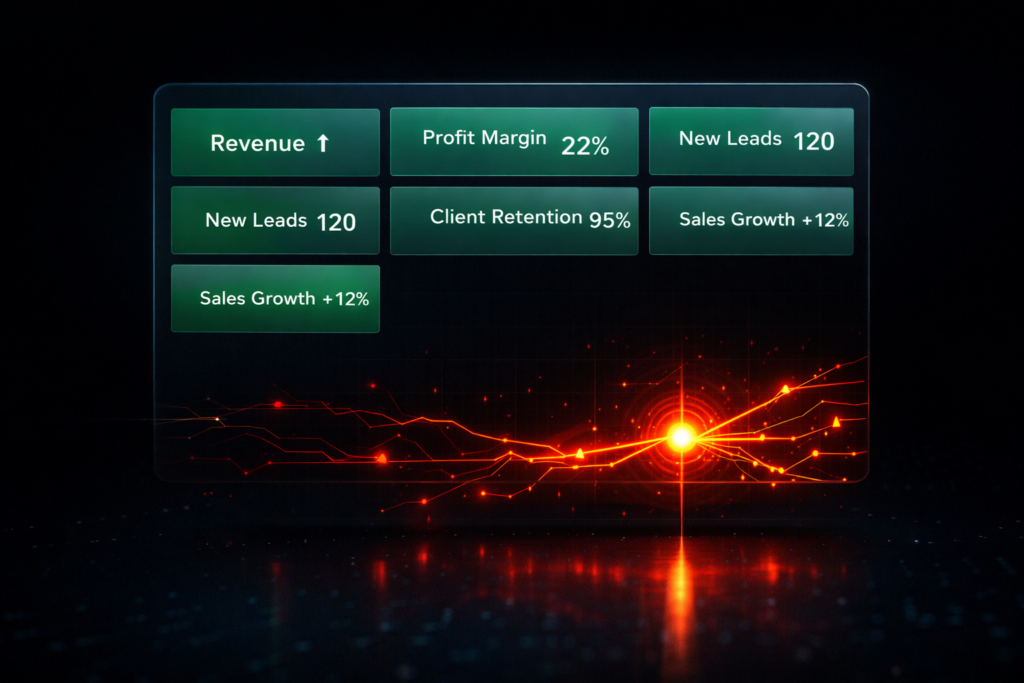
The danger is not lack of data. It is the default belief that dashboards are decision systems. They are not. They are memory systems.
The sharper lens starts from first principles: a business changes state before it changes numbers. Every important outcome first appears as a shift in behaviour—buyer hesitation, response lag, margin exceptions, scope ambiguity, escalation density. Metrics confirm. Signals warn.
The overlooked truth is signal half-life: the value of a signal decays with time. A slowdown noticed today is strategic leverage. The same slowdown noticed in 21 days becomes a recovery problem.
This is why deals feel close but stall. This is why your pipeline looks strong but doesn’t convert consistently.
The founder who wins is not the one with the most data. It is the one who notices state changes earliest—and acts while intervention is still cheap.
Why KPI Dashboards Miss the Signals That Matter First
KPI dashboards fail as early-warning systems because they are built on confirmed events. Revenue closed, margin landed, churn happened.
By the time a number moves, the business has already been living inside the cause for weeks.
This is not a tooling issue. It is a timing architecture issue.
The default leadership habit optimises for certainty over timing. Founders wait for proof, but proof is often too late. Small frictions—slower follow-up, proposal ageing, handoff delays, delivery rework—begin as pattern anomalies inside motion, not as clean numerical deviations.
Dashboards stabilise reporting. They do not detect state transition.
The stronger expression is this: metrics tell you what finished, signals tell you what is becoming more likely. The strategic consequence is reversibility.
The earlier the signal, the cheaper the decision is to change; the later the metric, the more the business pays in recovery cost.
The better lens is to treat the company as a living system. Systems fail gradually, then visibly. The earliest signs appear as small frictions across functions that seem disconnected until they converge.
Dashboards wait for convergence. A signal review hunts divergence.
Disciplined founders do not manage by scorecards alone; they manage by pattern recognition.
This is where most leaders lose timing. They inspect stable KPIs while leading frictions worsen beneath them. That comfort is operationally dangerous.
The longer leadership stays dashboard-only, the more expensive each response becomes. Lost timing compounds faster than lost deals.
Pro Tip
Review anomalies in time-to-state-change, not just totals.
Speed shifts reveal truth before volume shifts do.
He used to open the dashboard at 6:30 every morning, coffee cooling beside the keyboard, waiting for reassurance in green numbers.
Revenue still looked stable, so he ignored the sales team’s growing silence around ageing proposals. Three weeks later, the miss showed up in cash, but the real mistake had happened much earlier: he had trusted confirmation over movement.
He stopped checking for comfort and started scanning for drift—the moment he began leading like a systems thinker.

What a Founder Signal Review Actually Tracks in 10 Minutes
A founder signal review should not ask, How did we perform? It should ask, What changed in system behaviour since yesterday?
That single shift changes everything.
Instead of totals, scan movement-based variables:
proposal ageing distribution
sales cycle elongation by segment
customer reply latency
scope clarification frequency
margin exceptions
handoff delays
escalation volume
forecast confidence movement
These are not result metrics. They are decision-path stress indicators.
The stronger lens is to treat each function as a sensor array. Sales senses hesitation. Delivery senses complexity drift. Finance senses margin decay. Customer success senses trust erosion.
The founder review compresses these weak signals into one strategic picture.
The uncommon angle most leaders miss is signal contradiction. Pipeline can grow while proposal ageing worsens and reply speed slows. More activity can hide lower decision quality.
This is why your sales team keeps re-explaining the same thing on calls. The issue is rarely messaging alone. It is often offer ambiguity entering the pipeline.
Elite founders are not addicted to more data—they are trained to notice contradictions early.
Hidden contradictions create good months that turn into bad quarters. If they stay invisible, forecast confidence becomes false confidence.
Pro Tip
Build your review around movement, contradiction, and time compression.
Strategic timing beats retrospective accuracy.
The Five Weak Signals That Predict Revenue Surprises Early
Revenue misses leak through five weak signals before finance ever names the problem.
Proposal ageing drift — rising age without higher complexity signals weakening buyer confidence.
Sales response lag — even small delays accelerate intent decay.
Scope clarification frequency — repeated pre-sale questions often signal offer ambiguity.
Margin inconsistency by cohort — rising exceptions hide economic deterioration beneath topline growth.
Escalation density — more issues reaching the founder reveals weakening local decision systems.
Most leaders dismiss these as operational noise. That default thinking fails because surprises are rarely random. They are uncategorised repetitions.
This is why deals feel close but stall. The stall is usually unresolved risk, not bad luck.
The strongest founders recognise repetition before the business labels it.
Once these signals cluster, the issue is no longer diagnostic—it is financial.
The founder of a $12M services firm saw healthy monthly reports, yet every deal seemed to need “just one more call.”
Her 10-minute signal review exposed the real issue: proposal age was stretching while customer reply speed slowed in the same segment. Once she adjusted the offer packaging and set escalation thresholds, deal velocity recovered within weeks.
She stopped chasing numbers and started shaping momentum.
Pro Tip
Track signal clustering, not isolated events.
One drift can be noise. Three aligned drifts across functions is strategic truth.
How to Separate Leading Signals from Lagging Metrics
The easiest way to misread your business is to confuse movement with outcome.
A lagging metric tells you what finished. A leading signal tells you what is becoming more likely.
The cleanest way to separate them is by time-to-financial-impact:
buyer reply speed = leading
proposal win rate = lagging
scope confusion frequency = leading
gross margin = lagging
escalation requests = leading
churn = lagging
The overlooked strategic edge is decision reversibility. The earlier the signal, the cheaper the decision is to reverse. Once it becomes a lagging metric, the business pays full recovery cost.
This is why your pipeline looks strong but doesn’t convert consistently. Volume creates comfort. Friction upstream determines truth.
Serious founders think in reversibility windows, not reporting windows.
The business you think you are running may already be changing shape beneath the metrics you trust.
Pro Tip
Classify every review variable by how cheaply it can still be changed.

A Simple Daily Founder Review Cadence for Faster Decisions
The cadence matters more than the dashboard.
Without cadence, signals stay interesting. With cadence, they become operating leverage.
A practical 10-minute rhythm:
Scan signal shifts
Check contradictions
Identify clustered friction
Name the likely state change
Trigger one intervention
The overlooked advantage is executive memory externalisation. Instead of relying on fragmented intuition from meetings, founders create a living archive of pattern shifts.
Over time, predictive judgment sharpens.
Great founders do not trust memory under pressure; they trust disciplined recurrence.
Decision speed is rarely limited by intelligence. It is limited by inconsistent review loops.
Pro Tip
End every review with one question: If this pattern continues for 14 days, what breaks first?
How AI Can Compress Cross-Functional Signals Into One Brief
AI’s role is not to replace judgment. It is to reduce the cognitive cost of seeing the system clearly.
Used correctly, AI compresses:
CRM anomalies
proposal ageing shifts
support sentiment changes
delivery delays
margin exceptions
escalation density
customer language drift
into:
contradiction flags
signal clusters
probability shifts
escalation recommendations
The most overlooked signal AI can detect is language drift. Customer objections, support tone, and internal escalation phrasing often change before numeric behaviour formalises.
The practical consequence is immediate: if customer objections shift from budget pressure to timing hesitation, AI should flag this as decision-confidence decay rather than pipeline strength.
That one distinction changes whether the founder pushes volume, repositions the offer, or intervenes in the buying process.
This is why deals feel close but stall: buyer language changes from urgency to caution days before stage progression reflects it.
Modern founders use AI not for answers, but for earlier visibility into system drift.
Once the business crosses $5M, signal volume exceeds founder bandwidth. Compression restores decision quality.
Pro Tip
Train AI to flag new language patterns, not just KPI exceptions.
Turning Daily Signals Into Escalation Triggers and Action
A signal without a trigger is just interesting information.
The real edge is not early visibility. It is pre-decided response architecture.
Tie each signal to:
a threshold
an owner
a 48-hour response rule
For example:
proposal ageing +20% for 5 days → review offer friction
sentiment decline + response lag → customer success reset
margin exceptions across 3 wins → pricing review
rising founder escalations → decision rights redesign
Powerful founders remove hesitation from the response layer, not just the insight layer.
Every day a signal remains unbound to action, its half-life decays and recovery cost rises.
Most founders do not lose control when revenue drops.
They lose control the week they first notice hesitation and still decide to wait. The signal was never weak—the response architecture was.
The turning point comes when leadership stops treating visibility as “interesting” and starts binding it to irreversible action logic.
Pro Tip
Attach every signal to one named owner and one irreversible next step.
Conclusion
The real danger was never missing the number. It was missing the moment the business changed state.
That is the friction most founders quietly carry: revenue feels unpredictable not because the market is chaotic, but because the operating system notices too late.
The relief is simpler than most leaders think. You do not need more dashboards. You need a daily founder signal review that notices hesitation, contradiction, and drift while intervention is still cheap.
Founders who scale cleanly are not better forecasters—they are earlier recognisers of state change.
Your current unpredictability is optional.
The emotional decision now is clear: keep leading from proof and keep calling surprises “unexpected,” or move toward earlier clarity while the future is still flexible.
Stay stuck in retrospective comfort, or step into earlier visibility and reclaim control while the business is still reversible.
Action Steps
Detect behavioural drift
Start each morning with proposal age, reply speed, or escalation density. This shifts leadership from proof-based review to early state-change detection, making intervention cheaper.
Classify contradictions
Compare healthy topline indicators against weakening forward signals. Contradictions reveal fragile growth before forecasts distort.
Define signal half-life
Assign a time window to each critical signal before it becomes a financial recovery issue. This turns timing into strategic leverage.
Prioritise reversibility
Focus first on variables that can still be changed cheaply. This improves intervention economics and reduces response hesitation.
Compress with AI
Use AI to surface anomaly clusters, contradiction patterns, and language drift. This reduces founder cognitive overload while improving early visibility.
Automate escalation logic
Tie each weak signal to an owner, threshold, and response path. This turns visibility into reliable decision motion.
FAQs
What is a founder signal review?
A founder signal review is a 10-minute daily decision habit focused on weak behavioural shifts rather than KPI totals. Its purpose is to detect business state changes early so founders can act before the issue becomes a revenue event.
Why do KPI dashboards miss revenue surprises?
Dashboards track confirmed outcomes, which makes them lagging by design. The immediate decision path is to pair them with behavioural drift signals so leadership sees what is changing before finance records the result.
What signals should founders check every day?
Focus on proposal ageing, response lag, escalation density, scope clarification frequency, and margin exceptions. These variables matter because they reveal friction movement early, allowing cheaper intervention decisions.
How long should a founder signal review take?
Ten minutes is enough when the review is built around movement, contradiction, and escalation thresholds. The decision path is compression, not completeness—identify what changed, what clusters, and what needs action now.
What is signal half-life in business decision-making?
Signal half-life is the time window before a weak signal loses strategic value and turns into a financial recovery problem. The practical decision is to define response windows so timing becomes an operating advantage.
How can AI improve a founder signal review?
AI should compress cross-functional signals into contradiction flags, drift clusters, and recommended escalation paths. The immediate decision benefit is reduced cognitive overload and faster visibility into system-wide risk.
What is the biggest mistake founders make with signals?
The biggest mistake is noticing patterns without binding them to pre-decided action thresholds. The decision consequence is false confidence: visibility improves, but intervention timing still fails.
Other Articles
Decision Intelligence in Business: From Data to Action