
Most small businesses lose hours each week chasing updates that should happen automatically.
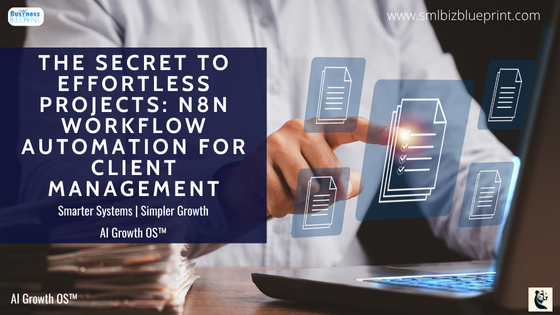
With n8n, you can connect your tools so that every client task triggers an instant update across your systems.
This workflow replaces friction with flow—freeing your team to focus on outcomes, not admin.
Discover the automation formula that transforms client chaos into seamless productivity.
You know the cycle.
A client emails a task. Someone replies, “Got it.” Another person updates the project tracker. Then another posts it to Slack. By the time it’s logged everywhere, the work itself hasn’t even started.
Hours disappear into status updates and coordination. You didn’t start a business to become an air-traffic controller—but that’s what managing clients often feels like.
The real problem isn’t communication. It’s coordination.
And that’s the gap automation—done right—can close.
Today’s spotlight shows how one n8n workflow can automatically turn client submissions into real-time updates across your tools, without a single manual step.

Mindset Shift: Automation Isn’t About Replacing People—it’s About Replacing Repetition
Most businesses approach automation as a luxury. They ask, “Can we afford to automate this?”
The smarter question is: “Can we afford not to?”
Every repetitive handoff—email, update, status check—costs money. It’s silent inefficiency.
A $5M business losing just one hour per team member per week to admin coordination is burning the equivalent of a full salary every month.
The problem with how most companies think about automation is that they start with tools, not systems. They look for quick fixes (“let’s automate our emails”) instead of designing workflows that move information intelligently.
n8n flips that logic.
It’s not a single-purpose automation tool; it’s an orchestration engine—a layer that connects your apps, data, and decisions into one cohesive flow.
The goal isn’t to remove humans.
It’s to remove redundant effort.
What It Is: n8n in Plain Business Language
n8n (pronounced “n-eight-n”) is an open-source automation platform that lets you build workflows—chains of actions triggered by events.
In human terms:
“When X happens, do Y and Z automatically.”
Example:
When a client submits a form → create a new task in ClickUp → send confirmation email → update CRM status.
Each of those steps is a “node,” and n8n links them like Lego pieces.
Unlike Zapier, which focuses on simplicity and limits flexibility, n8n gives you:
Conditional logic (if-then decisions)
Data transformation (edit or clean data mid-flow)
Self-hosting (for privacy or compliance)
Advanced branching (run parallel actions)
You don’t need to code—just understand how information moves.
Stay ahead of the curve!
Subscribe to our newsletter and never miss the latest in business growth and marketing strategies.
When to Use It (and When Not To)
Use n8n when:
You have multiple tools that don’t talk to each other (e.g., ClickUp + Gmail + HubSpot).
Your team repeats the same manual updates (status reports, CRM changes, client notifications).
You want visibility—knowing what’s done, what’s pending, and where the bottleneck is.
You’ve outgrown basic automators like Zapier or Make but aren’t ready for full custom development.
Don’t use n8n when:
You only need simple one-step automations (e.g., “send Slack message when form is submitted”).
You don’t have consistent processes yet—automating chaos only multiplies chaos.
You lack internal ownership. Automation without accountability leads to confusion, not clarity.
How It Works: The Basics (With a Simple Workflow Example)
Let’s build the Client Task → Automatic Update workflow.
Scenario:
Your client submits a new task through a form (Typeform or Google Form). You want it to automatically:
Create a task in your project manager (ClickUp, Asana, Monday).
Send a confirmation email to the client.
Notify your internal team in Slack.
Log the task in your CRM for tracking.
Step-by-Step in n8n:
Trigger Node: “When a new form submission is received.”
Project Tool Node: “Create a new task” using client name, task title, and due date fields.
Email Node: “Send confirmation” to client email with a templated message.
Slack Node: “Notify team channel” with task details.
CRM Node: “Update or create client record” with new task activity.
Result:
A client enters data once.
Your systems, team, and communication update everywhere—instantly and consistently.
That’s operational leverage.

Comparison: Why Not Zapier or Make?
Most small businesses start with Zapier, and for good reason—it’s easy and fast.
But once your automations need logic (“If client is new, do this; if existing, do that”) or multi-step branching, Zapier feels like Lego bricks glued together with duct tape.
Zapier is great for:
Simple “trigger → action” automations.
Quick wins.
n8n is better for:
Workflows that evolve.
Systems that require context (client type, project status, pricing tier).
Data transformation (merging, cleaning, routing).
Make (formerly Integromat) sits in the middle—more visual than Zapier, less open than n8n.
The key advantage of n8n is ownership: you can self-host, customise, and scale without paying per automation or action.
For growing businesses, that’s control—and cost predictability.
Practical Business Example: Before & After
Before:
A digital agency managing 30 clients spent 10–15 hours weekly chasing task updates. Each client submission had to be copied manually into ClickUp, tagged, and communicated via Slack. Mistakes were frequent, and updates lagged.
After:
They implemented an n8n workflow:
Typeform → ClickUp → Slack → HubSpot.
Automatic tagging and client acknowledgment.
Weekly reports generated via Google Sheets node.
Result:
100+ manual updates eliminated weekly.
Client response times dropped by 60%.
Team meetings shortened from 45 to 20 minutes.
Visibility improved—everyone saw real-time updates.
The system became the manager.
The people became problem-solvers again.
Tips & Pitfalls
Start Small. Don’t automate your whole business at once—begin with one clear workflow that solves a visible pain.
Map Before You Build. Sketch your process on paper first. Automation should mirror your logic, not replace it.
Use Error Triggers. n8n lets you add “error branches” to catch issues automatically (e.g., email notification if a task fails).
Name Nodes Clearly. Treat your workflows like employees—they need readable job titles.
Document Everything. Future you—or a new hire—will thank you.
Avoid Over-Automation. If a process needs human judgment, don’t automate it. Use automation to deliver information to the human who decides.
Don’t Skip Testing. One missing variable can create data chaos. Always test each node.
Don’t miss a beat in your business growth journey!
Join Pulse and stay ahead with expert tips and actionable advice every month.
Subscribe to Pulse Today
Conclusion
Automation isn’t the future—it’s the present tense of intelligent work.
The businesses that scale are the ones that build systems that think, not just teams that react.
n8n gives you that missing layer of operational intelligence—the bridge between ideas, data, and execution.
At SmlBiz, we help growing companies build these systems from the ground up.
If you’re ready to replace repetition with clarity, this is where you start.
👉 Let’s design your first automated workflow.
FAQs
Q1: What is n8n used for in business?
A1: It connects tools and automates workflows—turning manual, repetitive updates into automatic sequences that keep your team and clients aligned.
Q2: Do I need coding skills to use n8n?
A2: No. It’s a visual drag-and-drop builder. You just need to understand your process logic.
Q3: Is n8n free or paid?
A3: It’s open source and free for self-hosting. Paid cloud versions start affordably and scale with usage.
Q4: Can it integrate with my CRM and project tools?
A4: Yes—n8n supports hundreds of native integrations (HubSpot, Pipedrive, ClickUp, Notion, Google Workspace, Slack, and more).
Q5: What’s the biggest benefit for a business owner?
A5: Time. You eliminate coordination delays, ensure consistent data, and free your team from low-value admin.
Q6: What’s the biggest risk?
A6: Building before you’re ready. Automating unclear or broken processes only amplifies inefficiency.
Q7: How long does it take to set up?
A7: A simple workflow takes less than an hour. Complex systems evolve over weeks as you refine and expand.
Other Articles
How to Use AI to Improve Focus at Work (Without Burning Out Again)
The Hidden Reason You’re Always Busy But Never Advancing — And What to Do About It