
The Real Reason Why Strategic Plans Fail During Execution
Strategic alignment works when strategy is designed as a decision system, not a document.
Most business plans fail because they list priorities without resolving trade-offs, forcing teams to improvise under pressure and slowing execution.
A decision-driven, 5-step planning system reduces friction, accelerates execution, and helps leaders plan for 2026 with confidence—even when conditions change.
It’s not effort or buy-in—it’s the hidden flaw no plan addresses.
You’ve done the work.
The planning sessions. The decks. The priorities. The offsites that were meant to bring clarity.
And yet—here you are again, staring at the end of the year with a familiar tension: we’re busy, but we’re not fully in control. Decisions feel heavier than they should. Alignment slips the moment real trade-offs appear.
The plan looks solid, but you already know how this story tends to go—strong start, then drift, then reactive course-corrections by Q2.
That’s the frustration most leaders don’t say out loud: you’re doing “strategy” correctly, but it isn’t delivering confidence.
Not the kind that lets you move faster. Not the kind that makes decisions easier. Not the kind that holds when conditions change.
What’s at risk isn’t just another plan that underperforms. It’s momentum. Focus. Trust in the process itself.
When strategy keeps failing quietly, leaders compensate by working harder, deciding later, and carrying more weight personally.
Over time, that pressure compounds—and the business starts running on effort instead of alignment.
But there’s another way to approach this moment.
What if planning for 2026 wasn’t about predicting the future more accurately—but about designing a system that keeps working even when your assumptions break?
What if strategic alignment wasn’t a meeting outcome, but an operating condition—one that reduces decision friction, sharpens trade-offs, and restores a sense of control?
This article introduces a different lens on strategic alignment in action: a 5-step planning system built around decisions, not documents.
It explains why the default approach to strategic planning fails, how misalignment actually forms, and how to build a roadmap that executives can trust—not because it’s detailed, but because it’s decidable.
If you’re the kind of leader who wants fewer priorities, faster decisions, and a 2026 plan that doesn’t collapse under pressure, you’re in the right place.
Why Strategic Plans Fail by Q2 (Even When Everyone Agrees)
Strategic plans fail early because agreement is mistaken for alignment.
Most leadership teams leave planning sessions feeling aligned because everyone nodded at the same priorities. The relief is real—finally, a plan. But that relief is temporary.
By Q2, the same plan is quietly breaking down, not because people forgot it, but because it never told them what to do when priorities collided.
The frustration is subtle but persistent: decisions feel harder, not easier.
On paper, everything is clear. In practice, managers are forced to choose between competing “top priorities” with no guidance on trade-offs.
When revenue growth competes with margin discipline, when speed competes with quality, when innovation competes with operational stability—the plan goes silent.
What follows isn’t rebellion; it’s improvisation.
Most people don’t realize the plan failed the moment it tried to include everyone.
To maintain harmony, plans often list every important objective. But strategy only works when it excludes. Inclusion feels collaborative. Exclusion feels risky.
Yet without enforced trade-offs, teams default to local logic—doing what makes sense for them, even when it contradicts the broader direction.
That’s how misalignment forms without conflict.
The logic is simple: if a plan doesn’t decide, people will. And they’ll decide differently.
Execution is not the act of following instructions; it’s the act of choosing under constraint.
When a plan doesn’t specify which objective wins when both can’t, it pushes that burden down the organization. Decisions slow. Escalations increase. Meetings multiply.
The strategy doesn’t collapse dramatically—it dissolves quietly into case-by-case judgment.
What that means for your business is drift disguised as progress.
Work continues. Metrics move. But momentum leaks. Teams spend more time justifying decisions than advancing them. Leaders step in more often, becoming the bottleneck the plan was supposed to eliminate.
The cost isn’t just inefficiency—it’s erosion of confidence in planning itself.
Relief comes from understanding this isn’t a discipline problem—it’s a design problem.
Most plans don’t fail because teams resist them. They fail because the plan never answered the hard questions upfront. Strategy isn’t about stating what matters; it’s about deciding what matters more.
When that decision is missing, alignment never had a chance.
Leaders who scale beyond this stage stop trying to create buy-in through consensus. They design clarity through constraint. They understand that a good plan doesn’t make everyone happy—it makes the right decisions inevitable.
The longer this stays the same, the more time you’ll spend resolving conflicts your strategy should have prevented. Every quarter of ambiguity compounds into slower decisions, heavier leadership load, and a growing gap between effort and results.
Pro tip:
When reviewing your current plan, don’t ask “Are we aligned?” Ask: “When two priorities compete, which one wins—and is that written down?”
Alignment isn’t proven in meetings; it’s proven at the moment of trade-off. If your strategy doesn’t collapse choices into decisions, it’s not reducing complexity—it’s redistributing it.
I once watched a leadership team automate their planning dashboard so thoroughly that no one questioned it anymore.
Every Monday, the numbers refreshed, the indicators stayed green, and decisions felt justified—until revenue stalled despite “on-track” metrics. The insight came late: they had automated measurement, not meaning, and the system was rewarding activity instead of progress.
Once they removed two metrics and replaced them with one decision-based signal, discussions shortened and priorities sharpened within weeks.
What Strategic Alignment Actually Is (And Why Most Teams Get It Wrong)
Strategic alignment fails because most teams confuse shared understanding with shared decision-making.
The frustration shows up fast: everyone can recite the strategy, yet day-to-day choices still feel inconsistent. Leaders assume the issue is communication—so they explain the strategy again, louder, with better slides.
The relief is brief. Nothing really changes.
Most people don’t realize alignment only reveals itself under pressure.
When resources are plentiful and timelines are flexible, alignment looks easy. But the moment capacity tightens, a customer escalates, or an unexpected opportunity appears, teams diverge.
That’s because alignment isn’t agreement in calm conditions—it’s consistency in constrained ones.
The logic is uncomfortable but clean: alignment is a behavior pattern, not a belief system.
If two teams face the same trade-off and make different choices, alignment doesn’t exist—no matter how well the strategy was communicated.
Real strategic alignment means that independent actors, facing ambiguity, default to the same decision logic without escalation.
What that means for your business is that meetings don’t create alignment—design does.
Alignment emerges when the organization makes it easier to choose the right option than the wrong one. That requires explicit decision rules, clear trade-offs, and constraints that guide action when leadership isn’t in the room.
Without those, teams optimize locally and call it execution.
Relief comes when you stop trying to align people and start aligning decisions.
Once leaders shift from “Are we all on the same page?” to “Would we all make the same call?” strategy becomes practical. Fewer clarifications are needed. Escalations drop.
Momentum improves—not because people work harder, but because they hesitate less.
Aligned leaders don’t measure success by how well the strategy is understood. They measure it by how predictably it shapes decisions at the edges. They build organizations where clarity travels faster than approval.
The longer this stays the same, the more leadership time gets burned on resolving decisions that should be automatic. Every unclear trade-off becomes a tax on speed, trust, and focus—paid daily, not quarterly.
Pro tip:
Take one recurring decision that keeps escalating upward and write down the rule that should resolve it next time.
Alignment isn’t about control—it’s about compression. When decision logic is clear, judgment collapses into action. That’s how organizations move faster without becoming reckless.
Stay ahead of the curve!
Subscribe to our newsletter and never miss the latest in business growth and marketing strategies.
The Default Planning Approach Fails Because It Optimizes for Certainty
Traditional strategic planning breaks down because it tries to remove uncertainty instead of designing for it.
The frustration most leaders feel isn’t that the plan is unclear—it’s that the plan stops helping the moment reality shifts. Forecasts miss. Assumptions expire.
And suddenly the document that once felt reassuring becomes something people quietly work around.
Most people don’t realize certainty is the wrong goal.
Detailed plans feel responsible because they promise control. But in volatile conditions, detail hardens into fragility.
The more tightly a plan specifies the future, the more brittle it becomes when the future refuses to cooperate. What looked like rigor turns into resistance.
The logic is straightforward: uncertainty can’t be eliminated, only managed.
Markets move faster than planning cycles. Customer behavior shifts between quarters. Inputs change midstream.
When a plan is built on fixed predictions, teams spend more time defending assumptions than responding to signals. The plan becomes a constraint on judgment instead of a guide for it.
What that means for your business is slower adaptation and heavier leadership load.
When teams don’t know how far they can deviate, every exception escalates. Leaders become the risk buffer. Decisions bottleneck upward.
Execution slows—not because people lack initiative, but because the system punishes deviation more than delay.
Relief comes when planning shifts from prediction to control.
A resilient plan doesn’t try to guess every outcome. It defines how decisions will be made when outcomes change. It sets boundaries, priorities, and rules that hold even as inputs move.
That’s how confidence is restored—not by being right, but by being ready.
Leaders who mature past this stage stop asking for better forecasts. They design planning systems that absorb uncertainty without drama. They know confidence comes from adaptability, not accuracy.
The longer this stays the same, the more time your teams will waste debating whether the plan still applies. Every delay waiting for certainty is momentum lost—and opportunities missed while competitors move.
Pro tip:
Replace one fixed annual target with a decision rule (e.g., “If X happens, we shift resources to Y within two weeks”).
Planning for uncertainty isn’t about flexibility for its own sake—it’s about preserving decision speed. When the rules are clear, adaptation becomes automatic. That’s how organizations stay decisive when conditions don’t.
A Better Lens — Strategy Is a Decision System, Not a Document
Strategy fails when it’s treated as something people read instead of something that shapes how they decide.
The frustration leaders feel here is familiar: the strategy is clear, well-written, and widely shared—yet execution still fragments. People don’t ignore the plan; they simply can’t use it when real choices show up.
The relief comes from realizing the issue isn’t buy-in. It’s usability.
Most people don’t realize documents don’t execute—decision systems do.
A strategy deck can describe intent, but it can’t resolve trade-offs in the moment. Execution happens through thousands of small decisions made under time pressure, incomplete information, and competing demands.
If the strategy doesn’t change how those decisions are made, it isn’t operational.
The logic is unavoidable: every execution failure is a decision failure upstream.
When teams ask, “Should we do this?” and the strategy doesn’t answer, they default to habit, hierarchy, or risk avoidance. That’s not disobedience—it’s rational behavior in the absence of decision design.
Strategy that lives only in language leaves decision-making to chance.
What that means for your business is hidden inconsistency.
Two teams facing the same situation make different calls. Leaders step in to reconcile outcomes after the fact. Progress feels uneven, and accountability blurs because no one violated the plan—there just wasn’t a rule to follow.
Over time, this erodes trust in strategy itself.
Relief comes when strategy is rebuilt as a decision architecture.
A decision-based strategy clarifies which choices matter most, who owns them, what criteria apply, and how quickly they must be made. It doesn’t try to script behavior—it narrows the field so the right decision becomes obvious.
That’s how alignment becomes practical instead of aspirational.
This is the mark of leaders who scale without slowing.
They don’t rely on constant oversight to keep things aligned. They design systems where judgment is distributed but consistent. They know the goal isn’t control—it’s coherence at speed.
The longer this stays the same, the more leadership time gets consumed by resolving ambiguity the strategy should have prevented. Every unclear decision adds drag, slows execution, and pulls leaders back into the weeds.
Pro tip:
Identify the five decisions that most affect your strategy’s success and write explicit decision rules for each.
Strategy earns its value at the moment of choice. When decision logic is clear, execution accelerates—not because people move faster, but because they stop second-guessing.
A mid-sized services firm had alignment meetings every quarter and escalation calls every week. Projects slowed not because teams disagreed, but because no one knew who could decide when trade-offs appeared—so everything waited.
The shift came when leadership mapped five recurring decisions and assigned clear ownership with time limits.
Within a quarter, decision turnaround dropped from days to hours, and leadership involvement fell without any loss of control.
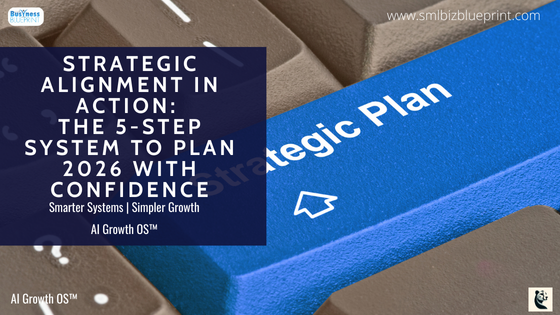
The 5-Step System to Plan 2026 With Confidence
Most strategic plans fail because they start with goals instead of decisions.
The frustration at this stage is predictable: leaders invest weeks in planning, only to watch execution drift within months.
The relief comes when planning is reframed—not as a wish list for the future, but as a system that makes the hardest choices easier before pressure hits.
Most people don’t realize confidence doesn’t come from detail—it comes from decisiveness.
A plan packed with initiatives feels thorough, yet still leaves teams guessing when trade-offs appear.
What works is a planning system that answers one question repeatedly: When we can’t do everything, what wins—and why?
That’s the foundation of the 5-step system.
Step 1 — Decide the Winning Problem
Strategic clarity begins by choosing the one problem the business must solve next.
Growth, efficiency, innovation, and resilience cannot all lead at once. When leaders avoid choosing, the organization pays in confusion.
The winning problem sets strategic gravity—it tells everyone where to place attention when choices collide.
What that means for your business is fewer debates and faster alignment.
Without a dominant problem, every initiative competes on opinion. With one, decisions collapse into logic.
Step 2 — Convert Vision into Explicit Trade-offs
Vision only becomes strategy when it forces trade-offs.
Inspiring language aligns hearts, but execution requires constraint. Explicit trade-offs clarify what will not be prioritized, even if it’s attractive.
This prevents strategy from being overridden by urgency.
Most people don’t realize unspoken trade-offs are where misalignment hides.
When leaders don’t make trade-offs explicit, teams make them anyway—differently.
Step 3 — Build the Roadmap as a Logic Chain
Execution accelerates when the roadmap explains cause and effect, not just activity.
Instead of listing initiatives, connect actions to outcomes: If we do X, then Y should change.
This creates a testable path forward rather than a static plan.
What that means for your business is learning replaces guessing.
Progress becomes visible. Adjustments become rational, not political.
Step 4 — Cascade Execution Without Cascading Confusion
Alignment breaks at handoffs, not at the top.
Execution fails when ownership, interfaces, and decision rights are unclear. Cascading the plan isn’t about copying it downward—it’s about translating decisions into local rules teams can actually use.
Most people don’t realize clarity at the edges determines speed at the center.
When teams know where authority begins and ends, momentum holds.
Step 5 — Install an Operating Rhythm That Survives Reality
Alignment decays without reinforcement.
Annual plans fail because they assume alignment is permanent. A strong operating rhythm revisits assumptions, tests progress, and reaffirms trade-offs before drift sets in.
What that means for your business is fewer resets and fewer surprises.
Strategy stays alive, not archived.
Relief comes when planning shifts from hope to control.
This 5-step system doesn’t promise certainty. It promises coherence. And coherence is what allows organizations to move confidently even when the future doesn’t cooperate.
This is how leaders distinguish themselves at scale.
They don’t chase perfect plans. They build systems that keep working when conditions change.
The longer this stays the same, the more cycles you’ll lose rebuilding momentum after drift. Every year spent re-learning the same lessons is time competitors use to pull ahead.
Pro tip:
After finalizing your plan, ask each leader to state the single decision their team must make faster next year.
Strategy isn’t proven by ambition—it’s proven by the speed and consistency of decisions. When planning accelerates choice, confidence follows.
How to Align Strategy and Execution Using One Scoreboard
Most strategy tracking fails because it measures activity, not alignment.
The frustration shows up fast: dashboards are full, reports are on time, yet leaders still feel blind. Teams are busy, metrics are green, but something feels off.
The relief comes when it clicks—we’re tracking movement, not direction.
Most people don’t realize misaligned metrics quietly reward the wrong behavior.
Traditional KPIs are designed for performance management, not strategic alignment. They optimize local outcomes—revenue targets, utilization rates, delivery speed—without showing whether those outcomes are reinforcing the strategy or pulling against it.
When metrics don’t reflect strategic intent, execution drifts while performance looks fine.
The logic is simple: what you measure becomes the default decision rule.
In the absence of clear strategic signals, teams follow the numbers closest to them. If KPIs reward speed, quality erodes. If they reward growth, margin suffers.
A dozen disconnected metrics create a dozen competing strategies—and no one notices until results diverge.
What that means for your business is silent misalignment at scale.
Leaders assume the plan isn’t working because people aren’t executing. In reality, people are executing exactly what the metrics tell them to.
The scoreboard is misaligned, so execution is too.
Relief comes from using one strategic scoreboard instead of many operational ones.
A strategic scoreboard doesn’t replace KPIs; it sits above them.
It tracks a small number of signals that indicate whether the strategy is actually taking hold—things like resource allocation toward the winning problem, speed of key decisions, constraint removal, or leading indicators tied to the logic chain in your roadmap.
Most people don’t realize fewer metrics increase alignment.
When everyone watches the same handful of strategic signals, trade-offs become clearer. Teams adjust earlier. Leaders intervene less.
The organization starts learning in the same direction instead of optimizing in parallel.
This is how disciplined leaders keep strategy alive without micromanaging.
They don’t drown the organization in data. They choose a scoreboard that tells the truth about whether the strategy is working—and let teams align themselves around it.
The longer this stays the same, the more time you’ll spend debating why performance looks good but progress feels slow. Every month spent tracking the wrong signals compounds misalignment and delays correction.
Pro tip:
Limit your strategic scoreboard to no more than five measures, and review them monthly at the leadership level.
Measurement isn’t about control—it’s about orientation. When the scoreboard reflects strategic intent, execution self-corrects. That’s how organizations stay aligned without constant oversight.
The Overlooked Constraint — Decision Latency Is the Real Strategy Killer
Most strategies don’t fail because they’re wrong—they fail because decisions happen too slowly.
The frustration is familiar: everyone agrees on direction, yet execution crawls. Opportunities stall in approval loops. Teams wait for clarity that never quite arrives.
The relief comes when leaders realize the bottleneck isn’t commitment—it’s decision speed.
Most people don’t realize decision latency silently overrides strategy.
Decision latency is the time between recognizing a choice and committing to it. When that gap widens, strategy loses force. Teams hedge. Workarounds appear. Momentum leaks.
Even the best-designed plans can’t survive if decisions lag behind reality.
The logic is unforgiving: slow decisions force fast compromises.
When decisions drag, teams don’t stop working—they improvise. They move forward without alignment, defer risk upward, or choose the safest option rather than the right one.
None of this shows up as resistance. It shows up as diluted execution.
What that means for your business is invisible drag.
Projects take longer than planned. Costs creep upward. Energy dissipates. Leaders feel busier but less effective because they’re constantly pulled in to unblock issues that shouldn’t require their attention.
The strategy didn’t fail loudly—it was outpaced.
Relief comes when decision speed is treated as a strategic variable.
High-performing organizations don’t just define what decisions matter—they define how fast those decisions must be made and who owns them.
They design decision pathways that move at the speed of the market, not the speed of consensus.
Most people don’t realize speed is a function of clarity, not urgency.
Pushing harder doesn’t reduce latency. Clear authority, explicit criteria, and trusted judgment do. When people know the rules, they decide. When they don’t, they wait.
This is where experienced leaders separate themselves.
They don’t demand faster answers. They remove the friction that slows answers down. They know that strategic advantage compounds through consistent, timely decisions.
The longer this stays the same, the more opportunities you’ll lose to indecision you can’t see. Every delayed call costs momentum, morale, and market position—quietly, but relentlessly.
Pro tip:
Map one critical decision from signal to commitment and eliminate a step that doesn’t add clarity.
Speed isn’t the edge—clarity is. When decision paths are clean, execution accelerates naturally. That’s how strategy keeps pace with reality instead of chasing it.
Most leaders think execution problems mean people need clearer direction. But watch closely, and you’ll see teams hesitate not from confusion—but from fear of choosing wrong.
In organisations with real alignment, people don’t wait for permission because the strategy has already decided for them.
That’s the difference between alignment as communication and alignment as infrastructure.
A Strategic Planning Checklist for 2026 That Isn’t Cosmetic
Most strategic planning checklists fail because they focus on completion, not coherence.
The frustration is easy to spot: the boxes get ticked, the documents get finalized, and yet the same execution problems reappear months later.
The relief comes when leaders recognize that the checklist didn’t fail because it was incomplete—it failed because it never tested whether the plan would actually hold under pressure.
Most people don’t realize checklists should expose weakness, not confirm effort.
Traditional year-end planning checklists ask what was done: goals set, budgets approved, initiatives listed. What they rarely ask is whether the strategy can survive conflict, constraint, and change.
Without those tests, a plan can look finished while still being fragile.
The logic is simple: if a plan can’t answer hard questions now, it will create harder ones later.
A meaningful checklist doesn’t add work—it removes illusion. It forces leaders to confront ambiguity early, when it’s still cheap to resolve.
The goal isn’t polish; it’s proof that the strategy can guide decisions when conditions shift.
What that means for your business is fewer surprises and fewer resets.
Plans that pass coherence tests adapt faster. Teams waste less time debating intent. Leaders intervene less often. Strategy becomes a stabilizing force instead of a quarterly reset button.
Relief comes from reframing the checklist as a series of stress tests.
Instead of asking whether planning steps are complete, ask:
Are trade-offs explicit and enforced?
Are decision rights clear at the edges?
Can the plan adapt without escalating every exception?
Does the roadmap reduce cognitive load or add to it?
Would two teams facing the same trade-off make the same call?
Most people don’t realize these questions prevent drift more effectively than any dashboard.
They reveal whether alignment is real or performative.
This is how disciplined leaders protect momentum.
They don’t use checklists to prove diligence. They use them to remove fragility. They know the cost of discovering misalignment during execution is far higher than confronting it during planning.
The longer this stays the same, the more cycles you’ll lose correcting problems that could have been designed out upfront. Every cosmetic plan costs time, trust, and another year of rework.
Pro tip:
Run your checklist as a red-team exercise: ask one leader to challenge where the plan would break first.
The value of planning isn’t reassurance—it’s resilience. A checklist that surfaces discomfort early creates strategies that endure.
Don’t miss a beat in your business growth journey!
Join Pulse and stay ahead with expert tips and actionable advice every month.
Subscribe to Pulse Today
Conclusion
If you’re honest, the frustration isn’t that planning is hard—it’s that it keeps failing quietly.
You invest the time. You align the leaders. You commit to the priorities.
And yet, months later, you’re back in the same place: making too many decisions yourself, mediating trade-offs that should have been settled, watching momentum leak while the plan technically remains “on track.”
That slow erosion is what wears leaders down—not chaos, but effort without control.
The relief comes from seeing the pattern clearly.
Strategic plans don’t fail because people don’t care. They fail because they aren’t designed to survive pressure.
When strategy is treated as a document, alignment dissolves into interpretation. When it’s designed as a decision system—anchored in trade-offs, decision rights, operating rhythm, and speed—it holds.
Execution accelerates. Leaders step back. Confidence returns, not because the future is predictable, but because the organisation can respond without hesitation.
This is the difference between managing work and designing momentum.
Leaders who move past this stage stop trying to perfect plans and start building systems that decide. They understand that alignment isn’t something you announce—it’s something you engineer.
And once that shift happens, planning stops being an annual burden and becomes a strategic advantage.
Here’s the real choice in front of you.
You can keep doing what you’ve been doing—tightening plans, adding detail, hoping this year sticks.
The cost is familiar: slower decisions, heavier leadership load, and another cycle of quiet drift you’ll be forced to correct later.
Or you can take the next step—designing a strategy that reduces friction instead of creating it.
One that makes decisions easier, faster, and more consistent across the business. One that gives you back control without demanding more of your time.
Your current state isn’t permanent. It’s optional.
The question is simple: do you stay stuck inside a system that keeps asking more of you—or do you build one that finally carries its weight?
Action Steps
Identify the Decision That Keeps Coming Back
Write down one decision your leadership team has had to revisit more than three times this year.
Repeated decisions signal missing strategy, not poor follow-through. If the strategy were clear, this decision would already be settled.
Name Your “Winning Problem” for the Next 12–18 Months
Force a choice: growth, margin, resilience, or capability building. Pick one to lead.
When everything is a priority, decision-making slows. One dominant problem creates strategic gravity that aligns choices automatically.
Make One Trade-Off Explicit and Public
Document one attractive initiative or request you will not pursue—and explain why.
Strategy only becomes real when it constrains action. Unspoken trade-offs are where misalignment hides.
Map Decision Ownership, Not Just Initiative Ownership
For your top five strategic decisions, clearly state who decides, who contributes, and how fast the decision must be made.
Decision latency—not lack of effort—is the silent execution killer.
Replace One KPI with a Strategic Signal
Remove one metric that tracks activity and add one that shows whether the strategy is taking hold (e.g., decision speed, resource shift, constraint removal).
Teams follow the scoreboard. If it’s misaligned, execution will be too.
Stress-Test Your Plan Against Reality
Ask: If conditions change suddenly, what decision would we make first—and do we agree on it?
A plan that only works in stable conditions isn’t a strategy—it’s a forecast.
Install a Monthly “Decision Review” Rhythm
Review only three things monthly: decisions made, decisions delayed, and decisions escalated.
Alignment decays without reinforcement. Rhythm keeps strategy alive without micromanagement.
You don’t need a better plan to regain confidence.
You need a plan that decides.
The moment decisions become easier, execution follows—and leadership pressure drops with it.
FAQs
Q1: What is strategic alignment in business, really?
A1: Strategic alignment is the ability of an organisation to make consistent decisions under pressure.
It’s not about shared understanding or agreement in meetings. It shows up when different teams, facing the same trade-off, make the same call without escalation. If decisions vary by department, alignment doesn’t exist—no matter how clear the plan sounds.
Q2: Why do strategic plans fail even when everyone agrees?
A2: Because agreement doesn’t resolve trade-offs.
Most plans list priorities without deciding what wins when priorities compete. When the plan goes silent, teams default to local logic. That’s not resistance—it’s a design failure. Strategy fails when it doesn’t decide.
Q3: How do you align strategy and execution in practice?
A3: By treating strategy as a decision system, not a document.
Execution improves when leaders define:
Which decisions matter most
Who owns them
What criteria apply
How quickly they must be made
When decision logic is clear, execution accelerates without added oversight.
Q4: What’s the difference between strategic planning and operational planning?
A4: Strategic planning decides what must win. Operational planning decides how work gets done.
Confusion arises when strategy tries to manage tasks, or operations try to set direction. Strategic alignment happens when strategy sets constraints and operations execute freely within them.
Q5: Why do plans often fall apart by Q2?
A5: Because alignment decays without reinforcement.
Annual plans assume stability. Reality doesn’t. Without an operating rhythm to revisit assumptions, decisions slow, exceptions escalate, and strategy dissolves into reaction. Planning isn’t a one-time event—it’s an ongoing system.
Q6: What is decision latency, and why does it matter?
A6: Decision latency is the time between recognising a decision and committing to it.
High decision latency quietly kills execution. Teams wait. Workarounds appear. Momentum leaks. Reducing decision latency is one of the fastest ways to improve execution without adding resources.
Q7: How do you know if strategic alignment is actually working?
A7: Alignment is working when decisions get faster, escalations decrease, and trade-offs feel easier.
If leaders spend less time resolving conflicts and teams move with confidence under constraint, the system is doing its job—even before results fully show up.
These questions all point to the same truth:
Strategy succeeds when it removes friction from decision-making—not when it adds more plans to manage.
If your current approach isn’t doing that, the issue isn’t effort.
It’s design.
Bonus: Three Ideas That Quietly Change How You Think About Strategic Alignment
Most leaders believe strategic alignment is something you add: clearer goals, tighter plans, better communication, more rigour.
That assumption makes sense—it feels responsible. But it also explains why alignment efforts so often feel heavy without becoming decisive.
What’s usually missing isn’t intelligence or intent. It’s perspective. Alignment problems persist not because leaders aren’t thinking hard enough, but because they’re solving the wrong layer of the problem.
When you shift the lens—even slightly—the entire conversation changes.
The ideas below aren’t fixes or frameworks. They’re reframes.
Each one reveals a deeper way to think about strategy—not as something you build more of, but as something you shape, subtract, and test.
The Decision Kill List: Strategy Advances Faster When Old Decisions Die
The surprising insight:
Progress often stalls not because new decisions are missing—but because old ones are still alive.
Every organisation carries decisions that were once correct and are now quietly misaligned. Pricing exceptions. Custom processes. Legacy approvals.
Projects that exist only because they were approved years ago. They rarely show up in strategic plans, yet they shape behaviour every day.
What’s overlooked is how much cognitive and operational drag these legacy decisions create.
Teams hesitate because they’re unsure whether old rules still apply. Leaders get pulled back into debates that feel strangely familiar.
Momentum leaks in places no one is actively managing.
The idea of a Decision Kill List invites reflection:
Which decisions are we still honouring that no longer reflect who we are or where we’re going?
What would immediately become easier if those decisions were formally retired?
Leaders who do this well don’t just add clarity—they remove noise. They create space for the strategy to breathe by letting outdated decisions go.
The One-Decision Stress Test: If It’s Real, It Shows Up Here
The surprising insight:
If a strategy is real, it can be proven with one decision.
Most plans are tested with scenarios and forecasts. That’s abstract.
A single forced decision is concrete. It removes narrative and exposes substance.
The One-Decision Stress Test asks:
If we could only make one decision in the next 90 days that would prove this strategy is real, what would it be?
This question does something subtle but powerful.
It reveals whether the strategy has leverage. It surfaces disagreement without debate. It shows whether alignment exists beyond words.
Often, leaders discover the strategy isn’t unclear—it’s uncommitted. Too many options remain open. Too few choices have been locked.
When leaders anchor strategy to a decisive moment, alignment stops being theoretical. It becomes lived.
Alignment as Subtraction: Speed Comes From Removing Friction, Not Adding Direction
The surprising insight:
Alignment improves fastest when you remove the reasons people hesitate.
Most alignment efforts add layers: more communication, more metrics, more meetings.
Yet hesitation usually comes from friction—unclear authority, conflicting incentives, unnecessary approvals, legacy measures that pull in different directions.
Seeing alignment as a subtraction problem changes the work:
What approvals could disappear without increasing risk?
Which metrics quietly reward off-strategy behaviour?
Where does effort persist simply because stopping feels uncomfortable?
This isn’t about simplification for its own sake. It’s about restoring decision flow.
Leaders who master this don’t push for urgency—they design clarity. As friction falls away, speed emerges naturally.
None of these ideas require a new system or a major initiative. They require a shift in attention—from adding more structure to reshaping what already exists.
That’s often where the most meaningful strategic advantage hides.
Not in doing more.
But in deciding—deliberately—what no longer needs to be done.
Other Articles
Why Most Year-End Reviews Fail — and How to Run an AI Audit That Actually Moves You Forward
The 2026 AI-Driven Planning Framework to Build a Business That Runs Itself
How to Build an Airtable Dashboard That Turns Your 2026 Plan Into Weekly Action