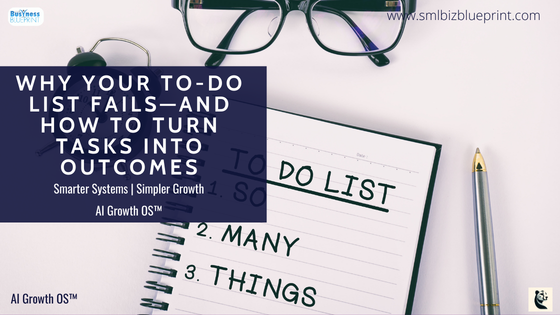

To-do lists slow you down because they multiply decisions instead of creating direction.
Outcome-based productivity works by collapsing dozens of tasks into a small number of clear outcomes, reducing friction and speeding execution.
The One List Method turns 30 tasks into 3 outcomes so focus becomes structural, not something you have to force.
You’re not disorganised—the system is broken, and here’s the smarter way to work.
You’re busy. Relentlessly busy.
The list is full. Meetings stack. Messages keep coming. By any visible measure, you’re doing everything right.
So why does it still feel like nothing meaningful is moving?
This is the quiet frustration most people don’t name: you’re working hard, making progress on paper, yet the business doesn’t feel clearer, lighter, or faster.
The to-do list grows, not shrinks. Every completed task seems to unlock two more. And somewhere underneath the motion is a low-grade tension—the sense that you’re spending energy without gaining momentum.
What’s at risk isn’t productivity. It’s judgment.
When everything is a priority, decision fatigue creeps in. Focus fractures. Important work competes with urgent noise.
Over time, this doesn’t just slow execution—it dulls confidence. You stop trusting your plan because every plan feels crowded.
Here’s the uncomfortable truth most productivity advice avoids: the problem isn’t that you have too much to do.
The problem is that a to-do list is the wrong tool for the stage you’re in. It tracks activity, not progress. It multiplies decisions instead of removing them.
And in complex work, that friction compounds fast.
There is another way to work—one that replaces task volume with clarity, and busyness with direction.
Outcome-based productivity doesn’t ask you to do more. It asks you to decide better.
To collapse dozens of tasks into a small number of outcomes that actually change something.
This article introduces a simple but demanding lens—the One List Method—that turns 30 tasks into 3 outcomes, restores focus, and rebuilds momentum. Not through motivation. Through constraint.
Because the people who move fastest aren’t more disciplined.
They’re clearer about what no longer deserves their attention.
And on the other side of that clarity, work starts to feel lighter—and more powerful—again.

The Default Approach Fails Because It Confuses Motion With Progress
Tasks get ticked off, emails get answered, meetings get held—and still, the needle barely moves. The quiet tension comes from doing a lot and advancing very little.
Most people assume productivity is about managing volume. In reality, it’s about managing direction.
A to-do list is excellent at capturing activity, but terrible at telling you whether that activity is worth doing. It tracks effort without judging impact.
Checking off tasks gives immediate feedback, so the brain rewards it. But those rewards are local and short-term. They don’t account for whether the work reduced friction, removed a bottleneck, or changed an outcome.
Over time, this creates a dangerous illusion: you feel productive while the underlying constraints remain untouched.
Most people don’t realise this until the gap widens—between how busy they are and how slow results feel.
What that means for your business is simple but costly: energy is being spent on work that doesn’t compound.
Where it quietly breaks down: “priority” becomes a label, not a decision.
When everything is on the list, everything competes for attention. Without a constraint, priorities multiply. The list grows. Context switching increases. Decision fatigue sets in.
You’re no longer choosing the most important work—you’re reacting to whatever is loudest.
This is why longer lists don’t create clarity. They create noise.
When you define what must change—instead of what must be done—decisions collapse.
Tasks either serve the outcome or they don’t. Focus stops being an act of willpower and becomes a structural feature of how work is organised.
They remove ambiguity upstream so execution downstream is clean. They don’t rely on discipline to stay focused; they design their work so focus is the default.
The longer this stays the same, the more time you spend reinforcing the wrong signal—busyness instead of progress.
Every week of unchecked motion compounds inefficiency, not momentum.
Pro tip
At the end of each week, don’t ask “What did I complete?” Ask “What changed because of my work?”
Progress is defined by outcomes, not effort. The faster you retrain your reflection loop to look for change instead of activity, the faster your judgment sharpens. That’s how leaders regain control of complexity.
It was a Tuesday afternoon, and the list was immaculate. Colour-coded. Prioritised. Every box checked by 4:30pm. And yet, nothing important had actually changed.
The shift came later that week, when it became clear the problem wasn’t effort—it was that the list never asked what had to be different by Friday.
Once the focus moved from finishing tasks to forcing outcomes, the work got lighter almost immediately.
The Real Unit of Productivity Isn’t a Task — It’s a Constraint
You prioritise harder, plan more carefully, and still feel pulled in ten directions. The problem isn’t effort. It’s that tasks don’t tell you what must change—only what can be done.
Tasks are interchangeable. Constraints are decisive. A task answers what could be done. A constraint answers what matters now.
When you confuse the two, work expands to fill every available hour without delivering leverage.
Every task on a list creates a micro-decision: now or later, me or them, important or urgent.
Multiply that by 30 tasks and you’ve created a constant cognitive tax.
Constraints do the opposite. They narrow the field. They tell you what to ignore. They reduce choice so execution can speed up.
Most people don’t realise this because task management feels responsible. Constraints feel risky. Saying “these three outcomes matter and everything else waits” feels uncomfortable—until you experience how much lighter decisions become once you do.
You rely on discipline, motivation, and willpower to stay on track. With constraints, focus becomes structural. The work itself guides decisions. You stop negotiating with your calendar every hour.
An outcome isn’t a vague goal. It’s a specific change that must occur—reduced cycle time, faster onboarding, fewer errors, higher conversion.
When an outcome is clear, tasks line up behind it or fall away. You don’t need better prioritisation skills; you need fewer valid options.
This is why outcome-based productivity works when task-based systems fail. It changes the unit of work. Instead of managing dozens of actions, you manage a small number of constraints that shape all actions beneath them.
They understand that progress requires exclusion. They don’t ask, “What else can we do?” They ask, “What would make everything else easier?”
Their confidence comes from clarity, not from keeping up.
The longer this stays the same, the more decisions you’re forced to remake every day. That’s time, energy, and judgment leaking quietly.
Every week without constraints increases drag—and drag compounds faster than effort.
Pro tip
When reviewing your work, replace the question “What are my top tasks?” with “What is the one constraint that, if eased, makes the rest simpler?”
Constraints are leverage points. When you train yourself to look for limits instead of lists, you stop managing work and start shaping systems. That shift is how complexity becomes manageable—and momentum becomes predictable.
Ready to level up your business?
Sign up for our newsletter and get expert tips delivered weekly.
The One List Method: Convert 30 Tasks Into 3 Outcomes
You clear items, add more, reshuffle priorities—and somehow the list never stabilises. It feels like maintenance work masquerading as progress.
The pressure isn’t that you can’t keep up. It’s that keeping up no longer feels like it leads anywhere.
The One List Method works because it doesn’t try to optimise task order. It collapses tasks into outcomes.
Instead of asking “What should I do next?”, it asks “What must change?” That single shift removes dozens of decisions before they even appear.
A typical list contains actions, reactions, habits, and half-decisions all blended together.
Many tasks exist only because another problem hasn’t been resolved yet. When you list them separately, you end up managing symptoms instead of addressing the source.
The One List Method forces pattern recognition. When you look at all tasks at once, you start to see clusters—work that exists for the same underlying reason.
Those clusters are outcomes waiting to be named.
How the method works in practice:
Step 1 — Capture everything in one place.
The goal isn’t organisation; it’s honesty. Getting every task out of your head reduces background cognitive load. You can’t simplify what you haven’t fully surfaced.
Step 2 — Tag each task by why it exists.
Revenue. Delivery. Risk. Leverage.
Most people don’t realise how many tasks share the same underlying purpose. Tagging exposes duplication and busywork instantly.
Step 3 — Merge tasks into outcomes by shared constraint.
If five tasks exist to reduce errors, the outcome isn’t “do five tasks.” It’s “reduce errors.” Tasks become interchangeable. The outcome becomes fixed.
Step 4 — Choose only three outcomes.
This is the hard part—and the part that makes the method work. Three outcomes create a forcing function. They introduce constraint. They make trade-offs real instead of theoretical.
Step 5 — Create the anti-list.
Explicitly name what will not be worked on this cycle. This removes second-guessing and protects focus when new requests appear.
Once outcomes are clear, daily work becomes simpler.
You no longer need to constantly re-prioritise. Tasks either serve an outcome or they don’t. Focus stops being something you “try” to maintain—it becomes built into the structure of your work.
They trust clarity over control. They understand that fewer commitments create more movement. Their confidence comes from knowing what they’ve chosen not to do.
The longer this stays the same, the more time you spend managing complexity instead of reducing it. Every week you keep operating from an uncollapsed task list, you pay a hidden tax in decision fatigue, delays, and diluted effort.
Pro tip
Once a week, rewrite your entire task list into outcomes—don’t edit, rebuild.
Rebuilding forces you to confront why work exists at all. Speed isn’t the advantage—clarity is. The faster you can collapse activity into outcomes, the faster your execution stops leaking energy and starts compounding results.
He ran a growing business and felt constantly behind—despite working long days and answering everything on time.
When he collapsed his entire task list into three outcomes for the month, meetings shortened, decisions sped up, and the team stopped asking what to work on next.
Nothing magical changed—except clarity.
Choosing the Right 3 Outcomes (So You Don’t Choose Comfort Outcomes)
You picked outcomes. You committed. And still, weeks later, nothing material has shifted. The uncomfortable truth is this: not all outcomes create movement.
Some just make you feel organised.
Most people don’t struggle to choose outcomes. They struggle to choose uncomfortable ones. Comfort outcomes tidy things up. Instrumental outcomes change how the business actually runs.
If the outcome doesn’t reduce drag, speed up flow, or remove a bottleneck, it’s decoration—not leverage.
Comfort outcomes sound sensible: “improve documentation,” “tighten processes,” “refresh messaging.” They’re safe. They rarely create resistance. But they also rarely change constraints.
Instrumental outcomes, by contrast, are specific, sharp, and slightly annoying. They force decisions. They break habits. They surface trade-offs.
Most people don’t realise how often they choose outcomes that avoid conflict rather than create progress. What that means for your business is stagnation dressed up as structure.
A simple test: does this outcome remove work—or add more of it?
An outcome that creates leverage simplifies everything downstream. An outcome that adds work, meetings, reviews, or dependencies is a red flag.
If achieving the outcome requires significant coordination but doesn’t remove a bottleneck, it’s likely a comfort outcome.
Examples:
Comfort: “Improve internal reporting.”
Instrumental: “Reduce rework caused by late data by 30%.”
The second forces trade-offs. The first invites activity.
Another filter: important vs instrumental.
Important outcomes feel aligned with values or long-term goals. Instrumental outcomes directly change execution.
The mistake is assuming important automatically means instrumental.
In reality, many “important” initiatives don’t move anything in the near term. Instrumental outcomes do.
This is where most prioritisation frameworks quietly fail—they rank importance without asking whether anything gets easier once the outcome is achieved.
When you choose outcomes that remove constraints, effort compounds. Teams make faster decisions. Fewer exceptions are needed. Work starts to flow instead of pile up.
You don’t need to push harder; resistance simply drops.
They don’t ask, “What would be nice to fix?” They ask, “What’s slowing everything else down?” Their confidence comes from solving the right problem, not from doing visible work.
The longer this stays the same, the more time you invest in outcomes that feel good but don’t pay back. Every cycle spent on comfort outcomes delays the moment real friction is removed—and that delay quietly taxes growth, energy, and trust in the plan.
Pro tip
For each proposed outcome, write one sentence finishing this prompt: “If this works, the business will now be able to _ that it couldn’t before.” If the sentence is vague, the outcome is weak.
Leverage comes from constraint removal, not improvement everywhere. Speed isn’t the edge—clarity is. The faster you learn to distinguish comfort from constraint, the faster your outcomes start producing momentum instead of maintenance.

The Overlooked Advantage: Focus Increases Revenue Velocity
Sales cycles drag. Decisions stall. Initiatives take longer to land than planned.
You add more activity to compensate—more meetings, more follow-ups, more projects—yet velocity doesn’t improve. It just gets heavier.
Most people don’t realise that growth is constrained less by effort and more by cycle time.
When attention is fragmented across too many outcomes, work queues up. Feedback slows. Decisions get deferred. Revenue doesn’t stop—but it leaks time.
Revenue velocity improves when ideas move quickly from decision to action to feedback.
That requires concentration. When teams pursue five, seven, or ten “key” outcomes at once, everything competes for shared resources—time, judgment, approvals.
The result is longer cycles, more rework, and delayed learning.
What that means for your business is simple: even good strategies underperform when focus is diluted.
Speed is lost not because people are slow, but because attention is spread thin.
When you focus on a small number of outcomes, feedback arrives sooner.
You see what’s working and what’s not while it still matters. Adjustments are cheaper. Confidence increases. Momentum builds.
This is how focused teams outperform larger, busier ones with fewer resources.
Most people mistake focus for rigidity. In reality, focus increases adaptability—because you’re not waiting months to discover what failed.
Where most teams go wrong: over-commitment masquerades as ambition.
Teams don’t underperform because they lack capability. They underperform because they’re committed to too many directions at once.
Every extra priority adds coordination cost. Every added dependency slows execution. Eventually, the system becomes fragile.
When outcomes are few and clear, execution tightens.
Decisions are made closer to the work. Bottlenecks are visible. The organisation stops thrashing and starts flowing. Growth becomes something you steer, not chase.
They understand that revenue is a lagging indicator of focus. They protect attention as a strategic asset. They don’t confuse motion with progress—they design for speed.
The longer this stays the same, the more revenue is trapped in slow cycles and delayed decisions. Every month of diluted focus extends time-to-impact and increases the cost of learning. That lost velocity is invisible—but expensive.
Pro tip
Track cycle time, not just output—how long it takes for a decision or initiative to move from intent to result.
Speed isn’t the edge—clarity is. The faster you can concentrate effort into fewer outcomes, the faster learning compounds. That’s how execution turns into growth instead of grind.
Most teams don’t move slowly because they lack urgency. They move slowly because they’re trying to move in too many directions at once.
When focus narrowed, execution didn’t feel more intense—it felt calmer. Work flowed instead of colliding.
A Weekly Operating Rhythm That Protects Clarity
Monday starts with intention. By Wednesday, urgency takes over. By Friday, you’re busy reviewing what happened instead of shaping what happens next.
The plan wasn’t wrong—but it wasn’t protected.
Most people don’t lose focus because they chose the wrong priorities. They lose it because their operating rhythm defaults to reaction.
Without a cadence that reinforces outcomes, noise slowly reclaims territory.
You don’t wake up and abandon your priorities. They get diluted—meeting by meeting, request by request. Each interruption feels small. Collectively, they fragment attention.
A weekly rhythm acts as a reset mechanism. It pulls decisions back to the surface before drift becomes damage.
What that means for your business is this: clarity is perishable. If it isn’t renewed deliberately, it decays.
A simple rhythm that works:
Monday — Outcome planning, not task planning.
Start the week by revisiting your three outcomes. Ask: What must move this week for each outcome? Not everything—just one meaningful advance.
This frames the week around progress, not volume.
Daily — One decisive move per outcome.
Each day, identify the single action that meaningfully advances an outcome. This prevents dilution. It also creates visible momentum, which reinforces confidence and focus.
Friday — Friction review, not performance review.
End the week by asking: What slowed us down? Where did decisions bottleneck? What created drag? This shifts reflection from blame to system design.
Over time, friction drops and speed increases.
Most people don’t realise how powerful this is because it feels almost too simple. But simplicity is what makes it repeatable.
When outcomes are reinforced weekly, focus stops relying on memory or discipline. The rhythm carries it forward. You spend less time recalibrating and more time executing with confidence.
They don’t hope focus survives the week—they engineer conditions where it’s the default. Their calendar reflects their priorities, not their anxiety.
The longer this stays the same, the more weeks slip by with effort but no compounding progress. Each unfocused week quietly resets momentum to zero. That lost time is rarely recovered—it’s just replaced with more urgency.
Pro tip
Block a 30-minute recurring slot each Friday for friction review—protect it like a client meeting.
Rhythm beats intention. Speed isn’t the edge—clarity is. The faster you can close the loop between outcomes and how the week actually unfolded, the faster your system learns. That’s how focus turns into sustained execution instead of another short-lived reset.
Conclusion.
More tasks. More noise. More weeks where effort is high and traction is thin.
You already know this pattern—work expands, priorities blur, and the feeling of control quietly erodes.
Not because you’re doing anything wrong, but because the system you’re using was never designed for the complexity you’re operating in now.
When you stop managing tasks and start managing outcomes, decisions shrink. Focus stabilises. Momentum returns.
The One List Method isn’t about working harder or caring more.
It’s about collapsing work into what actually changes something. Three outcomes. Clear constraints. A rhythm that protects them. That’s enough to turn motion into progress.
Effective operators don’t try to keep up—they decide what matters and let the rest fall away.
They understand that productivity isn’t about endurance. It’s about design. When outcomes replace lists, confidence comes back—not because everything is under control, but because the right things are.
Here’s the decision in front of you:
You can keep refining the list—reordering tasks, chasing urgency, hoping next week feels different.
Or you can change the unit of work. Decide what must change. Collapse the noise. Reclaim momentum.
The longer you delay that shift, the more time and energy leaks into work that doesn’t compound. Weeks pass. Effort resets. Nothing breaks—but nothing accelerates either.
And that’s the real cost of inaction.
Your current state isn’t fixed. It’s optional.
You can stay stuck managing motion. Or you can take the next step and design for progress—starting today, with one list, three outcomes, and fewer decisions standing in your way.
Because the people who move forward fastest aren’t more motivated.
They’re clearer about what no longer deserves their attention.
Don’t miss a beat in your business growth journey!
Join Pulse and stay ahead with expert tips and actionable advice every month.
Subscribe to Pulse Today
FAQs
Q1: What is outcome-based productivity?
A1: Outcome-based productivity focuses on the change you want to create, not the tasks you complete.
Instead of measuring success by how much work gets done, it measures whether something meaningful has shifted—speed, quality, revenue, or friction. Tasks become optional tools; outcomes remain fixed.
If you only track tasks, you can stay busy indefinitely without improving results. Outcomes force clarity and trade-offs.
Q2: Why don’t to-do lists work as businesses grow?
To-do lists fail at scale because they multiply decisions instead of reducing them.
As complexity increases, lists grow longer, context switching increases, and decision fatigue sets in. The list captures activity, but it doesn’t resolve what actually matters.
The longer you rely on lists alone, the more energy you spend deciding rather than executing.
Q3:What’s the difference between tasks and outcomes?
A3: Tasks describe actions. Outcomes describe impact.
A task is something you do. An outcome is something that changes because you did it. Multiple tasks can serve one outcome—but one task rarely creates an outcome on its own.
When you manage tasks, work expands. When you manage outcomes, work collapses.
Q4: How many priorities should I focus on at once?
A4: Three outcomes at a time is the practical upper limit.
Beyond that, attention fragments and execution slows. This isn’t about motivation—it’s about cognitive and operational limits.
Every additional priority increases coordination cost and delays feedback, even if the work is “important.”
Q5: How does focusing on fewer outcomes increase momentum?
A5: Fewer outcomes shorten execution cycles and speed up learning.
When attention is concentrated, decisions are made faster, feedback arrives sooner, and adjustments cost less. Momentum builds because progress is visible and repeatable.
Momentum doesn’t come from effort—it comes from speed, and speed comes from focus.
Q6: How do I reduce overwhelm without falling behind?
A6: You reduce overwhelm by removing friction, not by adding effort.
That means deciding what no longer deserves attention. Clear outcomes act as filters, eliminating low-leverage work before it consumes time and energy.
If you don’t remove work deliberately, overwhelm will remove clarity for you.
Q7: Is the One List Method just another productivity system?
A7: No—the One List Method changes the unit of work, not the toolset.
It doesn’t optimise task management; it replaces it with outcome management. You can use it with any tool—or none at all—because the leverage comes from how you decide, not where you track.
Other Articles
What to Automate First (And What to Fix Before You Do)