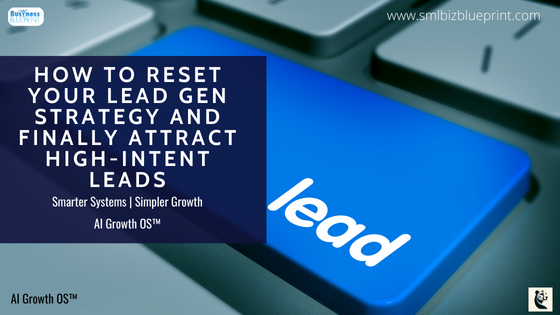

Resetting your lead generation strategy means shifting from volume-based tactics to intent-driven systems that adapt in real time.
Instead of chasing more leads, focus on aligning your funnel with how buyers think, behave, and decide.
This guide breaks down the key missteps—especially around AI, automation, and funnel design—and shows how to rebuild a smarter, more responsive lead engine.
You’ve got the funnel.
You’ve got the forms, the ads, the emails, the automation.
Maybe you’ve even added AI to the mix—auto-sequences, chatbots, content at scale.
And still… leads stall. Pipelines dry up. Conversion rates drift sideways.
You start questioning everything.
Is it the offer? The traffic? The team?
You keep fixing pieces. But nothing changes at the core.
This is the quiet frustration high-performers never talk about:
The system looks built—but it doesn’t move.
Here’s the hard truth:
Most lead generation strategies don’t fail because they’re broken.
They fail because they’re misaligned with how buyers actually decide.
Misaligned with intent.
Misaligned with timing.
Misaligned with the emotional logic that drives action.
And the more “tactics” you stack on top—
The more your system calcifies into something efficient, but ineffective.
But what if you didn’t need to rebuild everything?
What if the fix wasn’t more tools, but smarter alignment?
What if your lead generation strategy could learn –
Adapt in real-time, filter what matters, and simplify growth?
This isn’t a guide to patching another leaky funnel.
It’s a reset for how you think about lead generation—
From volume-driven motion to intent-driven clarity.
Let’s look under the hood.
Let’s reset—deliberately, strategically, and permanently.

Why More Leads ≠ More Sales (and Never Did)
Chasing more leads without redefining quality is how high-growth businesses quietly bleed out.
You’re generating leads—maybe even thousands a month. But the real question is: Are they converting?
For most teams, the answer is no.
Sales blames marketing. Marketing blames follow-up.
And everyone ends up staring at dashboards full of movement and wondering why revenue is stuck.
This is the silent frustration of modern lead gen:
You’re drowning in activity, but starving for results.
The problem isn’t the top of your funnel.
It’s what you’re measuring—and what you’re mistaking for progress.
Clicks. Downloads. Open rates. Impressions.
These vanity metrics are seductive because they give you the illusion of momentum.
But motion is not the same as growth.
Here’s the trap most businesses fall into:
They optimise their systems to capture more leads, instead of better ones.
What that means for your business is simple but brutal:
You’re spending time, budget, and headspace nurturing leads who were never going to buy.
📊 According to MarketingSherpa, only 27% of B2B leads are actually sales-ready.
That means 73% of what fills your pipeline right now is clutter, not opportunity.
The longer this stays the same, the more it compounds:
Sales teams waste hours chasing ghost leads
Marketing funnels deliver diminishing returns
And the brand erodes from repeated irrelevance
Because here’s what most people don’t realise:
Every irrelevant touchpoint reduces trust.
And once you lose that, you’ve lost the game.
Now imagine the opposite:
Your funnel is smaller, but sharper.
Sales calls feel like conversations, not uphill battles.
Marketing feels human again—because you’re actually speaking to someone who’s listening.
This is the shift from chasing traffic to attracting traction.
From more noise to measurable movement.
You’re not here to push volume.
You’re here to build systems that create momentum with intent.
Because every week this stays manual, you lose leads you never even see.
The cost isn’t just wasted spend—it’s an opportunity you never even knew you had.
Pro Tip:
Use a GPT model trained on your best-performing leads to score incoming prospects based on behavioural cues, not just demographics.
Because the edge isn’t reach, it’s recognition. The faster your system can spot who matters, the faster your business compounds in the right direction.
Ready to level up your business?
Sign up for our newsletter and get expert tips delivered weekly.
The Hidden Cost of Automation – How Over-Optimising Destroys Buyer Intent
When automation scales the wrong signals, it doesn’t accelerate sales—it amplifies friction.
You’ve built the funnel.
It’s automated, it’s segmented, and everything “runs itself.”
Yet somehow… conversions are slipping.
The irony?
The more efficiently your system runs, the worse your results feel.
That’s not a bug. That’s the system working against your buyers.
Modern lead gen tools are powerful, but indifferent.
They’ll follow any logic you give them, even if it’s flawed.
And too often, that logic is rooted in output:
More emails. More retargeting. More follow-ups.
But more automation doesn’t mean more relevance.
It just means more noise delivered at scale.
📉 Gartner found that 56% of customers believe companies overuse automation in ways that reduce personalisation.
Here’s what that looks like on the ground:
Leads feel pursued, not supported.
Sequences fire with tone-deaf timing.
Personalisation misses the context.
And buyers start ghosting—not because they’re not interested, but because they feel commoditised.
You didn’t lose the sale—you lost their attention.
And once trust is gone, the automation can’t fix it.
This is where friction hides:
Not in your conversion tools, but in the emotional disconnect they create.
What that means for your business is this:
Your lead funnel is quietly repelling the very people it was meant to convert.
Every irrelevant email, misfired follow-up, or generic CTA subtly erodes your authority.
What was supposed to create leverage has become a liability.
But here’s the shift:
Automation isn’t the problem.
Unquestioned automation is.
The relief comes when your system learns to slow down where trust needs time,
And speed up only where intent is high and consent is clear.
Smart funnels adapt.
They don’t just execute faster—they make better decisions.
You’re not just building workflows.
You’re designing experiences that earn permission and build traction.
Because every automated misfire today creates more resistance tomorrow.
The longer your system runs unchecked, the harder it gets to rebuild trust with the leads that actually matter.
Pro Tip:
Audit your current automation for emotional timing. Does each sequence support the lead’s state of mind or just the funnel logic?
Because timing isn’t just about speed—it’s about sync. The businesses that win don’t just automate faster—they align deeper. That’s how relationships scale.
Resetting the Right Layer – Why the Middle of Your Funnel Is Where Growth Dies
If you only optimise the top and bottom of your funnel, you’re ignoring the layer where most conversions fail—the middle.
You’ve updated your ads.
You’ve rewritten your sales script.
And yet… deals stall. Engagement fizzles. Nobody moves.
That’s because the part of your funnel most in need of a reset is the part you rarely question:
The middle.
This is where your strategy quietly dies—not from poor awareness or bad offers, but from misaligned momentum.
The middle is where leads go to sleep.
That includes:
Nurture sequences that no longer match the buyer’s urgency
Segmentation that lumps everyone into the same tired logic
Offers that assume interest instead of validating it
📉 Salesforce reports that 79% of marketing leads never convert, mainly due to poor lead nurturing.
They were spending $10K a month on ads and generating a steady stream of leads, but sales had plateaued. The team kept optimising top-of-funnel tactics, but nothing moved the needle.
Then someone mapped the entire journey and realised their mid-funnel emails hadn’t changed in 18 months. Leads were clicking, hesitating, and quietly disappearing.
Once they rewired the nurture logic to respond to real behaviour, conversion rates jumped, without increasing traffic or ad spend.
Most businesses don’t lose leads at the top or bottom. They lose them between clicks and conversations.
Here’s the trap:
Everyone focuses on attraction (top) or conversion (bottom).
But if your mid-funnel journey is flat, fragmented, or out of sync, you’re leaking intent at the worst possible moment—after a lead shows interest, but before they’re ready to act.
What that means for your business is this:
You’re generating momentum, then letting it evaporate—because the system assumes instead of guides.
Now here’s the shift:
Don’t treat the middle as a handoff. Treat it as a navigational system.
Design it to:
Respond to behaviour in real time
Adapt based on context (timing, topic, temperature)
Offer layered paths—not a single track
Relief comes when your funnel stops pushing and starts listening.
That’s when friction turns into flow, and leads stop ghosting because they finally feel understood.
You’re not chasing leads.
You’re architecting systems that honour intent and guide action.
Because the longer the middle of your funnel stays stagnant, the more opportunity dies in silence.
Every misaligned email, irrelevant follow-up, or rigid sequence sends another warm lead out the side door.
Pro Tip:
Map your nurture flow against real lead behaviour, not stages. Ask: What are they doing between clicks? Then use GPT to rewrite sequences based on those signals.
Because relevance isn’t static—it’s contextual. The faster your funnel adjusts to signal shifts, the more trust you earn. That’s how influence compounds.

The Most Dangerous AI Mistake in Lead Gen Today (It’s Not What You Think)
The biggest mistake in AI-powered lead generation isn’t overuse—it’s misuse. Most teams are using AI to create more noise instead of clarifying who’s worth listening to.
You added AI to your funnel, thinking it would fix the lead quality problem.
And now you’ve got a pile of content, 12 new sequences, and double the data—
But conversions? Still stagnant.
The frustration isn’t just that AI didn’t help. It’s that it made everything louder without making anything clearer.
The common assumption is that AI should be used to generate more:
More leads
More content
More touchpoints
But that’s not where the value lies.
The real edge of AI is not creation. It’s discernment.
The most dangerous mistake today is using AI to scale content instead of using it to filter signal from noise.
Here’s what that looks like in most funnels:
GPTs that churn out blog posts but don’t map to buyer pain
Lead scoring models that weight engagement over intent
AI emails that sound clever but land flat—because they’re not calibrated to when or why the buyer is listening
📊 Forrester reports that 62% of marketers don’t fully understand how their AI tools qualify leads.
This means most teams let algorithms decide what matters, without auditing what those algorithms reward.
At one point, I thought the solution was volume—so I set up AI to generate more content, more emails, more follow-ups.
Within weeks, I had dozens of sequences running and inboxes flooded with replies… none of which led to sales. I’d created the illusion of momentum and buried my team in noise. The problem wasn’t lead volume—it was relevance.
That was the moment I stopped using AI to scale output and started using it to filter for fit.
The longer this stays the same, the worse the funnel gets:
CRMs fill with the wrong prospects
Sales wastes time on false positives
And strategy drifts further from the truth with every automation cycle
What that means for your business is this:
AI isn’t saving you time—it’s costing you traction.
Because every bad lead that looks like a good one distracts you from the ones that actually matter.
But here’s the shift:
The smartest companies don’t use AI to automate output.
They use it to enhance judgment.
To qualify faster, not just louder.
To filter the funnel, not flood it.
Relief comes when your AI stops chasing activity and starts recognising alignment.
That’s when your system becomes intelligent in more than name.
You’re not just deploying AI.
You’re building systems that understand before they execute.
Because every irrelevant lead AI puts into your system steals time, budget, and attention from the right ones.
And the longer you let that misalignment run, the more false data reshapes your strategy.
Pro Tip:
Fine-tune a GPT to evaluate lead form responses or conversation transcripts and assign an intent score based on language, not just clicks.
Because the future of lead gen isn’t mass personalisation—it’s precision filtration. When AI helps you see who matters faster, growth stops feeling random and starts feeling inevitable.
How to Build a Lead Generation Strategy That Learns as Fast as Your Market Moves
Static funnels don’t fail because they’re broken—they fail because they can’t adapt. The future of lead gen is systems that learn in real time.
You’ve followed the playbook.
Built the funnel, mapped the journey, and loaded the automation.
But here’s the problem, no one tells you:
Your market doesn’t stand still.
And the minute your strategy does, it starts drifting—slowly, quietly—out of sync with reality.
That’s the core frustration:
What used to work… doesn’t.
And what should work… underperforms.
Not because it’s wrong—
But because it’s outdated the second you launch it.
Most lead generation strategies are static by design.
Built to guide leads through a linear path:
Step 1 → Step 2 → Step 3 → Close.
But buyers don’t move in straight lines.
They jump around, pause, research, disappear, and then reappear two weeks later with new questions.
A fixed funnel assumes behaviour.
A smart system follows behaviour and adapts accordingly.
📊 According to McKinsey, companies with adaptive marketing systems grow twice as fast as those using static campaigns.
Here’s the real shift:
Stop thinking in terms of funnels.
Start thinking in terms of feedback loops.
Instead of a pipeline, build a responsive system where:
Every click informs the next message
Every no-show reshapes the follow-up
Every conversion teaches the system how to improve the next interaction
This is how growth becomes self-correcting.
Where each iteration makes the next one smarter.
And the payoff?
Instead of chasing performance, you’re compounding intelligence.
Your strategy improves itself every single week.
Relief comes when your system becomes a learning engine, not just a delivery system.
It doesn’t just get faster. It gets sharper.
You’re not building a funnel.
You’re architecting a system that thinks in real time and evolves with your buyer.
Because every day your strategy stays static, it falls further behind your market.
And every decision made on stale logic creates wasted effort, and missed conversion windows.
Pro Tip:
Use AI to track and cluster behaviour patterns across your funnel—then trigger adaptive paths based on those signals.
Because adaptability isn’t a feature—it’s the foundation. Businesses that learn faster than the market shifts are the ones that own the momentum. That’s not automation. That’s evolution.
Don’t miss a beat in your business growth journey!
Join Pulse and stay ahead with expert tips and actionable advice every month.
Subscribe to Pulse Today
Bonus Insight – The One Thing No One Audits: Behavioural Feedback Loops
Most lead gen systems collect data—they just don’t learn from it. Without feedback loops, your funnel repeats the same mistakes, silently and endlessly.
You’ve got dashboards. Heatmaps. Click reports.
Your tech stack is tracking everything…
But nothing seems to change.
The frustration here is subtle but costly:
You’re collecting mountains of behavioural data, but none of it is influencing your decisions.
You know what people clicked.
You know when they dropped off.
But your funnel still treats every lead the same.
This is the blind spot no one talks about:
Feedback loops are the missing layer in most lead gen systems.
Not the kind that tracks open rates—
But the kind that turns observations into adjustments.
That means:
Your nurture emails evolve based on what people skip
Your CTAs shift based on hesitation patterns
Your sequences pause when signals fade and accelerate when intent spikes
Without these loops, you’re not iterating.
You’re just recycling old logic with new traffic.
📉 ContentSquare reports that 54% of digital teams collect behavioural data but rarely apply it meaningfully.
That means half the insight you need is already there—you’re just not acting on it.
The longer this stays the same, the more invisible waste piles up:
Leads drop off because the next step assumes too much
Retargeting ads chase the wrong people with the wrong message
Sales teams follow up on leads that were never warm to begin with
What that means for your business is simple:
You’re spending budget to repeat yesterday’s mistakes—at scale.
But here’s the shift:
Think of every funnel interaction as a signal.
Clicks, scrolls, skips, exits—these aren’t noise.
They’re data with direction—if you’re listening.
Relief comes when your system closes the loop.
Where your next campaign isn’t just better—it’s informed.
You’re not just optimising assets.
You’re designing a system that learns from attention, not just asks for it.
Because every unexamined click is a missed opportunity to learn, and every repetitive mistake makes your system dumber over time.
Behavioural feedback isn’t optional—it’s how modern lead funnels stay relevant.
Pro Tip:
Use AI to create a “funnel intelligence layer” that tags behavioural cues (e.g., scroll depth, CTA interaction, bounce points) and maps them to segment-specific optimisations.
Because your competitive edge isn’t in guessing—it’s in learning faster than your competitors forget. Intelligence compounds when feedback becomes function.
Conclusion
You’ve tried the quick fixes.
Tweaked the pages. Rebuilt the funnel. Added automation.
Maybe even plugged in AI and hoped it would fill the gaps.
And still, conversion rates stall.
Leads drift.
The system feels heavier, not smarter.
This is the quiet frustration too many business owners carry:
You’re doing more than ever, but getting less back.
But here’s the truth:
Your lead gen isn’t broken—it’s just misaligned.
With how buyers think. With what trust feels like. With how fast markets shift.
This isn’t a traffic problem. It’s a clarity problem.
And clarity doesn’t come from working harder.
It comes from resetting the system around how decisions actually happen—
Not how your tools were designed to track them.
You don’t need more tactics. You need traction.
There’s a quiet lie most teams believe: that if a lead doesn’t convert, they just weren’t ready. But when you talk to those leads, you find something else—confusion, misalignment, small friction points that killed momentum.
Most of them were ready. Your system just didn’t know how to recognise the signal or adapt in time.
That’s not a marketing issue—it’s a feedback issue. And it’s costing you silently.
That starts with:
Prioritising lead quality over quantity
Building mid-funnel journeys that respond, not assume
Using AI to filter noise, not flood your CRM
Embedding feedback loops that evolve your strategy week by week
This isn’t about AI. It’s about clarity, freedom, and growth.
And it starts now.
Not with another tool, but with a better question:
What’s the cost of staying misaligned one more quarter?
Because every week you delay, more trust decays.
More budget gets wasted.
More leads slip through cracks you don’t even see yet.
But it doesn’t have to stay this way.
You can reset your strategy.
You can rebuild your funnel to learn, adapt, and connect.
You can design a system that actually works with you, not against your growth.
You’ve done enough the hard way.
Let your business breathe.
You’re not here to chase leads.
You’re here to build systems that create momentum, with intent.
So here’s the choice:
Keep pushing inside a system that’s slowly exhausting your team and draining your results.
Or take the first real step toward a lead generation engine that learns, aligns, and scales.
Stay stuck. Or move forward.
Either way, it’s a choice.
But only one gets you your time, traction, and clarity back.
Let’s reset. Properly. Intentionally. And permanently.
Action Steps
Audit Your Funnel for Misalignment, Not Just Drop-Off
Map the full lead journey and identify where expectations break down (not just where leads exit).
Look for gaps between what your funnel assumes and how your buyers actually behave.
Redefine Lead Quality Based on Intent, Not Activity
Stop rewarding clicks, opens, or downloads.
Instead, focus on signals that indicate readiness, relevance, and urgency.
Review All Automation for Emotional Blind Spots
Ask: Does this step support the lead’s state of mind, or just serve the funnel’s sequence?
Strip out tone-deaf follow-ups and default emails that treat leads like numbers.
Fix the Middle of Your Funnel First
Rebuild your nurture flows, segmentation logic, and offer progression to reflect where leads actually are.
Don’t just guide behaviour—adapt to it.
Use AI to Qualify, Not Just Generate
Leverage AI to score, segment, and filter leads based on patterns in behaviour and language.
Let AI enhance your judgment, not just your workload.
Embed Behavioural Feedback Loops into Every Step
Design your system to learn: every click, scroll, skip, or bounce is feedback.
Turn interaction data into optimisation data—automatically.
Set a Monthly ‘Funnel Intelligence Review’
Every 30 days, meet with your team to assess what the system learned and adjust.
Make improvement a rhythm, not a reaction.
FAQs
Q1: What does it mean to reset a lead generation strategy?
A1: Resetting your lead generation strategy means reassessing the entire system—your messaging, funnels, automations, and AI tools—to realign with how buyers actually behave. It’s not just fixing broken pieces; it’s rethinking what signals you’re tracking and what kind of leads you’re attracting.
Q2: Why aren’t my leads converting, even though my funnel looks complete?
A2: Most likely, your funnel is optimised for volume, not intent. Without addressing the middle of the funnel—where trust is built and decisions form—you risk generating noise, not traction.
Q3: How can AI help improve my lead generation strategy?
A4: AI should be used to qualify and prioritise leads based on behaviour and language patterns, not just to generate content or automate follow-ups. When used correctly, AI reduces friction and highlights high-intent prospects before they go cold.
Q4: What are the signs that my funnel is misaligned?
A4: Common signs include: high traffic but low conversions, leads ghosting after initial interest, automated sequences that get ignored, or sales teams complaining about lead quality. These are symptoms of a system that no longer reflects real buyer journeys.
Q5: How often should I review or reset my lead generation strategy?
A5: Set a monthly review to analyse funnel behaviour, performance metrics, and buyer engagement patterns. Small, frequent adjustments based on real data keep your strategy aligned and adaptive.
Q6: What’s the difference between optimising and resetting?
A6: Optimisation improves efficiency within the existing structure. Resetting challenges the structure itself, often revealing deeper misalignments that tweaks alone can’t fix.
Q7: Can I use automation without losing personalisation?
A7: Yes—but only if your automation is built on behavioural triggers, not just time-based sequences. The goal is to respond to intent, not just to act on a schedule. Smart automation adapts—it doesn’t just execute.
Bonus Reset: 3 Unconventional Moves That Sharpen Lead Strategy
Sometimes the problem isn’t what’s broken—it’s what’s been overlooked.
These three tactics may seem counterintuitive at first, but they challenge how most businesses approach funnels, and they open the door to far smarter systems.
Use Friction as a Filter, Not a Flaw
We’ve been told to make things seamless. Fast. Effortless.
But the truth is, friction—used intentionally—can be one of your most powerful tools.
When you introduce thoughtful friction into your funnel, you’re not slowing people down… you’re asking them to opt in with intent.
That might mean:
Adding a qualification step to a lead magnet
Requiring a choice before progressing (e.g., “I’m ready now” vs. “Still exploring”)
Asking one bold question that makes them reflect
This kind of micro-friction deters passive skimmers and invites real engagement.
In a sea of “yes funnels,” friction is how you earn the next step.
Why it works:
Buyers who invest effort early are more likely to value the experience and convert.
Design a Funnel That’s Interruptible (On Purpose)
Most funnels are built like conveyor belts—once a lead enters, the steps are fixed.
But real life isn’t linear. People pause. Their priorities shift. They ghost… and return.
If your funnel can’t recognise that and reorient them, you’re quietly losing high-potential leads.
Here’s what building “interruptibility” looks like:
Triggering a new re-entry path based on dormant behaviour
Using retargeting not to repeat, but to recalibrate the message
Designing checkpoints that allow a lead to resume where they left off, without friction
Smart systems flex.
They don’t punish hesitation—they plan for it.
Why it works:
Because momentum isn’t constant, and leads are more likely to re-engage if the path forward feels like it fits where they are now.
Interview Lost Leads Monthly
You study what worked. But do you study what didn’t?
Every month, talk to 2–3 leads who didn’t convert. Not via survey. Via conversation.
Ask:
What confused you?
What made you hesitate?
What did we miss?
These are the people who made it far enough to matter, but didn’t close.
Which makes them a goldmine of insight into the moments your system almost worked.
What you’ll uncover:
Emotional objections that your messaging never addressed
Gaps in follow-up timing
Clarity issues in your offers
Trust breakdowns that went unnoticed in your metrics
Why it works:
Because your most powerful optimisations come from understanding why people walked away just before saying yes.
Final Thought:
These aren’t hacks. They’re calibration tools.
They push your system closer to reality—and that’s where the best results happen.
When your funnel reflects how people actually move, think, and choose…
You don’t just convert better.
You build a machine that earns trust, filters noise, and grows with precision.
Other Articles
Why a Messy Tech Stack Could Be Holding Your Business Back