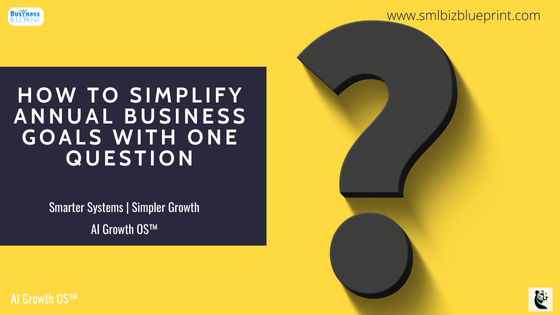

The one question that simplifies every 2026 goal is: “If we actually achieved all of these goals, what would break first?”
This question exposes the hidden constraints, capacity limits, and operational risks that determine whether your goals are achievable—not just desirable.
By designing your 2026 plan around what your system can support, you create a clearer, stronger, and more sustainable roadmap for growth.
Cut the clutter, stop drowning in priorities, and finally build a plan your team can execute.
You know the pattern. December arrives, you sit down to map out your 2026 goals, and within an hour the page is already crowded.
Too many priorities. Too many competing expectations. Too many “must-win” targets that all feel urgent but none feel truly grounded.
The pressure isn’t the planning itself—it’s the quiet fear that no matter how carefully you stack your goals, the year will still unfold like the last one: stretched teams, stalled initiatives, and a plan that slowly unravels under the weight of real operations.
And here’s the tension no one says out loud: even when your goals look impressive, you can still feel the fragility underneath them.
A whisper of doubt: If this actually works… can we even handle it?
That’s the stakes of 2026 planning—ambition without structural readiness turns into hidden risk. Growth becomes strain. Momentum becomes overwhelming.
And once the year begins, course-correcting feels impossible without losing time, credibility, or both.
But there’s a different way to plan—one that doesn’t rely on optimism, templates, or long lists. A way to build goals that hold up under pressure instead of collapsing under it. A way to design 2026 with clarity, not clutter.
Leader-level clarity—the kind that comes from seeing the system for what it is and choosing goals that your business can actually sustain.
This is where things shift. Because the moment you approach planning through a single ruthless question, everything gets lighter. Fewer goals. Stronger priorities. A sense of calm replacing the annual scramble.
You’re not just a leader trying to hit targets—you’re the architect building the conditions for real progress.
That’s what this article delivers: a clearer, more honest way to shape your 2026 roadmap using one question that cuts through overwhelm and reveals the goals that truly matter.

The Problem With 2026 Planning: You’re Starting From the Wrong Question
Most leaders begin their 2026 planning already overwhelmed—not because the goals are too big, but because the starting point is wrong.
The annual ritual usually opens with a deceptively simple prompt: “What do we want to achieve next year?” It feels logical. It feels strategic. It feels responsible.
But the moment goals begin piling up—sales increases, market expansion, hiring cycles, product improvements—the friction shows up fast.
You can feel the weight of it before the plan is even written. Frustration.
And yet, there’s a moment of relief when you realise the issue isn’t your discipline or ambition—it’s the frame itself. When you shift the starting point, clarity returns.
Because you’re not just someone filling in targets—you’re a builder shaping the conditions for execution.
The default question creates clutter, not direction.
When a planning conversation begins with “What do we want?”, it activates imagination instead of discernment. Suddenly, the plan collects goals that reflect personal preferences, departmental agendas, and untested assumptions.
It becomes a wishlist disguised as a strategy.
This is why planning meetings swell into hours of negotiation, unclear trade-offs, and competing priorities.
Strategy is fundamentally about constraint, not aspiration—yet the default starting question ignores this truth.
Leaders who recognise this aren’t less ambitious; they’re more precise.
Once you stop beginning with desire, you stop building plans that collapse under their own weight.
Most planning fails because it multiplies goals instead of sharpening them.
Every added goal seems reasonable on its own. But goals don’t live “on their own”—they interact, compete, and consume shared resources.
What looks like a strong plan on paper quietly creates internal strain: leadership bandwidth evaporates, teams lose focus, and execution fragments.
Studies show that teams with more than five annual priorities deliver almost none reliably.
That’s not a lack of skill—it’s a structural mismatch between intentions and capacity.
When leaders understand this, they stop equating “more goals” with “more progress.” They start equating fewer, cleaner goals with forward motion.
The real cost of starting with the wrong question is hidden, cumulative, and expensive.
A plan built from “What do we want?” masks the realities of your system—your constraints, bottlenecks, handoffs, cycle times, capacity limits.
The longer this stays the same, the more silent debt accumulates: misalignment, wasted hours, abandoned initiatives, duplicated efforts, and slowed decision-making.
What that means for your business is simple: you start the year optimistic, and end it firefighting. And that pattern compounds.
Leaders who shift their starting point stop the cycle before it begins. They define strategic planning by what is structurally sustainable, not just attractive.
Because continuing to plan from a faulty starting question is the fastest way to repeat the same year again—different goals, same fatigue. And the longer you operate from aspiration-first planning, the more unpredictable your execution becomes.
Pro Tip:
Reframe the opening question before you plan anything.
Before goal-setting, ask your team a different opening question: “What must be true for 2026 to be easier, not just bigger?”
Because ease—not ambition—is the true test of a scalable system. When you design around ease, you build a foundation that absorbs growth instead of cracking under it. That’s how operators become architects.
A few years ago, I built a beautiful annual plan—colour-coded, ambitious, and completely disconnected from what the business could actually hold.
By March, half the goals were already behind, and every week felt like playing whack-a-mole with priorities. The shift happened when I realised the plan wasn’t failing because of effort—it was failing because it ignored constraints.
Once I started asking what would break if everything worked, the noise dropped and clarity showed up. I stopped planning like an optimist and started planning like an operator.
The One Ruthless Question That Instantly Simplifies Your 2026 Roadmap
Most leaders feel buried in annual planning because they’re trying to refine too many goals instead of revealing the few that actually matter.
That’s the frustration: you’re drowning in priorities, and every goal looks important. The relief comes when you realise the issue isn’t the goals—it’s the lack of a single filter strong enough to cut through them.
And the identity shift is this: you stop being the leader juggling priorities and start becoming the leader who diagnoses reality before committing to anything.
The core takeaway: One question exposes which goals deserve your attention and which will quietly break your business.
Most planning exercises assume success will be smooth, linear, and evenly distributed across the company. That has never been true.
Instead, test your goals with the question that simulates pressure rather than fantasy:
“If we actually achieved all of these 2026 goals, what would break first?”
This question forces your plan out of optimism mode and into operational truth. It brings hidden constraints to the surface—team bandwidth, process gaps, platform limitations, cash cycles, and leadership bottlenecks.
This is how operators transform into system thinkers. You’re no longer accepting goals at face value—you’re evaluating the system that must carry them.
When you stress-test success, you eliminate the fragility in your plan before it hits your calendar.
This question works because it replaces wishful planning with system diagnosis.
Most people don’t realise how fragile their goals are until they collide with real constraints.
Sales skyrockets? Support collapses. Lead flow doubles? Onboarding bottlenecks. Bigger deals close? Cash flow gets lumpy.
The longer this stays invisible, the more it costs you—not just in performance, but in confidence and team cohesion.
By asking what breaks under success, you’re no longer designing the year around desire—you’re designing around what your business can sustain and scale.
That’s strategic maturity.
Stress-testing goals reveals the competing priorities no meeting ever fully surfaces.
Annual planning often masks conflicts. Sales wants aggressive growth. Operations wants stability. Product wants investment. Finance wants fewer surprises.
The ruthless question exposes the friction between goals by forcing you to consider downstream consequences. It shows when one goal amplifies pressure while another requires relief.
Leaders who integrate this question see themselves not as goal collectors, but as architects who build the capacity for future goals to succeed.
Clarity emerges when you understand that not all goals deserve equal weight, and that some should be removed entirely—not because they’re bad, but because the system cannot support them yet.
Because if you don’t ask this question now, the year will answer it for you later—through breakdowns, rushed decisions, missed deadlines, or overwhelmed teams. And what that means for your business is simple: the cost of ignoring constraints compounds faster than the benefit of adding more goals.
Pro Tip:
Run every goal through a success simulation—not a feasibility check.
Before approving a goal, imagine it fully achieved and identify the first point of operational strain it would trigger.
Because the real edge isn’t planning harder—it’s planning honestly. When you design your year around what breaks under pressure, you stop reacting and start engineering stability. That’s how leaders make growth predictable, not painful.
Stay ahead of the curve!
Subscribe to our newsletter and never miss the latest in business growth and marketing strategies
How the Default Approach Fails: The Hidden Cost of Goal Pile-Ups
Most leaders don’t struggle because their goals are wrong—they struggle because they’re carrying too many at once.
That’s the frustration: every department adds “just one more priority,” and suddenly your 2026 plan looks like a warehouse inventory list instead of a strategy.
The relief comes when you realize the problem isn’t your capacity—it’s the structure that keeps multiplying goals without accountability.
You stop acting like a goal collector and start leading like someone who protects focus as a competitive advantage.
The core takeaway: Goal inflation quietly destroys execution long before the year begins.
The moment a business begins stacking goals, complexity scales faster than capacity. Every new initiative creates new dependencies, new coordination overhead, and new decision friction.
Research consistently shows that organisations pursuing more than five goals achieve almost none reliably. Not because they lack talent, but because attention fragments.
Execution becomes diluted. Bandwidth disappears into context switching.
Leaders who understand this stop treating goals as statements of ambition and start treating them as resource commitments.
Once you limit goals, the noise drops, alignment strengthens, and your team finally has room to deliver at a high level.
Most planning fails because teams never stress-test how goals interact.
A goal may look reasonable in isolation, but goals don’t live in isolation—they compete for people, energy, and time.
When too many goals stack up, you create overload loops. Marketing needs sales. Sales needs support. Support needs product. Product needs engineering. Everyone needs bandwidth—and no one has it.
This is how businesses end up “busy but underperforming.”
Leaders who think in systems—not silos—stop planning based on ideal conditions and start planning based on how work actually flows.
The moment you see your company as an interconnected system rather than a list of departments, your goals become sharper, cleaner, and fewer.
The hidden costs of overloaded plans compound invisibly until they spill into Q3.
Pile-ups lead to delayed timelines, incomplete projects, and chronic scrambling.
When goals exceed capacity, teams default to firefighting. Urgent replaces important. Strategy gets pushed to “later this quarter,” which quietly becomes “never.”
Most people don’t realize how much this pattern costs: missed opportunities, declining quality, slower response time, and leadership exhaustion.
When you own your role as the protector of focus, you stop letting the business drift into effort-heavy, low-impact cycles.
A simpler plan isn’t a smaller plan—it’s a stronger one.
Because if your 2026 plan already has more goals than your team can realistically absorb, you’re preloading the year with delay, frustration, and preventable burnout. And the longer this stays the same, the harder it becomes to regain momentum once the year starts slipping.
Pro Tip:
Cut 30% of your goals before you finalise your plan—then reinforce the remaining ones.
Review your full goal list and remove anything that doesn’t directly strengthen the system or meaningfully change the business.
Because cutting goals isn’t about lowering ambition—it’s about increasing force. The fewer directions your team pushes in, the more power each effort carries. That’s how real leverage is built: not by doing more, but by aiming cleanly.
A Better Lens: Design 2026 Around System Constraints, Not Aspirations
Most leaders plan from aspiration, not architecture—and that’s why their goals collapse under real-world pressure.
That’s the frustration: you map out bold targets only to discover, months later, that your systems, people, and processes were never built to carry them.
The relief comes when you realize the issue isn’t your ambition—it’s the underlying structure that wasn’t designed to support it.
You stop leading like someone chasing outcomes and start leading like someone engineering the conditions that make outcomes inevitable.
The core takeaway: Your business is a system of constraints—so your 2026 plan must be built around those constraints, not around wishful targets.
Most leaders still build plans based on what they want, ignoring the structural bottlenecks that decide whether those goals can survive contact with reality.
A business is not a collection of goals; it is a network of constraints—people, processes, platforms, capital. Whichever constraint is weakest determines the speed, quality, and stability of everything you attempt in 2026.
If hiring capacity is constrained, a sales surge becomes a liability. If onboarding is constrained, growth amplifies churn. If cash cycles are constrained, expansion becomes dangerous.
Leaders who see the business this way shift from setting goals to designing capacity—a far more durable power move.
Once you plan around constraints, you stop fighting the same battles every year. The system becomes easier, cleaner, and more predictable.
The biggest missed step in planning: diagnosing constraints before assigning goals.
Most planning sessions jump straight into commitments—revenue targets, headcount plans, product launches—before understanding the actual load the business can handle.
This guarantees strain. When constraints aren’t identified upfront, you assign goals that overtax the system. That strain shows up later as bottlenecks, inconsistent execution, repeated delays, and team burnout.
Most people don’t realise that the constraint isn’t the problem—the ignorance of it is.
When you lead from system-awareness, you stop treating symptoms and start solving root causes.
Once you know your true constraints, your plan stops being aspirational and becomes structurally grounded.
Designing your 2026 plan around constraints unlocks leverage—not limitation.
Many leaders resist constraint-first planning because it “feels limiting.”
In reality, constraints provide the clearest path to leverage. Eli Goldratt proved that improving the primary constraint (and only the constraint) can increase throughput by 20–50%—without adding more resources.
This is how companies make the biggest gains: not by pushing harder, but by reinforcing the one area that determines everything downstream.
When you adopt this lens, you stop being the leader who demands more and become the architect who enables more.
Strengthening constraints isn’t restrictive—it’s what makes your future goals achievable at scale.
Because if you build your 2026 plan on aspiration instead of constraint awareness, you’re guaranteeing friction, overwhelmed teams, and stalled initiatives. And the longer this stays the same, the more you invest in goals your system cannot support—wasting time, energy, and momentum that you don’t get back.
Pro Tip:
Before setting goals, map your system by identifying its single most restrictive constraint.
Name the constraint that slowed you most in 2025—be it hiring speed, onboarding inefficiency, tech gaps, leadership bandwidth, or cash cycles. Make your first 2026 goal to strengthen that constraint.
Because improvement isn’t about adding more work—it’s about removing the bottleneck that makes all work harder. When you design your year around the constraint, you gain leverage that compounds. That’s how operators evolve into architects who build businesses that scale without strain.
Maya ran a fast-growing operations team, and every year she added more goals hoping it would create more progress. Instead, her team was always behind, juggling too much and delivering too little.
Everything changed the day she mapped her goals against the question, “If this works, what breaks?” She saw that onboarding, not sales, was the constraint—and shifted her entire plan.
Six months later, her team wasn’t scrambling anymore; they were running ahead of schedule. She stopped chasing growth and started designing for it.
The Uncommon Angle: Plan for the Break Point Before It Happens
Most leaders plan for growth but rarely plan for the strain that growth will create—and that’s where things break.
That’s the frustration: every goal looks exciting until you imagine the real operational load that achieving it would produce. The relief comes when you finally look ahead with honesty rather than hope.
You stop acting like a forecaster and start behaving like a strategist who designs resilience instead of scrambling later to fix what success exposes.
The core takeaway: Every business has a break point—and planning around it makes your 2026 goals safer, smarter, and more sustainable.
Most leaders assume growth is purely positive. They imagine doubling revenue, increasing lead flow, expanding headcount, or releasing new products—and picture linear upside. But growth isn’t linear. It’s destabilizing.
Every meaningful improvement stresses the system:
More customers → overwhelms support
More sales → strains onboarding
More products → complicates operations
More hiring → stretches leadership bandwidth
The break point is the exact moment where today’s system fails under tomorrow’s success.
Leaders who anticipate the break point aren’t pessimists—they’re architects ensuring that growth doesn’t become chaos.
Once you factor in the break point, your 2026 goals stop being fragile ideas and start becoming structurally sound commitments.
Your future problems are already visible—you just haven’t zoomed out enough to see the pattern.
Breakdowns rarely appear out of nowhere; they show up as small warning signs—slower response times, creeping backlog, inconsistent handoffs, rising error rates, leadership overwhelm.
These aren’t isolated issues. They’re early signals of where your system will fail under increased pressure.
Most people don’t realise that these “minor frustrations” are forecasts.
Leaders who pay attention to these micro-strains develop a diagnostic instinct. They see the system not as it is today, but as it will behave under load.
This lens gives you an advantage few leaders hold—you’re not surprised by growth; you’re prepared for it.
Predicting your break point turns your 2026 plan into an anti-fragile system.
Without identifying your break point, you risk building a plan that looks good but breaks your team by midyear.
When you anticipate what will fail, you can reinforce weaknesses proactively—before the year exposes them in real time.
Examples:
If you know onboarding will break at 20% growth, fix onboarding before scaling sales.
If leadership bandwidth is the cap, prioritise team development before headcount expansion.
If your tech stack lags, upgrade platforms before increasing volume.
This is what strong operators do—they don’t just celebrate potential; they design for pressure.
Planning becomes calmer, more confident, and more grounded because you’re no longer guessing—you’re engineering resilience.
Because if you don’t identify your break point before 2026 begins, you will meet it at the worst possible time—mid-quarter, mid-hiring cycle, mid-growth surge. And the longer this stays unknown, the more your success becomes a liability rather than an asset.
Pro Tip:
Identify one “stress indicator” from 2025 and treat it as the leading signal of your 2026 break point.
Pick the most frequent friction point—support backlog, slow decision cycles, inconsistent onboarding, missed handoffs—and map how it behaves at 2x the current load.
Because the earliest signs of strain are never random—they’re structural. When you design your plan around strengthening that weak link, you transform it from a choke point into an advantage. This is how operators stop reacting to growth and start absorbing it with confidence.

Translating the One Question Into a Concrete 2026 Roadmap
Most leaders know what they want to achieve in 2026—but translating that ambition into a plan the business can actually carry is where things fall apart.
That’s the frustration: your instinct says “set the goals,” but the execution reality says “we can’t absorb this.” The relief comes when you see that the path isn’t to work harder—it’s to work with a clearer structure.
You stop acting like the person writing a list and start acting like the architect designing a year.
The core takeaway: You turn the ruthless question into a roadmap by filtering, grouping, and sequencing your goals around system readiness—not imagination.
Without a filter, you end up with a sprawling plan that competes with itself.
Running each proposed goal through the question—“If this succeeds, what breaks first?”—reveals a pattern. After evaluating all goals, you’ll notice clusters of strain: hiring, onboarding, bandwidth, process gaps, tech limitations. These clusters are your roadmap’s foundation.
Leaders who plan from these patterns think like system engineers rather than goal chasers.
This approach produces a roadmap that feels lighter, stronger, and more in sync with how your business actually functions.
Step 1: List every 2026 goal without filtering.
Most teams filter too early, which hides the full landscape of what people want to tackle.
Capture everything first. Only when all ideas are visible can you see which ones overlap, conflict, or ignore constraints.
When you approach planning as information gathering—not judgment—you elevate from managing tasks to diagnosing the system.
Once everything is on the table, clarity becomes easier because patterns reveal themselves.
Step 2: Stress-test every goal using the break-point question.
Goals look reasonable on paper because paper doesn’t push back. Your system does.
By imagining each goal fully succeeding, you expose the operational cost of that success. You find hidden risks: where timelines slip, where teams overload, where revenue outruns capacity.
Leaders who simulate success before committing protect their teams from overreach and burnout.
This simple stress-test transforms planning from guesswork into structural intelligence.
Step 3: Group break points into themes—your constraints will reveal themselves.
When each department plans separately, constraints remain blurry.
Once you categorise break points, you see the true limiting factors: onboarding, leadership bandwidth, process maturity, systems integration, cash cycles. This is the “x-ray view” of your business.
Leaders who plan with an x-ray instead of a wish list build with confidence, not hope.
The moment you see the constraint themes, you know exactly where your 2026 energy must go.
Step 4: Prioritise system-fixing goals over shiny growth goals.
Shiny goals are seductive—they look serious and inspiring, but often destabilise the system.
System-first planning means you reinforce the weakest link before applying pressure. When constraints improve, all downstream goals become easier, faster, and cheaper.
This is how strategic leaders operate—they decide not just what they want, but what the system can absorb.
Prioritising infrastructure before expansion sets the stage for growth that doesn’t break your team.
Step 5: Sequence 2026 into two phases: strengthening → scaling.
Most companies try to scale and stabilise at the same time, creating internal whiplash.
Divide the year:
Q1–Q2: Fix constraints, streamline processes, upgrade systems, build capability.
Q3–Q4: Deploy growth goals once the system is stronger.
This sequencing removes friction by aligning goals with readiness.
Leaders who design the year this way think like architects—build the foundation, then build the structure.
You move into Q3 with a business that can finally handle the goals you’ve set.
Because if you roll into 2026 without sequencing, filtering, and system alignment, you risk repeating the same cycle of overcommitment and underdelivery. And the longer your team works inside a roadmap built on hope instead of readiness, the more time, energy, and momentum you lose—quietly, and expensively.
Pro Tip:
Turn your roadmap into a capacity plan, not a dream plan.
Before finalising your goals, estimate the workload, decision load, and bandwidth each one requires—then match it to real capacity.
Because a roadmap is only as strong as the system beneath it. When you plan from capacity, not fantasy, your execution becomes smoother, your team becomes sharper, and your growth becomes sustainable. This is how operators become architects of predictable success.
Key Questions to Pressure-Test Your 2026 Goals
Most leaders finalize their 2026 goals too quickly—without interrogating whether those goals are aligned, realistic, or structurally sound.
That’s the frustration: the plan looks clean on paper, but you can already feel the friction points beneath it. The relief comes when you realize you don’t need more meetings or more frameworks—you just need better questions.
You stop acting like someone who “approves goals” and step into the role of the leader who tests goals before the year tests you.
The core takeaway: The right diagnostic questions expose fragile goals before they become expensive failures.
Companies often learn too late that their goals were misaligned, unrealistic, or competing with one another.
Pressure-testing isn’t pessimistic—it’s preventive. Asking a sharp set of diagnostic questions gives you visibility into blind spots you’d otherwise discover midyear, when the cost is higher and options are fewer.
Key questions include:
Which 2026 goals would we still choose if we had half the capacity?
Which goal, if removed, would barely change the business?
Which single constraint, if fixed this year, makes next year dramatically easier?
Leaders who ask these questions think like strategists, not wishful planners.
Once the weak goals fall away, the strong ones rise to the surface—and your roadmap becomes lighter, clearer, and more credible.
Pressure-test by identifying which goals create friction instead of flow.
Not all goals coexist peacefully. Some create hidden tension—overlapping timelines, shared resources, or conflicting priorities.
Asking, “What happens to this goal if another one succeeds faster?” reveals conflicts. Some goals choke each other. Others require pre-work. Others depend on capacity that doesn’t exist yet.
Most people don’t realize that misaligned goals feel like “execution failures,” but they’re actually design failures.
Leaders who pressure-test for friction stop setting their teams up for preventable collisions.
This clarity gives your team permission to focus with confidence.
Use reflection questions to uncover what your system is already telling you.
Teams often repeat the same problems year after year because no one stops to ask what the pattern reveals.
Questions like “Where did we experience recurring friction in 2025?” or “Which initiatives flatlined due to lack of bandwidth?” expose operational truths your plan must address.
What that means for your business is simple: your 2026 plan is only as strong as your ability to diagnose your past.
When you listen to your system, you lead from awareness rather than assumption.
Your goals begin to align with reality instead of optimism.
Create space by asking what you should stop doing—not just what you should start.
Most planning adds goals without removing commitments. The load compounds until everything slows.
Asking, “What must we stop doing to make space for the goals that matter most?” is the discipline that separates scalable operators from overwhelmed ones.
When everything is important, nothing is.
Leaders who design subtraction into their planning become protectors of focus—and their teams feel the difference.
Stopping creates leverage. It makes the remaining goals possible.
Because without pressure-testing, your 2026 plan will quietly collect hidden risks—conflicting timelines, overloaded teams, unrealistic dependencies. And the longer those risks stay invisible, the more expensive they become to fix once the year is already in motion.
Pro Tip:
Turn each diagnostic question into a meeting filter—not just a planning exercise.
Use these pressure-test questions quarterly to re-evaluate priorities and catch drift early.
Because planning isn’t a one-time event—it’s an ongoing calibration. The leaders who revisit the right questions throughout the year stay aligned, agile, and grounded. The ones who don’t end up reacting to problems they could’ve prevented.
One of the strangest patterns I’ve noticed is that companies don’t break at their weakest moments—they break at their strongest. Not during slow quarters, but during the sudden uptick everyone was hoping for.
The shift comes when leaders stop treating success as harmless and begin seeing it as a stress test. When they do, growth stops feeling like a threat and starts becoming a signal.
That’s when they evolve from managing problems to engineering resilience.
Conclusion
You’ve lived the frustration: planning seasons that feel heavier than they should, goal lists that grow instead of sharpen, and a quiet fear that the year ahead will repeat the same patterns—overcommitment, strain, and stalled initiatives.
It’s exhausting to hold big ambitions while knowing your current system can’t fully support them.
That’s the tension most leaders carry into every new year.
Here’s the relief: it only takes one shift—one ruthless question—to cut through the noise. If we actually achieved all our 2026 goals, what would break first?
This question simplifies everything. It removes the guesswork, exposes the bottlenecks, and grounds your goals in the reality of how your business actually operates.
Suddenly, planning becomes lighter. Priorities become obvious. And you stop building a year on optimism alone. The fog lifts because the structure finally makes sense.
You’re not just someone setting goals anymore—you’re the architect designing the conditions for them to succeed. Your power isn’t in writing more objectives; it’s in choosing the ones your system can support and strengthening the parts that can’t.
You lead differently when you see constraints not as limitations, but as the blueprint for leverage.
Because 2026 will not wait for clarity.
And the longer you rely on planning-by-hope, the faster your team runs into friction you could have prevented. Every month spent chasing too many goals is a month where momentum thins, bandwidth drains, and hidden break points gain strength. What that means for your business is simple: doing nothing costs more than making the shift.
Your decision point: stay stuck, or move forward.
You can continue carrying the same weight into each new year—piling on goals, absorbing the strain, and hoping this time will be different.
That path is familiar. Predictable. Comfortably painful.
Or you can step into the version of yourself who leads with clarity: the architect who plans from constraints, designs around reality, and builds systems that make success sustainable—not accidental.
That’s the identity waiting on the other side of this shift.
Your current state is optional.
You get to choose whether 2026 becomes another demanding year you power through—
or the year you finally build a strategy that feels aligned, grounded, and unmistakably yours.
Take the next step. Don’t let another year collapse under goals your system was never designed to hold.
Start designing 2026 like the leader who’s done waiting for the business to catch up—and is ready to build the one that can.
Don’t miss a beat in your business growth journey!
Join Pulse and stay ahead with expert tips and actionable advice every month.
Subscribe to Pulse Today
Action Steps
List Every Goal You’re Currently Considering for 2026—Without Editing
Capture sales targets, operational improvements, hiring plans, product ideas, efficiency goals, and internal initiatives. Don’t filter yet.
This gives you a full, honest inventory of everything competing for attention—because clarity comes from visibility.
Run Each Goal Through the Question: “If this succeeded, what would break first?”
Identify the strain each goal would put on your system: bandwidth, onboarding, cash flow, leadership attention, support load, or process maturity.
This exposes the real cost of success—not the imagined version.
Group the Break Points Into Themes
Look for repeated patterns:
Do multiple goals strain the same team?
Do they rely on a process that’s already fragile?
Do they expose missing capacity or outdated systems?
These patterns reveal your true business constraints for 2026.
Prioritise System-Fixing Goals Over Outcome Goals
Before scaling sales, strengthen onboarding.
Before adding headcount, reinforce leadership capacity.
Before expanding products, tighten operational flow.
Fix what would break—then pursue what could grow.
Cut or Pause Goals That Don’t Survive the Stress Test
If a goal creates more strain than value, or relies on capacity you don’t have, it’s not a 2026 goal—it’s a distraction.
Removing it frees energy for commitments that matter.
Sequence 2026 Into Two Intentional Phases
Phase 1 (Q1–Q2): Stabilise and strengthen constraints.
Phase 2 (Q3–Q4): Accelerate growth once the system can support it.
This turns your year into a designed progression rather than an overloaded sprint.
Pressure-Test Your Final Goal Set With Reflection Questions
Ask:
Which goal makes the rest easier?
Which one will still matter in 18 months?
What must we stop doing to deliver this?
These questions refine your roadmap into a focused, high-leverage plan.
FAQs
Q1: What is the one question that simplifies my 2026 goals?
A1: The question is: “If we actually achieved all of these goals, what would break first?”
This reframes planning from aspiration to operational truth—helping you eliminate fragile goals, uncover hidden risks, and prioritise what your business can realistically support.
Q2: Why do most annual plans fail even when the goals look reasonable?
A2: Because they’re built from the wrong starting point: “What do we want?” This leads to inflated wishlists, misaligned priorities, and goals that compete for the same limited resources. Without stress-testing success, you end up with a plan that collapses under real-world conditions.
Q3: How do I identify the constraints that limit my 2026 goals?
A3: Look for recurring friction in your operations—slow onboarding, stretched leadership bandwidth, tech limitations, inconsistent processes, cash cycle gaps, or customer support backlog. These patterns reveal the system’s weak points. Strengthening them makes every future goal easier to execute.
Q4: What should I do if achieving our goals would overwhelm my team?
A4: Use that signal strategically. Overwhelm isn’t a failure—it’s a diagnostic clue. It tells you where systems need reinforcement before growth. Prioritize stabilizing those constraints in Q1–Q2 before accelerating execution later in the year.
Q5: How many goals should a growing business set for 2026?
A5: Most teams can reliably execute 3–5 core goals per year. More than that leads to diluted focus and inconsistent execution. Fewer, stronger goals create more leverage, clarity, and alignment across the business.
Q6: How does this planning method reduce stress and overwhelm for my team?
A6: Because it removes ambiguity and unrealistic expectations. When goals are filtered through capacity, constraints, and break-point analysis, the team knows exactly why the plan exists and what the system can support. That clarity reduces friction, increases confidence, and protects morale.
Q7: What happens if I don’t adjust my planning approach for 2026?
A7: You risk repeating the same cycle: too many goals, under-resourced execution, mounting friction, exhausted teams, and stalled progress. The longer this stays the same, the more expensive it becomes—both financially and operationally.
Adopting a constraint-based planning approach ensures your year is designed for stability, not struggle.
Bonus Section: Three Unconventional Ideas That Shift How You Plan 2026
Most leaders think annual planning is about ambition—setting bold targets, expanding scope, adding initiatives. But what they often overlook is that growth isn’t a straight line; it’s a stress test.
Success places weight on the places you least expect, pressure shows up in places you thought were stable, and your system reveals truths no meeting ever surfaced.
That’s the quiet tension beneath planning: the belief that more goals equal more progress, when the opposite is usually true.
And here’s the surprise: the smartest planning moves aren’t the loud ones. They aren’t new templates, frameworks, or goal-setting acronyms.
They’re shifts in perspective—small, unconventional questions that change how you see your business entirely. They don’t just clarify what to aim for; they clarify what to protect, what to strengthen, and what to question.
This is where planning transitions from motion to mastery.
Below are three unconventional ideas that don’t add complexity—they expand intelligence.
Use them not as tactics, but as lenses that help you think with more depth, curiosity, and strategic confidence.
Evaluate the “Success Tax” — Because Growth Is Expensive
Most leaders obsess over the cost of failure, but almost no one calculates the hidden cost of success.
Growth is not neutral—it amplifies every weakness in your business. When something works too well, too fast, the strain can exceed the benefit.
Ask yourself:
“If this goal exceeded expectations, what extra load, complexity, or risk would we suddenly inherit?”
Support collapsing under volume. Cash cycles tightening under rapid expansion. Leadership bandwidth evaporating.
These are not failures; these are the “success taxes” you pay when your system tries to run at a pace it wasn’t built for.
Leaders who anticipate the success tax don’t fear growth—they design for it. They build capacity ahead of demand and create a business that can enjoy success instead of survive it.
Run a “Constraint Reversal” — What If the Thing Limiting You Is Also Protecting You?
Constraints aren’t always problems. Sometimes they’re safeguards that keep your business focused, disciplined, and sane.
A limited hiring pipeline forces operational clarity. A narrow product line strengthens execution. Tight budgets sharpen decision quality.
Instead of asking how to remove constraints, ask:
“What strength does this constraint give us?”
Constraints eliminate low-value options. They force creativity. They protect your team from complexity creep. They create the boundaries that make strategy possible.
When you start treating constraints as design features, not flaws, you stop fighting your reality—and begin using it as an advantage.
Leaders who master constraints become clearer thinkers, better decision-makers, and more disciplined strategists.
Use a “2027 Backcast” — Build the Future First, Then Let It Shape 2026
Forecasting from today limits your imagination. It simply stretches current problems into the future.
Backcasting does the opposite—it imagines a successful 2027 and works backward to determine what must change in 2026 to make that vision inevitable.
Ask:
“If 2027 were our easiest, healthiest, most stable year yet, what did we fix in 2026 to earn that ease?”
Suddenly, your priorities shift. You stop asking what you want next year and start asking what your future self will thank you for. The work becomes clearer and more honest.
Backcasting creates a sense of inevitability. It anchors your goals in the future you’re committed to building—not the constraints of the present moment.
Leaders who adopt this lens plan with foresight, not just optimism.
Other Articles
How To Identify Low-Value Work With AI Before Planning
How to Build an Airtable Dashboard That Turns Your 2026 Plan Into Weekly Action
Why Most Year-End Reviews Fail — and How to Run an AI Audit That Actually Moves You Forward